Topic
Converting & Finishing Equipment
Slitting, rewinding, die cutting, folder-gluing and sealing equipment.
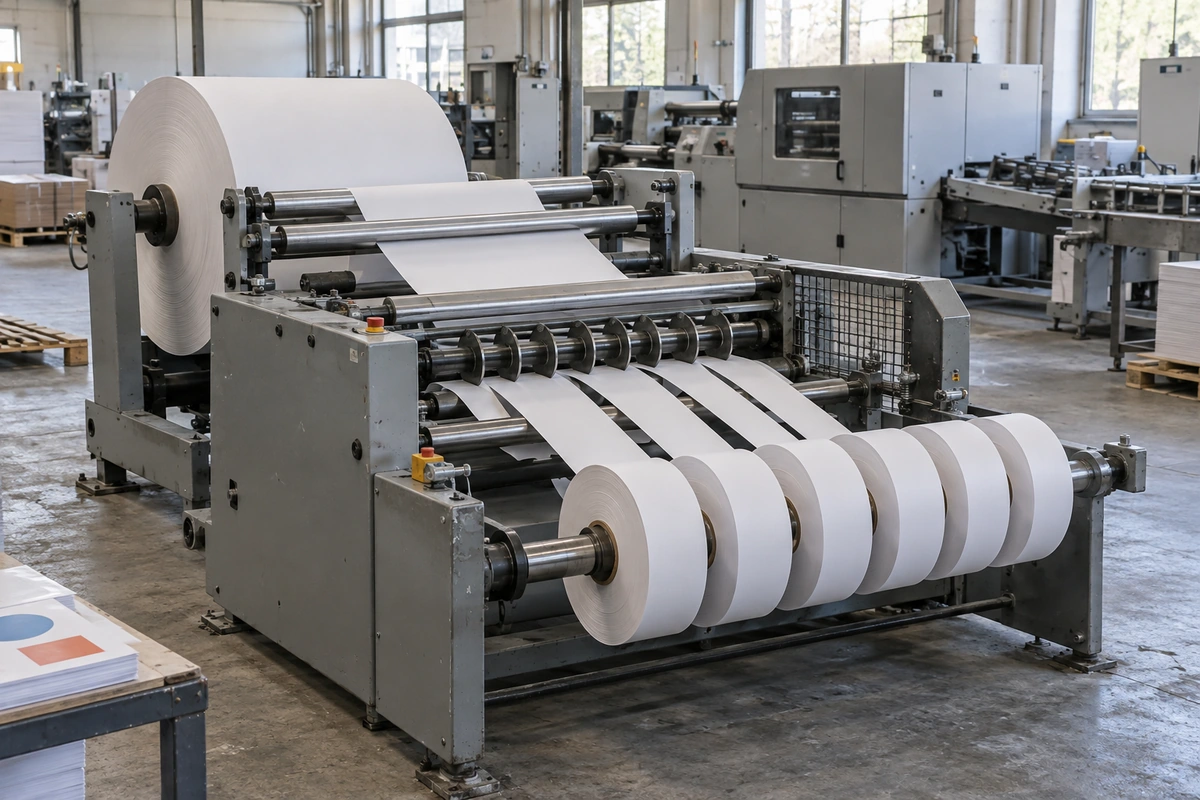
Comparing machines before defining the finished product can leave a production step uncovered. Converting equipment changes rolls, sheets or shaped blanks into a required format through operations such as slitting, rewinding, die cutting, creasing, folding and gluing.
This section helps print and paper-packaging buyers, production staff and engineers identify the equipment family behind a job. Start with the incoming material and the output you need, then use the process map below to define the next questions. This is an independent educational guide; it does not sell machinery or rank manufacturers. Detailed operating settings and model selection require the documentation for the actual unit and material.
| Start with | Record from the job or machine documentation | Why it matters |
|---|---|---|
| Incoming format | Roll, sheet or already-cut blank | Identifies the feeding and handling route |
| Material construction | Grade, thickness, coatings and any liner | Gives the equipment maker a defined sample to evaluate |
| Required output | Narrow roll, cut blank, folded carton, bag or envelope | Identifies the conversion task |
| Acceptance conditions | Drawing, dimensional limits, edge, fold and bond criteria | Defines what a satisfactory sample must demonstrate |
Match the equipment family to the output
The table organizes the functions described in the manufacturer sources below. The final column is an editorial checklist for comparing like-for-like proposals, rather than a specification that every machine can meet.
| Incoming material | Equipment or operation | Required output | Question to resolve |
|---|---|---|---|
| A continuous web from a roll | Slitting and rewinding [1, 2] | Material divided lengthwise and wound into rolls | What slit widths, edge condition and finished-roll construction are required? |
| A moving web | Web guiding and tension control [1] | Material presented to the converting station in a controlled path | Which guiding and tension-control functions are included in the proposed line? |
| Sheet or web stock | Die cutting; creasing where the product needs folds [1, 3] | A shaped blank, with fold locations where applicable | Which cutting and creasing tools suit the actual substrate and drawing? |
| Prepared carton blanks | Folding and gluing [4] | Folded, bonded cartons | Which box styles and feeding, folding and delivery modules are included? |
| Paper web and handle components | Paper carrier-bag conversion [5] | A formed bag with attached handles and a closed bottom | Which handle, side-seam and bottom operations does the line perform? |
| Paper sack materials | Tuber and bottomer equipment [6] | Sack tubes and finished sack bottoms | Which operations belong to each machine in the proposed sack route? |
These functions can be combined on a line or divided between machines. Treat the table as a map of operations, not a mandatory station order. For product-family context, see the paper packaging and mailers overview.
Roll processing: slitting, rewinding and web handling
Slitting changes the width of a continuous web; rewinding builds it into output rolls. Guiding and tension control support the material’s passage through the line. They are separate functions: Maxcess lists winding, web guiding, tension controls, slitting and rotary dies as distinct product categories [1].
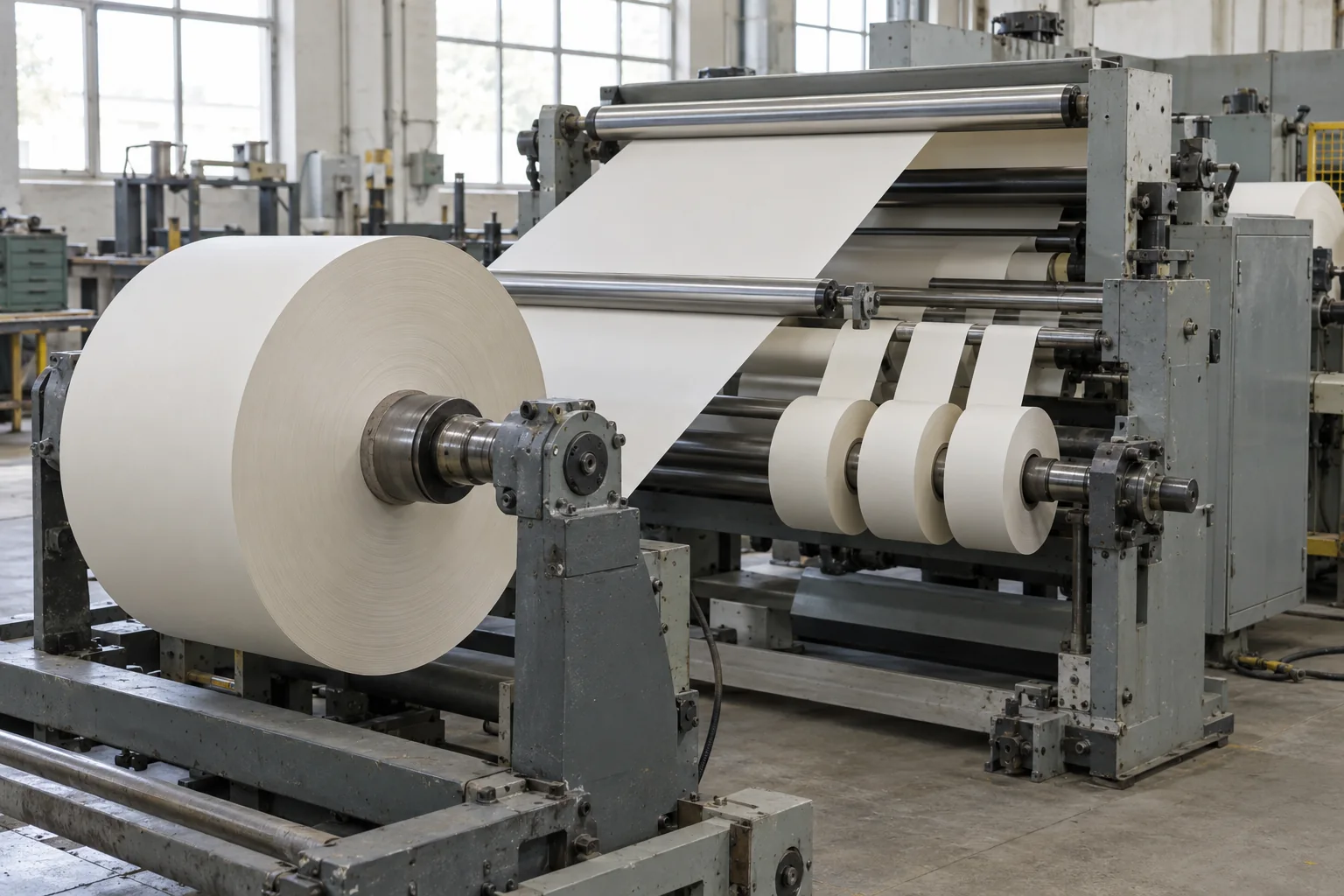
When defining a roll job, record the input web width, required output widths, material construction and finished-roll requirements together. Do not reduce the job to a blade spacing. Tidland’s slitting catalog describes different knifeholders and systems alongside complementary guiding and tension equipment [2]; it does not establish one setup for all papers, films or laminates.
For label work, first identify the material layers. The paper versus film label-material guide explains why the face material alone does not describe the entire label construction. That material description is a useful input to a converting discussion; it does not by itself prove machine compatibility.
Sheet and blank processing: cutting, creasing, folding and gluing
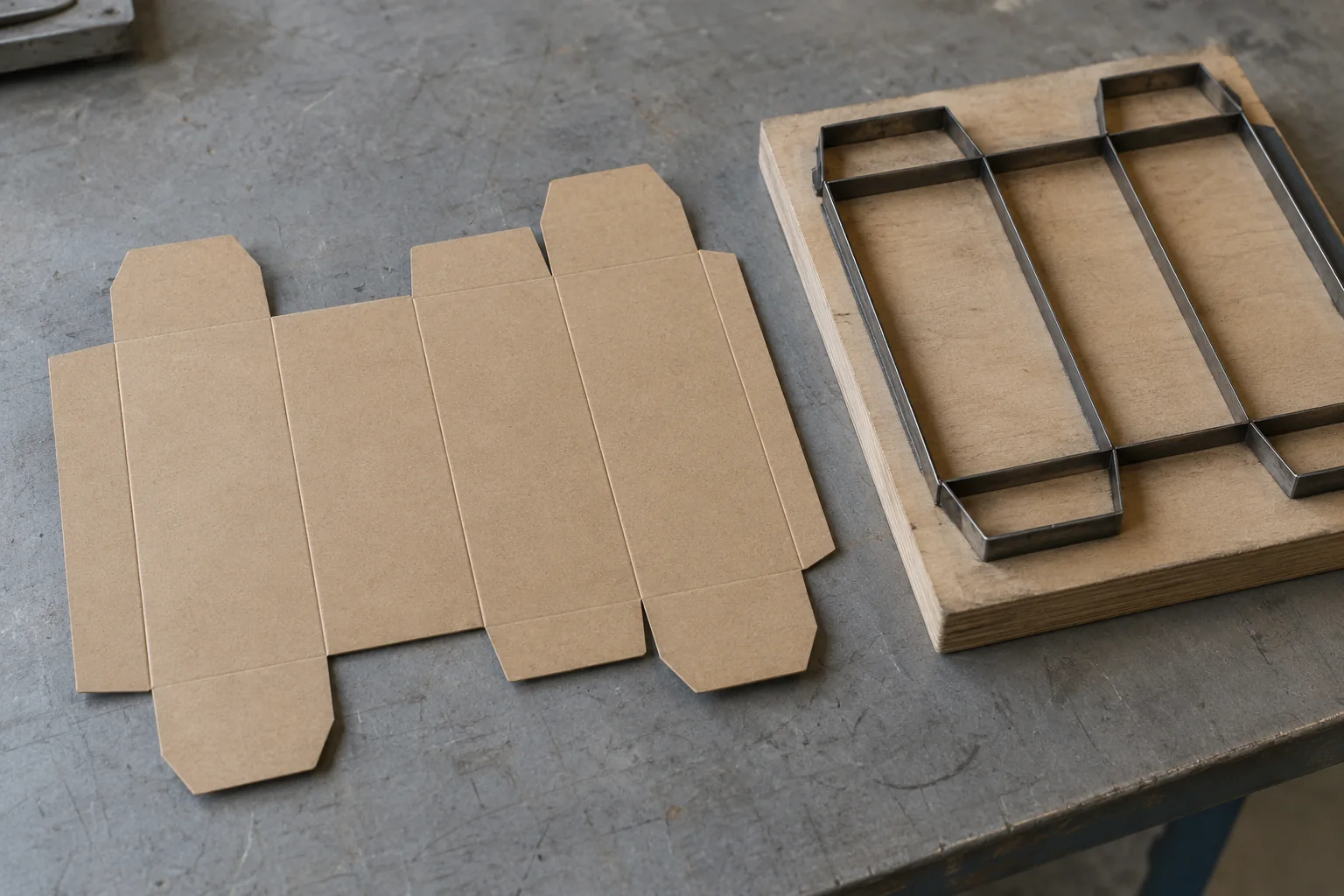
Cutting establishes an outline; a crease establishes a location for a fold. Keep those requirements distinct when reviewing a carton drawing. BOBST’s technical discussion of folding-carton die cutting connects cutting-plate condition with cutting and creasing quality [3]. Tooling and its condition therefore belong in the review, alongside the machine name.
A folder-gluer handles the prepared blank through further operations. BOBST’s EXPERTFOLD example lists feeding and alignment, prebreaking, folding, a gluing unit, transfer and delivery features [4]. That is a documented example of modular equipment, not a guarantee that every folder-gluer includes every module or handles every carton style.
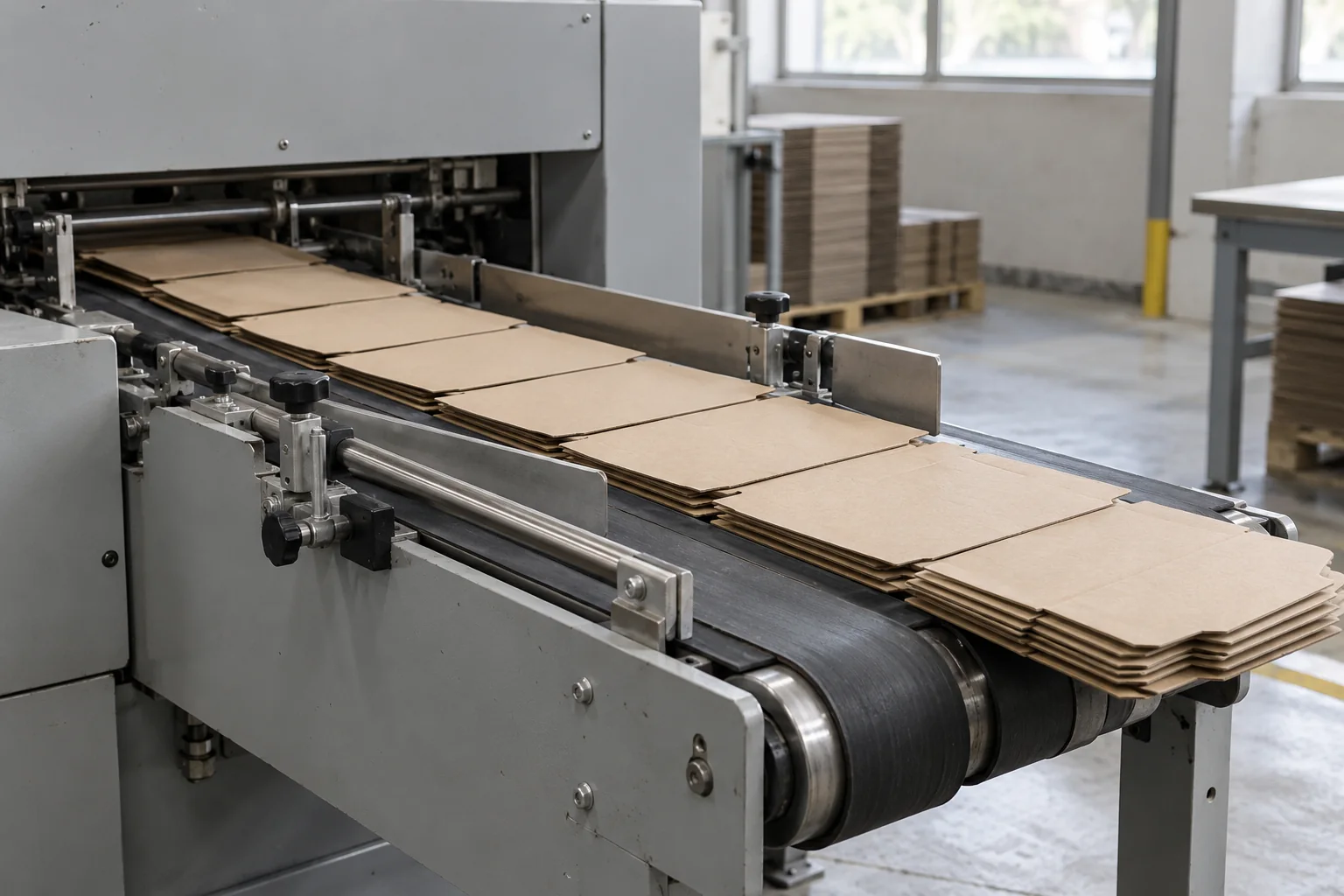
Keep a cut blank and a finished sample with the job record. Use the drawing to identify which dimensions belong to the cutting operation, where folds must occur, and where the bond must be made. This gives the sample review a concrete purpose without assuming that a catalog’s maximum speed is the output for that job.
Envelope conversion uses related cutting, scoring, folding and adhesive functions, but its product route deserves separate treatment. The envelope manufacturing workflow follows both web-fed and blank-fed production and distinguishes factory seam glue from the later seal-flap closure.
Bag making and closing: specify the construction
“Bag-making equipment” covers different routes. Robatech’s flat-handle paper carrier-bag example includes handle attachment, longitudinal tube formation, cutting and bottom gluing [5]. W&H separately lists tubers and bottomers for paper sacks [6]. A carrier-bag process should not be used as a complete description of a multiwall sack line.
For closing or sealing, write down the actual material construction and proposed joining method before discussing equipment settings. In the Robatech example, the paper-bag bottom is closed with adhesive and pressure [5]. That example supplies no heat-sealing settings for a coated paper or film construction. If the process has not been specified, record Unknown / verify on the unit rather than borrowing conditions from a different product.
Terms used in this section
| Term | Meaning here | Keep separate from |
|---|---|---|
| Web | A continuous length of material fed from a roll | A stack of individual sheets |
| Blank | A flat piece prepared for later forming, such as a cut carton shape | A finished folded product; in printing, “blank” can also mean unprinted |
| Slitting | Dividing a web along its length | Cutting an individual pack outline |
| Rewinding | Winding material into output rolls | The cutting operation itself |
| Creasing | Forming a defined fold location in board | Cutting through the board |
| Folder-gluer | Equipment that folds and bonds prepared blanks | A complete printing and die-cutting route |
| Inline / offline | An operation connected into the production line / performed separately | A statement about output quality or achievable speed |
These are working definitions for navigating the subject. Machine makers may use different names for modules; check the function in the layout rather than relying on the label alone.
A job record to prepare before comparing equipment
Copy the following fields into a project note. They are an editorial starting checklist, not a machine acceptance standard.
- Product and output: name the finished product, required output format and next operation.
- Material: attach the grade and construction description and identify the samples supplied for evaluation.
- Geometry: attach the input format and finished drawing, with the relevant width, cut, fold and bond requirements.
- Process boundary: list what arrives prepared, which operations the proposed equipment performs, and what leaves unfinished.
- Demonstration conditions: agree the material, tooling, job layout and acceptance criteria before evaluating sample output.
- Unresolved items: leave machine-specific capacity, operating settings and suitability as Unknown / verify on the unit until supported by the relevant documents or evaluation.
This page maps the subject. Use the linked product and process guides for the material or finished article involved; do not assume that equipment sharing a family name has identical capabilities.
Sources and scope
Sources were accessed on October 16, 2026. Manufacturer documents support the process examples and category distinctions; the classification and job checklist are this site’s editorial synthesis. No machine has been tested for this guide, and no universal capacity, speed, material limit or setting is asserted.
- Maxcess — product categories: winding, rotary dies, guiding, tension controls and slitting.
- Tidland — Slitting Solutions catalog: slitting tooling and complementary web-handling equipment. Used for functional context, not current availability or performance.
- BOBST — cutting plates in folding-carton die cutting: cutting and creasing tooling considerations.
- BOBST — EXPERTFOLD folder-gluer: one published example of feeding, prebreaking, folding, gluing and delivery modules.
- Robatech — paper carrier-bag adhesive application: the flat-handle paper carrier-bag example.
- Windmöller & Hölscher — paper sack production: tuber and bottomer categories.