EnvelopesProcess guide
How Envelopes Are Made: Production Workflow
How paper becomes an empty envelope: blank and web routes, printing, cutting, scoring, windows, folding, seam and seal-flap gum, and what to inspect at each step.
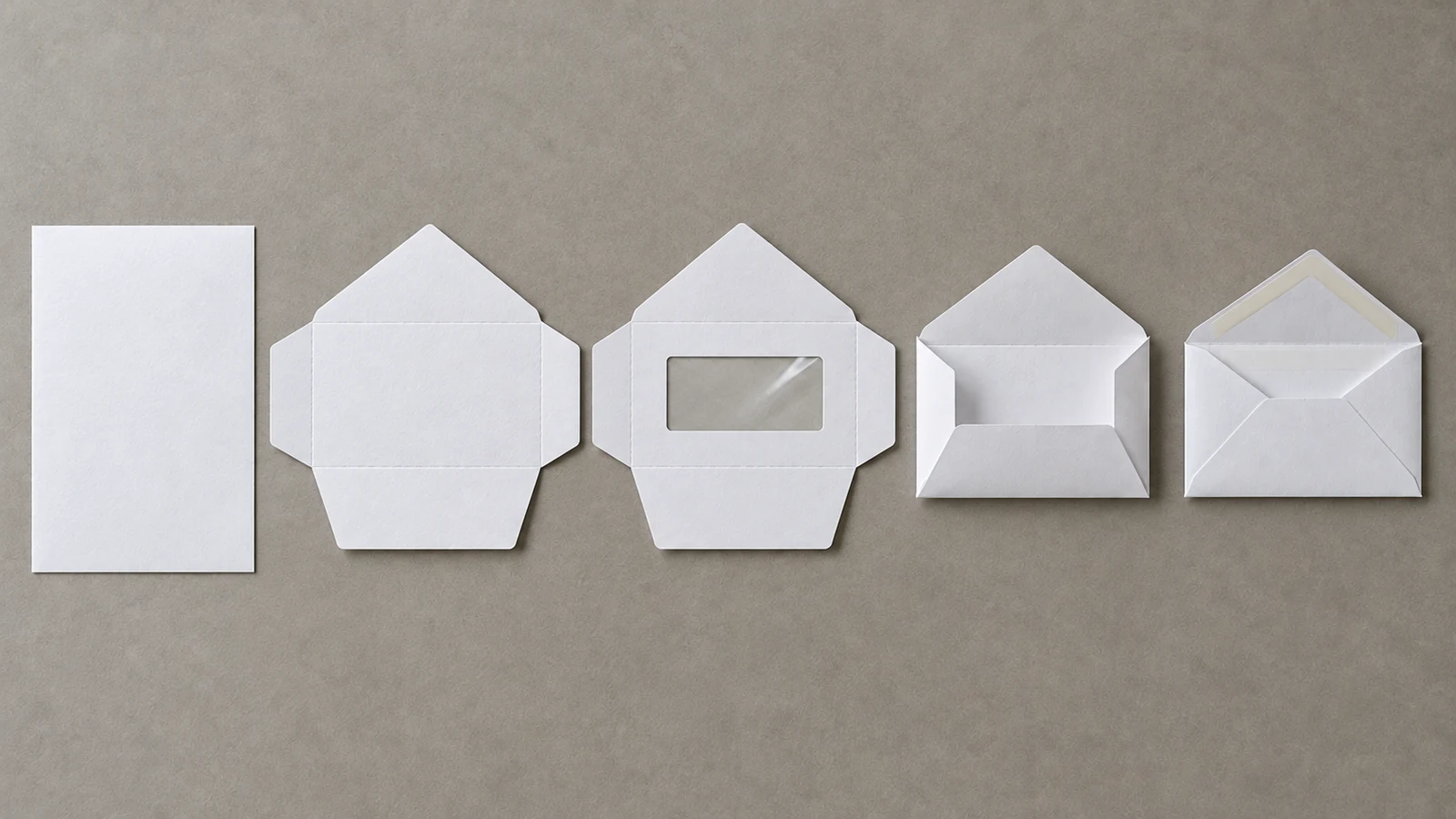
An envelope made from the wrong paper grain, with a misplaced score or glue line, can crack along its folds, jam an inserting machine or hide part of the address in the window. Envelopes are made by feeding paper, as a continuous roll or as pre-cut blanks, through cutting, scoring, optional windowing, folding and gluing, then adding the closure adhesive to the seal flap, which leaves the factory unsealed so the envelope can be closed later.
This page explains how an empty paper envelope is made, step by step, for people who specify, buy or start working with envelopes. It covers the two ways paper enters the process, where printing and windows fit, which glue does which job, and what to check at each stage. Machine selection, postage rules and papermaking are outside its scope. The steps are drawn from published industry documents and one published machine layout; they describe common routes, not the workings of any particular factory.
Key points:
- Two starting inputs: a die-cut blank fed to a folding machine, or a paper web cut and folded on one machine.
- Printing can happen before conversion, inline on the envelope machine, or on finished envelopes.
- The seam glue that holds the pocket together is not the seal-flap gum; the flap leaves the factory unsealed.
- Most defects trace back to a specific step, so each step has its own inspection point.
Two starting points: a prepared blank or a paper web
An envelope starts either as a blank, paper already die-cut to the flat shape of the envelope, or as a web, a continuous roll of paper that the envelope machine cuts itself. Which route a job takes depends on the envelope style and the equipment, and the order of later steps varies by machine.
The Envelope Manufacturers Association (EMA) guide describes the usual split: diagonal-seam envelopes are generally cut as blanks on a die press and then folded and gummed on a separate folding machine, while side-seam envelopes are more often made from a web fed through a die-cutting unit mounted on the folding machine. The guide adds that both styles are also made the other way. Tension’s glossary calls the folding machine for pre-cut shapes a blank converting press.
| Route | What enters the machine | Where the outline is cut | Where printing can happen | Usual style (EMA guide) |
|---|---|---|---|---|
| Blank | A stack of blanks, already shaped or rectangular | On a separate die press; rectangular blanks can be shaped on the machine | Before cutting (preprinted blanks), inline, or after folding | Diagonal seam, with exceptions |
| Web | A roll of plain or preprinted paper | On the envelope machine, then each piece is separated | On the roll beforehand, inline, or after folding | Side seam, with exceptions |
One published machine family, the W+D 628, is sold in reel-fed and blank-fed versions and can run preprinted rolls or blanks. Its layout is used on this page as an example of how the stations follow each other, not as the only way to build an envelope. The Envelope Manufacturing & Materials overview gives the same route as a short station list; this page follows the paper itself through each change.
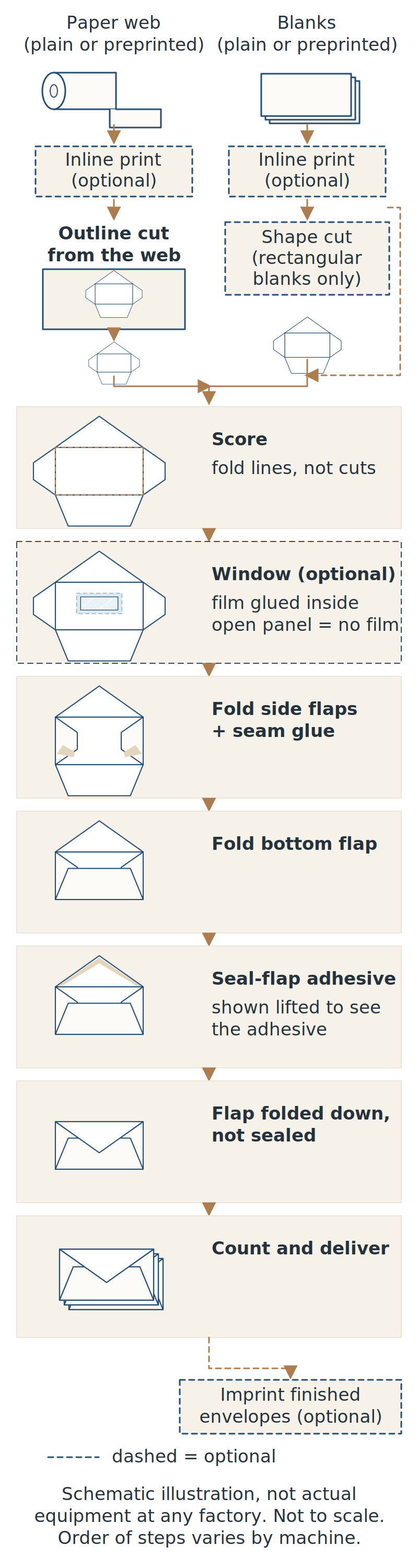
Common mistake: Reading one supplier’s step list or one machine layout as the fixed order for all envelopes. Some lines print first and some print last, some cut the shape on the machine and some receive it already cut, and a plain envelope skips the window steps entirely.
Takeaway: Ask which route a supplier will use for a given envelope before comparing their quotes or lead times.
Before conversion: paper and printing
Two decisions are fixed before the envelope machine starts: the paper and, for printed envelopes, when the print goes on. Paper grain, formation and grade affect folding and print quality, and print can be applied to the stock beforehand, on the envelope machine, or to finished envelopes.
Paper. The EMA guide calls grain direction crucial for envelope makers. Folding against the grain can crack and curl the paper, and grain affects feeding, printing and conversion. Formation, the distribution of fibers and filler in the sheet, matters for print: uneven formation absorbs ink unevenly and produces blotchy images. Opacity, thickness, formation and basis weight are separate properties, so basis weight alone does not describe how a sheet will print or fold. Tension’s glossary describes wove as a short-fiber paper with a smooth surface that prints well, and kraft as a longer-fiber, stronger paper that prints less well. “Recycled” describes the fiber content, which varies by paper and mill, rather than a different converting process. For grades and weights by envelope style, see types of mailing envelopes.
Printing. Print can be applied at three points:
- Before conversion. Rolls or blanks are printed first, for example by offset or digital printing, and then converted. The W+D brochure lists preprinted rolls and blanks as inputs.
- Inline. Flexographic units on the envelope machine print the web or the blanks as they run, on the outside and, where fitted, on the inside.
- After conversion. The EMA glossary describes imprinting folded envelopes, a fast way to print stock envelopes.
Inside printing is how security tint is added: opaque patterned printing on the inside of the envelope that makes the contents harder to see through the paper.
Takeaway: Fix the paper grade, grain and print route together, because each one limits the others.
Cutting the outline, scoring the folds and adding a window
Cutting removes paper to create the envelope outline; scoring presses a fold line into the paper without cutting through it; windowing cuts an opening and, unless the envelope is an open-panel design, glues a transparent patch inside it. These are three separate operations, and a plain envelope needs only the first two.
Cutting. A die is a tool that cuts or shapes material, and die cutting uses it to create the envelope blank. On a web line, the outline is cut from the roll and each piece is separated. On a blank line, the blank arrives already shaped or is shaped on the machine.
Scoring. A score is a prepared line that helps the paper fold cleanly. In the W+D layout, the paper is scored before the window station and before any folding. The EMA guide notes that machine heat and wear can shift cutting and score positions slightly, which shows up as envelopes a little larger or smaller than ordered.
Windowing. The window station cuts the opening, and a patching station glues a transparent film over it from the inside. The EMA guide says the patch glue depends on the window material, the gluing equipment and the machine speed. An open-panel or open-face envelope has the opening but no film. The film also has to suit what happens to the envelope later: the EMA guide notes that polyester is used for envelopes that will go through high-heat laser printing.
Takeaway: State whether the window is filmed or open and how the envelopes will be printed later, because both decide the window steps.
Folding the pocket and preparing the seal flap
The pocket is formed by folding the side flaps, gluing the seams where flaps overlap and folding the bottom flap up. The seal flap then gets its closure adhesive but leaves the factory unsealed, so the user or an inserting machine can fill and close it later. How it closes depends on the adhesive type, which the buyer chooses.
In the W+D layout, the side flaps are folded and gummed, and then the bottom flap is folded over them to form the pocket. The EMA guide says most envelopes today use closed-seam construction: at least three folds and two overlapping edges, with seam glue only where the paper overlaps, so the whole inside stays free for the contents.
After the pocket is formed, the seal flap is prepared for its closure:
- Moisture-activated (remoistenable) gum is applied as a thin wet film and dried. It reactivates with moisture when the envelope is closed, so drying does not seal anything.
- Latex self-seal is applied as two patterns, one on the flap and one on the body, that stick only to each other when pressed together.
- Peel-and-seal uses a pressure-sensitive adhesive covered by a release paper, which is peeled off before the flap is pressed down. The EMA guide describes water-based and hot-melt types. Self-adhesive labels use a similar adhesive-on-release-liner construction; see pressure-sensitive vs wet-glue labels.
The W+D layout shows a seal-flap gumming section, a heated drying section, an optional hot-melt pressure-sensitive gumming section, a seal-flap folding section and a delivery with a counter. Finished envelopes leave the machine counted, empty and unsealed.
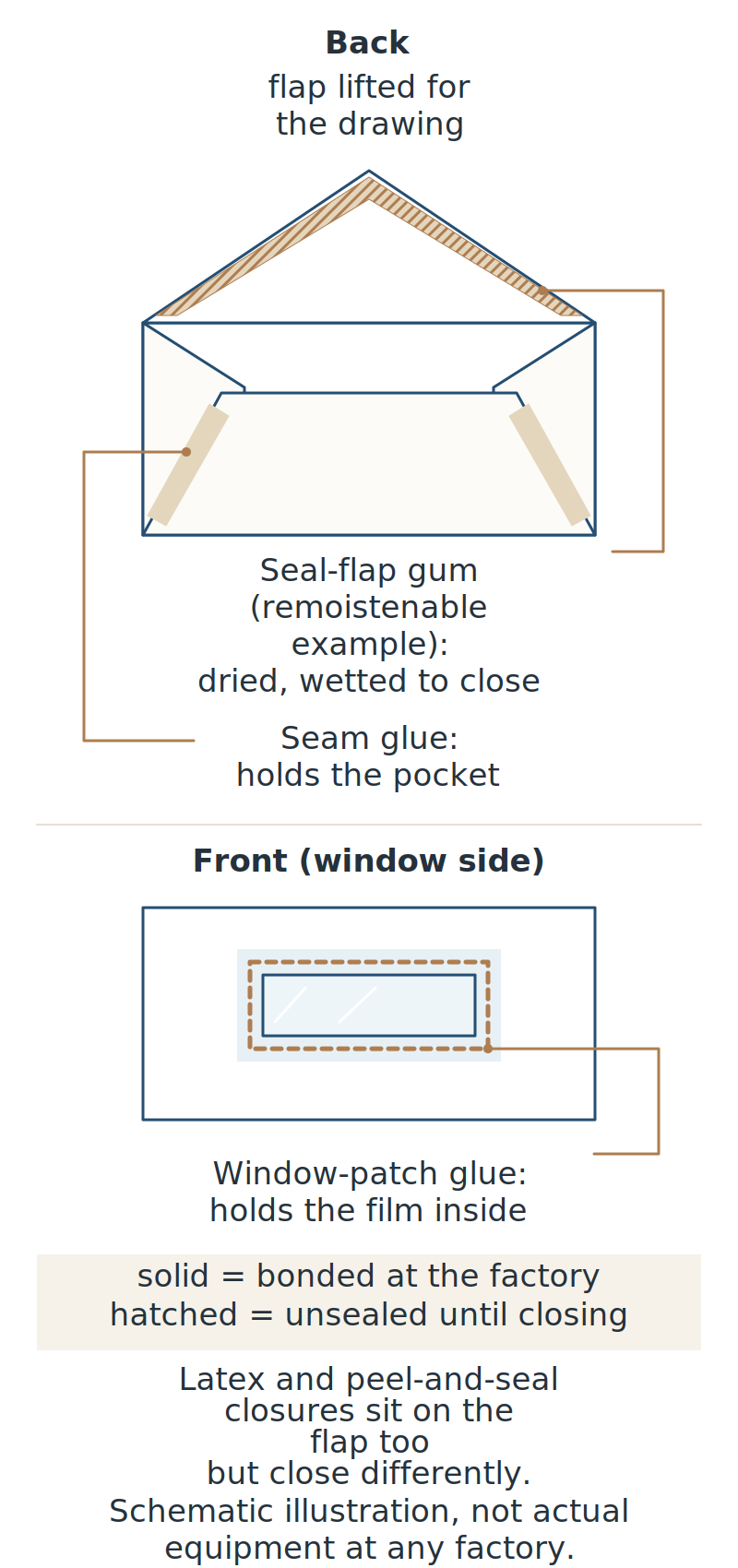
Common mistake: Treating the seam glue and the seal-flap gum as the same thing. The seam glue holds the envelope together from the moment it is made, the window glue holds the film, and the seal-flap gum is not used until the envelope is filled. Each has its own formulation and its own failure.
Takeaway: Specify the closure for the way the envelopes will be filled and sealed; the seam glue is the converter’s concern, but the closure is the buyer’s decision.
Inspection checkpoints from paper to delivery
Most envelope defects can be traced to one step: cracked folds to grain and scoring, a hidden address line to window position, stuck or stained envelopes to glue. Checking each step against the approved order, rather than inspecting only the finished carton, makes faults easier to find and to explain to the supplier.
The table below is an editorial checklist drawn from the EMA guide’s descriptions of materials and quality. It is not a test method, a factory sampling plan or a contract tolerance.
| Stage | What to look at | Defect it points to | What the order should state |
|---|---|---|---|
| Paper | Folds along every edge, especially across the grain | Cracking or curl from folding against the grain | Paper grade, weight and grain for the envelope style |
| Approved proof against the run; color on the run | Shifted artwork, wrong barcode, color variation | Color reference and where artwork and barcode sit | |
| Cut and score | Size and fold position against the specification | Envelope larger or smaller than ordered; folds off the panel edge | A tolerance when exact dimensions matter |
| Window | Patch secure on all edges, clear, tight, free of wrinkles, streaks and fogging; no excess patch glue around the window; window position with the real insert | Film hiding part of the address; glue smears at the window; window in the wrong place | Window position and film type; a prototype check with the actual insert |
| Seams | Glue lines in place; no bleed-through, staining or wrinkling | Seams opening, visible glue, cockled paper | Closed-seam construction if the envelopes will be machine-inserted |
| Seal flap | Gum line position and the closure type ordered | Envelopes sticking together or failing to seal; after machine inserting, a failed seal can also come from the wetting fluid or dirty wetting equipment | Closure type and how the envelopes will be filled and sealed |
| Delivery | Count against the order | More or fewer envelopes than ordered, since runs are planned from estimated paper | Quantity, and whether overs or unders are acceptable |
The EMA guide explains that envelope dimensions vary slightly because machines heat up and parts wear, and that a buyer who needs an exact measurement should say so on the order. It also notes that most manufacturers check color with handheld densitometers at machine delivery and watch for excess gum around windows. Cameras on the W+D line are optional; they support process monitoring in hard-to-see areas such as the window station, which does not mean every envelope is inspected.
For window envelopes, the EMA guide recommends a prototype test: put the real insert in the envelope, push it to the right, and check that every character of the longest address line shows through the window. If the envelopes will be filled by machine, the inserting system matters too, because some inserters accept many styles and others need envelopes built to exact specifications.
Common mistake: Approving the window position from a drawing or a photocopy of the form. A copier can shift the form, and only the actual insert in a prototype envelope shows whether the address stays visible.
Takeaway: Put the tolerance, window position, closure and filling method on the order, then check each one on delivery.
Envelope making terms used on this page
Envelope converters use a small set of terms for the paper, the steps and the glues, and a specification is easier to follow when buyer and supplier use them the same way. The definitions below follow the Tension glossary and the EMA guide and are worded for the process described above.
| Term | Meaning in the process |
|---|---|
| Web | A continuous roll of paper fed into the envelope machine |
| Blank | Paper die-cut to the flat shape of the envelope, before folding |
| Die cutting | Cutting blanks or outlines with a shaped cutting tool (a die) |
| Score | A pressed line that prepares the paper to fold cleanly; it does not cut |
| Window patch | Transparent film glued inside a window opening |
| Open panel | A window opening with no film |
| Back seam | Where flaps overlap and are glued to hold the envelope together |
| Seal flap | The flap that closes the envelope after filling |
| Remoistenable gum | Dried seal gum that reactivates with moisture |
| Latex self-seal | Two latex patterns that stick only to each other |
| Security tint | Patterned opaque printing inside the envelope |
| Converting vs inserting | Making empty envelopes vs filling them, often by machine |
Takeaway: Use these terms on a specification so the converter and the mailing house mean the same step.
When this does not apply
This workflow covers empty paper envelopes made on envelope-converting equipment. It does not describe other mailers, the papermaking before it, the filling after it, or one-off handmade envelopes, and it says nothing about whether a filled envelope meets postal rules.
- Protective mailers. Padded, bubble and poly mailers use other materials and constructions; see paper mailers vs poly mailers and the wider paper packaging section.
- Papermaking. Making the paper itself happens earlier, at a paper mill.
- Printing on finished stock only. A printer imprinting bought envelopes uses only the last print route above.
- Postal acceptance. Postal rules apply to the filled mailpiece; the size and shape limits are covered in types of mailing envelopes.
- Choosing a machine. Speeds, formats and station options differ between machines and are not compared here.
Takeaway: For these cases, use a source written for that product or step.
Where to go next
Which page to read next depends on what you are deciding. For a specification, the envelope types guide combines style, seam, closure and paper; the overview collects materials and inspection in one place; protective mailers and labels have their own pages. None of them sells envelopes or compares machines.
- Envelope Manufacturing & Materials: the overview of envelope paper, windows, adhesives and inspection in one place.
- Types of mailing envelopes: how style, seam, closure and paper combine, and how USPS treats the filled envelope.
- Paper mailers vs poly mailers: for items that need a protective mailer rather than an envelope.
- Pressure-sensitive vs wet-glue labels: how self-adhesive labels on a release liner compare with labels glued on the labelling machine.
Takeaway: Start with the envelope types guide if you are writing a specification.
Sources and method
This page was last updated on 11 October 2026. It is based on published documents, read on 10 October 2026: the EMA guide (PDF file metadata dated 2015), the W+D 628 brochure (file metadata dated 2024) and Tension’s glossary. No envelopes or machines were tested, and no factory was visited.
The diagrams are schematic illustrations, not actual equipment at any factory. The W+D station layout is used as one published example, not an endorsement or a description of every line. The EMA guide’s postal figures and the machine brochure’s speed and size data were not used. Mail-Well.com is an independent publication; see about this publication and the editorial policy for how sources are chosen. If something here is wrong, the corrections section of the editorial policy explains how to report it with the page address and a source; errors are corrected on the page.
Takeaway: Check a supplier’s own specification sheet for any figure this page deliberately leaves out.
Frequently Asked Questions
Why do envelopes have patterns inside?
The pattern is a security tint: opaque patterned printing on the inside of the envelope, defined that way in Tension's glossary. It makes the contents harder to read through the paper at a glance. It is an optional print step, not encryption or tamper evidence, and a tinted envelope does not guarantee confidentiality.
What is envelope glue made of?
Envelope glues are made from starch (dextrin), synthetic resins or natural rubber latex, and the mix changes with the job each glue does. The EMA guide describes moisture-activated seal gum as dextrin (modified corn or potato starch), synthetic resin emulsion, or a blend; latex self-seal as natural rubber latex; peel-and-seal as a water-based acrylic or a hot-melt synthetic rubber adhesive; and seam and window-patch glues as starch and resin blends or synthetic resins, usually supplied as water-based liquids.
What are envelope windows made of?
Usually a transparent film glued inside the opening. The EMA guide lists cellophane, glassine (a paper-based material), polystyrene, polypropylene, polyester, acetate, colored film and PLA, and notes that polyester is used when the envelope will go through high-heat laser printing. An open-panel envelope has the opening but no film at all.
What weight paper is used for envelopes?
There is no single weight. Paper is described by grade and basis weight, the weight of 500 sheets at that grade's basic sheet size, so the same pound number means different things in different grades. State the grade with the weight, such as wove or kraft at a given basis weight; the envelope types guide shows common weights by envelope size.
How are envelopes sealed?
The factory glues the seams, but the seal flap is closed later by whoever fills the envelope. Moisture-activated gum is wetted and pressed, latex self-seal patterns stick when pressed together, and peel-and-seal is closed by removing a release strip and pressing. The EMA guide says moisture-activated gum is the most common because it suits automatic inserting machines.
Blank or printed, and if so, how many colors on front and back?
Here blank means unprinted: a plain envelope skips printing, while a printed one needs its colors listed separately for the front, the back and any inside print such as a security tint. How many colors are possible depends on the converter's printing equipment, so ask rather than assume a limit. In converting, a blank is also the flat die-cut paper before folding, which can be plain or printed.
Sources
- The EMA Guide to Envelopes and Mailing (Envelope Manufacturers Association)
- W+D 628 envelope machine brochure (Winkler+Dünnebier, hosted by BW Converting)
- Glossary of Envelope Terms (Tension)