Paper PackagingComparison
Rigid Mailers vs Padded Paper Mailers: Board Caliper, USPS Flat Rules, and Curbside Recycling
Compare 20 to 28 pt paperboard rigid mailers and macerated or honeycomb padded paper mailers on bending stiffness, USPS DMM 201 flat flexibility, peel-and-seal closures, and mill repulping.
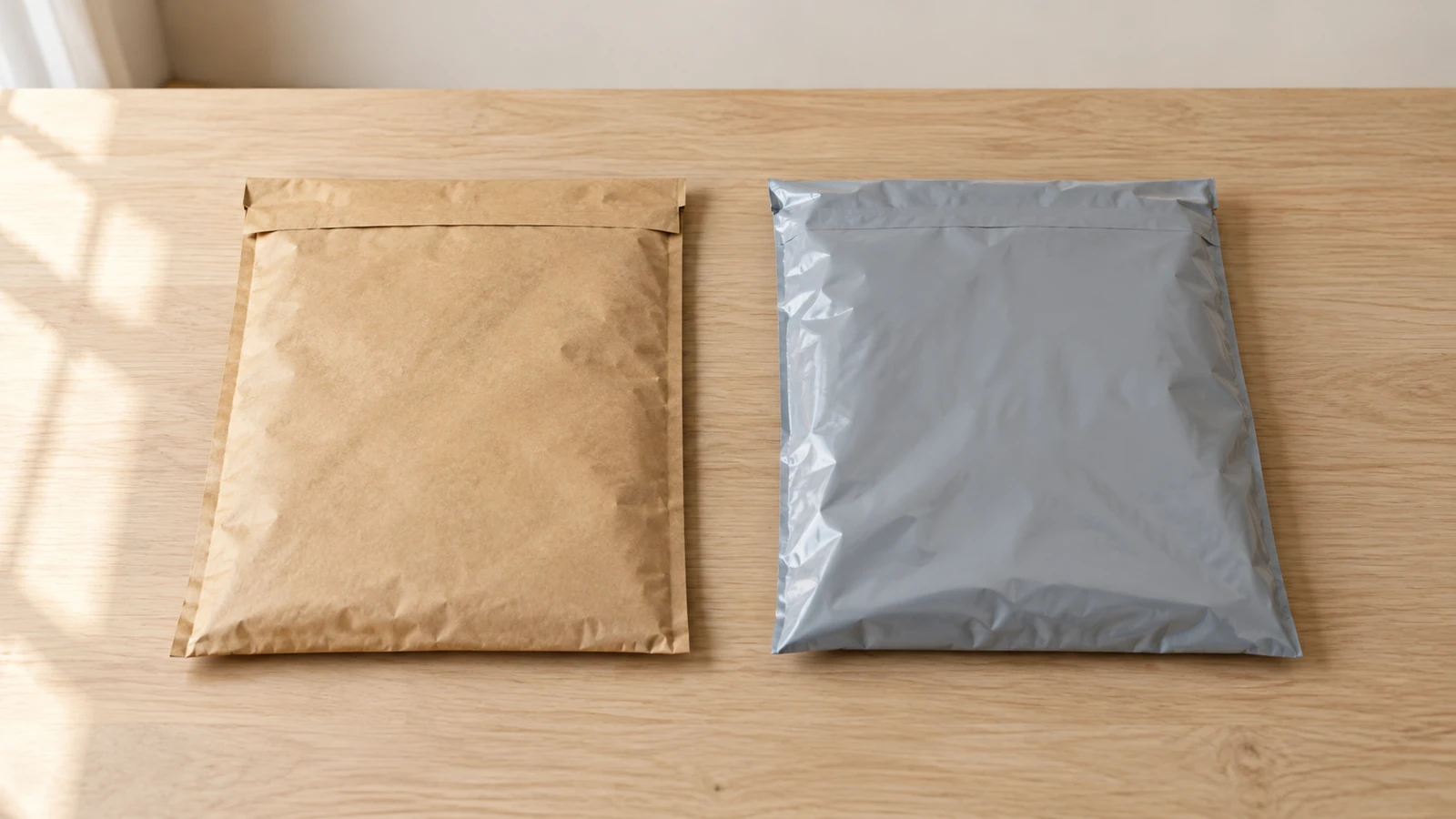
Packing a bend-sensitive art print inside a cushioned pouch causes flexural crease damage on conveyor turns, while putting a small boxed cosmetic jar into a stiff paperboard sleeve transmits drop shock and triggers costly parcel reclassification. Selecting between rigid mailers and padded paper mailers requires separating bending stiffness from impact damping, then checking the filled pack against USPS DMM 201 physical standards and North American paper mill repulping thresholds.
Within the broader paper packaging and mailers hierarchy, paper shipping envelopes split into stiff fiberboard shells that resist folding and multi-wall cushioned constructions that absorb surface impacts. Teams evaluating a broader paper mailer vs poly mailer transition must also verify whether a kraft-faced mailer hides an internal polyethylene bubble liner that blocks curbside paper recovery.
| Mailer architecture | Typical wall substrate and caliper | Primary protection mechanism | USPS DMM classification (filled) | Curbside recycling stream |
|---|---|---|---|---|
| Solid fiberboard rigid mailer (Stayflats, Jiffy Rigi Bag) | 20 to 28 pt (0.51 to 0.71 mm) SBS, CUK/SUS, or CCNB paperboard; 400 to 550 g/m2 (PPC; Sealed Air) | Bending stiffness (TAPPI T489) and edge/corner crush resistance; zero vertical shock cushion | Fails DMM 201 Section 4.3 flat bend test; reclassified to Parcel under Section 4.7 | 100% paperboard; Widely Recyclable at curbside (AF&PA; How2Recycle) |
| Micro-corrugated bookfolder (E-flute or F-flute rigid) | Combined board: E-flute (~90 flutes/ft, 1.5 to 1.8 mm) or F-flute (~125 flutes/ft, 0.8 to 1.0 mm) between two liners (FBA; PPC) | I-beam liner separation maximizes span stiffness and edge crush; flutes cushion light side pressure | Boxes and hinged folds are never flats per DMM 201 Section 4.3; billed as 3D Parcel | 100% corrugated containerboard (OCC stream); Widely Recyclable |
| Macerated paper padded mailer (Jiffy Padded) | Two natural brown kraft walls enclosing blown recycled newsprint batt; 3.0 to 5.0 mm wall; ~70.6 g in No. 2 size (Sealed Air; AF&PA) | Distributed impact damping and vibration absorption across dense cellulose fiber mat | Flat only if bend >= 1 in, total thickness <= 3/4 in, and bump variation <= 1/4 in; otherwise Parcel | All-paper construction; cellulose batting disperses in mill hydrapulper (AF&PA) |
| Honeycomb or embossed paper padded mailer (NatureMailer, EverTec) | Two kraft plies over an expanded die-cut 3D kraft honeycomb lattice or fluted core; 4.0 to 6.5 mm wall (Ranpak; Pregis) | Progressive cellular lattice crush under drop shock at 25% to 40% lower mass than newsprint batt | Flat if contents flex and bump variation stays <= 1/4 in; Parcel if rigid contents exceed 1/4 in step | 100% long-fiber kraft; >= 80% mill fiber yield; Widely Recyclable (How2Recycle) |
| Kraft-faced plastic bubble mailer (Jiffylite composite) | Outer bleached or natural kraft paper laminated directly to an inner LDPE cellular air-bubble film (Sealed Air) | Pneumatic air cells cushion impact; outer kraft sheet supplies a stiff printable face | Same dimensional and flexibility gates as padded paper mailers; ~15.5 g tare in No. 2 size | Multi-material reject in paper mills; restricted to Check Locally (How2Recycle) |
Structural comparison: 20 to 28 pt rigid mailers vs padded paper and composite constructions
Manufacturers divide fiber-based protective mailers into rigid flat mailers and cushioned mailers according to the failure mode of the enclosed merchandise. In the Sealed Air Jiffy Mailer brochure, Jiffy Rigi Bag mailers use an extra-rigid, kraft-laminated fiberboard wall engineered to resist bending and corner crushing across sizes No. 1 (7-1/4 by 10-1/2 inches) through No. 7 (14-1/4 by 18-1/2 inches). By contrast, Jiffy Padded mailers pair a heavy-duty natural kraft outer shell with uniform inner paper padding and a double-folded, double-glued bottom flap from size No. 000 (4 by 8 inches) to No. 7 (14-1/4 by 20 inches).
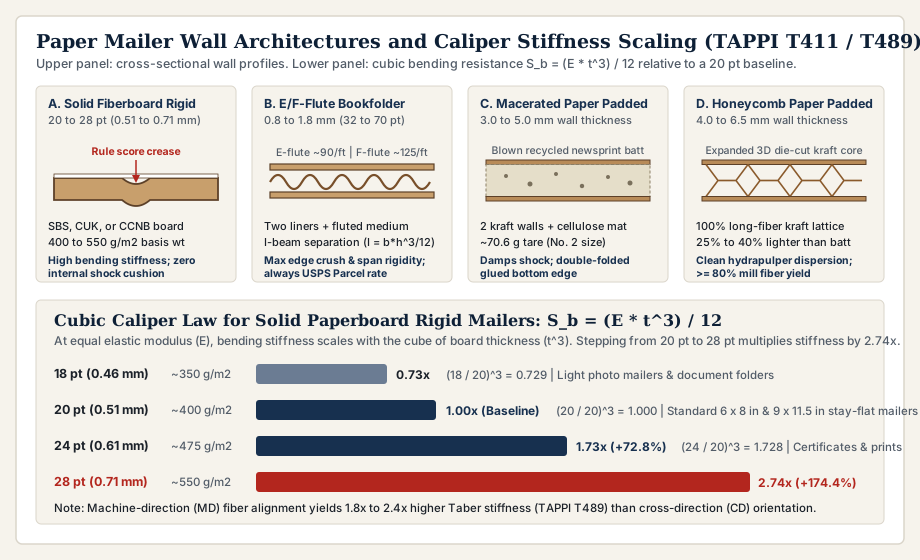
According to the Paperboard Packaging Council (PPC), folding-carton and rigid-mailer paperboard grades span 10 to 36 points (0.010 to 0.036 inch, or 0.25 to 0.91 mm) across Solid Bleached Sulfate (SBS), Coated Unbleached Kraft or Solid Unbleached Sulfate (CUK/SUS), and Coated Recycled Board (CRB, including clay-coated newsback CCNB). When a shipment requires higher span rigidity than single-ply 28 pt paperboard can supply, converters laminate mini-flute corrugated board in E-flute (approximately 90 flutes per linear foot) or F-flute (approximately 125 flutes per linear foot, developed for thin bookfolder and carton profiles) as documented by the Fibre Box Association (FBA).
On the cushioned side, all-paper constructions avoid plastic film by trapping air within fiber structures. Macerated paper mailers blow shredded newsprint between two kraft plies, whereas newer honeycomb and embossed paper mailers, such as Ranpak NatureMailer and Pregis EverTec cushioned paper mailers, bond an expanded die-cut kraft lattice or multi-ply fluted core between kraft facings. Buyers must keep all-paper padded mailers separate from composite kraft bubble mailers (such as Jiffylite), which laminate low-density polyethylene (LDPE) bubble wrap to the inside of a kraft sheet.
Takeaway: Match solid paperboard or E/F-flute rigid mailers to flat items that fail by creasing, and specify macerated or honeycomb padded paper mailers for low-profile goods that fail by surface impact.
Bending stiffness, caliper cubic scaling, and grain scoring on rigid mailers
Flat items such as photographs, art prints, diplomas, vinyl records, and saddle-stitched catalogs suffer permanent crease damage if the carrier envelope deflects under conveyer belt tension or parcel stacking loads. Paperboard resists out-of-plane deflection through flexural rigidity, governed by the plate bending stiffness equation per unit width:
S_b = (E * t^3) / 12
Here E represents the tensile elastic modulus of the paperboard in the tested fiber direction, and t is the sheet caliper measured under TAPPI T411 (with bending moment resistance measured in Taber stiffness units under TAPPI T489 / T566, as indexed in the AF&PA Design Guidance for Recyclability). Because bending stiffness scales with the cube of caliper (t^3), small point increases produce large gains in flexural resistance at equal board density and modulus:
- Stepping from 20 pt (0.020 in / 0.508 mm) to 24 pt (0.024 in / 0.610 mm) increases board thickness by
24 / 20 = 1.20x(+20%), which raises theoretical bending stiffness by(24 / 20)^3 = 1.20^3 = 1.728x(+72.8%). - Stepping from 20 pt to 28 pt (0.028 in / 0.711 mm) increases thickness by
28 / 20 = 1.40x(+40%) and multiplies cubic bending resistance by(28 / 20)^3 = 1.40^3 = 2.744x(+174.4%). - Stepping down from 20 pt to 18 pt (0.018 in / 0.457 mm) reduces thickness by 10% (
18 / 20 = 0.90x) and drops cubic bending stiffness to0.90^3 = 0.729x(-27.1%).
| Rigid mailer board tier | Nominal caliper (points and inches) | Metric thickness (mm) | Typical basis weight (g/m2) | Relative cubic stiffness (t / t_20)^3 |
Primary payload match |
|---|---|---|---|---|---|
| Light solid paperboard | 18 pt (0.018 in) | 0.46 mm | 330 to 370 g/m2 | 0.73x | Small 5 x 7 in photo prints, postcards, and thin pamphlets |
| Standard solid paperboard | 20 pt (0.020 in) | 0.51 mm | 380 to 420 g/m2 | 1.00x (baseline) | Standard 6 x 8 in and 9 x 11.5 in document and print mailers |
| Heavy solid paperboard | 24 pt (0.024 in) | 0.61 mm | 450 to 500 g/m2 | 1.73x (+72.8%) | Certificates, 9.5 x 12.5 in art prints, calendars, and comic books |
| Extra-heavy solid paperboard | 26 to 28 pt (0.026 to 0.028 in) | 0.66 to 0.71 mm | 510 to 560 g/m2 | 2.20x to 2.74x | Large-format photography, bound portfolios, and heavy flat media |
| F-flute micro-corrugated | ~32 to 40 pt combined | 0.80 to 1.00 mm | 420 to 520 g/m2 | Structural I-beam (~125 flutes/ft) | Softcover and hardcover books, boxed media sets, and plaques |
| E-flute micro-corrugated | ~60 to 70 pt combined | 1.50 to 1.80 mm | 500 to 650 g/m2 | Structural I-beam (~90 flutes/ft) | Heavy hardcover volumes, vinyl LPs, and framed acrylic or metal signs |
Paperboard is also orthotropic because cellulose fibers align parallel to the paper machine web during sheet formation. Machine-direction (MD) bending stiffness is typically 1.8x to 2.4x higher than cross-machine-direction (CD) stiffness. As explained in The EMA Guide to Envelopes and Mailing and our converting and finishing equipment overview, folding 24 to 28 pt board across the grain without preparation ruptures the outer surface fibers along the spine. Die-cutting and folder-gluer lines press mechanical rule scores (creases) along the closure flap and variable-depth expansion gussets, which delaminates the internal plies locally so the board hinges cleanly without cracking. These same grain and score checks appear in the direct mail production workflow.
Takeaway: Specify board caliper in points alongside grade (SBS, CUK, or CCNB) and verify that expansion gussets and closure flaps carry pre-broken rule scores.
Cushioning mechanics and tare-weight steps in padded paper mailers
Unlike solid paperboard rigid mailers, padded paper mailers are built to decelerate semi-fragile, three-dimensional items during chute drops and parcel sorting impacts. Two distinct all-paper cushioning designs dominate commercial fulfillment:
- Macerated newsprint batting (exemplified by Sealed Air Jiffy Padded mailers) sandwiches a dense layer of blown recycled cellulose fibers between two kraft paper walls. When a heavy metal fitting or hardcover book corner strikes the mailer, the loose fiber mat compresses and spreads the contact force, while the double-folded, double-glued bottom edge prevents seam splitting.
- Expanded 3D kraft honeycomb and embossed multi-wall cores (used in Ranpak NatureMailer and Pregis EverTec mailers) replace loose newsprint fibers with a continuous geometric paper lattice bonded between kraft liners. Under impact, the hexagonal or fluted paper cells buckle progressively.
Because continuous honeycomb lattices trap a higher volume of air per gram of cellulose than dense macerated newsprint, they reduce empty mailer tare weight by 25% to 40%. In the University of Calgary life-cycle comparison cited in paper mailers vs poly mailers, a No. 2 (8.5 by 12 inch) kraft and macerated-newsprint padded mailer weighed 70.62 g (2.49 oz), compared with 15.47 g (0.55 oz) for an LDPE bubble mailer of the same footprint. Under USPS DMM 283 USPS Ground Advantage Commercial rules, parcels under 1 pound are billed at 4, 8, 12, and 15.999 oz steps, where any fraction of an ounce above a cutoff moves the shipment to the next price tier.
| Mailer format (No. 2 size, ~8.5 x 12 in) | Typical empty tare weight | Total weight with 6.0 oz contents | USPS Ground Advantage Commercial step (DMM 283) | USPS DMM 283 Commercial Cubic measurement rule |
|---|---|---|---|---|
| Macerated newsprint padded paper mailer | ~70.6 g (2.49 oz) | 8.49 oz | Crosses 8 oz cutoff -> billed at 12 oz rate | Soft-pack rule: outside length + width of unpacked mailer <= 36 in |
| Expanded honeycomb / multi-wall paper mailer | ~42 to 52 g (1.48 to 1.83 oz) | 7.48 to 7.83 oz | Stays under 8.0 oz -> billed at 8 oz rate | Soft-pack rule: outside length + width of unpacked mailer <= 36 in |
| 24 to 28 pt solid paperboard rigid mailer | ~45 to 62 g (1.59 to 2.19 oz) | 7.59 to 8.19 oz | 8 oz or 12 oz step depending on exact board caliper | Rigid parcel rule: measured in 3D (L x W x H) |
| E-flute micro-corrugated bookfolder | ~75 to 110 g (2.65 to 3.88 oz) | 8.65 to 9.88 oz | Crosses 8 oz cutoff -> billed at 12 oz rate | Rigid/expandable rule: measured in 3D (L x W x H) |
DMM 283 also separates soft packs from rigid mailers under Commercial Cubic pricing (for parcels up to 1 cubic foot and 20 pounds). Soft packs and padded envelopes are tiered by the outside length plus width of the original, unpacked mailer (each dimension rounded down to the nearest 1/4 inch, total not exceeding 36 inches). Pleated, expandable, or rigid pieces must be measured as three-dimensional rectangular parcels (length x width x height).
Takeaway: Weigh the exact mailer size with representative contents against the 4, 8, 12, and 15.999 oz USPS Ground Advantage steps before locking in a macerated or honeycomb construction.
USPS DMM 101 and 201 rules: why rigid mailers reclassify from flats to parcels
A common costly error in direct mail and ecommerce fulfillment is budgeting USPS Flat (Large Envelope) postage for a 9 by 12 inch rigid mailer because its outer dimensions fit inside the 15 by 12 inch flat window. Under USPS DMM 101 (Retail) and USPS DMM 201 (Commercial), postal classification is determined by four sequential physical gates tested on the sealed, filled mailpiece. This handoff between automated mail sorting and parcel dispatch is mapped across mailing, inserting and fulfillment and types of mailing envelopes.
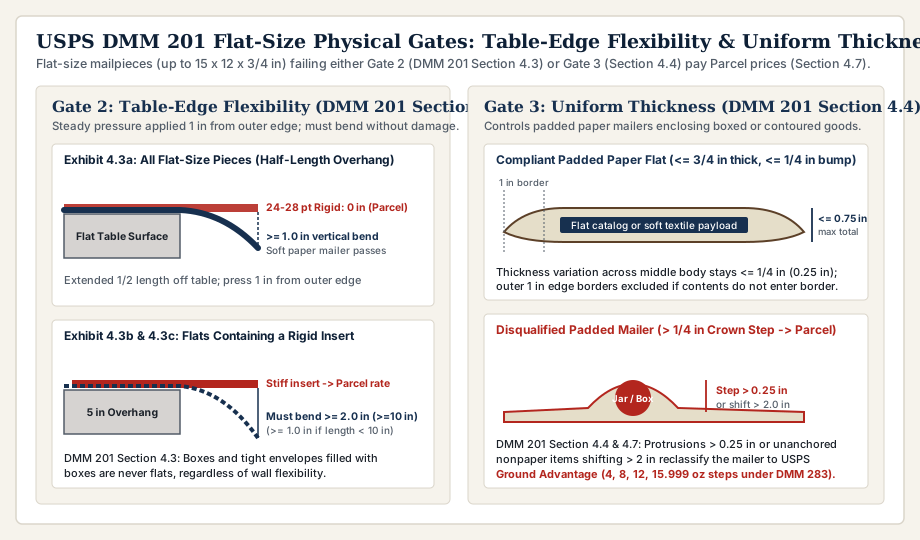
Under DMM 201 Section 4.3 (Minimum Flexibility for Flat-Size Pieces), every flat must pass a physical table-edge deflection test without damaging the envelope or its contents:
- All flat-size pieces (Exhibit 4.3a): with the length parallel to a flat table edge and extended halfway off the surface, the piece must bend at least 1 inch vertically under steady pressure applied 1 inch from the outer edge.
- Flats 10 inches or longer containing a rigid insert (Exhibit 4.3b): with the length perpendicular to the table edge and extended 5 inches off the surface, the piece must bend at least 2 inches vertically at both ends when turned around.
- Flats under 10 inches containing a rigid insert (Exhibit 4.3c): extended halfway off the table surface perpendicular to the edge, the piece must bend at least 1 inch vertically at both ends.
- Box exclusion (Section 4.3): boxes, with or without hinges, gaps, or breaks, and tight envelopes filled with boxes are never flats.
| USPS physical gate | DMM 101 / DMM 201 threshold | Filled 20 to 28 pt or E-flute rigid mailer outcome | Filled padded paper mailer outcome |
|---|---|---|---|
| Gate 1: Outer dimensions (DMM 101 §2.1 / DMM 201 §4.1) | Length > 11-1/2 in OR height > 6-1/8 in OR thickness > 1/4 in; max 15 x 12 x 3/4 in (0.75 in); square corners or radius <= 1/8 in | Fits flat length and height up to 12 x 15 in; smaller 6 x 8 in sizes fall in letter dimensions | Fits flat footprint up to 12 x 15 in only if packed center thickness stays <= 3/4 in (0.75 in) |
| Gate 2: Belt & table-edge flexibility (DMM 101 §1.2 / DMM 201 §4.3) | Letters: bend under 40 lb belt tension on 11-in turn. Flats: bend >= 1 in (Exhibit 4.3a) or >= 2 in on 5-in overhang with insert (Exhibit 4.3b) | Fails by design: letter-size rigid mailers pay the nonmachinable surcharge; flat-size rigid mailers reclassify to Parcel per DMM 201 §4.7 | Passes when enclosing flexible textiles or catalogs; fails and moves to Parcel if a stiff insert blocks the 2-in bend |
| Gate 3: Uniform thickness & shift (DMM 101 §2.4 / DMM 201 §4.4) | Max 1/4 in (0.25 in) thickness variation (excluding 1-in outer borders if empty); nonpaper contents must not shift > 2 in | Uniformly flat with sheet goods, but already reclassified to Parcel at Gate 2 | Primary disqualifier: boxed cosmetics, jars, or hardware creating a > 0.25 in bump step move the piece to Parcel pricing |
| Gate 4: Maximum droop deflection (DMM 201 §4.6 & §4.7) | Under a 5-lb weight, flats >= 10 in extended 5 in must not droop > 3 in vertically (Exhibit 4.6a) | Not applicable once classified as a Parcel | Limp, oversized mailers with heavy unanchored contents drooping > 3 in lose automation flat discounts |
Because 20 to 28 pt paperboard and E/F-flute rigid mailers are engineered specifically to prevent a 1-inch to 2-inch vertical bend, forcing them through high-speed flat sorting drums creases the board and ruins the enclosed print. DMM 201 Section 4.7 therefore reclassifies any flat-size rigid mailer to Parcel prices (such as USPS Ground Advantage). If a smaller rigid mailer (for example, 6 by 8 inches and under 1/4 inch thick) is mailed as a letter under DMM 101 Section 1.2, it fails the 40-pound belt tension test around an 11-inch diameter turn and incurs the nonmachinable letter surcharge.
Takeaway: Budget USPS Ground Advantage parcel postage for all flat-size rigid mailers, and test filled padded paper mailers against the 3/4-inch maximum thickness and 1/4-inch bump limits before claiming Flat rates.
Closure engineering, tear strips, and curbside paper mill repulpability
Fulfillment mailers use pressure-activated closures rather than the remoistenable gum used on high-speed letter inserters. As detailed in our comparison of self-seal vs gummed envelopes, automatic envelope inserters wet remoistenable gum inline and cannot peel release liners, whereas thick 24 to 28 pt paperboard flaps spring open before wet gum can tack. Packing stations therefore specify hot-melt peel-and-seal or two-band cohesive latex closures, paired with 4 by 6 inch pressure-sensitive shipping labels whose adhesive and thermal imaging behavior are covered in pressure-sensitive vs wet-glue labels and direct thermal vs thermal transfer labels.
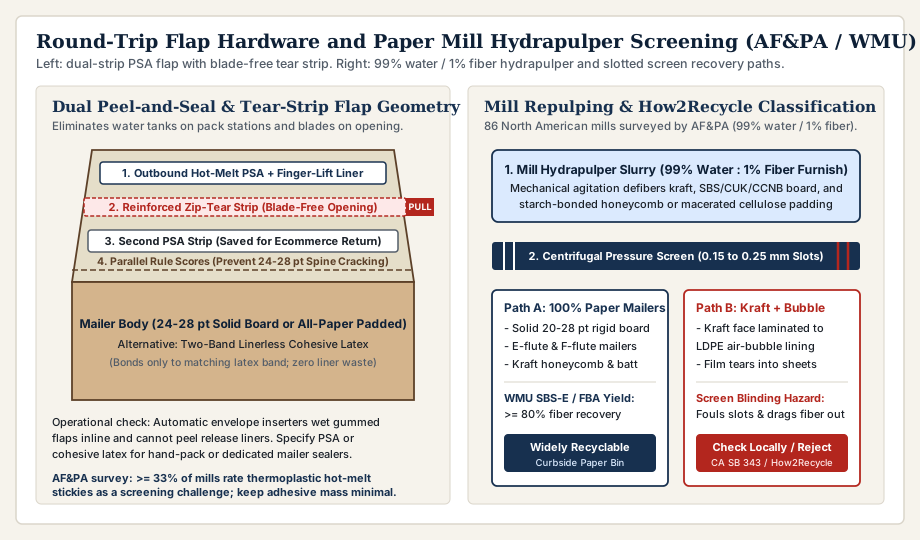
In the AF&PA Design Guidance for Recyclability, a survey of 86 US and Canadian paper mills (representing 74% of North American recovered fiber consumption in scope) documents how non-fiber closures and cushioning layers behave during repulping. Recovered paper bales enter a water-filled hydrapulper agitated to a 99% water and 1% fiber furnish, followed by centrifugal pressure screens with narrow slots (0.15 to 0.25 mm) that separate dispersed cellulose fibers from contaminants.
| Mailer component or construction | Closure / cushioning chemistry | Mill hydrapulper and screen behavior (AF&PA 86-mill survey) | WMU SBS-E / FBA fiber yield & How2Recycle status |
|---|---|---|---|
| Solid 20-28 pt rigid mailer + single PSA strip & tear tape | Uncoated or clay-coated SBS/CUK/CCNB board; discrete hot-melt PSA strip; reinforced pull tab | Board slushes cleanly; discrete PSA bead and tear tape are removed by coarse raggers and slotted screens | Meets >= 80% fiber yield; Widely Recyclable in curbside paper bins |
| Rigid mailer with two-band cohesive latex (Jiffy Rigi Bag) | 100% recycled kraft-laminated fiberboard with patterned natural/synthetic latex contact bands | Zero release-liner waste on pack floor; latex bands screen out if kept to narrow flap stripes | Widely Recyclable at curbside; store flat away from heat, UV, and dust (EMA) |
| Dual-strip round-trip paper mailer (honeycomb or rigid) | Two parallel hot-melt PSA strips separated by a perforated zip-tear opening track | Clean blade-free opening and return reuse; thermoplastic hot-melt stickies require controlled coat weight (>= 33% of mills rate stickies a challenge) | Qualifies for Widely Recyclable when total non-fiber content stays below mill sticky thresholds |
| All-paper padded mailer (macerated batt or kraft honeycomb) | Two kraft plies with starch-bonded kraft honeycomb or blown newsprint cellulose core | Honeycomb long fibers repulp into paper furnish; loose newsprint cellulose is recovered or filtered per AF&PA | Widely Recyclable (honeycomb passes WMU >= 80% yield; verify local MRF rules on loose newsprint filler) |
| Kraft-faced LDPE bubble mailer (Jiffylite composite) | Kraft paper laminated across its entire inner face to low-density polyethylene bubble film | Paper slushes while LDPE film tears into flexible sheets that blind pressure screen slots and trap fiber | Fails repulpability; assigned Check Locally or Not Yet Recyclable under CA SB 343 / How2Recycle (August 2026) |
Under the How2Recycle Guidelines for Use (August 2026 release) and California SB 343 recyclability criteria, uncoated or clay-coated all-paper mailers without restrictive non-fiber attachments qualify for a Widely Recyclable curbside label. By contrast, shipping mailers with adhered plastic cushions or foam, flood-coat adhesives, or wet-strength resins cannot carry a Widely Recyclable claim because the attached plastic film fouls material recovery facility (MRF) and paper mill screens.
Takeaway: Specify all-paper rigid or honeycomb/macerated padded mailers with discrete PSA seam beads and a built-in tear strip so recipients can open the pack without blades and place the empty mailer directly into curbside paper recycling.
Procurement and fulfillment specification record
Packaging buyers and fulfillment leads can copy the verification table below into a supplier RFQ or pack-station standard operating procedure before releasing a bulk mailer order.
| Specification line item | Target parameter to record | Verification method before bulk release |
|---|---|---|
| 1. Payload failure mode | Flexural crease sensitivity (flat sheets, books, media) vs drop shock sensitivity (boxed cosmetics, hardware, jars) | Pack 10 trial orders and inspect corners, spines, and inner primary packaging after parcel sortation |
| 2. Wall construction and caliper | Solid paperboard (20, 24, or 28 pt SBS/CUK/CCNB), E/F-flute bookfolder, macerated newsprint batt, or 3D kraft honeycomb | Measure board caliper under TAPPI T411 and verify Taber stiffness (TAPPI T489) or padding wall thickness |
| 3. Grain direction and fold scores | Machine-direction (MD) grain orientation and pre-broken mechanical rule scores on flaps and expansion gussets | Fold the flap 180 degrees at low warehouse humidity and check the outer spine for fiber cracking |
| 4. Closure and opening hardware | Single peel-and-seal PSA, dual-strip return PSA, or linerless cohesive latex; integrated zip-tear pull tab | Time 25 manual pack-and-seal cycles and test blade-free tear-strip opening on sealed samples |
| 5. Filled USPS DMM 201 & 283 check | Total packed weight (against 4, 8, 12, 15.999 oz steps), maximum thickness (<= 3/4 in), bump step (<= 1/4 in), and Exhibit 4.3a/b bend test | Weigh and gauge filled samples; classify rigid mailers and bumpy padded mailers as USPS Ground Advantage parcels |
| 6. Curbside repulpability proof | 100% paper construction (zero LDPE bubble lamination), starch or screenable PSA adhesive, and WMU SBS-E / FBA >= 80% fiber yield | Confirm How2Recycle Widely Recyclable eligibility and California SB 343 compliance on supplier spec sheet |
Takeaway: Lock the board caliper or paper cushion construction, the DMM 201 / 283 parcel step, and the mill repulpability proof on a signed sample before printing or ordering production quantities.
Frequently Asked Questions
Can a rigid paperboard mailer be shipped at USPS Flat (Large Envelope) rates?
Usually no. Under USPS DMM 101 Section 2.3 and DMM 201 Section 4.3, a flat-size mailpiece must be flexible enough to bend at least 1 inch vertically over a table edge without damage, and flats containing a rigid insert must bend 2 inches vertically on pieces 10 inches or longer (or 1 inch on pieces under 10 inches). Because 20 to 28 pt paperboard and E-flute rigid mailers are engineered to resist bending, DMM 201 Section 4.7 reclassifies rigid flat-sized mailers as parcels (such as USPS Ground Advantage).
What is the maximum thickness and bump variation allowed for a padded paper mailer sent as a USPS Flat?
Under USPS DMM 201 Sections 4.1 and 4.4, a flat-size mailpiece cannot exceed 3/4 inch (0.75 inch) in total thickness and must be uniformly thick so that internal bumps, protrusions, or shifting contents cause no more than 1/4 inch (0.25 inch) of thickness variation across the body (excluding a 1-inch border around the outer edges when contents do not extend into those edges).
Why are all-paper padded mailers accepted in residential curbside recycling while kraft bubble mailers are restricted?
All-paper mailers built with macerated newsprint, die-cut kraft honeycomb, or fluted paper cushioning disperse into recoverable cellulose fibers inside a paper mill hydrapulper. By contrast, a kraft mailer lined with polyethylene (LDPE) air bubbles is a multi-material composite whose plastic film tears into sheets that blind mill pressure screens; How2Recycle assigns mailers with adhered plastic cushions a Check Locally label rather than Widely Recyclable.
When should fulfillment lines specify a dual peel-and-seal strip with a tear tape on rigid or padded paper mailers?
Specify a single hot-melt peel-and-seal strip with an integrated tear-strip pull tab for one-way outbound shipments such as prints, books, certificates, or cosmetics where the recipient needs clean, blade-free opening. Add a second parallel peel-and-seal strip only when the ecommerce return workflow requires the customer to reuse the original mailer for reverse logistics.
Sources
- DMM 201 Physical Standards for Commercial Letters, Cards, Flats, and Parcels (United States Postal Service, Postal Explorer)
- DMM 101 Physical Standards for Retail Letters, Cards, Flats, and Parcels (United States Postal Service, Postal Explorer)
- DMM 283 USPS Ground Advantage Commercial: Prices and Eligibility (United States Postal Service, Postal Explorer)
- Jiffy Mailer Protective Shipping Products Brochure (D-101) (Sealed Air Corporation)
- Cushioned Mailers & Envelopes (EverTec Cushioned Paper Mailers) (Pregis)
- What is Paperboard Packaging? (Paperboard Packaging Council (PPC))
- What is Corrugated? (Fibre Box Association (FBA))
- Design Guidance for Recyclability for Paper-based Packaging (Version 1.1) (American Forest & Paper Association (AF&PA))
- Paper Packaging Overview (American Forest & Paper Association (AF&PA))
- How2Recycle Guidelines for Use (Abbreviated, August 2026 Release) (How2Recycle / GreenBlue)
- The EMA Guide to Envelopes and Mailing (Envelope Manufacturers Association (EMA))