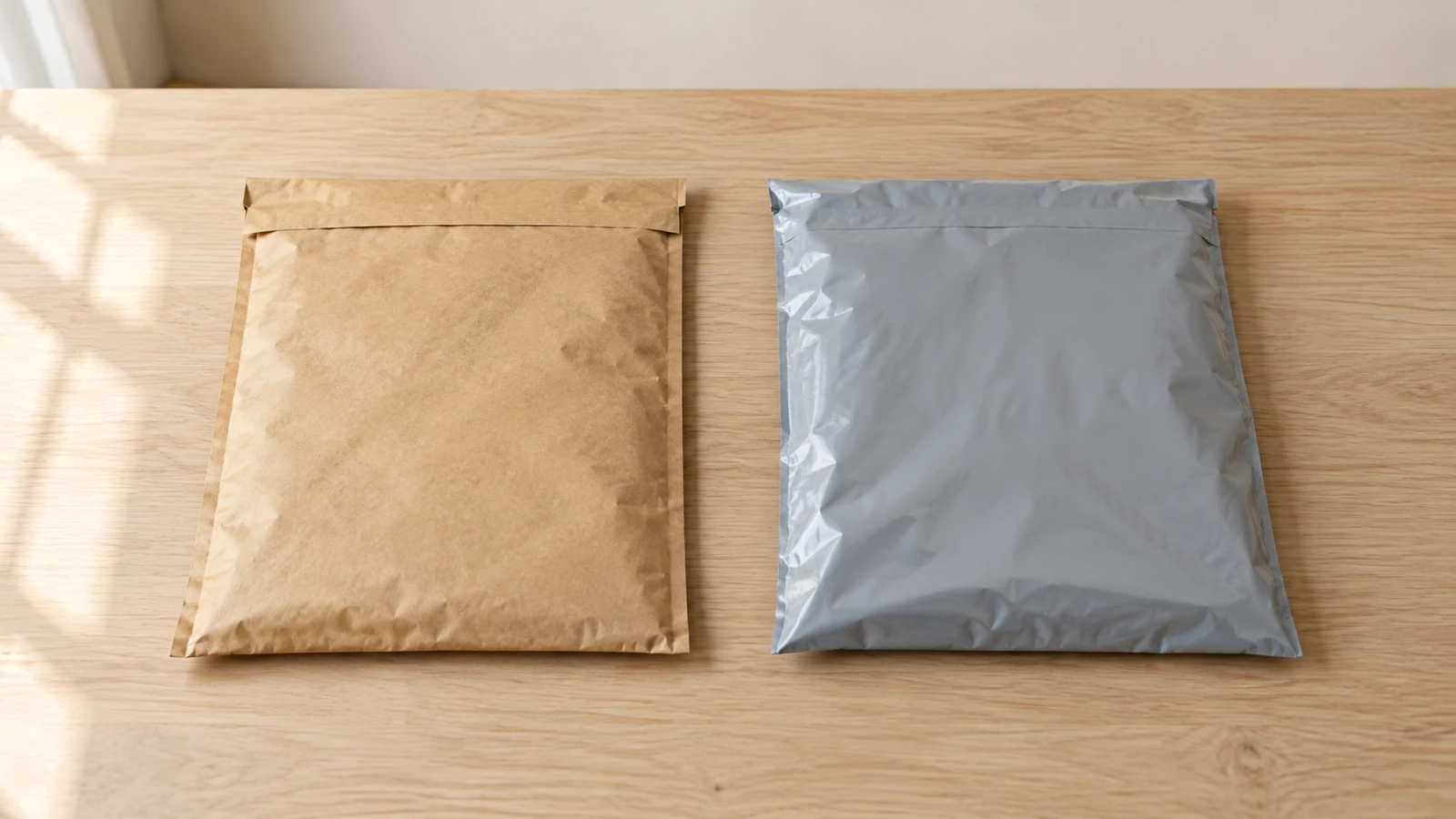
Paper Mailers vs Poly Mailers
How paper and poly mailers compare on construction, protection, weight and size billing, US recycling routes and cost drivers, based on public documents rather than our own tests.
Topic
Paper bags, cartons, corrugated boxes and mailers, and how they compare.
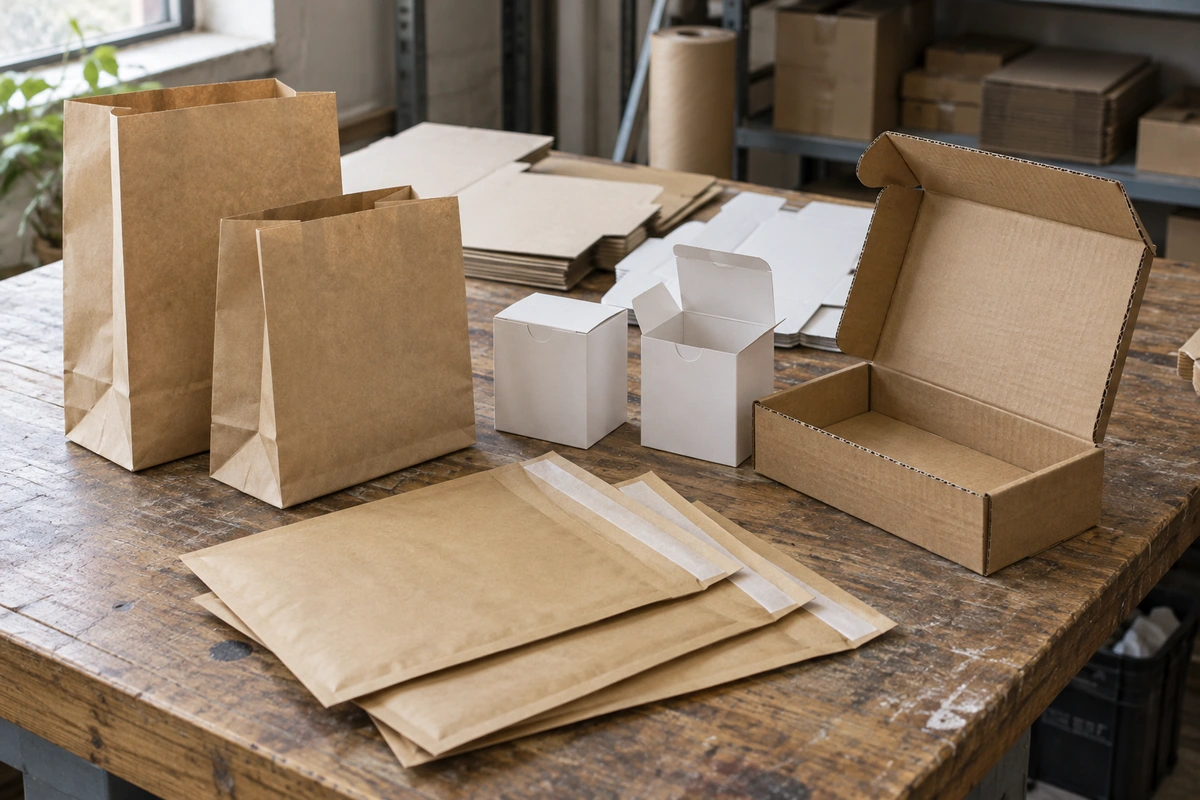
Ordering “cardboard” when a job needs folding-carton board, or a box when a mailer would do, gets the strength, print surface and converting route wrong. Start with the product family (paper bags and sacks, folding cartons, corrugated boxes, or mailers), then choose the material, coating and construction within it.
This section covers paper-based packaging for buyers, brand teams and operations staff: what each family is made of, how it is converted, and where it stops working. It does not sell packaging or make blanket environmental claims; articles state the conditions behind each comparison and cite sources readers can check. The first detailed comparison is paper mailers vs poly mailers.
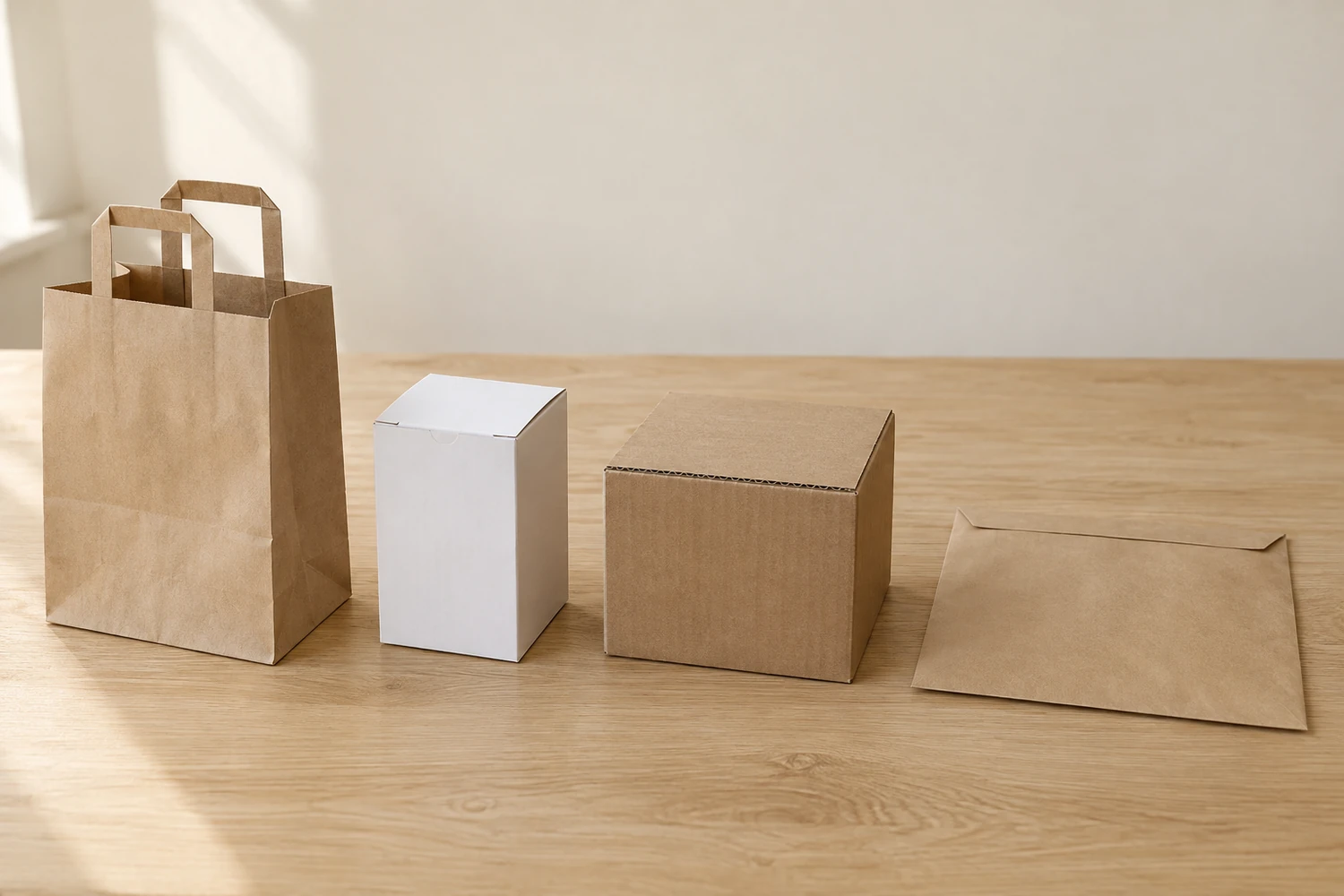
This section concentrates on four product families, each with its own material and converting route. They are not the whole field: AF&PA also lists foodservice formats such as paper cups, and PPC describes rigid set-up boxes. Wrapping paper and void fill are treated here as supporting materials.
| Family | Structure and material | Main job | Converting steps (simplified) | Limitation |
|---|---|---|---|---|
| Paper bags and multiwall sacks | Kraft paper; sacks use several paper layers and may add protective barriers (AF&PA) | Carry retail and food purchases; hold bulk goods (AF&PA) | Flat-handle carrier bags: make and attach handles, glue the web into a tube, cut to length, fold and glue the bottom (Robatech). Sacks: separate tuber and bottomer machines (W&H) | Handle and bottom construction vary by bag type |
| Folding cartons | Paperboard (boxboard); PPC cites 10 to 36 point board in virgin or recycled grades | Retail presentation, lighter products (AF&PA) | Prepress, print, embellishment, die-cut and crease, fold and glue (BOBST, 2026) | Shipped flat and assembled before filling; PPC calls them less strong than rigid boxes |
| Corrugated boxes | Containerboard: flat linerboard plus a fluted medium (FBA) | Shipping, heavier items, displays (AF&PA) | Medium fluted and glued between liners into combined board, then converted into boxes (FBA) | Performance depends on the specific board design, not the family name |
| Paper mailers | Kraft paper: plain, padded, honeycomb or with a plastic bubble lining; rigid fiberboard versions (AF&PA; Sealed Air, 2019; Ranpak, 2024) | Direct shipping of flat, low-profile items (Sealed Air, 2019) | Varies by construction | A paper face can hide a plastic lining |
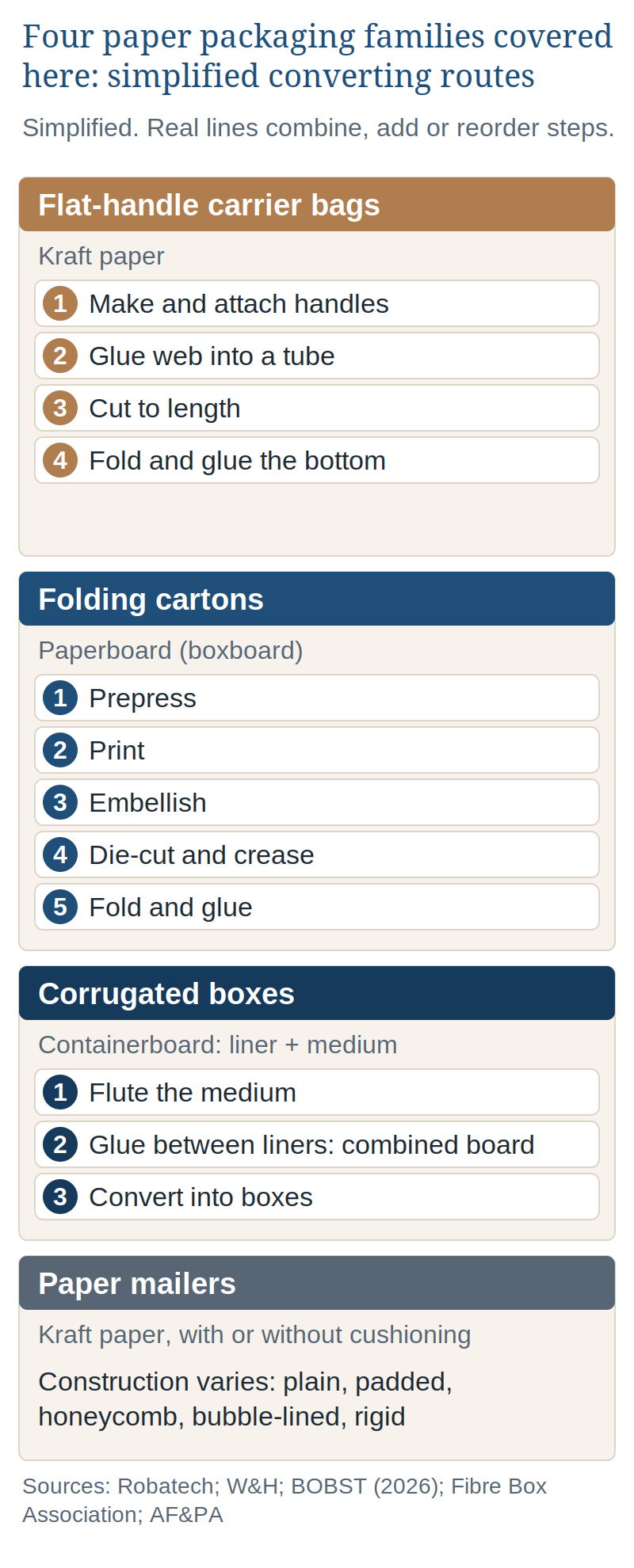
On a flat-handle carrier bag line, as described by adhesive supplier Robatech, a glued and folded paper strip becomes the handle, the handles are fixed to the kraft web, the web is glued lengthwise into a closed tube, cut, and the bottom is folded and glued shut. Multiwall sacks (several paper layers, sometimes with barriers) hold bulk goods such as pet food, cement and flour; machinery maker Windmöller & Hölscher (W&H) lists separate tuber and bottomer machines for paper sacks.
The Paperboard Packaging Council (PPC) describes folding cartons as paperboard packs that fold flat for storage and shipping, made from 10 to 36 point board in a range of virgin and recycled grades (it lists SUS, SBS, CUK, CRB and FBB). They can include a small “mini flute” (E, F, G or N) for extra protection. Rigid (set-up) boxes use 36 to 120 point board with a printed paper wrap and usually stay erect. In BOBST’s description of a conventional workflow, prepress is followed by printing, embellishment, die-cutting and creasing, then folding and gluing; inline printing and die-cutting can merge steps. A folder-gluer typically runs feeding, pre-breaking, folding, gluing, transfer and delivery.
The Fibre Box Association (FBA) describes corrugated (combined) board as a flat liner and a medium, both containerboard; the medium is formed into flutes on the single facer and glued between the liners. The basic constructions are single face, single wall, double wall and triple wall. This is what everyday speech calls “cardboard”; AF&PA notes the industry says containerboard or corrugated.
AF&PA describes paper-padded mailers with two paper layers and a cellulose-based cushioning designed to be filtered out in repulping. Other constructions use different cushioning: Sealed Air’s 2019 brochure lists kraft-faced mailers made with plastic bubble cushioning, and Ranpak’s 2024 overview describes an all-paper honeycomb cushion. Construction, protection, carrier billing and recycling routes are compared in paper mailers vs poly mailers. Envelope formats for flat items, including types of mailing envelopes, sit in the envelopes section.
Takeaway: Name the family first; it fixes the material grade and the converting route you will be quoting against.
Within a family, three decisions remain: substrate (kraft paper, paperboard or containerboard), structure (wall count, flute, padding, carton style) and any coating, adhesive or window.
BOBST notes that paperboard is hygroscopic: fiber direction, temperature and humidity all change how sheets behave in printing, die-cutting and folding, and damp conditions can warp or wrinkle them.
Common mistake: Choosing board by weight or thickness alone. Grade, fiber direction, structure and storage humidity change how the same caliper performs.
Non-fiber elements also matter at end of life. AF&PA’s design guidance for recyclability (version 1.1, last updated March 2021), based on a survey of member mills in the US and Canada, says barrier coatings or adhesives “may create challenges” for mills, and states that the guidance is not mandatory. How2Recycle’s August 2026 guidelines report that, because of California’s SB 343, some fiber packages with coatings, food residue, multilayer constructions or large attached parts (examples include paper bags with flood-coat adhesives and mailers with adhered cushions) now get a “Check Locally” label instead of “Widely Recyclable”. Clay-coated paper with standard printing and none of the listed attributes may still qualify as widely recyclable.
The FTC’s Green Guides summary treats recyclable, recycled content, renewable and degradable as separate claims. An unqualified degradable claim requires the whole package to break down within about a year after customary disposal, which items sent to landfill or recycling will not do.
Takeaway: Specify substrate, structure and coating separately, and make each environmental claim about the specific package.
The food and carton-thickness questions come from US search results and a packaging forum; the carton question is shortened from a longer post. The kraft and packaging-level questions are our rewording of the related searches “Kraft Paper” and “Types of food packaging: primary, secondary, and tertiary”.
Paper formats for food include paperboard boxes for cereal and pasta, corrugated pizza boxes, take-out bags and multiwall sacks for flour and grain (AF&PA). PPC notes aseptic and direct food contact uses for folding cartons; confirm a specific board and coating in the supplier’s documentation.
Primary packaging touches and holds the product, such as a pouch or jar. Secondary packaging groups primary packs, for example cartons, trays or shrink-wrapped bundles. Tertiary packaging (pallets, stretch wrap, strapping, corner boards) unitizes loads for transport (Packaging Digest, December 2025).
AF&PA’s design guidance notes that the name comes from the German word for “strong”, and presents kraft paper bags as a popular choice for their strength and range of sizes and shapes. In this section kraft paper is the substrate for bags, multiwall sacks and most paper mailers. For kraft paper bags, the same guidance lists hot-melt adhesives, polymer barriers and wet-strength resins among the elements mills rated as recycling challenges.
No general formula appears in the sources reviewed here. PPC gives 10 to 36 point as the folding carton range; within it, product weight, carton style, board grade and storage humidity decide the result, so confirm with converter samples and your own load checks.
Takeaway: Match the question to the family, then confirm grade, coating and food contact with the converter.
Takeaway: For regulated, load-bearing or non-US uses, start from the supplier’s documentation and the applicable rules.
Takeaway: Use the industry term (containerboard, paperboard, kraft) when asking for quotes; “cardboard” is ambiguous.
Read on 10 October 2026; supplier documents are cited for what they describe, not as guarantees.
Takeaway: Each source is dated where it carries a date; check for newer editions before relying on a detail.
How paper and poly mailers compare on construction, protection, weight and size billing, US recycling routes and cost drivers, based on public documents rather than our own tests.