Pressure-Sensitive vs Wet-Glue Labels
How pressure-sensitive and wet-glue (cold glue) labels differ in materials, machinery, changeover, cold and wet performance and recycling, and how to choose.
Topic
Materials, adhesives, printing, application and inspection of packaging labels.
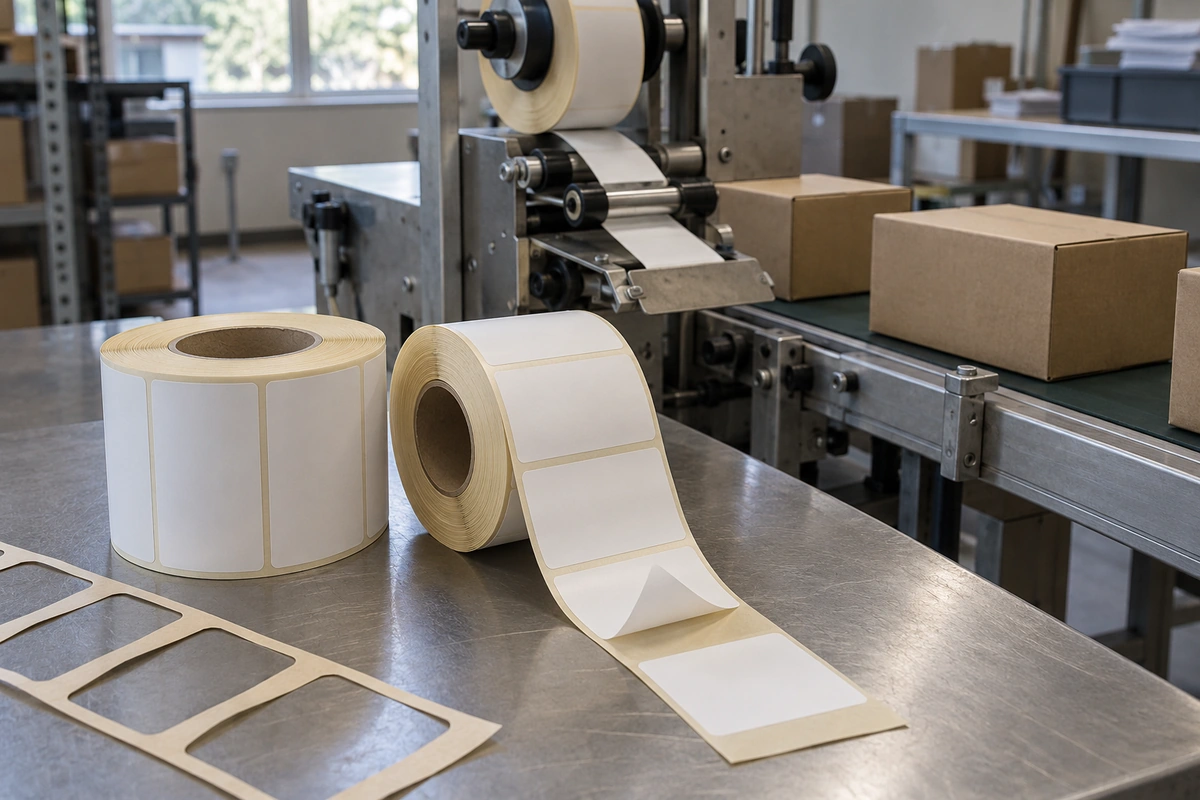
Choosing a label before you know how it will be attached can leave you with a design the line cannot apply, or a container the recycler cannot clean. Labels reach packages in several distinct ways, including pressure-sensitive labels, wet glue, hot-melt roll-fed labels, shrink and stretch sleeves and in-mould labelling, and the method largely decides the materials, the machinery and what the label has to withstand.
This section explains those application methods, the face materials and adhesives used with them, how labels are printed and checked on the line, and what happens to liners and labels after use. It is written for packaging engineers, buyers and label printers who want to compare options before talking to suppliers. The subject has a link to this site’s name: in April 2001 Packaging World named Mail-Well Label as the supplier of labels and a tamper-evident neck band for a line of refrigerated salad dressings, and that period is covered in our Mail-Well, Inc. history. Mail-Well.com is an independent site and is not connected with that company or its successors.
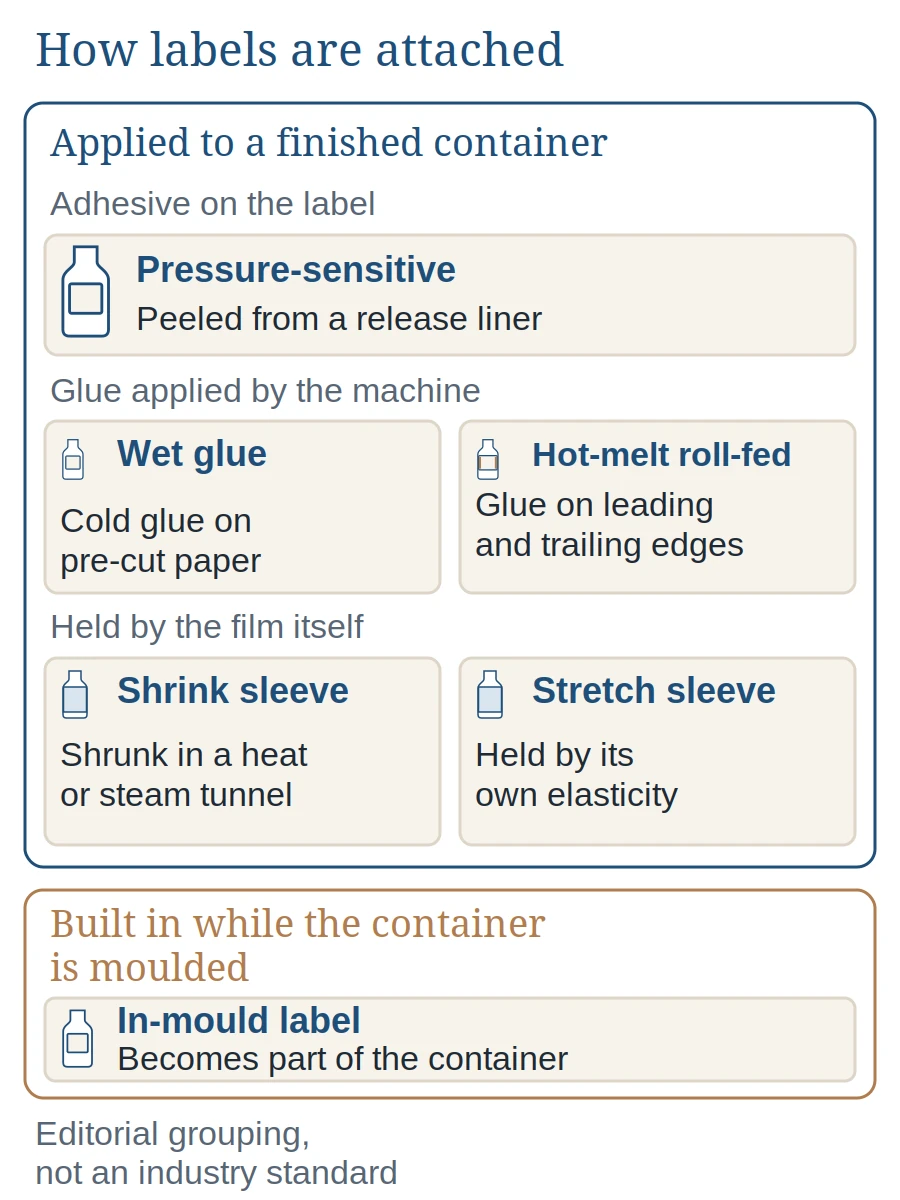
The grouping below follows how the label is held on. It is an editorial grouping, not an industry standard.
| Method | How it arrives and is applied | What holds it on | Check before choosing |
|---|---|---|---|
| Pressure-sensitive | Labels on a release liner, on a roll; peeled off at a dispensing beak | Adhesive already on the label | Liner disposal; adhesive suited to the surface, temperature and moisture |
| Wet glue (cold glue) | Pre-cut paper labels in a magazine; glue pallets and a gripper cylinder transfer them | Cold glue applied by the machine | Glue-pallet sets per label shape; cleaning of glue parts |
| Hot-melt roll-fed | Film on a reel, cut to length; the container rotates to wrap it | Hot-melt glue on the leading and trailing edges | Wrap-around format; reel-fed film handling |
| Shrink sleeve | A film tube placed over the container | The film shrinks to fit in a heat or steam tunnel | A heat or steam step on the line |
| Stretch sleeve | An elastic film tube, expanded, placed and released | Its own elasticity; no heat or adhesive | Cylindrical or slightly contoured containers |
| In-mould label | Placed inside the mould before the container is formed and filled | It becomes part of the moulded part | Label resin matched to the part; moulding process |
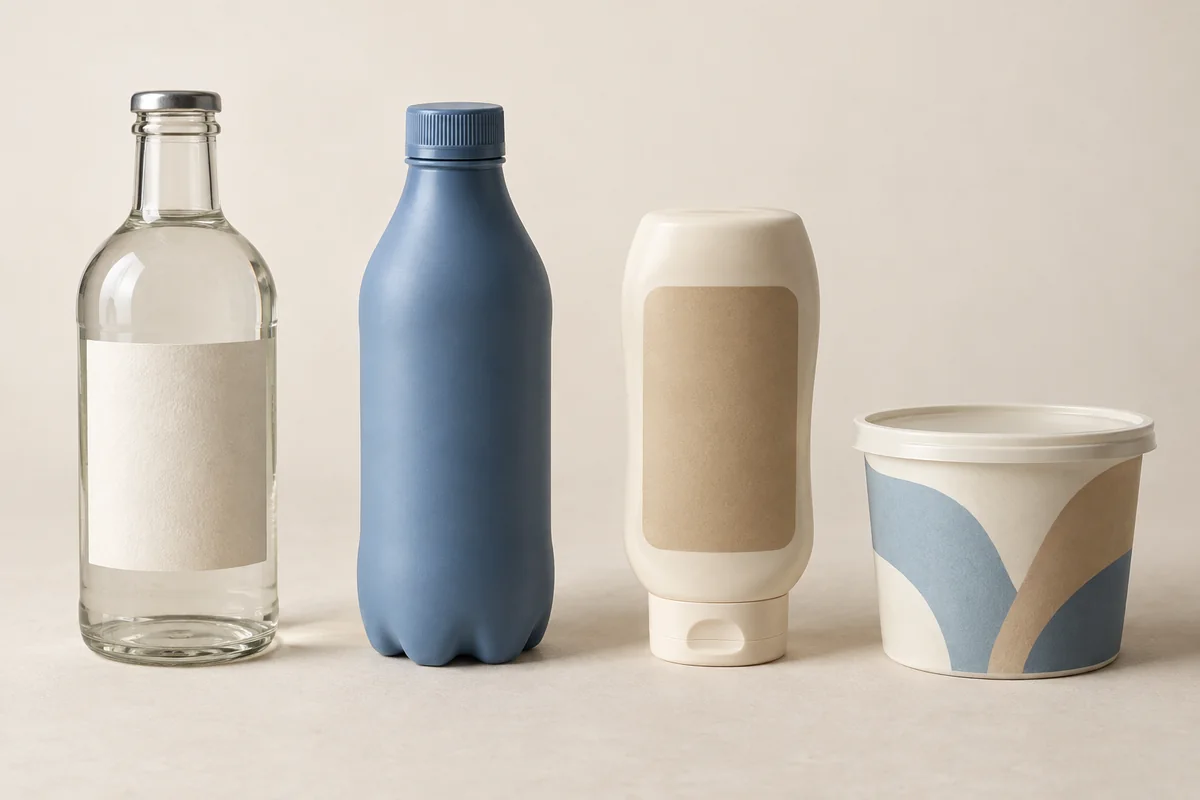
The method also decides what the line must manage: spent liner, glue parts to clean, or a heat or steam tunnel. In-mould labels exist only where the container is moulded with the label in place.
Takeaway: Settle the application method first, because it narrows the materials and equipment that can be used.
For paper labels on bottles and jars, the choice is often between pressure-sensitive stock and pre-cut paper with cold glue. The difference is where the adhesive comes from, which changes the change parts, cleaning and waste a line has to plan for.
Our comparison of pressure-sensitive and wet-glue labels sets the two side by side, separates in-use water resistance from labelling wet containers and from washing off, lists cost factors and ends with a five-step decision path.
Takeaway: If your line already has one of these two systems, start with the comparison before changing label stock.
It depends on which way you sort them. Lists that put “die-cut”, “thermal” and “pressure-sensitive” side by side mix three separate questions: how the label is shaped (die-cutting), how it is printed (thermal printing, for example) and how it is attached (pressure-sensitive adhesive). Sort first by how the label is attached, as in the table above, then by face material, then by what the label has to communicate.
Common mistake: Comparing a printing method with an attachment method as if they were alternatives. A thermally printed label can still be pressure-sensitive.
There is no fixed number. Some lists count label functions, such as brand, information or grade labels; others count materials or application methods. This section counts six application methods because each needs different equipment and checks.
For pressure-sensitive labels, the main choice is between paper and film faces, and among films the resin matters. UPM describes PE film labels as flexing with squeezable containers, PP film for rigid containers and high-clarity use, and PET film where chemical, heat or abrasion resistance comes first. Clear films on clear containers give the “no-label look”. The adhesive and any print coating are separate choices, so a suitable face material does not guarantee a suitable label.
The In-Mold Decorating Association describes three steps: the label is produced, an automated system places it inside the mould, and resin is injected to form the part; when the part is removed and cooled, the label is part of the product and no post-mould labelling is needed. The label is made of the same or a similar resin to the container and uses no release liner or adhesive. Whether such a pack is recycled still depends on local collection and sorting.
Shrink and stretch sleeves are both tubes of film placed over the container, but they are held on in different ways. According to CCL Label, a shrink sleeve is conformed to the container in a heat or steam tunnel, while a stretch sleeve is mechanically expanded, placed over the container and held by its own elasticity, without heat or adhesive. CCL describes stretch sleeves as suited to cylindrical or slightly contoured containers, so check container shape first.
Spent liner from pressure-sensitive labelling needs its own route. TLMI’s update on its US Liner Recycling Initiative, dated 20 February 2025, describes a pilot programme with a paper mill company that will take white, silicone-coated paper liner, planned to cover the areas around two mills; liner on cores may need grinding and baling, and generators may need a broker or aggregator. Check which areas are accepted now. In Europe, FINAT’s CELAB initiative (October 2020 presentation) aims to enable recycling of both liner and matrix, seeking solutions for the label printer (matrix) and for the end user (liner).
Takeaway: Most label questions become easier once you separate attachment method, material and message.
Recording these before asking for samples keeps quotes and trials comparable.
Takeaway: A label specification is only complete when it covers the container, the conditions and the end of life, not just the artwork.
Takeaway: Use these terms to check that two quotes describe the same construction.
This section does not cover what a label must say (content rules depend on the product and market), tamper-evidence testing, choosing a variable-data printer, or hand labelling of small batches.
Takeaway: For content rules, check with the authority that regulates your product.
Accessed 10 October 2026 unless a publication date is given.
HERMA’s labelling-systems overview and linerless label page, and P.E. Labellers’ cold-glue station page, were also read; they are not linked because they are product sales pages.
Takeaway: Product statements above are the makers’ own descriptions, not our tests.
How pressure-sensitive and wet-glue (cold glue) labels differ in materials, machinery, changeover, cold and wet performance and recycling, and how to choose.