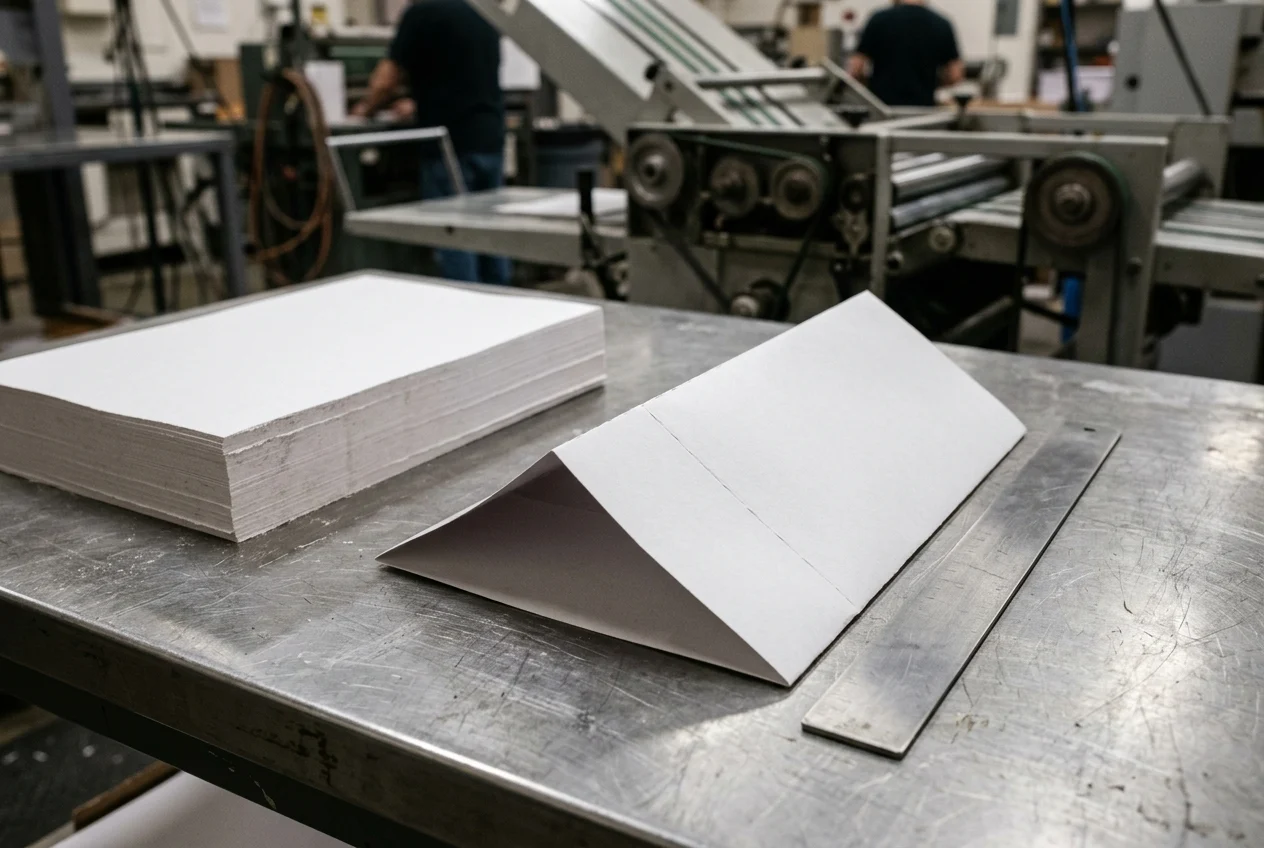
Direct Mail Production Workflow: Stage Handoffs & Sign-Offs
Stage-by-stage direct mail production workflow from address coding and press finishing to inserting and USPS entry, with a handoff sign-off record table.
Topic
Direct mail workflow, inserting, sealing, sorting and fulfillment packaging.
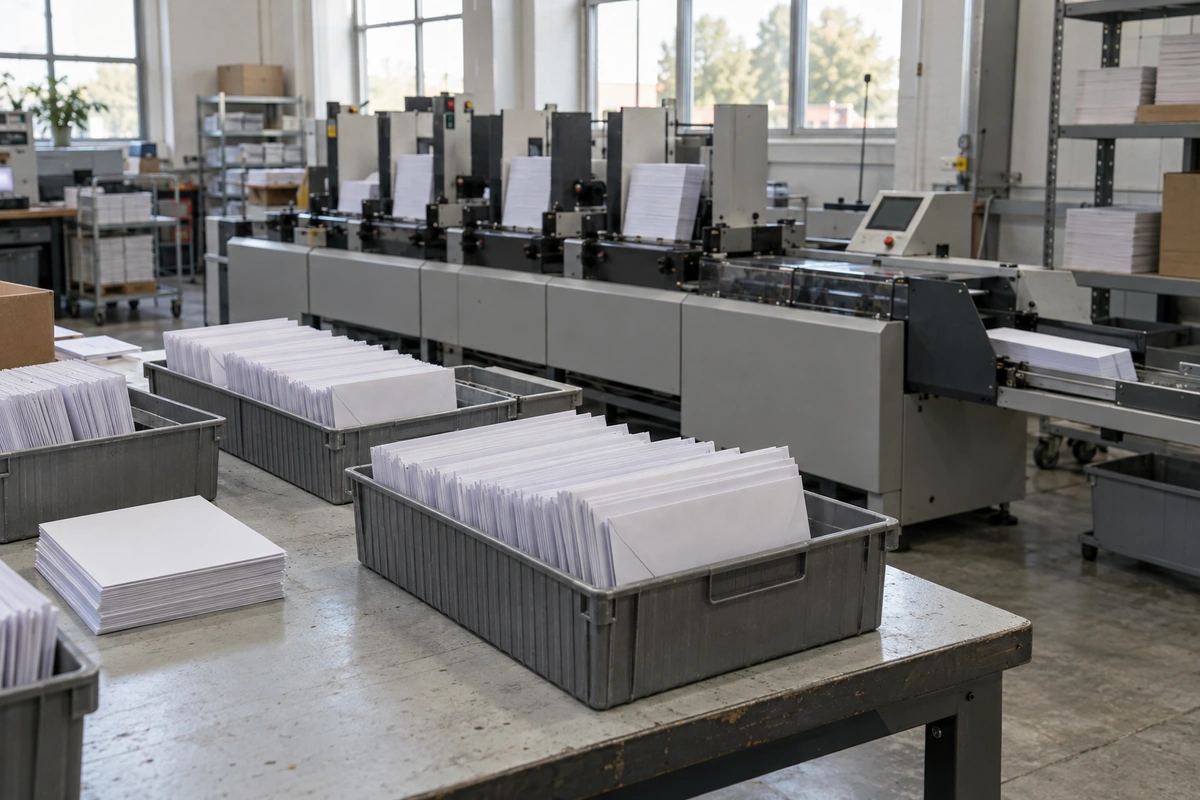
Approving an envelope, insert fold or address layout in isolation risks rejected mailings, wasted stock and jammed inserters. Check the handoffs across address coding, printing, folding, inserting and postal sorting before releasing a direct mail or fulfillment job.
This section maps those handoffs for print buyers, direct-mail coordinators and fulfillment operations staff, and for suppliers who furnish the envelopes, inserts, labels and mailers that run across those lines. It is an independent educational reference: it does not sell mailing services or equipment, does not offer legal advice on privacy or marketing rules, and does not quote postage rates, which change regularly. United States postal rules cited below come from the USPS Domestic Mail Manual (DMM), read on October 17, 2026.
| Handoff to check | What to record before releasing the job | Why it matters downstream |
|---|---|---|
| Address file to presort | Move Update method and date, CASS coding status, and presort software output [1, 4] | Determines whether the list meets USPS automation and presort documentation requirements |
| Print file to finishing | Approved proof type, variable-data fields, cut size, score lines and fold panels [5] | Sets the folded thickness and places the recipient address inside the clear zone or window |
| Folded inserts to envelope | Outer envelope seam style, throat clearance, window position and seal-flap adhesive [6, 7] | Controls whether an automatic inserter can feed, stuff and moisten-seal the piece |
| Sealed mailpiece to carrier | Finished length, height, thickness, weight, aspect ratio, facing direction and bundle or tray rules [2, 3, 4] | Separates machinable letters from flats, parcels and nonmachinable pieces |
| Order item to fulfillment pack | Item profile, cushioning need, closure method and shipping label format [11] | Decides whether the job runs on an envelope inserter or moves to a paper, padded or rigid mailer |
The table below organizes the operational stages described in postal standards and manufacturer documentation. Treat it as a map of dependencies across a job rather than a fixed equipment layout.
| Stage | Incoming input | Operation performed | Output and handoff check |
|---|---|---|---|
| 1. List hygiene and presort [1, 4] | Raw recipient records and mailing class | Standardize addresses with CASS-certified software, meet the 95-day Move Update rule, and sort records with PAVE-validated or standardized presort software | Coded address sequence, Intelligent Mail barcode data, electronic postage statement and USPS Qualification Report |
| 2. Print and post-press finishing [5] | Approved artwork, variable data and paper stock | Preflight files, sign off soft or hard proofs, print by offset or digital press, then cut, score and fold inserts | Trimmed, folded sheets and reply pieces checked for panel dimensions and address orientation |
| 3. Folding, inserting and sealing [6, 7, 8, 9, 10] | Collated inserts and outer envelopes | Feed sheets and enclosures from hoppers, verify multi-page set integrity where configured, insert into the envelope throat and seal the flap | Sealed, addressed envelopes held within the target thickness and closure specification |
| 4. Bundling, traying and entry [4] | Sealed mailpieces in presort order | Face addresses in the same read direction, band bundles where required, load and label letter or flat trays or sacks, and present with documentation | Containerized mailing matched to the electronic postage statement and qualification report |
| 5. Lightweight fulfillment packing [11] | Low-profile merchandise, catalogs or kits | Place items into kraft, cushioned or rigid fiberboard mailers (or cartons), close the flap and apply the shipping label | Packed orders staged for parcel or flat dispatch outside letter-inserting equipment |
A change in one stage alters the constraints on the next. Changing paper weight or adding an extra buck slip can push a folded packet past a feeder nip setting or across the 1/4-inch thickness limit for a machinable letter [2]. For the upstream envelope converting route, see the envelopes overview.
In commercial US mailings, list preparation is a technical prerequisite rather than a housekeeping step. Under USPS DMM 602 (read October 17, 2026), commercial First-Class Mail presorted or automation prices and USPS Marketing Mail prices are subject to the Move Update standard: each address and associated addressee must be updated within 95 days before the mailing date using a USPS-approved method such as Address Change Service (ACS) or the National Change of Address Linkage System (NCOALink) [1]. Any mailing claimed at an automation price must also be produced from address lists matched and coded with current Coding Accuracy Support System (CASS)-certified software, which standardizes address elements and applies ZIP+4, delivery point and carrier route codes [1].
Presort software organizes the coded records into trays, sacks or bundles and generates supporting documentation. USPS evaluates presort software and hardware through the Presort Accuracy Validation and Evaluation (PAVE) program, but DMM 602 notes that PAVE certification of software does not by itself guarantee acceptance of customer mail prepared with it [1]. The physical pieces must still match the address placement, barcode and preparation rules for the price claimed.
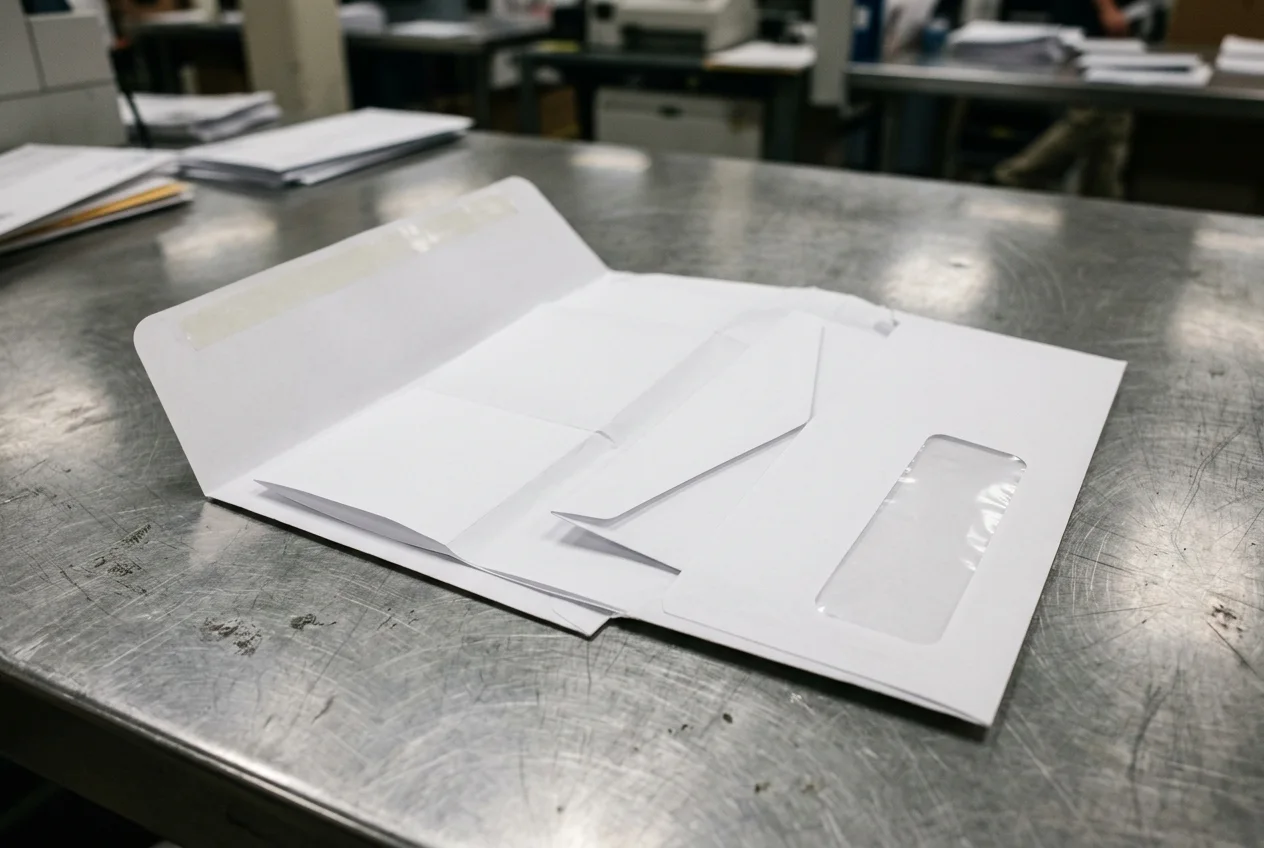
On the printing side, Mailing.com’s overview of direct mail printing separates preflight, proof sign-off, press production and post-press finishing [5]:
Takeaway: Lock the address layout, barcode placement and folded insert dimensions before releasing plates or variable-data print files.
Automated folder-inserters and production inserting systems pull printed documents and enclosures from separate feeder stations, fold or collate them into a set, open the outer envelope throat, insert the packet and seal the flap [8, 9]. Pitney Bowes and BlueCrest group their inserting lines around compact office or mid-volume folder-inserters and multi-format production inserters, including card-attaching modules [8, 9]. In high-volume or regulated mailings—such as financial, healthcare or insurance statements—operations combine vacuum or gripper feeding with optical mark or camera-based integrity verification so multi-page variable sets stay matched to the intended recipient [10].
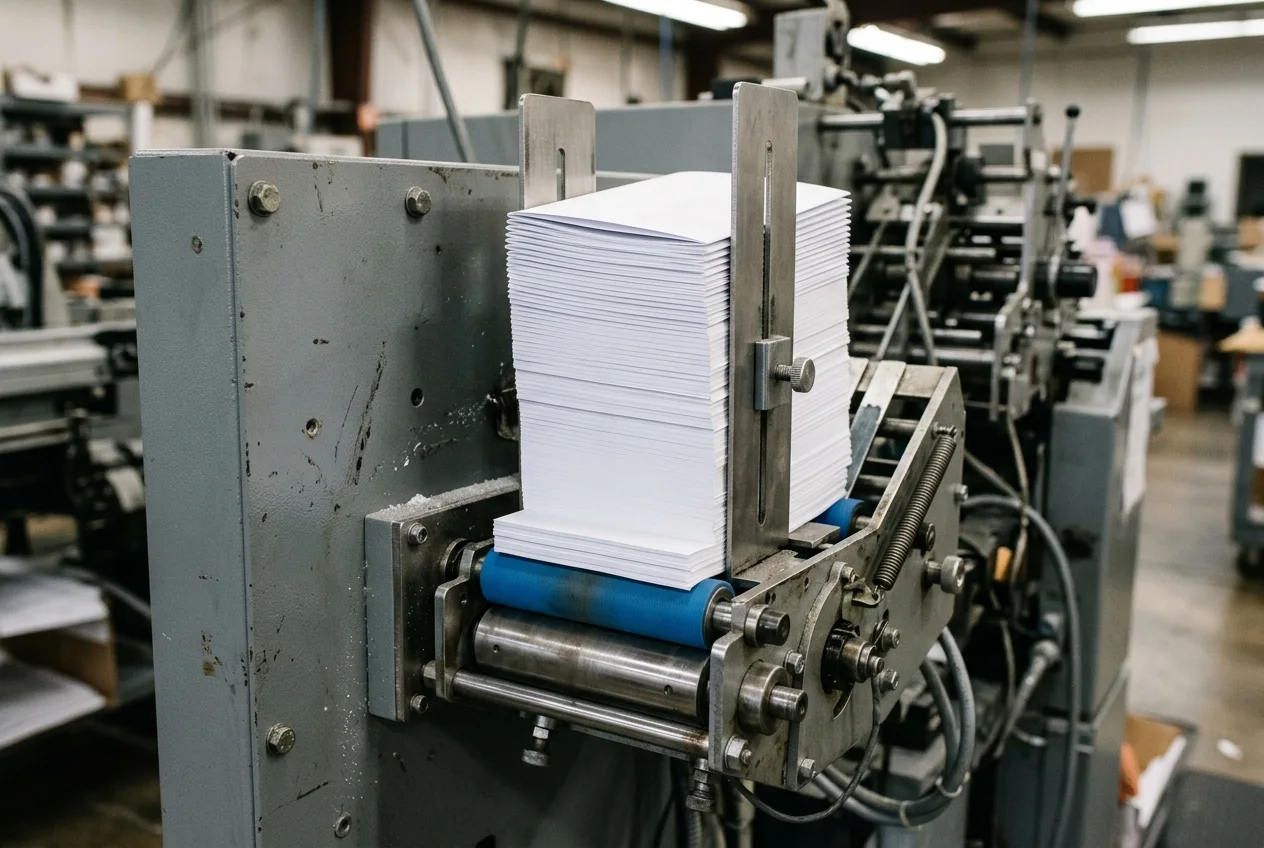
Whether an envelope runs cleanly through an inserter depends on its seam construction and closure adhesive:
Takeaway: Supply actual paper, insert and outer-envelope samples to the mailing operation before ordering bulk stock for an automated inserting run.
Finished mailpieces must satisfy both the physical standards for their processing category and the preparation rules for bundles, trays or containers. Under USPS DMM 201 and DMM 202 (read October 17, 2026), a commercial machinable letter must be rectangular, measure 5 to 11-1/2 inches long, 3-1/2 to 6-1/8 inches high, and 0.007 to 1/4 inch thick, and weigh no more than 3.5 ounces [2]. DMM 202 defines length as the dimension parallel to the delivery address as read, and height as perpendicular to the length; dividing length by height gives the aspect ratio, which must stay between 1.3 and 2.5 for machinable letters [2, 3]. Placing the address parallel to the short edge can drop the aspect ratio below 1.3 and render an otherwise standard envelope nonmachinable [3].
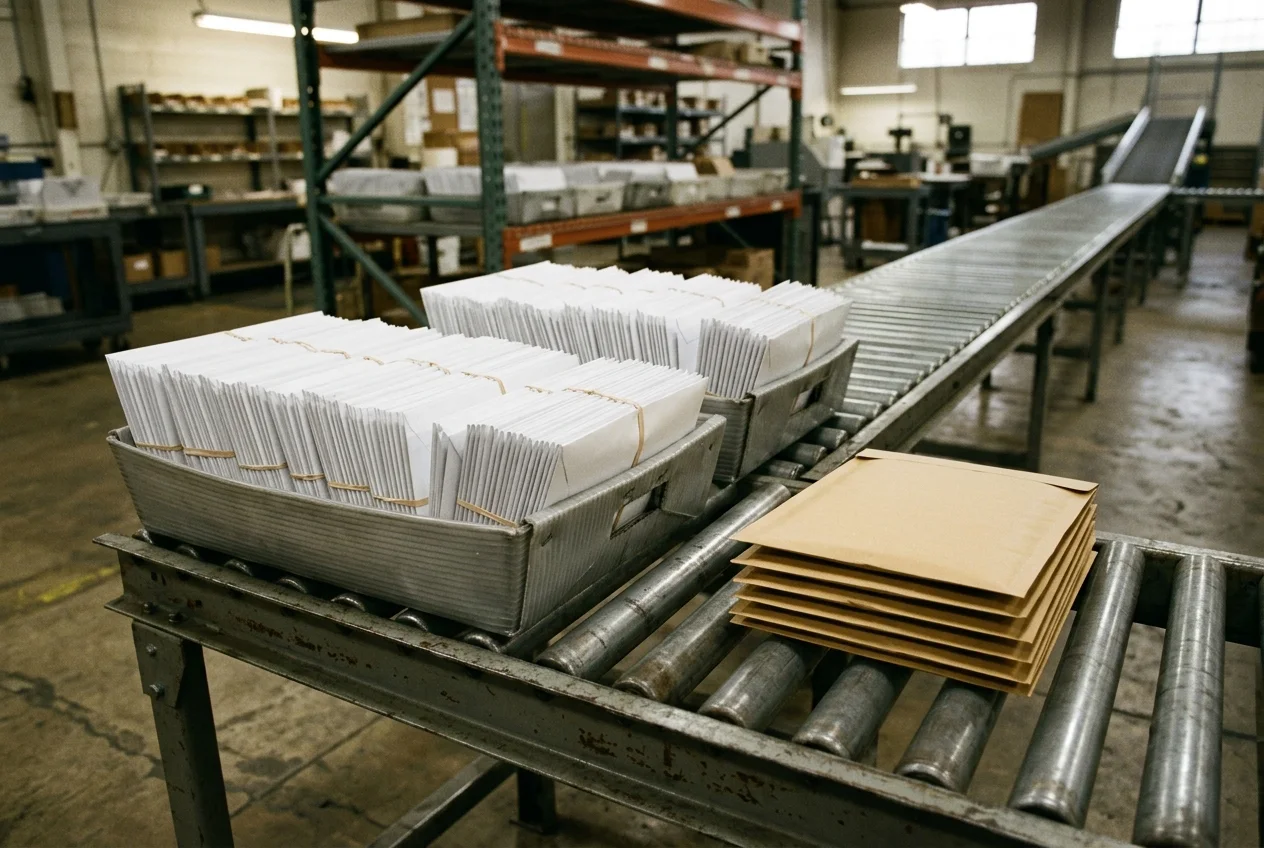
Under USPS DMM 203 (read October 17, 2026), commercial mailings claiming presort or automation prices must be accompanied by an completed electronic postage statement and standardized documentation—titled a USPS Qualification Report—showing piece counts by sortation level and destination ZIP Code [4]. When preparing bundles and trays, DMM 203 distinguishes between letter mail and flat mail:
When a shipment holds low-profile merchandise, thick literature or rigid items that exceed letter or flat machinability limits, operations shift from envelope inserters to fulfillment packaging. Sealed Air’s protective mailer catalog groups these formats into non-cushioned kraft or rigid fiberboard mailers and cushioned mailers lined with paper or cellular padding [11]. For how paper and plastic mailers compare in construction, cushioning and end-of-life handling, see paper mailers vs poly mailers. Where fulfillment lines apply pre-printed labels or print variable shipping labels inline onto mailers and cartons, see the label applicator vs print-and-apply comparison.
Takeaway: Check DMM physical limits, aspect ratio and container rules before printing, because an oversize or mis-oriented mailpiece changes both the equipment route and the postal category.
Copy these six items into a job ticket before releasing data, print files or envelope orders, or use the full stage-by-stage sign-off table in the direct mail production workflow guide. They are an editorial coordination checklist, not a carrier acceptance form.
USPS Qualification Report [1, 4].| Term | Meaning in mailing and fulfillment | Keep separate from |
|---|---|---|
| CASS (Coding Accuracy Support System) | USPS certification system for address-matching software that standardizes addresses and applies ZIP+4, delivery point and carrier route codes [1] | Move Update, which tracks recipient change-of-address records |
| Move Update | USPS standard requiring commercial presorted/automation First-Class Mail and USPS Marketing Mail addresses to be updated within 95 days before mailing via approved methods such as ACS or NCOALink [1] | Duplicate removal or marketing suppression lists |
| PAVE (Presort Accuracy Validation and Evaluation) | USPS program that tests presort software and hardware accuracy in sorting address files and producing documentation [1] | Final acceptance of a physical mailing at a postal entry unit |
| Closed-seam envelope | Envelope whose side flaps are folded in before the bottom flap is glued over them, preferred for mechanical inserting [6] | Open-side or exposed-seam constructions that can snag inserts |
| Remoistenable gum | Water-soluble seal-flap adhesive activated by moisture on an inserting machine or by hand [6, 7] | Latex self-seal or liner-backed peel-and-seal adhesives |
| Aspect ratio | Mailpiece length (parallel to the delivery address as read) divided by height; 1.3 to 2.5 for USPS machinable letters [2, 3] | Paper basis weight or caliper |
| Facing | Arranging mailpieces in a bundle or tray with all addresses oriented in the same read direction [4] | Presort grouping by destination ZIP Code |
| USPS Qualification Report | Standardized presort documentation listing piece counts by sortation level, bundle and tray or sack destination [4] | The electronic postage statement itself |
| Fulfillment mailer | A flat paper, padded, rigid fiberboard or film shipping pack used for low-profile goods or thick literature [11] | A letter-size mailing envelope designed for high-speed inserters |
All sources were accessed on October 17, 2026. Postal rules are quoted from current sections of the USPS Domestic Mail Manual; equipment and material examples come from manufacturer and trade publications and do not constitute machine testing or endorsements. See the Editorial Policy for how sources are reviewed.
Stage-by-stage direct mail production workflow from address coding and press finishing to inserting and USPS entry, with a handoff sign-off record table.