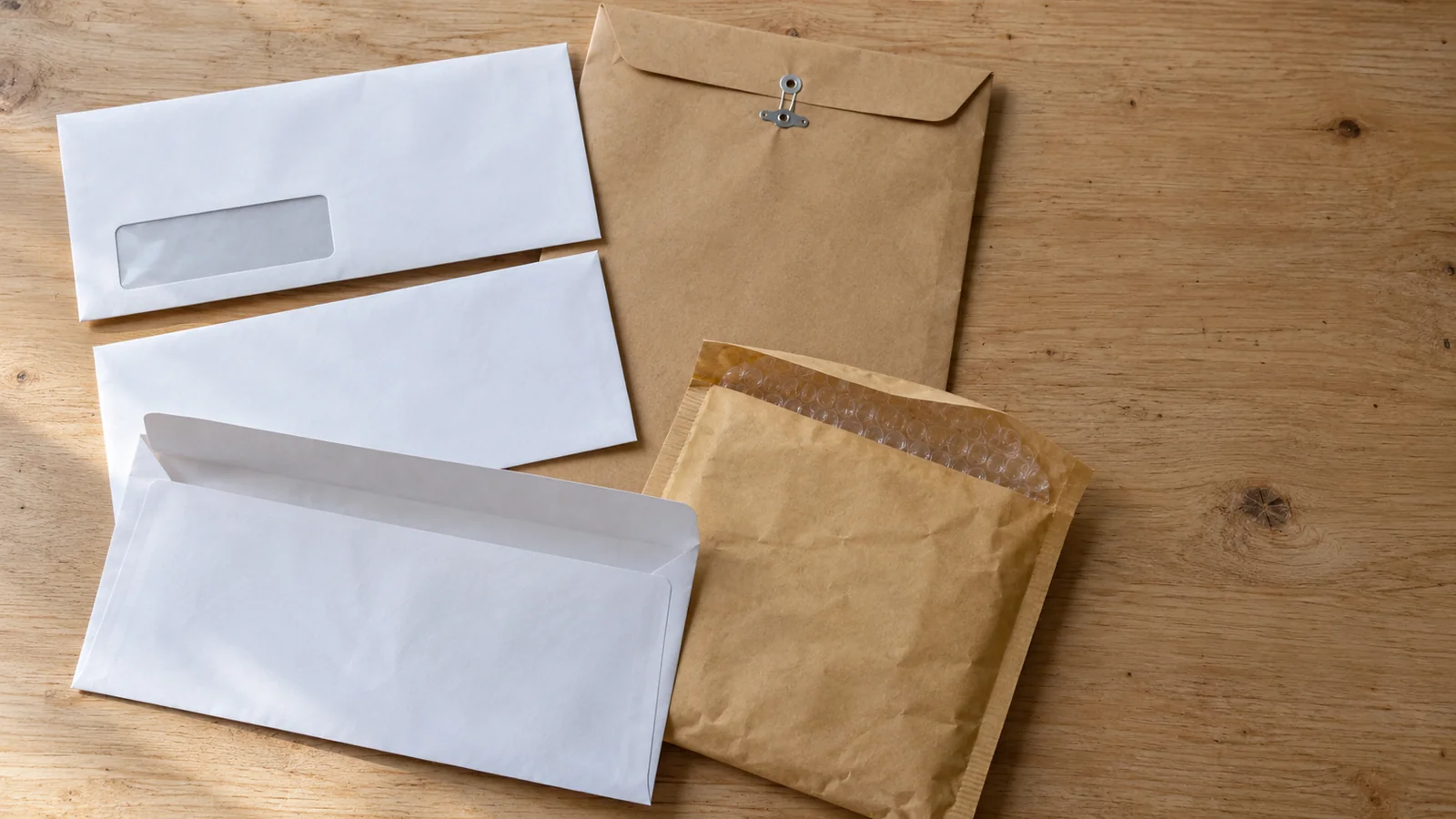
Types of Mailing Envelopes: Uses, Materials and Formats
Business, window, catalog, booklet, remittance and padded envelopes explained by opening, seam, closure and paper, with the U.S. letter and flat size limits.
Topic
Types, papers, sizes, windows, adhesives and the machines that make envelopes.
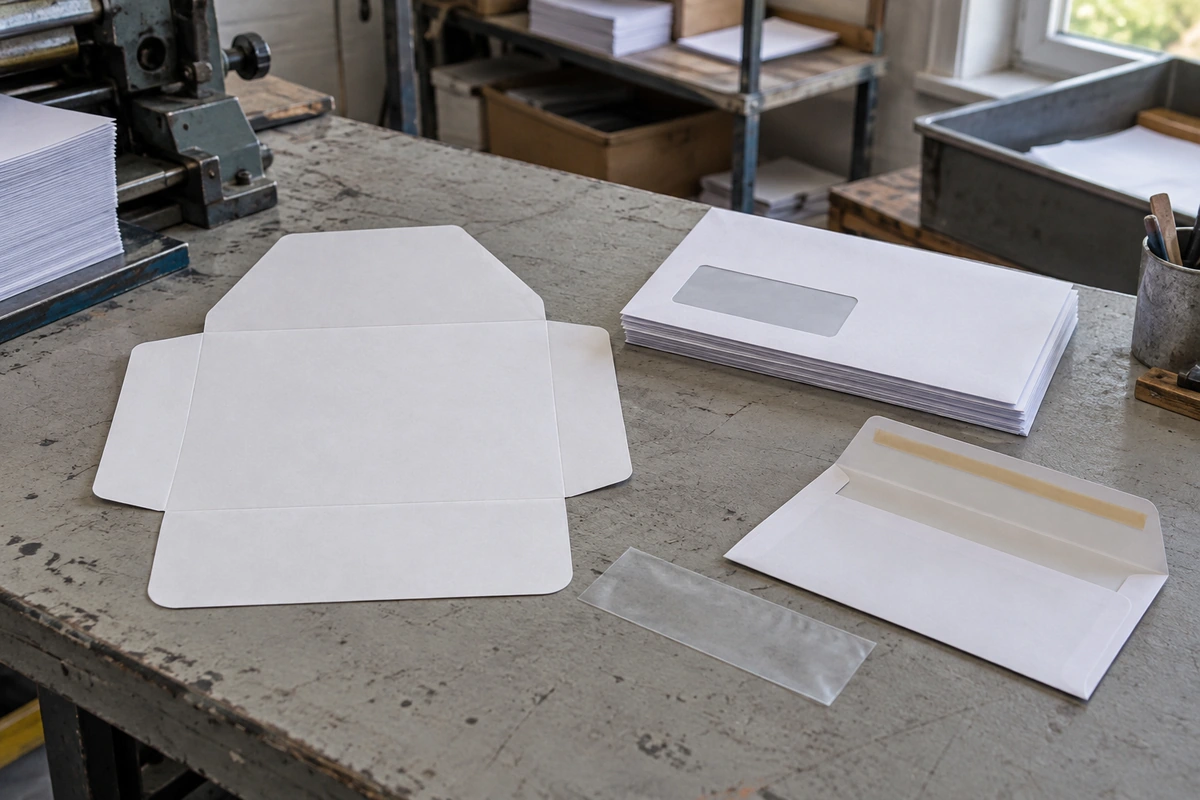
A badly specified envelope causes trouble late in a job: it cracks along a fold, jams the inserter, or shows the address in the wrong place. Envelope manufacturing turns paper into finished envelopes in a few repeatable steps (cutting a blank, adding any window, folding and gluing the seams, and applying seal gum to the flap), and the paper, window and adhesive chosen beforehand decide how the envelope will run and mail.
This section explains those steps and materials for people who buy envelopes, plan mailings or work in envelope converting. It does not list products for sale or give postage prices; postal rules are quoted from current USPS text with the date read.
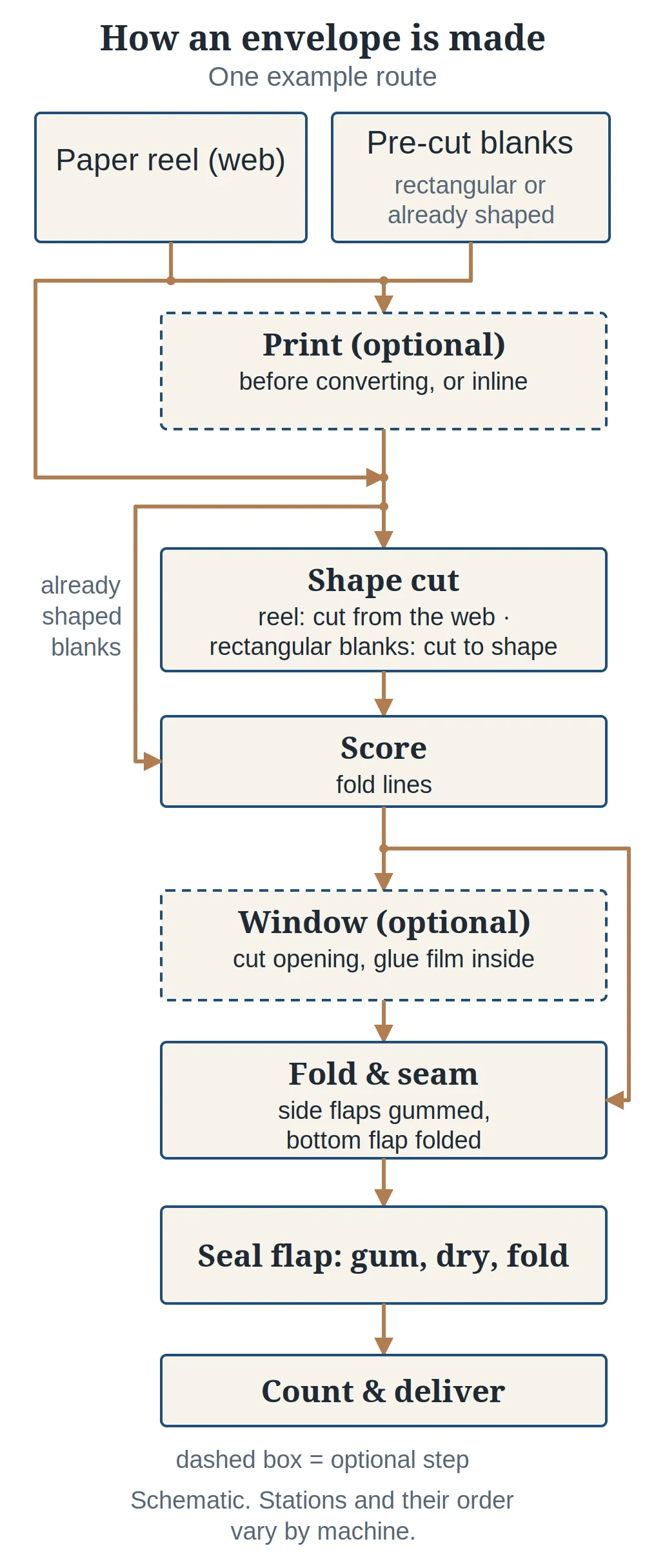
Envelope machines start either from a paper reel (the web) or from a stack of pre-cut blanks; a blank is paper die-cut to the flat shape of an envelope before folding. The Envelope Manufacturers Association (EMA) guide notes that diagonal-seam envelopes are usually cut as blanks on a die press and then folded and gummed, while side-seam envelopes are more often cut from a web by a die-cutting unit on the folding machine itself, with exceptions both ways. One machine family, the W+D 628, is offered in reel-fed, blank-fed and combined versions; its published layout gives an example of the stations:
Stations and their order vary by machine and options; envelopes without windows skip step 4.
Takeaway: When comparing suppliers or machines, ask which route (web or blank) and which optional stations a given envelope needs.
Common envelope papers include wove, a short-fiber paper with a smooth surface that prints well, and kraft, a paper with longer, stronger fibers that prints less well. Weight is quoted as basis weight. For bond, wove and kraft, that is the weight of 500 sheets of 17 × 22 in paper, so 24 lb works out to about 90 gsm. The EMA guide stresses grain direction: folding against the grain can crack and curl the paper, so it recommends running the grain the long way on open-end envelopes, the short way on open-side booklets, and diagonally on diagonal-seam envelopes. Treated and synthetic papers are less porous and may need special adhesives.
The window films the EMA guide names include cellophane, glassine, polystyrene, polypropylene, polyester, acetate, colored films and PLA. Whatever the film, it must be clear, tight and wrinkle-free so that it does not hide the address, and envelopes printed on high-heat printers after converting need heat-tolerant film.
An envelope carries up to three adhesives: back-seam adhesive holds it together, window-patch adhesive holds the film, and seal-flap adhesive closes it later. Moisture-activated seal gums are made from dextrin, resin or a blend of the two, applied as a thin film and dried. Latex self-seal uses two patterns that stick only to each other, and pressure-sensitive seals sit under a release strip. The same choice between a pre-applied adhesive and glue applied at the point of use appears in labeling; see pressure-sensitive vs wet-glue labels.
Most envelopes use closed-seam construction, with at least three folds and gum only on the overlapping edges, which is the construction inserter specifications emphasize. The EMA guide calls flaps the least standardized part of an envelope, shaped by the machine, the printer’s needs, the bulk of the mailing and the gum. How the opening and seams combine into named styles (business, catalog, booklet and others) is covered in Types of Mailing Envelopes.
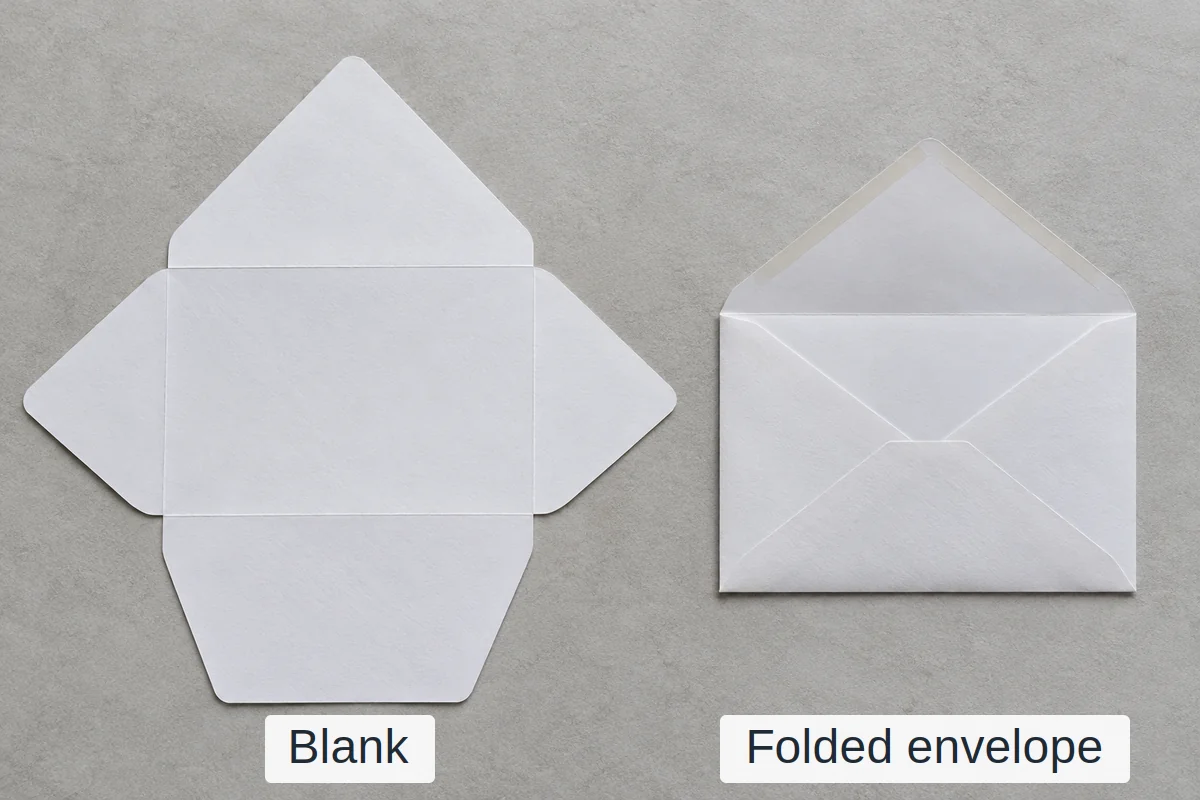
The EMA guide gives about ±1/16 in as normal machine variation, because machines heat up and parts wear. That is a rule of thumb, not a contract tolerance, so state a tolerance when exact dimensions matter. On receipt, check the finished size, the window position against the real insert, the gum lines (including excess gum around windows) and the print.
Common mistake: Approving a window envelope from a drawing alone. The window position has to be checked with the actual insert, because small shifts in the form or the window can hide part of the address.
Takeaway: Specify paper grade and grain, window film, closure and tolerance together; they affect one another on the machine.
Questions buyers ask when ordering envelopes, and what each one decides:
Takeaway: An envelope order is complete when it names style and size, paper, window, print colors, closure and how the envelopes will be filled.
| Term | Meaning |
|---|---|
| Blank | Die-cut paper in the flat shape of an envelope, before folding |
| Score | A prepared line that helps the paper fold cleanly |
| Throat | The opening at the top of the envelope, where the contents go in |
| Seal flap | The flap that folds over to close the envelope |
| Open end / open side | Opening on the short edge / on the long edge |
| Side, diagonal and center seam | Where the permanent back seams run: near the sides, diagonally across the back (corner to corner, in the EMA glossary), or down the middle |
| Window patch | The transparent film covering a window opening |
| Glassine | A transparent, highly hydrated paper used for windows |
| Remoistenable gum | Seal-flap gum reactivated with moisture |
| Latex self-seal | Two adhesive patterns that stick only to each other when pressed |
| Basis weight | Weight of 500 sheets at the grade’s basic size; 17 × 22 in for bond, wove and kraft |
| Converting | Turning reels or blanks into finished envelopes; separate from inserting, which fills them |
Takeaway: Use these terms in a specification so the converter and the mailing house read it the same way.
The history of Mail-Well, Inc. is covered separately in the Historical Archive.
Takeaway: For these cases, use a source written for that case.
All accessed 10 October 2026. The process route follows one published machine layout as an example, not a universal sequence. The EMA guide’s postal figures were not used; current postal limits are quoted from DMM 101. No envelopes or machines were tested. See the editorial policy for how sources are chosen and checked.
Takeaway: Recheck the dated postal limits before relying on them for a mailing.
Business, window, catalog, booklet, remittance and padded envelopes explained by opening, seam, closure and paper, with the U.S. letter and flat size limits.