Historical ArchiveHistorical reference
Mail-Well Inc.: Company History and Its Cenveo Transition
Mail-Well, Inc. was formed in 1994 from envelope businesses, grew into printing and labels, then refocused and announced its new name, Cenveo, on May 17, 2004.
Historical reference. This article describes a past period from published sources. It is independent and is not published by or affiliated with the former Mail-Well, Inc., Cenveo or their successors. See About.
Three things are easy to confuse when citing Mail-Well: the older envelope trademark, the company formed in 1994 and the Cenveo name of 2004. Mail-Well, Inc. was formed in February 1994 by merging Georgia-Pacific’s envelope business with a small envelope maker, Pavey Envelope and Tag Corp.; it grew by acquisition into envelopes, commercial printing and labels, narrowed its focus after 2001, and announced on May 17, 2004 that it would operate as Cenveo.
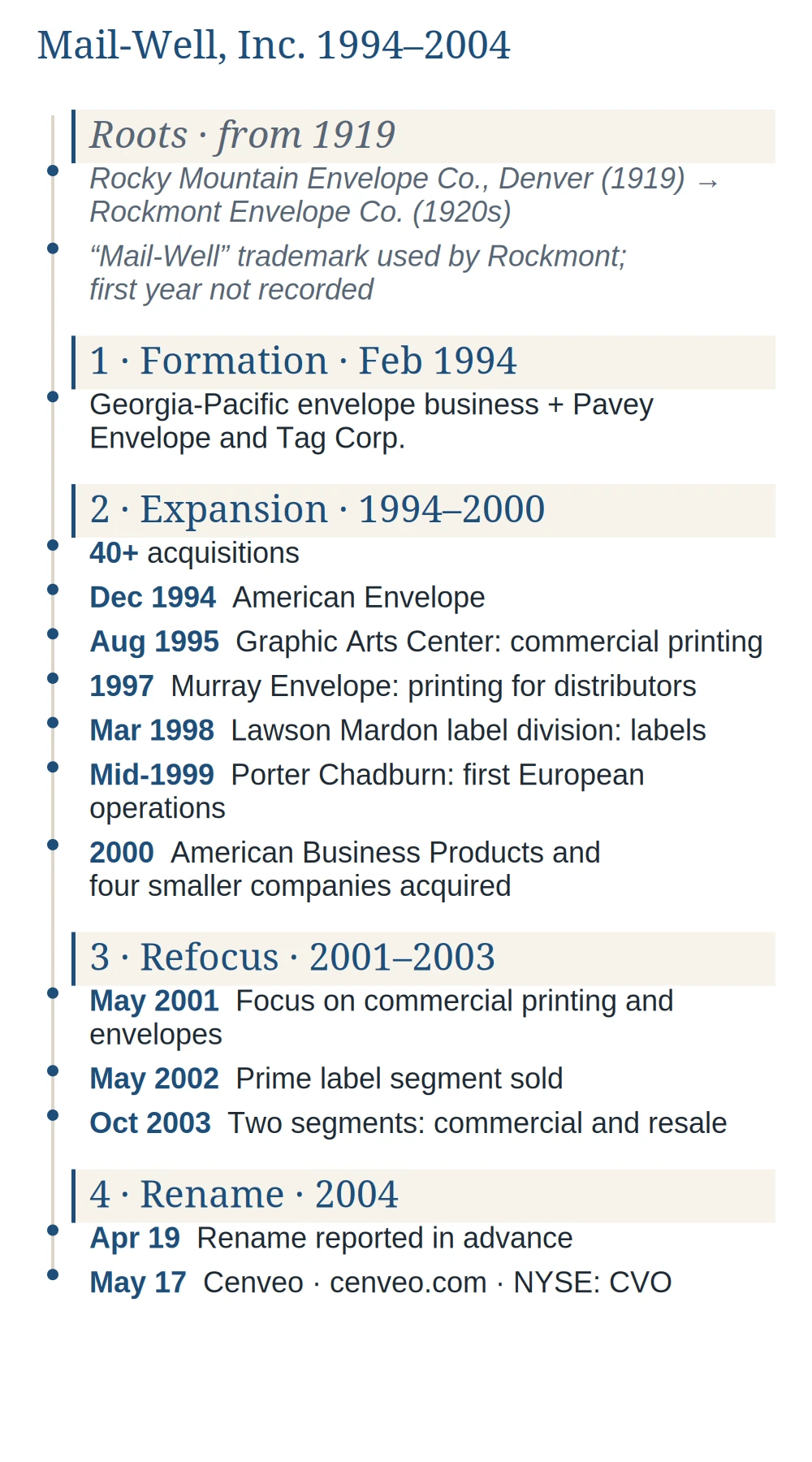
The history in five stages, each covered in its own section below:
| Stage | What happened | Source |
|---|---|---|
| Roots, from 1919 | Rocky Mountain Envelope Co. is founded in Denver, later renamed Rockmont Envelope Co.; Rockmont brands its envelopes “Mail-Well” (first year of use not given) | Company history entry |
| Formation, Feb 1994 | Mail-Well, Inc. is formed from Georgia-Pacific’s envelope business and Pavey | Company history entry; Form 10-K, FY1996 |
| Expansion, 1994–2000 | More than 40 acquisitions build four businesses: envelopes, commercial printing, printing for distributors and labels; American Business Products and four smaller companies follow in 2000 | Company history entry; Form 10-K, FY1998 and FY2001 |
| Refocus, 2001–2003 | Focus on commercial printing and envelopes; prime label segment sold in May 2002; two segments from October 2003 | Form 10-K, FY2001–FY2003 |
| Rename, May 17, 2004 | Cenveo name, cenveo.com and NYSE symbol CVO announced | Company release, published by WhatTheyThink May 18 |
Where did the Mail-Well name come from?
The name came before the company. According to the company history in the International Directory of Company Histories, the main predecessor began in 1919 as Rocky Mountain Envelope Co. in Denver, founded by Carl L. Tucker and Willett R. Lake. In the 1920s it was renamed Rockmont Envelope Co., and the entry says that “early on” Rockmont began branding its envelopes with the trademark “Mail-Well.” It gives no year for the first use of the trademark.
Rockmont later became a subsidiary of Pak-Well Paper Industries, which went public in 1963. The same entry calls the path from the early 1970s to 1994 “rather sketchy”: Pak-Well passed to Great Northern Nekoosa, which Georgia-Pacific acquired in 1990, and by the early 1990s the operation was strictly an envelope maker trading as Mail-Well Envelopes and Wisco Envelopes.
Takeaway: Treat “Mail-Well” as a Rockmont envelope trademark that predates the 1994 company, without assigning it a start year.
How was Mail-Well, Inc. formed in 1994?
Mail-Well, Inc. was created in February 1994, when the Sterling Group merged Georgia-Pacific’s envelope business with Pavey Envelope and Tag Corp. The company history says many paper companies were leaving envelopes in the early 1990s because postage increases, new technologies and changes in the customer base had eroded profits.
Gerald F. Mahoney had bought Pavey, a one-plant envelope maker, and joined partners to form the Houston-based Sterling Group. Georgia-Pacific agreed to sell its envelope business to Sterling for $155.1 million; Sterling also bought Pavey for $4.4 million and merged the two, with Mahoney as chairman and CEO. The new company started with 16 plants that had made about 13 billion envelopes in 1993, and Mahoney’s stated plan was to consolidate a fragmented industry of mostly regional envelope makers.
Mail-Well’s own filings agree. Its 10-K for 1996 says the company commenced operations in February 1994 with the acquisition of the envelope businesses of Georgia-Pacific and Pavey, and later filings list a Form S-1 registration statement dated March 25, 1994. Separately, a 2023 Printing Impressions retrospective with Paul Reilly, a later CEO, describes building Mail-Well from Pavey with Mahoney.
Common mistake: Giving 1919 as the founding year of Mail-Well, Inc. That year belongs to the predecessor envelope business; the company itself dates from 1994.
Takeaway: Mail-Well, Inc. was formed in February 1994 by merging two envelope businesses, with consolidation as its plan from the start.
Which acquisitions built the company between 1994 and 1999?
Acquisitions turned an envelope maker into a four-part printing group. The company history counts more than 40 acquisitions from February 1994 to early 1999, with revenue rising from $260 million to $1.5 billion in 1998. The deals below are the ones that entry singles out, and the deal values come from it alone. Mail-Well’s 10-K filings for 1996 and 1998 confirm the dates of the deals from December 1994 to May 1998; the 1998 filing counts 42 acquisitions since February 1994, at purchase prices from $2.5 million to $97.4 million.
| Date | Deal | What it added |
|---|---|---|
| Dec 1994 | American Envelope Company ($97.4 million) | Made Mail-Well the largest U.S. envelope maker |
| Jul 1995 | Supremex ($65.5 million) | Canada’s largest envelope maker |
| Aug 1995 | Graphic Arts Center ($82.6 million) | Entry into commercial printing (car brochures, annual reports) |
| Sep 1995 | NASDAQ initial public offering | Capital to reduce debt |
| Apr 1996 | Quality Park Products | Envelopes for the office products market |
| Nov–Dec 1996 | Pac National; Shepard Poorman | Canadian envelope share; calendars and instruction books. Stock moved to the NYSE (symbol MWL) in December 1996 |
| 1997 | Murray Envelope Corp. | Third business: printing for distributors |
| Jan–May 1998 | Poser Business Forms; label divisions of Lawson Mardon Packaging and International Paper; Anderson Lithograph | Fourth business: labels; more distributor and commercial printing |
| Mid-1999 | Porter Chadburn plc ($102 million) | London-based label maker; first European operations |
Acquisitions continued for one more year. According to the 10-K for 2001, the company acquired American Business Products, Inc. and four smaller companies in 2000, paying $331.1 million in cash plus $7.5 million of assumed debt for American Business Products. It sold that company’s extrusion coating and laminating operation in September 2000; the other four purchases were three commercial printers and an envelope company.
Takeaway: By 1999 Mail-Well had four businesses, each built largely through acquisitions, and it kept buying until 2000.
What did Mail-Well make, and for which markets?
Mail-Well made envelopes, commercial print, labels and business documents for distributors. The descriptions come from different years, so the table gives the date of each.
| Business | What the source describes | Date of description |
|---|---|---|
| Envelopes | Largest maker and printer of envelopes in North America, serving direct mail, corporate and retail office product markets; later, custom envelopes and packaging products such as Tyvek mailers used by the U.S. Postal Service | Late 1990s (company history); FY2001 (10-K) |
| Commercial printing | “High impact” color printing of premium, longer-run work for national and regional accounts, plus general commercial printing for local customers | FY2001 (10-K) |
| Labels | Glue-on paper labels and graphic services for food, beverage and household products | Late 1990s (company history) |
| Printing for distributors | Custom business documents, pressure-sensitive labels, envelopes and commercial printing for the U.S. distributor market | Late 1990s (company history) |
Envelopes remained central: in its 10-K for 2001 the company said it believed it was the world’s largest manufacturer of envelopes. For how mailer materials compare today, see the comparison of paper and poly mailers.
Two kinds of label appear here: glue-on paper labels for packaged goods, and pressure-sensitive labels sold through distributors. The comparison of pressure-sensitive and wet-glue labels explains how the two differ on a packaging line. One example of the label work is in Packaging World from April 30, 2001: it reported that Mail-Well Label supplied the front and back labels and a tamper-evident neck band for Marie’s Pourables, a Dean Foods line of refrigerated salad dressings in PET bottles.
Trade publications also reported two envelope ideas. On November 29, 2001, CreativePro described the Visulope, which Mail-Well created in response to public fears about biological terrorism through the mail. Its windows wrapped around the bottom of the envelope so that postal workers and recipients could see inside. On August 1, 2002, Chief Marketer described Rub n Reveal, a technology that showed previously hidden messages when the recipient activated it and could be applied to any envelope. The company said its research suggested such interactive devices could raise response rates; no figures were published. The historical reference page at /index1m.html compares the two ideas, and the guide to types of mailing envelopes covers window envelopes in general.
Takeaway: Treat each product description as true for its stated year, not as a permanent catalog.
Why did Mail-Well narrow its focus after 2001?
After a review completed in May 2001, Mail-Well chose to concentrate on commercial printing and envelopes and to sell the rest. Its 10-K for 2001 reports the label and printed office products businesses as discontinued operations, and plans to merge three commercial printing plants into one and close nine envelope plants. In 2001 commercial printing had sales of $818 million and envelopes $836 million; the label business had $219 million and called itself North America’s second-largest label supplier.
The 10-K for 2002 records the sales: Curtis 1000 in February 2002, the prime label segment in May 2002 and the envelope segment’s file folder division in August 2002. In June 2002 the company stopped trying to sell its PrintXcel printed office products group and kept it. That group supplied custom and stock labels, mailers and business forms to small businesses through office products distributors. In October 2003, according to the 10-K for 2003, Mail-Well replaced its three product-line segments (commercial printing, envelope and printed office products) with two: commercial and resale. The stated aim was to operate as one company with one point of entry for customers.
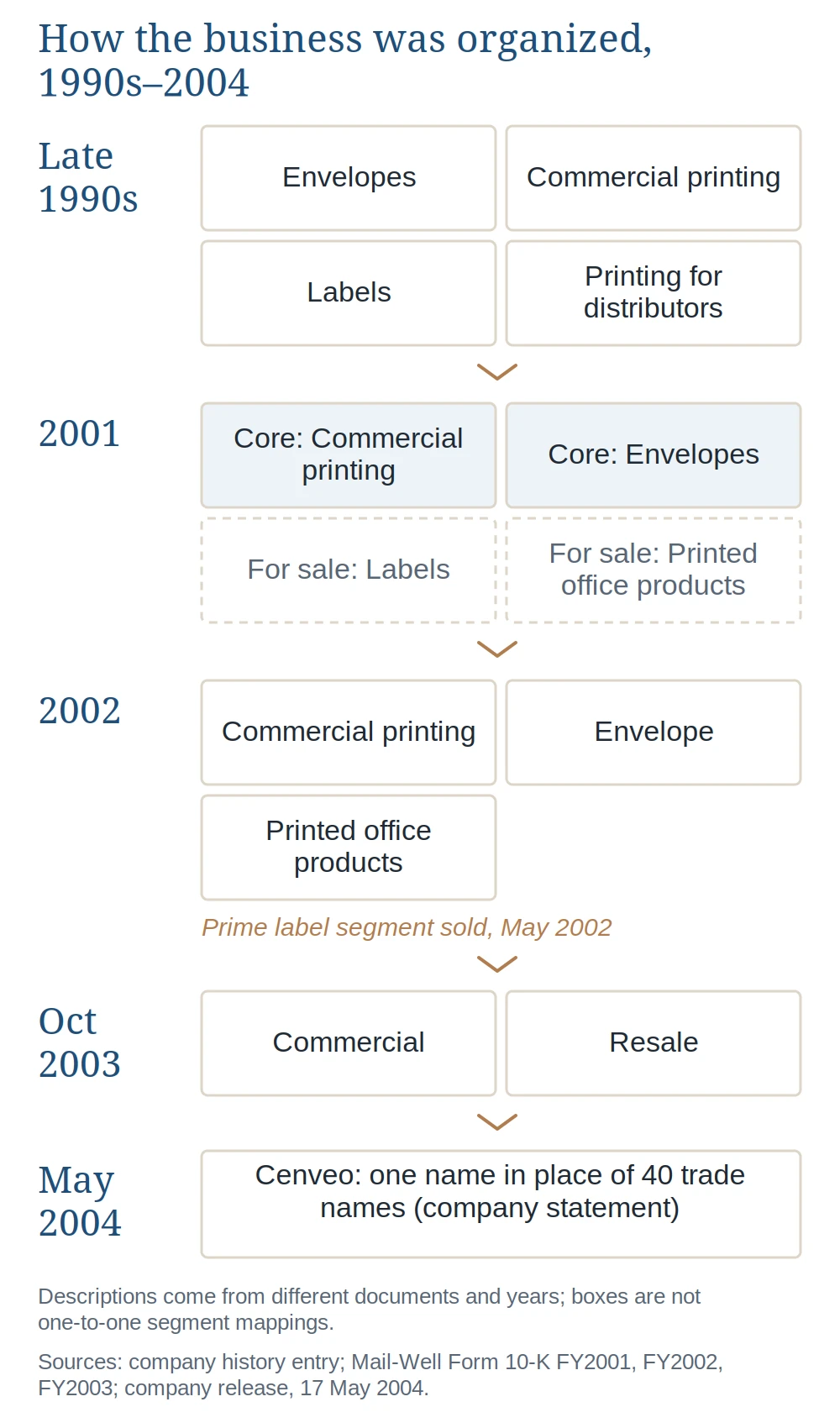
Common mistake: Assuming the four businesses of the late 1990s carried over into Cenveo. By 2004 the prime label segment had been sold, and the company was organized by customer channel, not by product.
Takeaway: The 2004 rename completed a three-year shift from a group of product businesses to one company with two channels.
How did Mail-Well become Cenveo in 2004?
The company announced the Cenveo name on May 17, 2004, after previewing it in April. On April 19, 2004, Chief Marketer reported that Mail-Well would rebrand as Cenveo effective May 17, with the tagline “Vision Delivered.” Paul Reilly, then president, CEO and chairman, said the company had been organized by product line a year earlier and had used many company names.
| Date | What happened | Source |
|---|---|---|
| April 19, 2004 | Rename to Cenveo reported in advance, effective May 17 | Chief Marketer |
| May 17, 2004 | Press release: shareholders approved the name; new identity, cenveo.com and NYSE symbol CVO | Company release |
| May 18, 2004 | Release published in the trade press | WhatTheyThink |
According to the release, the single name replaced 40 trade names used over ten years and covered 85 North American facilities and about 10,000 employees. It described the company’s services as running “from design through fulfillment,” including e-services, envelopes, offset and digital printing, and printed office products. These are the company’s own statements at the time. The 40 trade names are a separate count from the 40-plus acquisitions of 1994–1999.
Takeaway: Cite May 17, 2004 for the name change and treat April 19 and May 18 as the preview and the publication.
What does this history mean for envelope and label topics today?
Mail-Well’s history shows how closely envelopes, commercial print, labels and distributor printing were linked in one industry. The reasoning recorded at both ends of its history makes the point: according to the company history, Mahoney reasoned that larger corporations with operations in different regions might prefer a single envelope supplier with plants in each of those regions, and in 2004 the company said its many trade names had kept customers from using it for “one stop shopping” across envelopes, printing and office products. That link is also why this site groups its guides on envelopes, labels and paper packaging together. The history explains how those topics fit together; it is not a source of current product specifications.
Takeaway: Use this history for context and dates, and current technical guides for decisions about materials or equipment.
What this history does not tell you
- Events after May 2004. Later ownership, restructuring and current status are outside this reference.
- When the trademark was first used. The company history says only that Rockmont used “Mail-Well” early on.
- Product performance. No patents or testing for the Visulope have been confirmed, and no independent response data for Rub n Reveal exist in these sources.
- The old website. Internet Archive captures (CDX capture list, in the sources) show that
mail-well.com/index1m.htmlreturned pages from December 2001 to February 2004 as a framed corporate entry page; the framed content was not retrieved and is not reproduced. The page now at that address shows the frame layout only. - Publication dates. The publication year of the company history entry is not confirmed; its narrative ends around 1999.
Takeaway: Where a source is silent, this page leaves a gap rather than filling it with an estimate.
Sources and method
This page brings together published records. Nothing was supplied by the former company or its successors; company statements are quoted only from its public filings and press release. The 1919–1999 account relies on the International Directory of Company Histories entry; the formation date and the dates of the main deals from 1994 to 1998 are checked against Mail-Well’s 10-K filings for 1996 and 1998, and the 2000–2003 events come from its 10-K filings for 2001–2003. The rename comes from Chief Marketer (April 19, 2004) and the company release published by WhatTheyThink (May 18, 2004). The product examples come from Packaging World (April 30, 2001), CreativePro (November 29, 2001) and Chief Marketer (August 1, 2002). A 2023 Printing Impressions interview was used only to cross-check names, and the SEC’s EDGAR company page only to confirm the registrant number and the 2004 name change in its records. All sources were accessed on October 10, 2026. Figures are reported for the year stated and, where marked, are the company’s own statements.
Company names, product names and trademarks belong to their owners and are used only to identify the history; no logos or original company materials are reproduced. How this site selects and checks sources is described in the editorial policy, and who runs the site is on the About page.
Takeaway: Every date and figure here can be traced to one of the sources listed below.
Frequently Asked Questions
What is Cenveo?
Cenveo is the name Mail-Well, Inc. adopted on May 17, 2004. The company, formed in 1994 from envelope businesses, kept its SEC registrant number: EDGAR lists CIK 0000920321 as Cenveo, Inc., formerly Mail Well Inc, with the former name dated May 17, 2004. This reference does not cover the company after that date.
What did Cenveo do when it took the name in 2004?
It offered envelopes, offset and digital printing, e-services and printed office products, according to its May 17, 2004 release, which described the range as running "from design through fulfillment." The same release gave 85 North American facilities and a workforce of about 10,000; these are the company's own figures at the time.
Was Mail-Well an envelope company?
Yes. Mail-Well, Inc. began operating in February 1994 with the envelope businesses of Georgia-Pacific and Pavey Envelope and Tag Corp., and its 10-K for 1996 described it as the largest printer and manufacturer of envelopes in the United States and Canada. Commercial printing, printing for distributors and labels were added later.
What was American Mail-Well Envelope?
It was one of Mail-Well, Inc.'s trade names. A schedule filed with the company's 10-K for 1996 lists "American Mail-Well Envelope" first among its trade names, next to Mail-Well Envelope, Pavey and Quality Park Products. The filings used here do not say which plants traded under it; a Denver Business Journal headline of January 13, 1995, a month after the purchase of American Envelope Company, used the name "American Mail-Well."
What was Rockmont Envelope Company?
Rockmont Envelope Co. was the Denver envelope maker that branded its envelopes "Mail-Well." It was founded in 1919 as Rocky Mountain Envelope Co. and renamed in the 1920s, according to the International Directory of Company Histories, which gives no year for the first use of the trademark.
Did Mail-Well make labels?
Yes. Murray Envelope, acquired in 1997, already supplied pressure-sensitive labels to distributors, and a separate label division was built from March 1998 until the prime label segment was sold in May 2002. That business, run as Mail-Well Label, made glue-applied paper labels mainly for food and beverage containers; the printed office products group the company kept still supplied custom and stock labels through office products distributors.
What was the Visulope envelope?
The Visulope was a Mail-Well envelope with windows that wrapped around its bottom so that postal workers and recipients could see inside. CreativePro reported it on November 29, 2001, as a response to public fears about biological terrorism through the mail; the report gives no sizes or test results.
Is mail-well.com the Mail-Well Inc. website?
No. The former company launched a new website at cenveo.com in 2004. Today mail-well.com is an independently operated educational site about printing, mailing and packaging, with no connection to the former Mail-Well, Inc., Cenveo or their successors.
Sources
- Mail-Well, Inc. (International Directory of Company Histories) (Encyclopedia.com)
- Mail-Well, Inc. Form 10-K for fiscal year 1996 (U.S. SEC EDGAR, filed 28 March 1997)
- Mail-Well, Inc. Form 10-K405 for fiscal year 1998 (U.S. SEC EDGAR, filed 1 March 1999)
- Mail-Well, Inc. Form 10-K for fiscal year 2001 (U.S. SEC EDGAR, filed 27 February 2002)
- Mail-Well, Inc. Form 10-K for fiscal year 2002 (U.S. SEC EDGAR, filed 21 March 2003)
- Mail-Well, Inc. Form 10-K for fiscal year 2003 (U.S. SEC EDGAR, filed 27 February 2004)
- EDGAR company filings: Cenveo, Inc., formerly Mail Well Inc (CIK 0000920321) (U.S. Securities and Exchange Commission)
- Mail-Well to Become Cenveo on May 17 (Chief Marketer, 19 April 2004)
- Cenveo (MailWell) Completes Name Change with New Web Site, Ticker Symbol (WhatTheyThink, 18 May 2004 (company press release dated 17 May 2004))
- Dean Foods pours into extended shelf life (Packaging World, 30 April 2001)
- For Position Only: The Threat to Direct-Mail Advertising (CreativePro, 29 November 2001)
- Back-End and Below-the-Line Services (Stealth Marketing item) (Chief Marketer, 1 August 2002)
- Printing Industry M&A Veteran Paul Reilly Looks Back at His Career, What Lies Ahead (Printing Impressions, 17 January 2023)
- Wayback Machine capture of mail-well.com/index1m.html, 13 December 2001 (Internet Archive)
- Wayback Machine CDX capture list for mail-well.com/index1m.html (Internet Archive)