EnvelopesGuide
Types of Mailing Envelopes: Uses, Materials and Formats
Business, window, catalog, booklet, remittance and padded envelopes explained by opening, seam, closure and paper, with the U.S. letter and flat size limits.
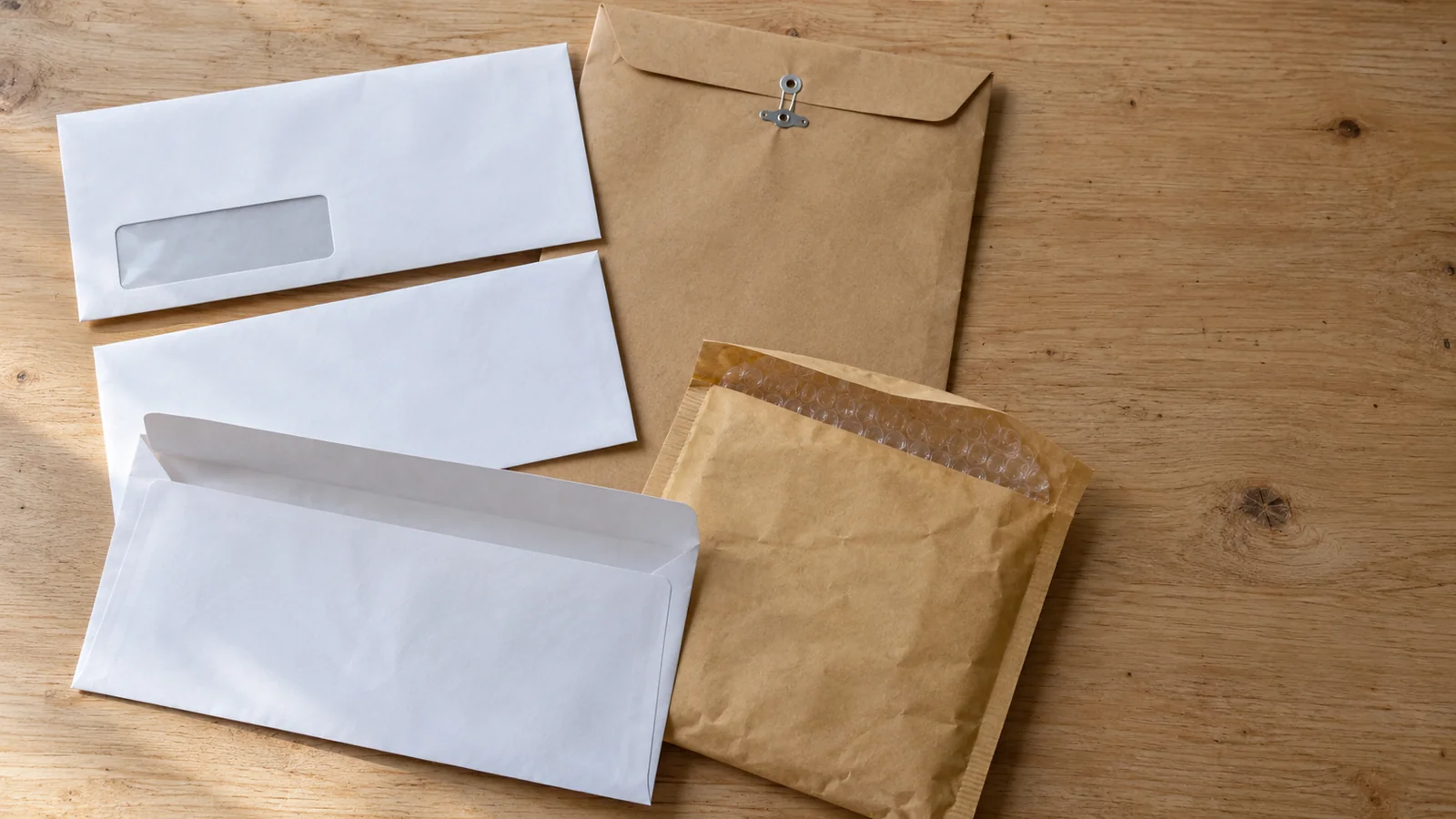
Choosing an envelope by its catalog name alone can leave you with wasted stock that does not fit the insert, will not run through the inserting machine, or is charged as a larger mail shape than you planned. Common mailing envelope styles include business, catalog, booklet, remittance and padded mailers, and windows, security tint, closures and paper grade are options added to one of those styles.
This guide explains each style by where it opens, how it is seamed and closed, and what it is made from, then shows how U.S. postal rules treat the filled envelope. It does not cover postage prices. How envelopes are made is covered in the Envelope Manufacturing & Materials section.
| Item | Typical value or source | Why it matters |
|---|---|---|
| Business #10 | 4-1/8 × 9-1/2 in (Tension size chart); usually open side (EMA guide) | The everyday size for letters, bills and statements |
| Window | Film patch over an opening; does not make a paper letter nonmachinable (USPS DMM 101 §1.2) | The address is printed once, on the insert |
| Catalog | Open end; 6 × 9, 9 × 12, 10 × 13 in are common (Tension) | Loads from the short edge; suits thick documents |
| Booklet | Open side; 6 × 9 and 9 × 12 in are common (Tension) | Shares the 6 × 9 and 9 × 12 sizes with catalog, but opens on the long edge |
| Remittance | Common sizes include 6-3/4 (3-5/8 × 6-1/2 in) and #9 (3-7/8 × 8-7/8 in); some have a deep flap (EMA guide) | Carries a payment back to the sender |
| Padded or bubble mailer | Padding or bubble lining in a kraft or poly exterior (Pregis) | Adds cushioning, thickness and stiffness |
| Security tint | Opaque patterned printing inside (Tension glossary) | Hides contents from casual view; an option, not a style |
How envelope types differ: four separate choices
An envelope is described by four independent choices, so a single #10 can be a window, security-tinted, self-seal and recycled-paper envelope all at once.
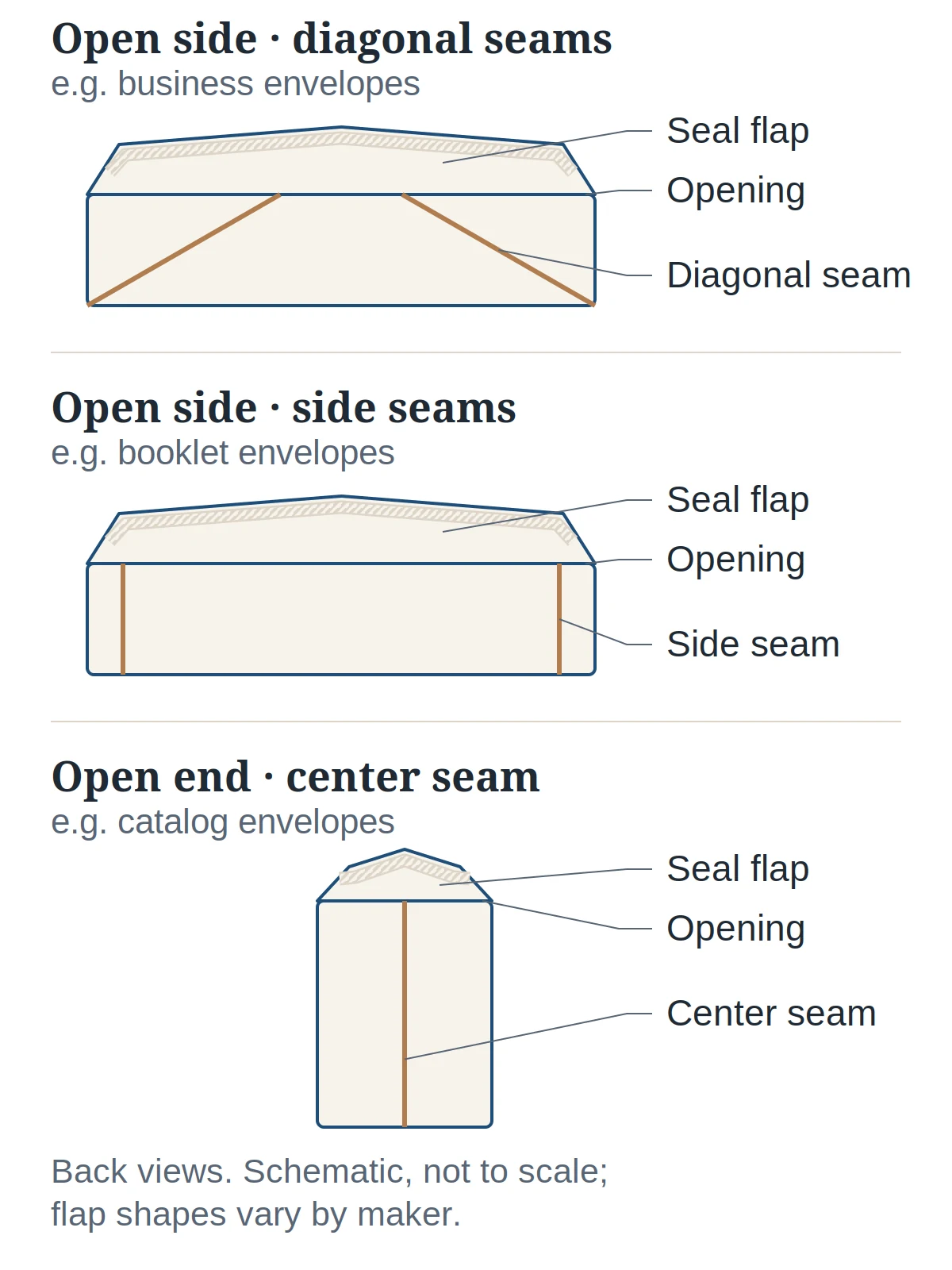
- Style: where it opens. An open-side envelope opens on its longer dimension, an open-end envelope on its shorter one. A #10 is usually open-side and a 9 × 12 usually open-end, though the Envelope Manufacturers Association (EMA) guide stresses that there are many exceptions.
- Construction: where the seams are. Open-side envelopes usually have diagonal or double side seams; open-end envelopes a center or single side seam. Most envelopes use closed-seam construction (at least three folds, gum only on the overlapping edges), which the EMA guide says inserter specifications emphasize.
- Closure. Moisture-activated gum, latex self-seal, peel-and-seal, or a clasp or string.
- Material and add-ons. Wove, kraft or recycled-content paper, or a padded or synthetic material, plus a window, inside security tint or printing.
Common mistake: Ordering “window envelopes” or “security envelopes” without stating the style and size. Those words describe options; the supplier still needs the style, outside size, opening edge and window position.
Takeaway: Specify style and size first, then list window, tint, closure and paper as separate lines.
Business and window envelopes
The business envelope is the open-side style used for letters, bills and other formal correspondence, and the #10 is the most common size. Tension’s size chart gives the #10 as 4-1/8 × 9-1/2 in with a maximum enclosure of 3-7/8 × 9-1/4 in, so a U.S. letter sheet folded in thirds (about 8-1/2 × 3-2/3 in) fits with a little room.
Tension notes that double side seams leave the back panel clear for printed messages, while heavy printing over diagonal seams is not recommended because ink can build up on them.
A window envelope shows the address printed on the insert, so the envelope and the form become one design job. The EMA guide recommends checking a prototype with the insert pushed to the right, to confirm that the longest address line still shows. For film, it describes polystyrene as often specified for inserting equipment and polyester for heat-resistant laser printing.
Takeaway: For window envelopes, approve the window position against the real insert before ordering, and name the printer the envelopes will run through.
Catalog and booklet envelopes
Catalog and booklet envelopes share the 6 × 9 and 9 × 12 sizes; the difference is which edge opens.
| Style | Opening | Typical seam | Common sizes (Tension chart) | Notes |
|---|---|---|---|---|
| Catalog | Short edge (open end) | Center seam or single side seam | 6 × 9, 9 × 12, 10 × 13 in | Tension says a center seam adds strength for heavier inserts |
| Booklet | Long edge (open side) | Double side seam | 6 × 9 and 9 × 12 in (listed as the 6-1/2 and 9-1/2) | Usually a wallet-style flap (Tension glossary) |
Tension describes larger open-end envelopes as not ideal for automatic insertion, so a machine-filled job may need a different style from a hand-filled one at the same size.
Takeaway: When two quotes both say “9 × 12”, confirm which edge opens and whether the envelopes will be machine-inserted.
Remittance and reply envelopes
A remittance envelope is the small envelope a customer uses to send a payment back. The EMA guide’s remittance sizes include the 6-3/4 (3-5/8 × 6-1/2 in) and the #9 (3-7/8 × 8-7/8 in). Some have a remittance flap, the deepest flap style, printed with payment details and perforated so it can be torn off and enclosed. Whether a reply envelope travels postage-paid is a separate postal arrangement, not part of the construction.
Takeaway: Size the reply envelope so it fits inside the outgoing envelope with the other inserts, and treat prepaid reply postage as a separate decision.
Padded and bubble mailers
Cushioned mailers have internal padding or a bubble lining, with a kraft paper or poly (plastic) exterior. Use them when an item needs protection from impact or abrasion but not a box.
Padding adds thickness and stiffness, so a padded mailer can fall into a different mail shape from a paper envelope of the same size (see the letter and flat rules below). For paper versus plastic protective mailers, see paper mailers vs poly mailers.
Takeaway: Fill one padded mailer with the real item, then check its thickness, flexibility and weight before choosing a postage class.
Closures: gummed, self-seal and peel-and-seal
The closure decides how the envelope is sealed and whether it can run on an inserter. The EMA guide says moisture-activated gum is the most common closure because it suits automatic inserting machines; latex self-seal and peel-and-seal close by pressure instead of moisture.
| Closure | How it seals | Typical use | Check before ordering |
|---|---|---|---|
| Remoistenable gum (“gummed”) | Dried gum reactivated with moisture | The most common closure; the EMA guide links it to automatic inserting | The inserter’s sealing solution and wetting equipment |
| Latex self-seal | Two latex patterns stick only to each other | Self-sealing envelopes closed by pressing, with no moistening (Tension, EMA) | Storage: heat, sunlight, UV and dust shorten shelf life (EMA) |
| Peel-and-seal | Pressure-sensitive adhesive under a release strip | Envelopes closed by peeling the strip and pressing the flap (EMA) | Inserter compatibility (see below) |
| Clasp or string-and-button | Metal clasp, or string wound around two buttons | Reusable and inter-office envelopes | Makes a retail letter nonmachinable (DMM 101 §1.2) |
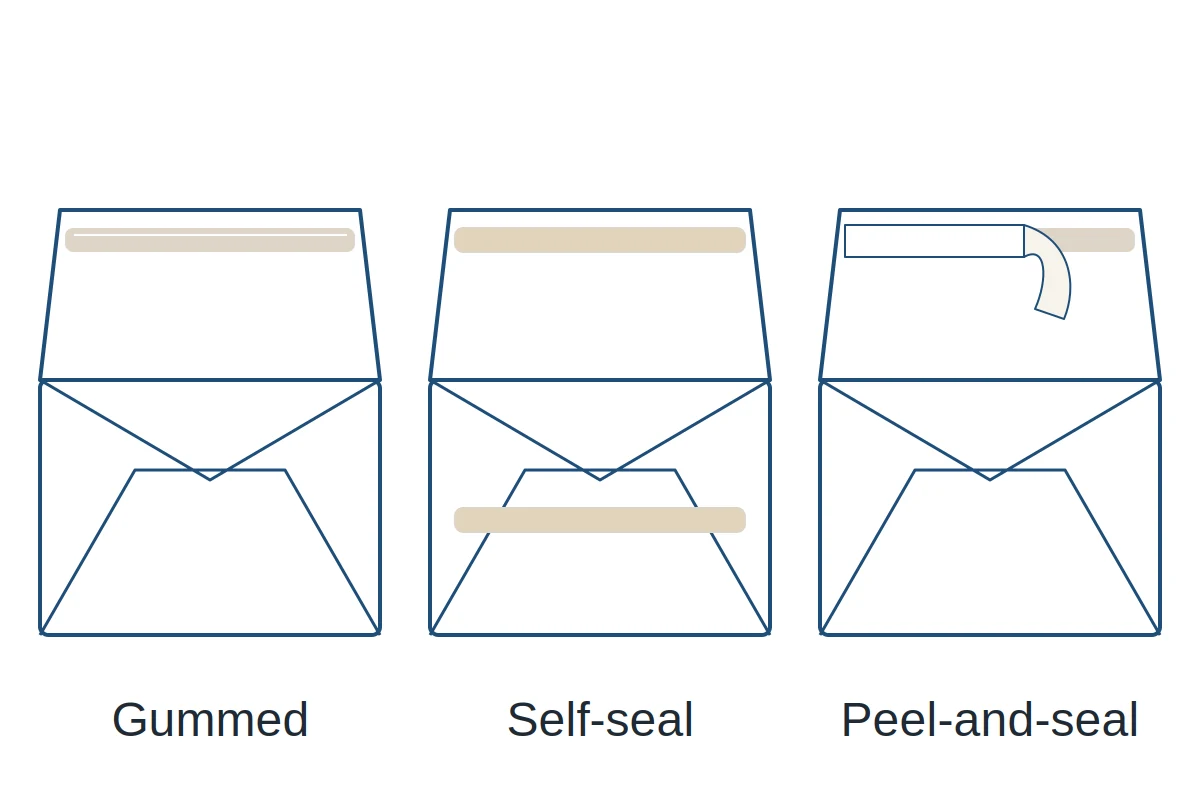
Common mistake: Ordering peel-and-seal envelopes for a mailing that will run on an inserter. The release strip must be peeled off before the flap is closed, and Tension states that its peel-and-seal envelopes are not compatible with automatic inserters.
Labels face the same split between pre-applied adhesive and glue applied at the point of use; see pressure-sensitive vs wet-glue labels.
Takeaway: Choose the closure for how the envelopes will be filled and sealed, and confirm inserter compatibility for anything other than moisture-activated gum.
Envelope papers and basis weight
Tension’s glossary describes wove as a short-fiber paper with a smooth surface that prints well, and kraft as a paper with longer, stronger fibers that prints less well. “Recycled” describes fiber content (pre-consumer, post-consumer or both, per the EMA guide), not a separate paper type.
Paper weight is quoted as basis weight: the weight in pounds of 500 sheets at the grade’s basic size, 17 × 22 in for bond, wove and kraft. A “24 lb” envelope describes the paper, not the envelope; Tension gives about 6.75 g for a #10 made from 20 lb paper.
| Bond basis weight | Approx. gsm (calculated) | Tension’s typical use |
|---|---|---|
| 20 lb | 75 | #9 and #10 |
| 24 lb | 90 | #9 and #10; 6 × 9 and 9 × 12 |
| 28 lb | 105 | 6 × 9 and 9 × 12 |
The gsm values are calculated from that definition and rounded; they are not thickness figures. For commercial machinable and automation letters, USPS DMM 201 §3.2 requires envelopes of at least 50 lb book basis weight or equivalent, which its conversion table equates with 20 lb bond.
Common mistake: Comparing pound weights across paper grades. Book paper is weighed on a 25 × 38 in sheet and bond on a 17 × 22 in sheet, so DMM 201 Exhibit 3.2 lists 60 lb book and 24 lb bond as equivalents. Convert to the same grade or to gsm before comparing quotes.
Takeaway: Quote paper as grade plus basis weight (for example, 24 lb white wove) or in gsm, never as a bare number.
Will the filled envelope mail as a letter or a flat?
USPS classifies the filled piece, not the empty envelope. Measure, weigh and flex a filled sample against the retail standards in DMM 101 (read October 2026).
| Mail shape | Size limits (U.S. retail, DMM 101) | Other conditions |
|---|---|---|
| Letter | 5 to 11-1/2 in long, 3-1/2 to 6-1/8 in high, 0.007 to 1/4 in thick | Rectangular; up to 3.5 oz at letter prices (First-Class letters over 3.5 oz pay flat-size prices). Over 6 in long or 4-1/4 in high, it must be at least 0.009 in thick to be machinable; thinner pieces pay the nonmachinable surcharge |
| Flat (“large envelope”) | Over 11-1/2 in long, or over 6-1/8 in high, or over 1/4 in thick; no more than 15 × 12 × 3/4 in | Flexible, rectangular and uniformly thick; First-Class Mail up to 13 oz |
| Parcel | Over any flat maximum, or a flat-size piece that is rigid, not rectangular or not uniformly thick | Parcel prices apply |
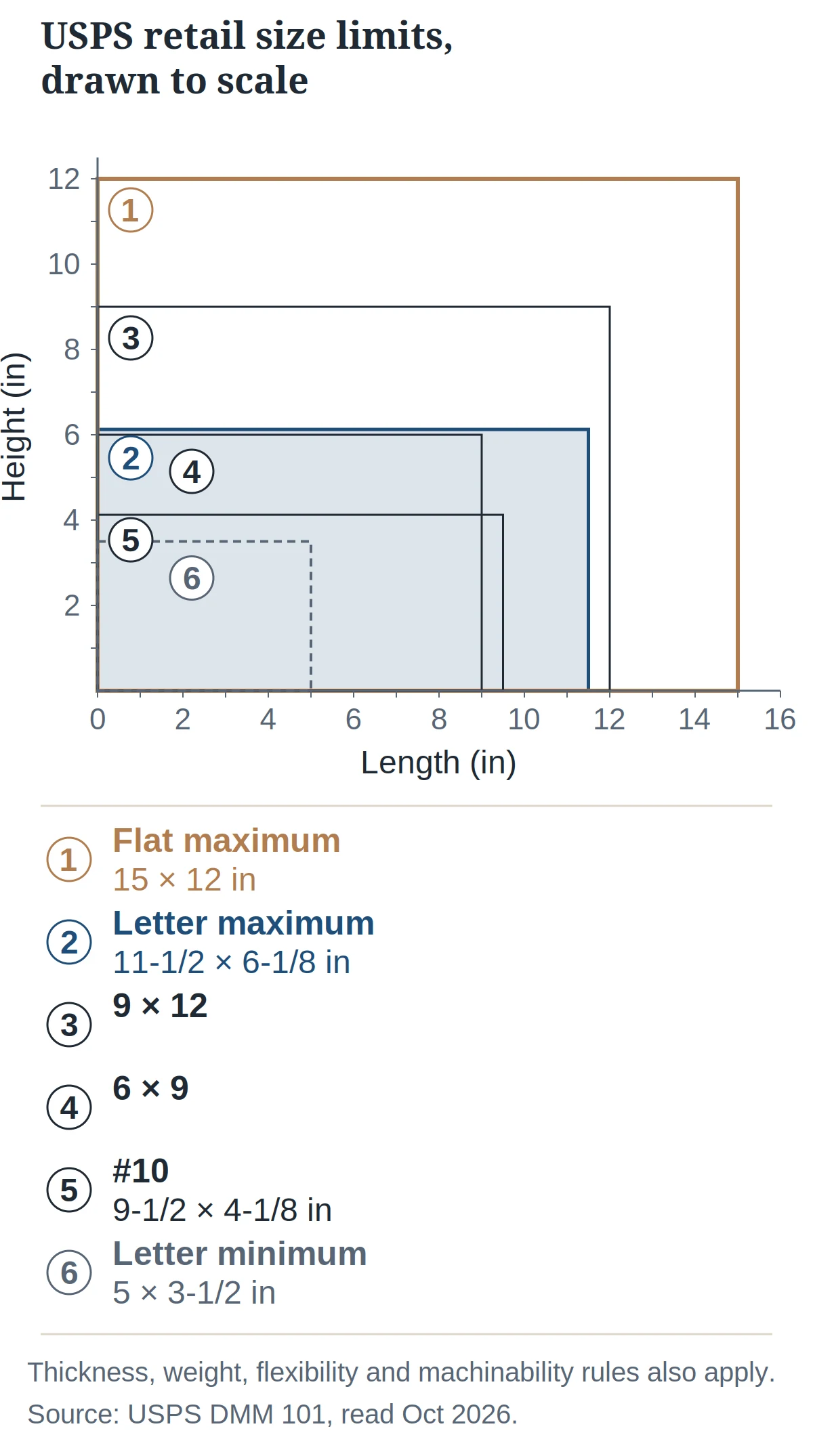
The two shapes treat problems differently. A letter-size piece that is rigid, lumpy, square or closed with a clasp is still a letter, but it is nonmachinable and pays a surcharge (DMM 101 §1.2 and §6.3.1). A flat-size piece that is rigid, not rectangular or not uniformly thick is charged as a parcel (§2.5 and §6.4).
Applied to common sizes (our arithmetic): a #10 has a length-to-height ratio of about 2.3, inside the 1.3 to 2.5 machinable range. A 6 × 9 is within letter length and height, so it can travel as a letter if it stays thin, light and flexible. A 9 × 12 exceeds both letter maximums, so it is a flat if it passes the flat rules and a parcel if it does not.
Takeaway: Decide the postage class from a filled sample, not from the envelope’s name or the size printed on the box.
When this does not apply
- Outside the United States. The limits above are USPS domestic retail rules. Elsewhere envelopes are usually named by metric series, such as DL (110 × 220 mm) and C5 (162 × 229 mm) in the EMA guide; ISO lists ISO 269:1985 (Correspondence envelopes — Designation and sizes) as withdrawn.
- Commercial and presorted mail. Machinable and automation prices add DMM 201 requirements, such as paper weight and folded self-mailer construction.
- Custom envelopes. The sizes quoted are typical; the EMA guide says there is no such thing as a standard mailing envelope.
- Prices. Postage prices and surcharges change; check the current USPS price list before mailing.
Takeaway: Outside U.S. retail mail and stock sizes, confirm the limits with the postal operator and the converter before ordering.
Sources and method
Sources were accessed on 10 October 2026. Postal limits come from USPS DMM 101 and 201 on Postal Explorer. Construction terms, sizes and closures come from the EMA guide (PDF metadata dated 2015; its postal figures were not used) and technical pages by Tension, an envelope manufacturer; the cushioned-mailer description is based on a Pregis product page. The gsm values and ratios are our arithmetic; ISO 269 status is from the ISO catalogue. No envelopes were tested. See our editorial policy for how we source and correct articles.
Takeaway: The postal figures here are dated October 2026; recheck DMM 101 before a large mailing.
Frequently Asked Questions
Does USPS allow black envelopes?
DMM 101 (read October 2026) does not exclude envelopes by color: its letter and flat standards cover size, shape, thickness, weight and flexibility. The practical issue is reading the address. The Envelope Manufacturers Association guide advises black print on a white or light background for optical readers, so on a dark envelope put the address on a light label.
What type of envelopes can be mailed?
Any style, as long as the filled piece is mailable; the style then decides only which shape and price apply. DMM 101 sets a general minimum of 5 by 3-1/2 inches and 0.007 inch thick for pieces 1/4 inch thick or less, and at the other end no retail piece may exceed 108 inches in length plus girth (130 inches for USPS Ground Advantage - Retail). Loose coins, keys or similar items can make a letter in a paper envelope nonmailable.
Does it matter what kind of envelope you mail?
Yes, for letter-size mail. Under DMM 101 section 1.2, a letter-size piece is nonmachinable, and pays a surcharge, if it is square or otherwise outside a 1.3 to 2.5 length-to-height ratio, has a plastic or other non-paper exterior, is closed with a clasp, string or button, or has its address parallel to the short side. A window in a paper envelope does not count against it.
Could someone explain the minimum dimensions for a large/flat envelope to me?
A flat has to exceed at least one letter maximum, not all of them: it must be more than 11-1/2 inches long, or more than 6-1/8 inches high, or more than 1/4 inch thick (DMM 101 section 2.1). It must not exceed 15 by 12 by 3/4 inch, and pieces 1/4 inch thick or less must still be at least 5 by 3-1/2 inches and 0.007 inch thick.
Would a padded/bubble envelope be able to be sent as a large envelope?
Only if the filled mailer still meets the flat rules: flexible, no more than 3/4 inch thick, and uniformly thick, with bumps causing no more than 1/4 inch of variation. DMM 101 also says boxes, and tight envelopes filled with boxes, are not flats. A flat-size bubble mailer that is rigid or lumpy pays parcel prices; at letter size, a poly bubble mailer is nonmachinable because its exterior is not paper, and a kraft one is nonmachinable if it is too rigid.
What constitutes rigid for a first class letter?
DMM 101 section 1.2 defines a letter as too rigid when it does not bend easily under a transport belt tension of 40 pounds around an 11-inch-diameter turn. A rigid letter-size piece pays the nonmachinable surcharge; a rigid piece larger than letter size pays parcel prices.
Sources
- DMM 101 Physical Standards (Retail Mail Letters, Cards, Flats, and Parcels) (USPS Postal Explorer)
- DMM 201 Physical Standards (Commercial Letters, Flats, and Parcels) (USPS Postal Explorer)
- The EMA Guide to Envelopes and Mailing (Envelope Manufacturers Association)
- Envelope Size Charts (Tension)
- Glossary of Envelope Terms (Tension)
- Envelope Basics: Seams (Tension)
- Envelope Basics: Closures (Tension)
- The Basics of Paper Weights (Tension)
- Window Technology at Tension (Tension)
- Cushioned Mailers (Pregis)
- ISO 269:1985 Correspondence envelopes — Designation and sizes (ISO)