LabelsComparison
Pressure-Sensitive vs Wet-Glue Labels
How pressure-sensitive and wet-glue (cold glue) labels differ in materials, machinery, changeover, cold and wet performance and recycling, and how to choose.
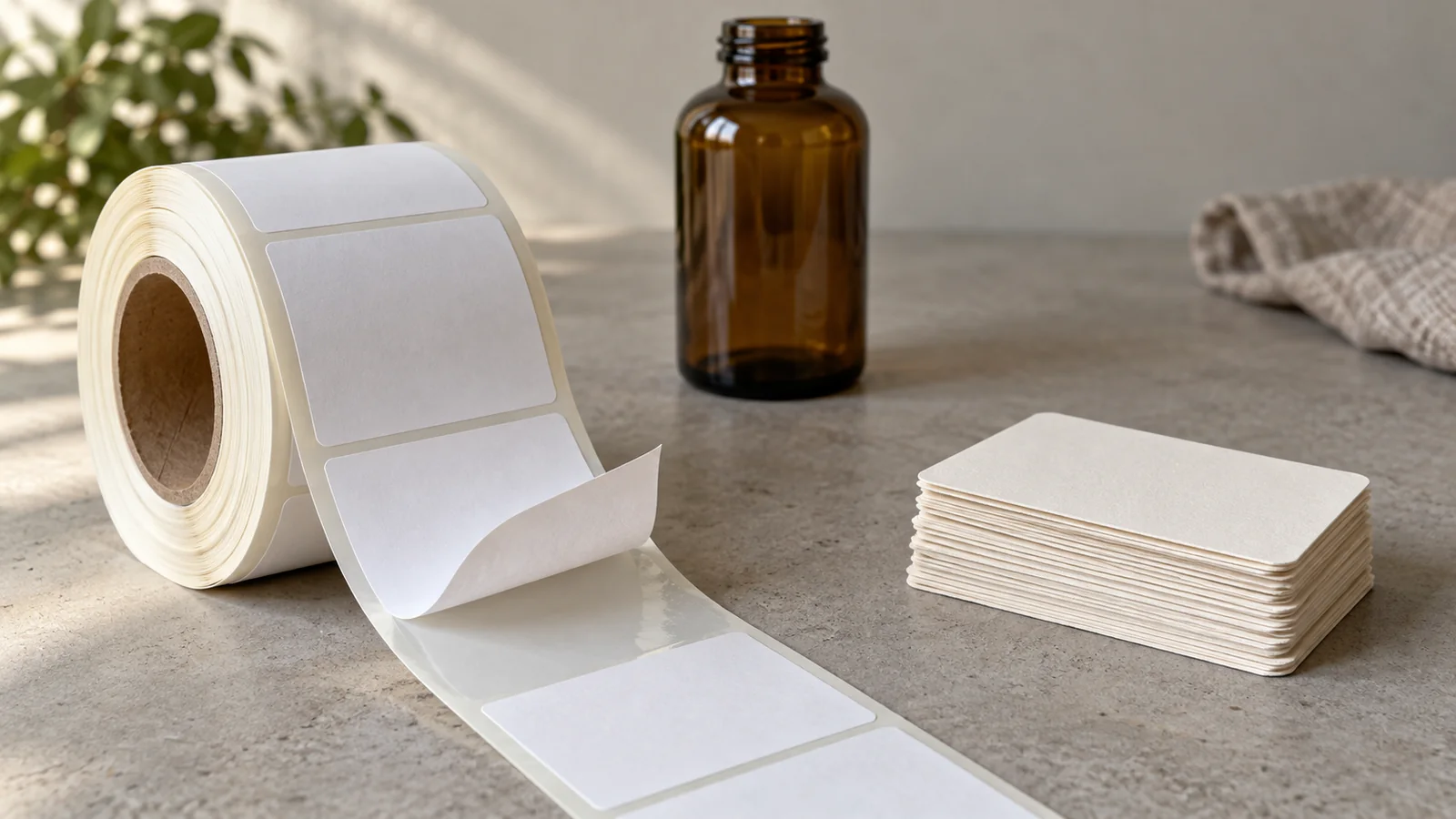
Choosing the wrong labelling route can leave a new label design that your line cannot apply, or labels that lift and wrinkle once the bottle is chilled. Pressure-sensitive labels arrive with their adhesive already on a release liner and are peeled onto the container, while wet-glue labels are plain pre-cut paper that the labelling machine coats with glue at the moment of application, so the better choice depends on the equipment you already run, the container and label shape, how often formats change and what the filled package goes through afterwards.
This comparison is based on public manufacturer and trade-association documents, not on our own testing. On this page “wet glue” means pre-cut paper labels applied with cold glue; hot-melt roll-fed labelling is a different route, covered under When this does not apply.
| Item | Typical value or source | Why it matters |
|---|---|---|
| Label as delivered | Pressure-sensitive: labels on a silicone-coated liner, on a roll (HERMA). Wet glue: pre-cut paper labels in a magazine (Krones) | Sets what the line stores and loads |
| When the adhesive is applied | Pressure-sensitive: when the stock is made. Wet glue: on the machine (Krones) | Moves glue handling to the line |
| New label shape | On pallet-type cold-glue machines, a new shape needs a matching set of glue pallets (Krones, 2020) | A redesign can mean new change parts, not only new labels |
| Waste left at the line | Pressure-sensitive: the spent liner is rewound at the applicator (HERMA) | The liner needs its own disposal or recycling route |
| Cold and wet service | Products for these conditions have been described on both routes (Henkel data sheet, 2021; UPM release, 2016) | Test on your container; do not decide by route alone |
| Recycling or bottle washing | Wash-off pressure-sensitive adhesives are designed for a specific wash process (UPM) | The label has to match the container’s end-of-life stream |
Quick verdict
Pressure-sensitive labels are usually the simpler fit when the line already runs pressure-sensitive applicators, or when the design calls for film or clear “no-label look” labels. When label shapes change, no new glue pallets are needed, but new die-cut label stock is; no source reviewed here compares changeover effort between the two routes.
Wet glue is the natural fit when the plant already has a cold-glue labeller and its change parts, when the design uses pre-cut paper labels on round or shaped containers, and when the plant can store glue and clean glue-contact parts as routine.
Neither route is automatically cheaper, faster or greener; no source reviewed here compares speed, cost or environmental impact under equal conditions.
Takeaway: Start from the machine you have and the label you need, then verify the conditions the package will meet.
Side-by-side comparison
| Factor | Pressure-sensitive | Wet glue (cold glue, pre-cut paper) |
|---|---|---|
| Materials | Face material (paper or film), adhesive layer, silicone release coating and release liner | Paper label with no adhesive, plus a separately bought cold glue; casein glues for glass bottles are one example |
| How it is applied | Peeled off the liner at a dispensing beak; liner rewound | Glue pallets pick glued labels from a magazine; a gripper cylinder places them |
| Shape change | New die-cut label stock; no glue pallets to change | New label stock plus a new set of glue pallets on pallet machines (Krones, 2020) |
| Limits | Liner waste; adhesive must suit labelling and service conditions | Mainly pre-cut paper labels (Sidel also lists aluminium); glue parts must be cleaned |
| Typical fit | Lines with pressure-sensitive applicators; film, clear and variable-data labels | Rotary lines labelling glass and other containers with pre-cut paper labels |
Takeaway: The two routes differ less in the finished look than in where the adhesive comes from and what the line must manage.
Why the two routes behave differently
The adhesive arrives with the label, or at the machine
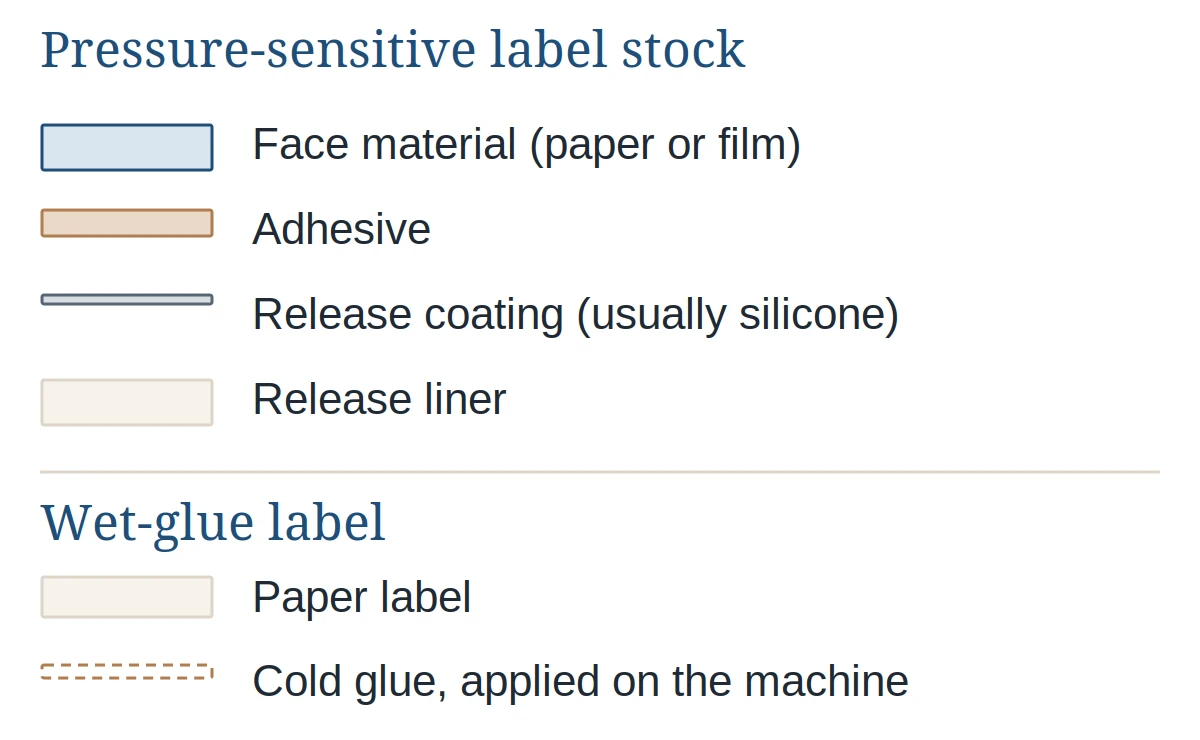
Conventional pressure-sensitive label stock has four parts: the label (face) material, a single layer of adhesive, a release coating that is usually silicone-based, and the release liner, as HERMA describes it. Because the adhesive is fixed when the stock is made, changing adhesive means changing label stock.
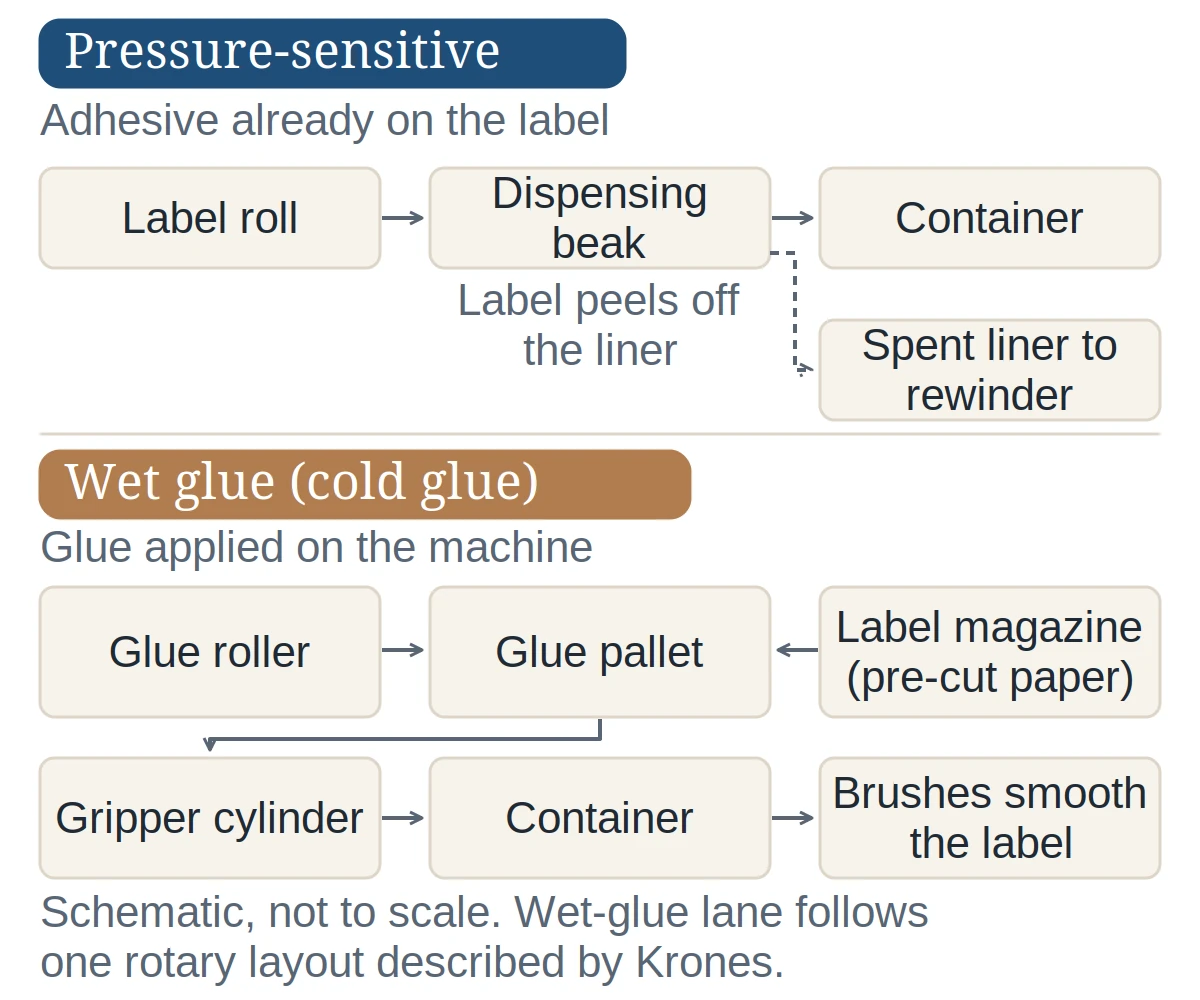
On the line, an applicator carries the label web to a dispensing beak, where each label leaves the backing paper and the backing paper is wound onto a rewinder. HERMA’s overview of its labelling systems lists an unwinder, label sensor, dispensing system, base unit and rewinder as the usual parts.
A wet-glue label is only paper until the machine glues it. In Krones’s description of its rotary Ergomatic labeller, a hardened-steel glue roller applies a very thin layer of glue to rubberised glue pallets. The glued pallets pick labels from the label magazine and pass them to a gripper cylinder, which places them on containers held and centred on a rotating table; brushes or roll-on sponges then fix and smooth the labels. Other machines are arranged differently.
What that means for the line
With wet glue, the plant takes on glue handling. Henkel’s AQUENCE GL 714 ETICOL, a casein glue sold for glass-bottle labelling machines and used as an example on this page, lists a recommended storage range of 5 to 30 °C, is marked frost-sensitive and has a recommended running temperature of 23 to 30 °C (data sheet dated February 2021). Those figures belong to that product only.
With pressure-sensitive labels, the label supplier’s construction decides how the adhesive behaves, and the line handles liner instead.
Common mistake: Calling every glue-applied label “wet glue”. Hot-melt roll-fed labelling cuts film labels from a reel and glues only their leading and trailing edges (Krones Contiroll), with different materials, machines and checks.
Takeaway: Wet glue puts glue control on the line; pressure-sensitive puts adhesive choice in the label stock and adds a liner to manage.
Cold, wet and washing: three separate checks
“Water-resistant” hides three requirements; a label can pass one and fail another.
1. Staying on in cold, wet use. Henkel’s February 2021 data sheet states that its casein glue for glass-bottle labelling machines has good ice-water resistance and performs on cold, wet bottles. On the pressure-sensitive side, UPM Raflatac announced label stocks for wine in Europe in June 2016 that it described as staying adhered in humid refrigerated storage and when the bottle is submerged in ice. These are dated manufacturer statements for specific products; we have not checked whether those exact products are still supplied, and Henkel itself recommends user trials.
2. Going on to a cold or wet container. Avery Dennison’s guide for one clear pressure-sensitive construction on PET (October 2025) asks for bottles that are as dry as possible before labelling, because droplets trapped behind the label can turn that adhesive milky; for beverages it suggests an air knife and heat tunnel close to the applicator. The Henkel glue above, by contrast, is described for cold, wet bottles. If condensation is unavoidable at your labeller, state it when you ask for samples.
3. Coming off when it should. Returnable bottles go through a bottle washer; single-use containers may go through a recycler’s wash. UPM describes wash-off pressure-sensitive adhesives that hold like a permanent adhesive in use and release in the wash, with adhesive, coat weight and face material chosen together for a specific recycling stream’s wash conditions. The whole printed label counts: Avery Dennison’s PET guidance says the finished label, including graphics, face material and adhesive, must have a total density below 1 g/cm³ to float away from PET flake, and that inks and varnish must stay on the label during the wash. We found no general public rule for cold-glue labels in washers or recycling; ask the glue and label suppliers for data.
Common mistake: Taking a good ice-bucket result as proof that a label will release in a bottle washer or a recycling wash. Each check needs its own evidence.
Takeaway: Specify the in-use condition, the labelling condition and the end-of-life wash as three separate lines in your label brief.
Cost factors and changeover
Label unit price is only one line. The sources point to these cost items, without comparable figures.
| Cost factor | Applies to | What to record |
|---|---|---|
| Complete label construction (face, adhesive, liner) | Pressure-sensitive | The full laminate quoted, and where the liner goes after use |
| Glue purchase, storage and handling | Wet glue | Storage and running temperatures and frost sensitivity from the glue’s data sheet |
| Change parts per label shape | Wet glue on pallet machines | How many glue-pallet sets your label range needs |
| Changeover and setting work | Both | Whether settings are recorded and reproducible, and which parts change without tools |
| Cleaning of glue-contact parts | Wet glue | Manual or automatic cleaning, and how often |
| Liner collection, baling and transport | Pressure-sensitive | Whether a mill, broker or aggregator near you accepts the liner |
Changeover is not simply slow on one route and fast on the other. Krones says glue pallets must match the label shape exactly, yet wet-glue makers also design for quick changes: a glue roller removable without tools (Krones), tool-less label pallets and automatic magazine loading (Sidel).
Spent liner is a real waste stream: TLMI’s update on its US Liner Recycling Initiative, dated 20 February 2025, describes a pilot programme with a paper mill company that will take white, silicone-coated paper liner, planned to cover the areas around two mills; liner on cores may need grinding and baling, and many generators may need a broker or aggregator to meet the mill’s bale specification. Check with TLMI or the mill which areas are accepted now. In Europe, FINAT’s CELAB initiative (October 2020 presentation) seeks recycling solutions for both: for the label printer, which trims off the matrix, and for the end user, which is left with the liner.
Takeaway: Compare the cost items each route adds to your line, not the price per thousand labels.
When this does not apply
- Hot-melt roll-fed labels. A separate route, as noted above.
- Sleeves and in-mould labels. Shrink and stretch sleeves, and labels moulded into the container, do not use either route; see the overview of label application methods.
- Linerless labels. Self-adhesive linerless labels carry a silicone layer on their face so they can be wound without a liner; HERMA describes its water-activated InNo-Liner labels for paper or board surfaces such as cartons. HERMA positions both for shipping cartons and similar surfaces.
- Shipping labels printed on the line. Print-and-apply is chosen for the variable data, not by this comparison.
- Hand labelling and regulated content. The machine comparisons above do not describe labelling by hand, and this page does not assess label content rules or tamper-evident performance.
Takeaway: If your label is not a pre-cut paper or pressure-sensitive label applied by machine, start from the method that actually applies to it.
A decision path
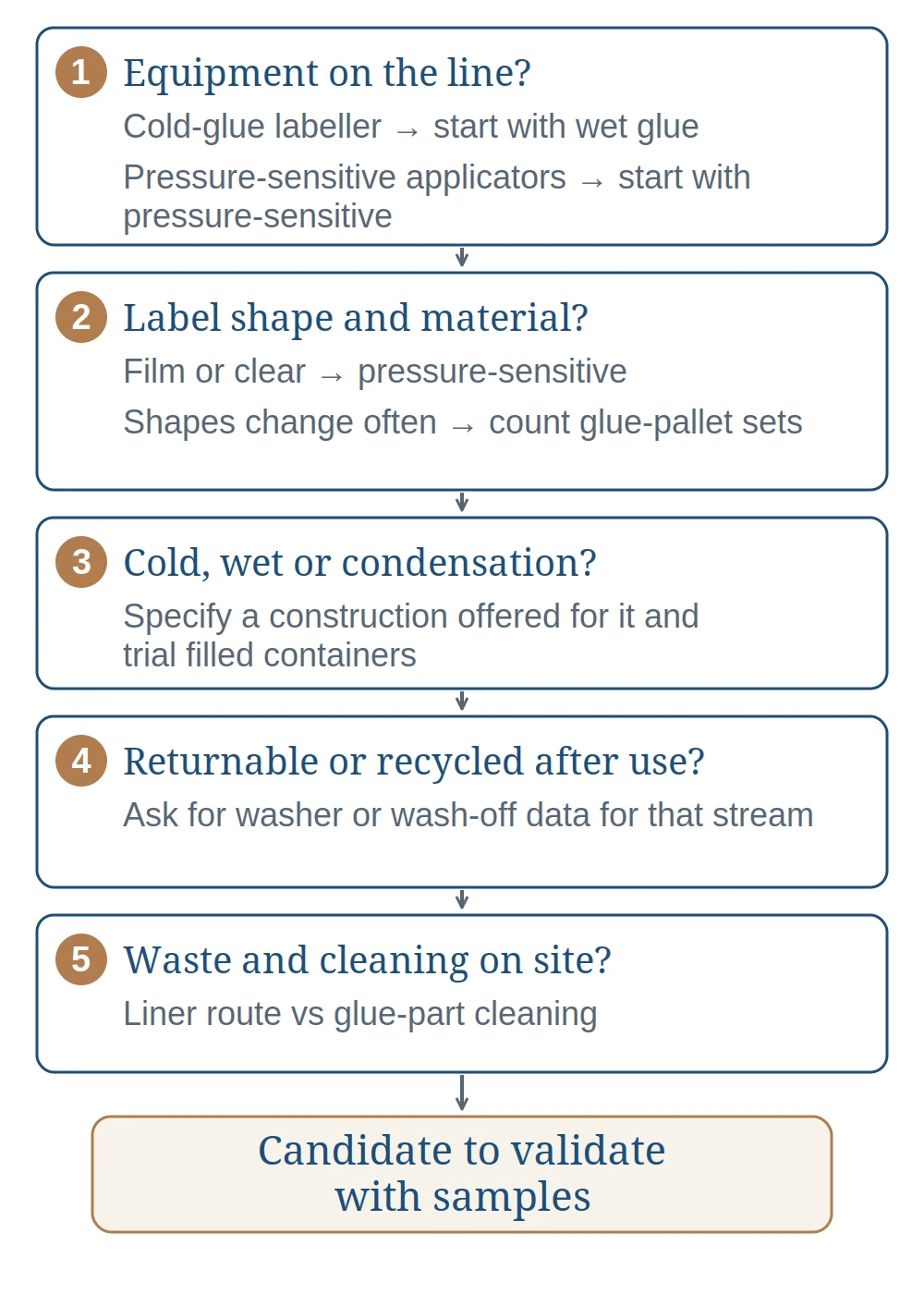
- What equipment is already on the line? A cold-glue labeller points first to wet glue; pressure-sensitive applicators point to pressure-sensitive. With neither, keep both open.
- What label shape and material does the design need? Clear or film labels point to pressure-sensitive. A paper face works on either route, but in different forms: wet glue uses pre-cut paper labels with no adhesive, while pressure-sensitive uses paper label stock with adhesive on a release liner, supplied on a roll. If shapes change often, count the glue-pallet sets a wet-glue line would need.
- What is the container’s condition at labelling and in use? If it is cold, wet or carries condensation, specify a glue or label construction offered for that condition and trial it on filled containers.
- Where does the container go after use? For returnable bottles or a target recycling stream, ask for wash-off or washer data that matches that stream.
- What waste and cleaning can the site handle? Weigh a route for spent liner against routine cleaning of glue parts.
Takeaway: Treat each answer as a candidate to validate with samples, not as a final verdict.
Example scenarios
These are illustrative situations with assumed inputs, not case studies.
- A brewery with a rotary cold-glue labeller adds a label shape. Stay with wet glue; order the new glue pallets with the artwork.
- A household-products brand moves to squeezable PE bottles. UPM describes PE film pressure-sensitive labels as flexing with squeezable containers; test filled bottles under squeezing.
- A winery sells white wine served from ice buckets. Ice-water performance has been described for products on both routes (Henkel 2021, UPM 2016); ask suppliers what they offer now, write the condition into the sample request and test filled bottles.
- A beverage brand wants PET bottles to suit a recycling stream. A wash-off pressure-sensitive construction is designed for that, but the whole printed label, inks included, must pass.
Takeaway: The route follows from the line and the conditions; the trial confirms the specific label.
Sources and method
We read technical pages and data sheets from HERMA, Krones, Sidel, Henkel, UPM, Avery Dennison and CCL Label, and publications from the label associations TLMI and FINAT, in October 2026, and checked each statement against the original wording. HERMA’s labelling-systems overview and linerless label page, and P.E. Labellers’ cold-glue station page, were also read; they are not linked because they are product sales pages. Product capabilities are reported as the manufacturer’s claims with their dates; they are not our measurements. Speeds, prices and changeover times are not compared because no source we found compared them under equal conditions. How we choose sources and correct articles is set out in our editorial policy. For the other ways labels are attached to packages, return to the Labels section.
Takeaway: Every figure here is a dated manufacturer or association statement, so confirm current products with the supplier.
Frequently Asked Questions
What is the difference between pressure-sensitive and self-adhesive labels?
In common usage the two names refer to the same kind of label: CCL Label lists its pressure-sensitive labels as self-adhesive labels, and HERMA describes conventional self-adhesive labels as sitting on a siliconised backing paper. Linerless self-adhesive labels also exist, so compare the actual construction, not the name.
What are pressure sensitive labels used for?
They are used wherever a ready-to-apply label suits the line: product labels on bottles, jars and tubes, film labels on squeezable or clear containers, and variable-data labels such as shipping labels printed and applied on cartons.
What are wet glue labels?
They are labels supplied cut to shape with no adhesive, usually paper (Sidel also lists aluminium), so they need a labelling machine that adds the glue, typically a cold-glue labeller; they cannot run on a pressure-sensitive applicator.
are pressure sensitive labels recyclable
It depends on the target recycling stream and what local programmes accept. Treat the two parts separately: a pressure-sensitive label is designed to wash off when it is a wash-off construction matched to that stream, and the liner left at the labelling line needs its own collection route.
What are bottle labels made of?
Usually a paper or film face. Pressure-sensitive labels add an adhesive layer and usually a liner that is removed at labelling; wet-glue labels are paper glued on the machine. Sleeves are film tubes, and in-mould labels use the same or a similar resin to the container.
can you recycle bottles with labels
The label is part of the answer. For PET bottles, Avery Dennison's October 2025 guidance says the finished label must have a total density below 1 g/cm³ so it floats away from PET flake, and that ink and adhesive should stay on the label in the wash. Whether a bottle is collected at all depends on the local programme.
Sources
- Innovative coating technology (HERMA)
- Ergomatic cold glue labellers (Krones)
- Labelling at the highest level: how the perfect glue pallet is created (2020) (Krones)
- EvoDECO Cold Glue (Sidel)
- Contiroll wrap-around reel-fed labelling (Krones)
- AQUENCE GL 714 ETICOL technical data sheet (February 2021) (Henkel)
- UPM Raflatac launches new Ice and Ice Premium label stock for wines (June 2016) (UPM)
- Wash-off label adhesives (UPM Adhesive Materials)
- Film label materials (UPM Adhesive Materials)
- AD CleanFlake technical guide: PET containers (October 2025) (Avery Dennison)
- TLMI's Liner Recycling Initiative: update (February 2025) (TLMI)
- Stretch sleeves (CCL Label)
- CELAB industry initiative (presentation, October 2020) (FINAT)