Paper PackagingComparison
Paper Mailers vs Poly Mailers
How paper and poly mailers compare on construction, protection, weight and size billing, US recycling routes and cost drivers, based on public documents rather than our own tests.
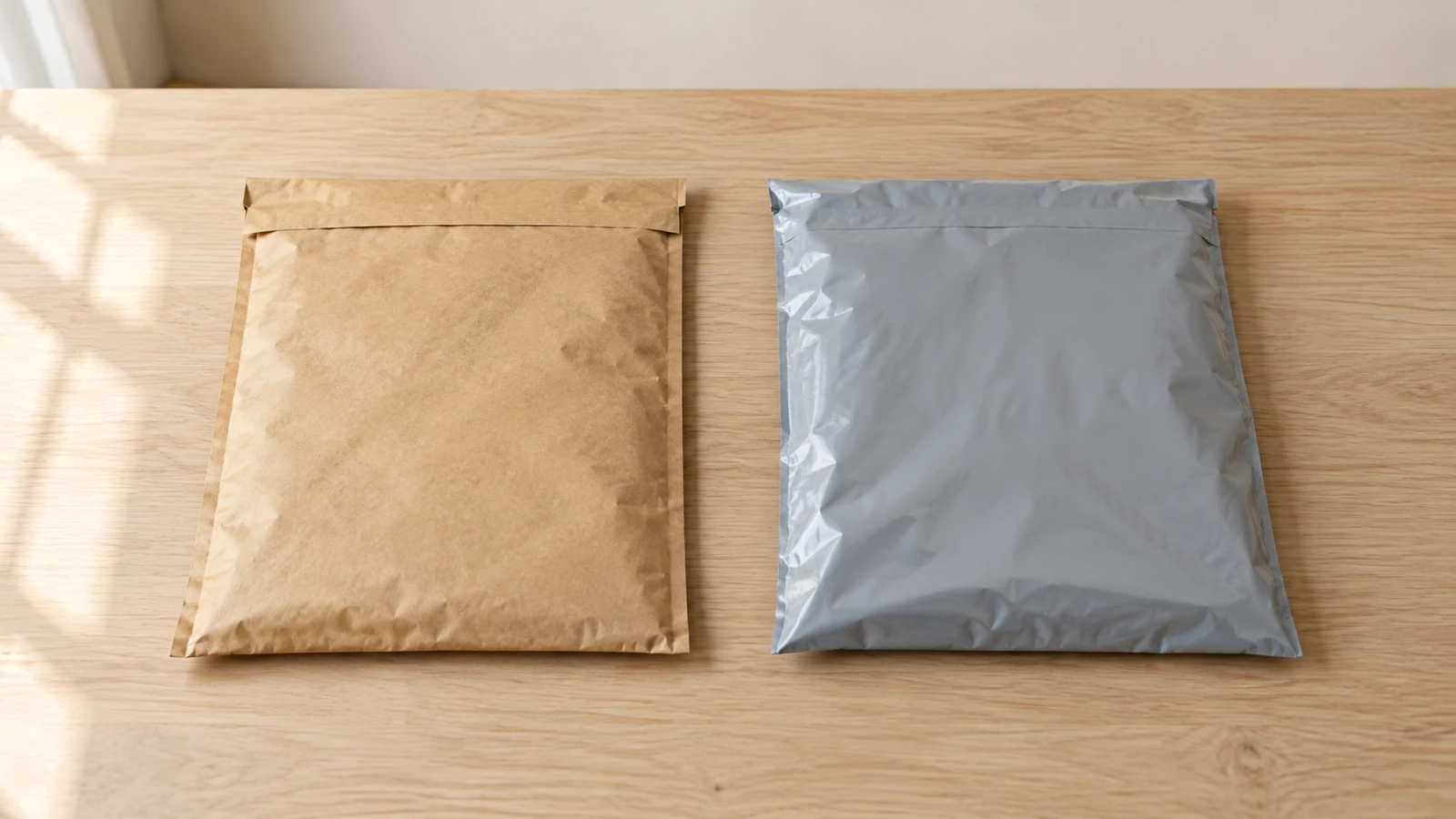
Choosing a mailer by its outer material alone can leave a fragile item without cushioning, or send a plastic-lined “paper” mailer to the wrong recycling bin. Choose the construction first (cushioned or not, flexible or rigid, one material or paper bonded to plastic), then compare paper and poly on moisture, packed weight and size, and the disposal route your customers actually have.
It is built from public manufacturer documents, US carrier rules and recycling guidance, not our own tests, for sellers and buyers choosing or switching mailers; other paper formats are covered in the paper packaging overview.
| Item | Typical value or source | Why it matters |
|---|---|---|
| Outer material | Kraft paper or plastic film, usually polyethylene (How2Recycle; University of Calgary study, 2013); some kraft-faced mailers have a plastic bubble lining (Sealed Air brochure, 2019) | The outside does not tell you the whole structure |
| Cushioning | None, paper padding, paper honeycomb or plastic air cells (Sealed Air 2019 and 2022; Ranpak 2024) | Decides whether the mailer suits semi-fragile items |
| Rigidity | Flexible bag, or kraft-laminated fiberboard “rigid” mailer (Sealed Air, 2019) | Bend-sensitive flat items need a rigid build |
| Moisture | Multi-layer mailer films described as puncture-, tear- and water-resistant (Sealed Air, 2022) | A film property, not a waterproof guarantee for the sealed pack |
| Mailer weight | Example: 70.62 g kraft and newsprint padded vs 15.47 g LDPE bubble, No. 2 size (University of Calgary study, 2013) | For light parcels, packed weight sets the price step |
| US billing, USPS Ground Advantage Commercial | Under 1 lb: 4, 8, 12 and 15.999 oz steps; dimensional weight (÷139) only above 1,728 cu in (DMM 283, revised 12 July 2026) | A small weight difference can move a parcel to the next step |
| US recycling route | Plastic film: not accepted in most curbside programs; eligible PE film via Store Drop-off (How2Recycle; EPA) | The route depends on the whole package and local access |
Construction comes before material
A mailer varies along two separate lines: what the walls are made of, and whether there is cushioning inside. A third, flexible or rigid, matters for flat items that must not bend. “Paper” and “poly” answer only the first.
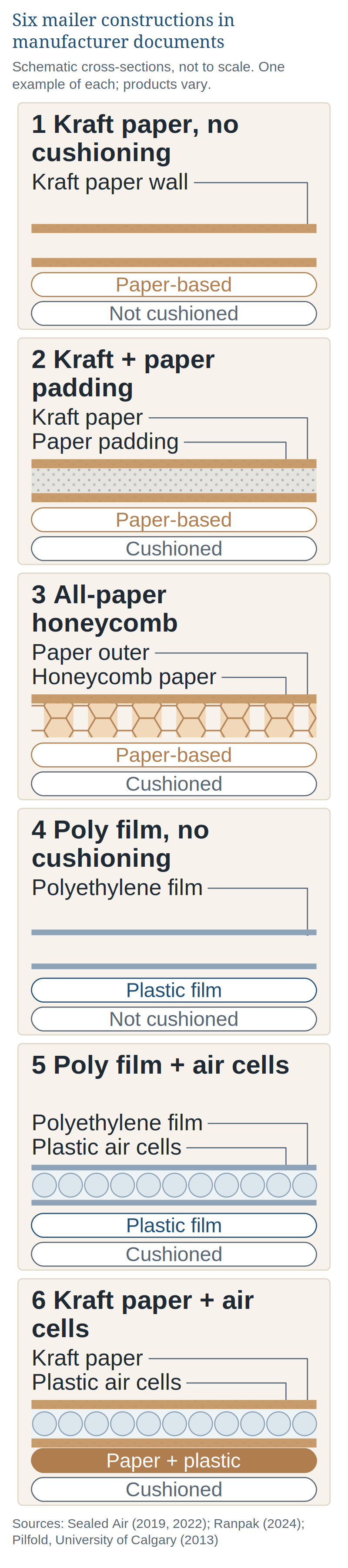
On the paper side, manufacturers publish at least four constructions. A plain kraft mailer has no cushioning. A padded mailer adds paper filling between two kraft walls; the mailer in the 2013 University of Calgary study used kraft paper with macerated newsprint padding. Ranpak’s April 2024 overview describes an all-paper honeycomb cushion “without a foam or poly interior”. And some mailers pair a kraft or white paper face with plastic bubble cushioning: Sealed Air’s 2019 brochure lists a kraft-faced mailer “made with Bubble Wrap brand cushioning”.
Poly mailers are usually polyethylene film: the bubble mailer in the 2013 University of Calgary study was LDPE, and How2Recycle’s Store Drop-off program, which covers flexible polyethylene packaging, lists “plastic mailers with compatible label”. Manufacturers’ sheets describe the film itself as multi-layer or co-extruded: Sealed Air’s 2022 sell sheet describes a proprietary multi-layer film, and one 2019 datasheet describes a co-extruded film with “a unique blend of resins”. Poly mailers come plain or with an air-cell lining.
Rigid mailers are a separate build. Sealed Air’s brochure describes a kraft-laminated fiberboard mailer that “resists bending and folding” and protects edges and corners, aimed at books, photographs and other low-profile items. Envelope-style formats, including padded envelopes, are covered in types of mailing envelopes.
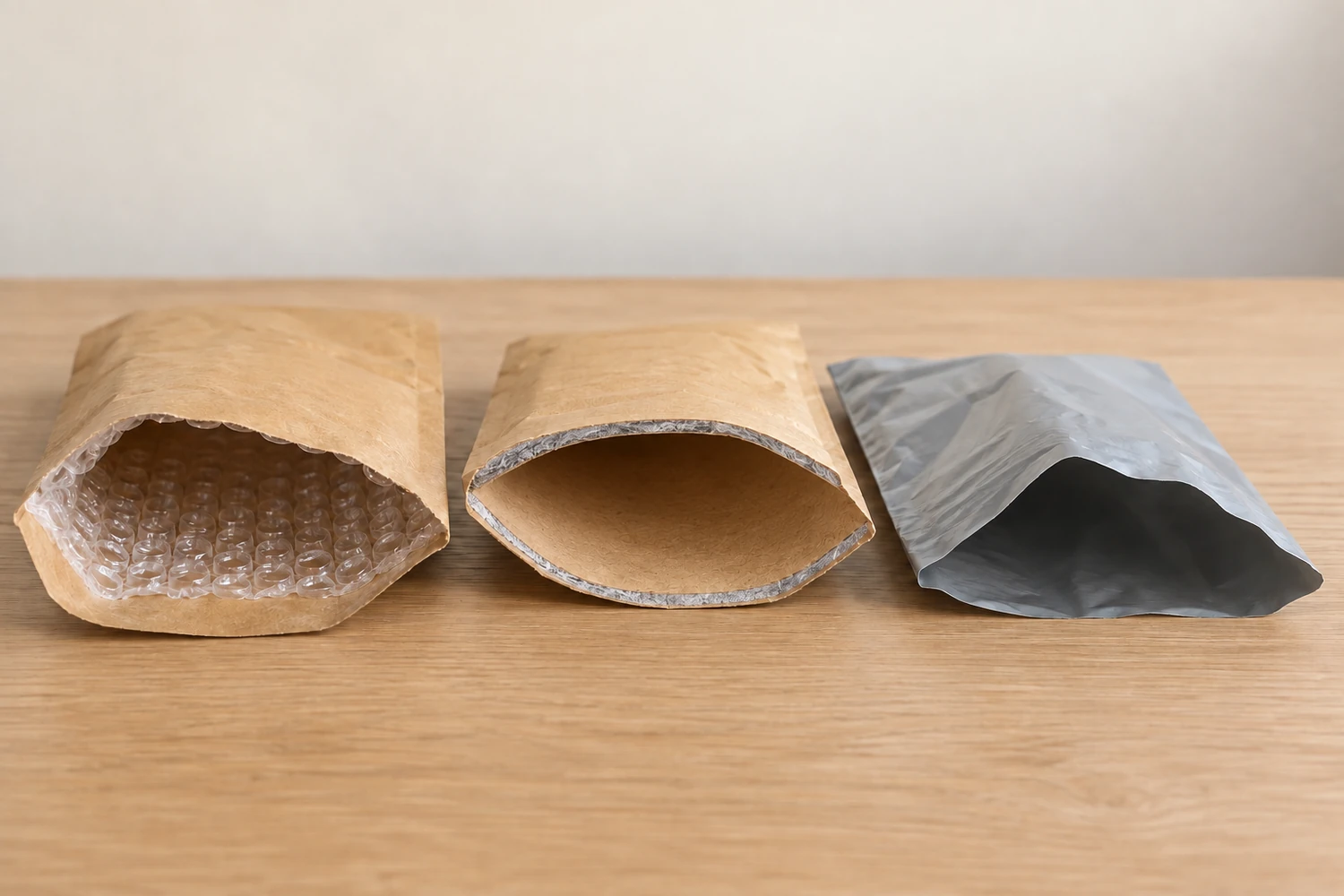
Common mistake: Treating every kraft-looking mailer as all paper. Cut a sample open or read the specification; a plastic bubble lining changes protection and disposal.
Takeaway: Name the construction (material, cushioning, rigidity) before you compare paper with poly.
Protection: match the construction to the item
Manufacturers position non-cushioned mailers for durable goods, cushioned mailers for semi-fragile items, and rigid mailers for flat items that must not bend.
| Item type | What the item needs | Construction to evaluate | Check before switching |
|---|---|---|---|
| Soft, durable goods (clothing, textiles) | Containment and some moisture resistance | Non-cushioned poly or kraft mailer | Closure strength, exposure to rain on the route |
| Semi-fragile, low-profile items | Cushioning against knocks | Cushioned mailer: paper padding, paper honeycomb or air cells | Packed thickness; whether the item can shift inside |
| Bend-sensitive flat items (books, photographs) | Stiffness, edge and corner protection | Rigid fiberboard mailer | Corners and edges after a trial shipment |
| Fragile, heavy, sharp or crushable items | Crush resistance and immobilization | A box or a validated protective pack | A mailer comparison does not settle this case |
No source we found tests paper and poly mailers of the same size with the same item, so neither can be ranked on puncture, tear or drop performance. Published data describes materials, not finished packs. One 2019 film datasheet lists nominal dart-impact and Elmendorf tear values by gauge and notes that its test data “reflect OFM material only”. A seam, flap or sharp corner can fail before the film does.
Common mistake: Reading “water-resistant film” as “waterproof package”. The closure, the side seals and any puncture decide whether water gets in, so test a sealed sample if moisture matters.
Takeaway: Start from the item’s weakness (crushing, bending, knocks or moisture) and choose the construction that addresses it.
Weight, size and how carriers bill them
A lighter mailer saves postage only when the weight difference moves the parcel to a lower price step, or when packed size triggers dimensional weight. Both depend on the service you use.
USPS Ground Advantage — Commercial (DMM 283, read 10 October 2026):
- Under 1 lb, postage is charged at 4, 8, 12 and 15.999 oz increments. Any fraction above a step moves to the next one, so a 4.1 oz item pays the 8 oz price.
- From 1 to 70 lb, any fraction of a pound counts as a whole pound.
- Dimensional weight applies only to parcels larger than 1 cubic foot (1,728 cu in) sent to zones 1–9. For a rectangular parcel, round each side up to the next whole inch, multiply, and if the result exceeds 1,728 cu in divide by 139 and round up to the next pound. The postage is based on the actual weight or the dimensional weight, whichever is greater. These steps carry a 12 July 2026 revision date.
- Nonrectangular parcels use their extreme dimensions multiplied by an adjustment factor of 0.785 before the same test.
- Eligible commercial customers can use cubic pricing instead. Each cubic piece must measure 1 cubic foot or less, weigh 20 lb or less, have no side longer than 22 inches, and not be a roll or tube. Soft packs (poly, plastic, cloth or similar) and padded envelopes are tiered by the outside length plus width of the original packaging material, not the packed shape: each side is rounded down to the nearest 1/4 inch and the total may not exceed 36 inches. Pleated or expandable pieces are measured as rectangular parcels instead (length × width × height).
UPS (support page, read 10 October 2026): dimensional weight equals length × width × height in inches divided by 139 for Daily Rates or 166 for Retail Rates, with any fraction raised to the next pound, and it “may apply to all” UPS package services. The page gives two different rounding instructions (round up, and round to the nearest whole inch), so confirm the method for your account.
Two examples with assumed inputs:
- Price step. Take 6 oz of contents and the two mailers from the 2013 study. With the 70.62 g (about 2.49 oz) padded paper mailer, the parcel weighs about 8.49 oz and pays the 12 oz step. With the 15.47 g (about 0.55 oz) bubble mailer, it weighs about 6.55 oz and stays in the 8 oz step. With 4 oz of contents, the same two mailers give about 6.49 oz and 4.55 oz, and both pay the 8 oz step, so the difference disappears. Weigh your own mailers.
- Size. A mailer packed flat to 10 × 13 × 2 inches measures 260 cu in, well below the 1,728 cu in threshold, so USPS dimensional weight does not apply to it on this service. Under cubic pricing, the same mailer, if it is a soft pack measuring 10 × 13 inches before packing, totals 23 inches and falls in the 0.20 tier (more than 21 up to 27 inches).
Billing uses outside dimensions; product fit depends on inside dimensions. Ranpak’s 2024 table, for example, lists a 6 × 9 in interior with a 6.75 × 9 in exterior. The shipping label also has to stay on that outer surface; label adhesive types are compared in pressure-sensitive vs wet-glue labels.
Takeaway: Weigh and measure the packed mailer, then check which price step and billing rule it falls under before assuming poly is cheaper to ship.
Recycling routes and environmental claims
Where a used mailer can go depends on its whole construction and on what the recipient’s community collects.
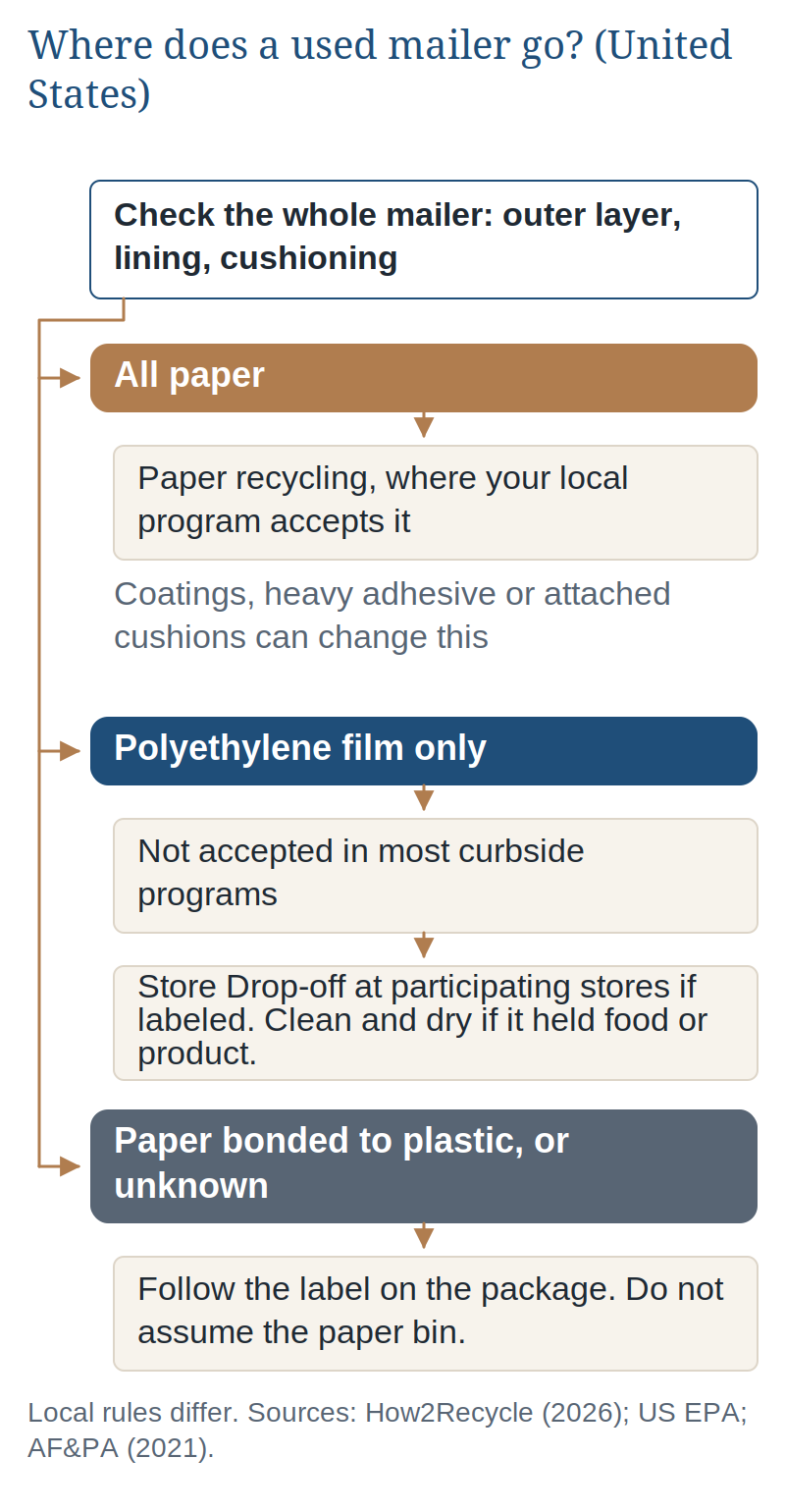
Plastic film (US). How2Recycle states that plastic bags, wraps and films are not accepted in most US curbside or drop-off programs; the EPA says they “cannot go in your household recycling bin” but that stores often accept them. Flexible polyethylene packaging carrying the How2Recycle Store Drop-off label can go to participating stores, and the program’s list includes “plastic mailers with compatible label”. Not every item in a category carries the label, and anything that has had contact with food or another product should be clean and dry before it goes in the bin.
All-paper mailers. These go to paper recycling where the local program accepts them. AF&PA’s design guidance for recyclability (version 1.1, last updated March 2021), based on a survey of member mills in the US and Canada, notes that non-fiber elements such as barrier coatings or adhesives “may create challenges” for mills, and states that the guidance is not mandatory. AF&PA also describes a paper-padded mailer whose cellulose-based cushioning is designed to be filtered out during repulping.
Paper bonded to plastic, or unknown construction. Do not assume the paper bin. In its August 2026 guidelines, How2Recycle lists “shipping boxes and mailers with adhered cushions or foam” among examples of paper packages that get a “Check Locally” label instead of “Widely Recyclable”, a change driven by California’s SB 343. The guidelines add that “paper as a material is not the issue”: the problems come from coatings, food residue, multilayer constructions and large non-paper attachments that restrict recycling in California. Follow the label on the package.
Which is greener? The only full comparative study we could read, a 2013 University of Calgary life cycle assessment, compared two No. 2 self-sealing mailers (8½ × 12 in) protecting 1 kg of contents on one shipment within Canada. With the mailers full, the kraft padded mailer had the higher overall impact. When the comparison was normalized per kilogram of material, the LDPE bubble mailer had the higher impact. Transport dominated several categories, and the author notes that significance levels of uncertainty could not be determined. The result depends on the scenario and supports no general claim either way.
For claims on a mailer or product page, the FTC’s Green Guides summary (October 2012) advises against unqualified “green” or “eco-friendly” claims and says recyclable claims need qualifying when facilities are not available to at least 60 percent of consumers or communities where the product is sold.
Common mistake: Printing “recyclable” on a mailer without checking what your customers’ communities accept.
Takeaway: Identify the whole construction, then describe the disposal route and any claim in the terms your customers’ location supports.
Cost drivers to compare
The unit price is one line of the cost; postage, damage, storage and labor are the others, and each can be checked with your own shipments.
| Cost driver | Where it shows up | How to check |
|---|---|---|
| Unit price at your volume | Purchasing | Quote the same size and construction from more than one supplier |
| Mailer weight | Postage step for light parcels | Weigh packed samples against the carrier’s steps |
| Packed outside dimensions | Dimensional weight | Measure packed samples as the carrier specifies |
| Flat mailer length plus width | USPS cubic tier for soft packs (eligible accounts) | Measure the unpacked mailer’s outside length and width |
| Damage and returns | Replacements, refunds, customer service | Track damage by construction during a trial period |
| Storage space | Warehouse and pack station | Manufacturers say mailers store flat, saving space against cartons; compare with your current format |
| Packing steps | Labor time | Time a packing run with each option |
| Printing | Brand presentation | Confirm print method and minimums for the chosen surface |
| Return strip | Returns handling | Specify a second self-seal strip only if returns use it |
Takeaway: Compare total cost per delivered order, not the unit price of the bag.
A five-step way to choose
- Define what the item needs: durable, semi-fragile, bend-sensitive, or fragile, heavy and sharp (usually a box).
- Pick the construction: non-cushioned, cushioned or rigid, as in the table above.
- Check moisture exposure: if parcels may sit in rain, test a sealed sample.
- Weigh and measure packed samples against your carrier’s price steps and dimensional-weight rules; for USPS cubic pricing, check the flat mailer’s length plus width instead.
- Check the disposal route and wording: match the material to what customers can recycle, and qualify any claim.
Paper tends to fit when the item suits paper padding or no cushioning and when customers can recycle paper locally. Poly tends to fit when water resistance matters most, when recipients have Store Drop-off access, and when a film surface suits your printing. Weight is not a fixed advantage of either: a heavier mailer matters only if it crosses a price step, so weigh both. If neither fits, the paper packaging section shows how mailers relate to bags, cartons and boxes.
Takeaway: Let the item and the route decide; paper versus poly comes last.
When this does not apply
- Hazardous, regulated or high-value items. Carrier packaging rules and insurance terms come first.
- Fragile, heavy or sharp items. A mailer comparison does not cover them; use a box or a protective pack validated for the item.
- Other services and carriers. The billing rules above cover USPS Ground Advantage — Commercial and the UPS support page as read on 10 October 2026; other services and later changes can differ.
- Outside the United States. Store Drop-off exists only in the US; elsewhere, local programs set the rules.
- Legal review. The FTC summary is guidance; state laws such as California’s SB 343 add requirements.
Takeaway: Even within scope, confirm details with your carrier and local program.
Related reading on this site
- Paper Packaging & Mailers: where mailers sit among paper bags, cartons and corrugated boxes.
- Types of mailing envelopes: envelope formats for flat items.
- Pressure-sensitive vs wet-glue labels: label adhesives on paper and film.
Takeaway: Start with the overview if cartons or boxes are still options.
Sources and method
This page uses public documents only, all read on 10 October 2026: manufacturer sheets (2019 to 2024), the USPS Domestic Mail Manual and a UPS support page, How2Recycle, EPA and AF&PA guidance, the FTC Green Guides summary, and one academic life cycle assessment. We did not test any mailer and do not sell packaging; manufacturer documents describe their own products, not whole categories. See the editorial policy.
Takeaway: Every sourced number above is dated; check for a newer edition before relying on it.
Frequently Asked Questions
Are paper envelopes or poly mailers better for shipping clothing?
Neither is better in every case; for folded clothing both come as non-cushioned options, and Sealed Air positions non-cushioned mailers for durable goods such as clothing and textiles. The deciding points are practical: whether parcels may get wet on the route (test a sealed sample), whether customers return items and need a second seal strip, and which material your customers can recycle locally.
Which Is Better To Ship Out Bubble Mailer, Poly Mailer Or Boxes?
It depends on the item: a plain poly mailer suits durable goods that need no cushioning, a bubble (cushioned) mailer suits semi-fragile, low-profile items, and a box suits fragile, heavy, sharp or crushable items. The first two follow how Sealed Air's 2022 sell sheet positions its non-cushioned and cushioned mailers. The box case is this page's boundary, because no source we read tests mailers with fragile or heavy items. Ship a trial order and check the item, corners and closure on arrival.
Why do people cheap out & use poly mailers instead of boxes?
Manufacturers give three reasons for soft, durable goods: less weight, less storage space and fewer packing steps than a box. Sealed Air's 2019 brochure describes its mailers as lighter and size-optimized compared with corrugated cartons, storing flat and needing fewer packing steps than carton setup. Check those claims by weighing and measuring packed samples against your carrier's price steps; for fragile, heavy or sharp items a mailer is not a like-for-like substitute.
How to seal a poly mailer?
Seal it with the closure built into the mailer, such as a self-seal strip on the flap. Sealed Air's 2022 sell sheet, for example, lists configurations with a cohesive self-seal, an easy-open tear strip, and two self-seal strips for the original and the return shipment; if the mailer has two strips, keep the second one for the return. For any other closure, follow the manufacturer's instructions for that product.
Can I ship a purse in a poly mailer?
It depends on whether the purse is a durable good or a semi-fragile one; that is our reading of manufacturers' categories, not a tested rule, and no source we read mentions purses. Sealed Air positions non-cushioned mailers for durable goods such as clothing and textiles, and cushioned mailers for semi-fragile items. Pack a trial order and check the bag and the mailer on arrival.
Amazon bubble mailers no longer marked as acceptable for store drop-off?
The label on the mailer you are holding decides it, not the retailer: How2Recycle's Store Drop-off program covers plastic mailers only when they carry a compatible label, and it says not every item in a category qualifies. We did not check Amazon's own mailers. A kraft-faced mailer with bubble cushioning attached is a different case; How2Recycle's August 2026 guidelines give mailers with adhered cushions a "Check Locally" label. With no Store Drop-off label, follow whatever label the mailer carries or your local program's rules.
Sources
- DMM 283 USPS Ground Advantage — Commercial: Prices and Eligibility (United States Postal Service, Postal Explorer (revisions dated 12 July 2026))
- Shipping Dimensions and Weight (UPS)
- Environmental Claims: Summary of the Green Guides (Federal Trade Commission (October 2012))
- Store Drop-off: US Only (How2Recycle / GreenBlue)
- How2Recycle Guidelines for Use (abbreviated), August 2026 release (How2Recycle / GreenBlue)
- How Do I Recycle Common Recyclables (US Environmental Protection Agency)
- Design Guidance for Recyclability for Paper-based Packaging (American Forest & Paper Association (version 1.1, last updated March 2021))
- Paper Packaging (American Forest & Paper Association)
- A Comparative Life Cycle Assessment of Protective Mailers in the Postal Industry (K. Pilfold, master's thesis) (University of Calgary (2013))
- Poly Mailers technical sell sheet (Sealed Air (2022))
- Jiffy Mailer Protective Shipping Products brochure (Sealed Air (October 2019))
- PolyShip eCommerce Mailer Film (OFM) datasheet (Automated Packaging Systems / Sealed Air (July 2019))
- NatureMailer product page (links the North America Product Overview, April 2024) (Ranpak)