PrintingComparison
PUR Hot Melt Adhesive vs EVA in Perfect Binding
Compare moisture-curing PUR hot melt adhesive against thermoplastic EVA for perfect bookbinding, coated stock hold, curing times, and closed melter setups.

Moisture-curing PUR hot melt adhesive outperforms conventional thermoplastic EVA in commercial perfect bookbinding by pairing molten application at 90 °C to 140 °C with irreversible moisture cross-linking. Once cured into a flexible thermoset network, PUR resists ink solvents and temperatures from −30 °C to 150 °C while keeping coated-paper catalogs intact and easier to open flat.
Commercial graphic post-printing relies on three primary bookbinding adhesive families: water-based polyvinyl acetate (PVAc), hot-melt ethylene-vinyl acetate (EVA), and reactive hot-melt polyurethane (PUR), as classified in University of Zagreb graphic-arts adhesive research. Selecting between EVA and PUR determines whether a heavy coated catalog survives repeated flexing, warm warehouse storage, and cold parcel transit without cracked spines or loose leaves.
What makes PUR hot melt cross-link irreversibly instead of remelting like EVA?
PUR hot melt adhesive cures in two sequential stages rather than relying solely on cooling. Applied as a molten, low-molecular-weight prepolymer with excess terminal isocyanate groups, it first solidifies by cooling to establish initial handling tack and then reacts chemically with atmospheric or paper moisture to build a permanent, non-remeltable thermoset network.
Two-stage moisture cross-linking in PUR prepolymers
According to reactive polyurethane hot-melt research in Polymers, PUR prepolymers are synthesized from polyester or polyether polyols reacted with a diisocyanate such as methylene diphenyl diisocyanate (MDI) at an isocyanate excess. Because reactive polyurethane hot melts melt at lower temperatures than conventional hot melts, they can be applied between 90 °C and 140 °C while still flowing readily to wet the paper spine. During the first phase, physical cooling develops initial cohesion known as green strength. During the second phase, free isocyanate groups react with ambient humidity or moisture inside the paper fibers, raising molecular weight until chemical cross-linking forms a permanent cross-linked thermoset structure.
Reversible thermoplastic cooling in EVA blends
By contrast, EVA hot melt adhesive is a reversible thermoplastic blend. Typical EVA formulations combine roughly 30–40% EVA copolymer, 30–40% tackifier resin to improve wetting and tack, 20–30% wax to lower melt viscosity and tune setting speed, and 0.5–1.0% stabilizers. EVA melts near 130 °C (266 °F) and solidifies solely as heat leaves the joint, with no secondary chemical cross-linking. Even linear thermoplastic polyurethane (TPU) behaves reversibly on reheating, leaving its heat and chemical resistance weaker than cross-linked PUR, as documented in reactive PUR nanocomposite research.
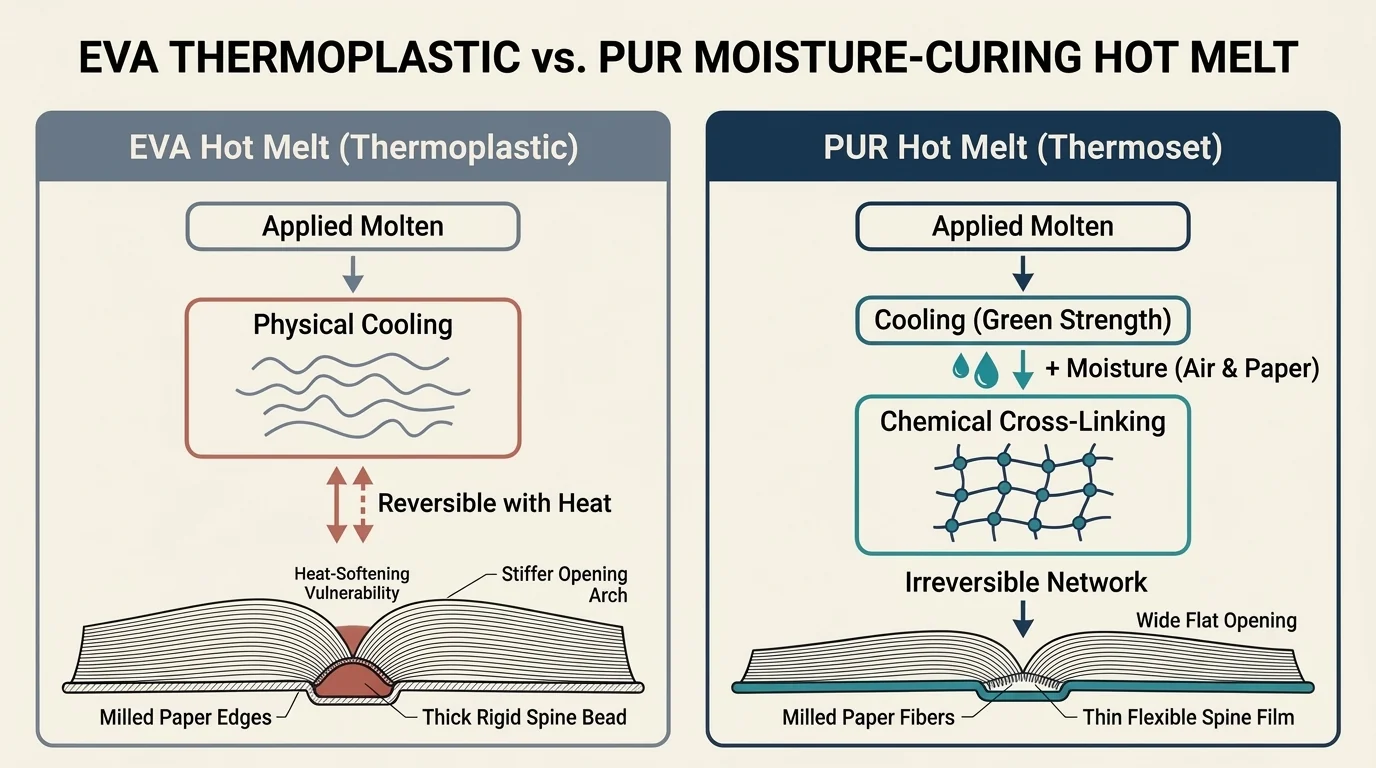
| Binding property | PUR reactive hot melt | EVA thermoplastic hot melt |
|---|---|---|
| Curing mechanism | Molten cooling for green strength followed by irreversible moisture cross-linking | Reversible physical solidification on cooling with no chemical cross-linking |
| Polymer base | Low-molecular-weight terminal-isocyanate prepolymer from polyols and MDI | Roughly 30–40% EVA copolymer blended with 30–40% tackifier, 20–30% wax, and 0.5–1.0% stabilizers |
| Application temperature | 90 °C to 140 °C typical melt application window | Near 130 °C (266 °F) typical melting point |
| Service temperature range | −30 °C (−22 °F) to 150 °C (302 °F) after moisture cure | Adequate strength at 30 °C to 50 °C; limited below 60 °C to 80 °C (140 °F to 176 °F) |
| Thermal and solvent stability | Resists heat, chemicals, and printing ink solvents once cross-linked | Low creep resistance under load; softens under heat and turns brittle in cold |
| Bindery run profile | High-end graphic books and long-run automatic binding lines | High-speed, automatic middle-run production requiring rapid setting |
Why do coated stocks and thermal swings fail under EVA where PUR holds flat?
EVA hot melts lose elasticity on non-porous coated sheets and under temperature extremes, causing stiff spines to crack or drop pages when opened wide. PUR maintains an elastic, solvent-resistant thermoset anchor inside milled paper fibers, preserving bond integrity across gloss coated covers, repeated flexing, and storage fluctuations in temperature and humidity.
Spine milling, hinge scoring, and coated-stock adhesion
In commercial perfect binding, folded sections are aligned, milled along the back edge, and notched into the spine so hot adhesive penetrates the paper edge before the wraparound cover is attached and the remaining three sides are face trimmed. On porous uncoated text stock, fast-setting EVA can anchor mechanically into exposed fibers. However, graphic-arts adhesive evaluations confirm that EVA becomes brittle at lower temperatures and with non-porous materials, while spine elasticity directly governs both binding strength and flat-opening behavior.
Heavy coated papers, varnished covers, and high-ink spreads restrict mechanical wicking and expose the spine film to printing ink solvents. Cured PUR resists ink solvents and chemicals while retaining high flexibility, which is why federal procurement documents specify PUR for heavy-use publications. For example, a U.S. Government Publishing Office perfect-binding specification pairs an 80 lb White No. 1 Gloss Coated Cover (basis size 20 x 26 in, JCP Code L11) with PUR perfect binding along the left 11-inch edge and cover hinge scores approximately 3/16 inch from the bind on both front and back covers so finished manuals survive extensive handling without page separation.
Temperature and ink-solvent exposure across shipping and use
Finished books and commercial catalogs encounter repeated temperature and humidity swings across warehousing, parcel trucks, and end-user handling. Graphic-arts aging studies note that thermal, light, and moisture exposure weakens adhesive bonds and erodes elasticity over time. Because standard EVA offers adequate load-bearing strength mainly between 30 °C (86 °F) and 50 °C (122 °F), exhibits low creep resistance under load, and reaches its thermal ceiling below 60 °C to 80 °C (140 °F to 176 °F), warm transport containers can soften an EVA spine while winter transit turns it brittle. Cross-linked PUR extends service stability across −30 °C (−22 °F) to 150 °C (302 °F) without remelting.
How does PUR formulation control open time, green strength, and full cure?
PUR formulation balances competing processing properties: open time to position covers accurately, green strength to hold pages right off the binder, and moisture diffusion to finish cross-linking. Polyol chemistry, melt viscosity, and crystalline or elastomeric modifiers determine how quickly a PUR film sets and how evenly it cures.
Polyol chemistry, melt viscosity, and open-time modifiers
Open time is the working window during which a molten hot-melt adhesive retains sufficient tack to form a bond, ranging from seconds in fast-setting formulations upward depending on polymer crystallinity and cooling rate. Because reactive PUR prepolymers are engineered for low melt viscosity to simplify application, they inherently have lower initial molecular weight and lower green strength right after cooling than non-reactive hot melts, as detailed in polycarbonate-polyol HMPUR research.
Formulators tune apparent melt viscosity—measured under ASTM D3236-15 using a Brookfield Thermosel viscometer—to match equipment shear and substrate wetting. Across working temperatures of 120 °C to 190 °C, melt viscosities between 5,000 and 10,000 mPa·s suit spray dispensing, whereas viscosities above 10,000 mPa·s (and up to 100,000 mPa·s on specialized equipment) support roller or curtain coaters. Adding crystalline polyester diols accelerates initial adhesion but substantially shortens open time, while incorporating 10–15 wt.% thermoplastic polyurethane (TPU) or rosin derivatives raises melt viscosity and boosts green strength at room temperature and after accelerated cooling.
| Formulation lever | Effect on open time and green strength | Trade-off to monitor |
|---|---|---|
| Polyester polyols | Add crystalline structure, high tensile strength, and elevated heat resistance | Limited hydrolytic stability under prolonged moisture exposure |
| Polyether polyols | Improve spine flexibility, handling ease, and hydrolytic and chemical resistance | Susceptible to oxidation under ultraviolet light exposure |
| Polycarbonate polyols (PPC) | Increase cohesion, thermal aging stability, and humidity resistance without losing flexibility | More complex and costly synthesis than standard polyester or polyether polyols |
| Crystalline polyester diols | Deliver rapid initial adhesion and faster physical setting on cooling | Substantially shorten achievable open time and can slow moisture penetration |
| TPU blend (10–15 wt.%) | Improves green strength and early handling tack during cooling | Requires viscosity control so coating uniformity stays stable |
Moisture diffusion and conditioning windows
Curing control remains just as critical after cover nipping. Excessive crystallization inside a PUR formulation hinders moisture penetration into the adhesive layer, and uneven humidity across wide bonded surfaces compromises ultimate bond strength. While initial cooling allows careful movement off the line, full moisture cross-linking requires controlled hold time: laboratory film-lamination protocols cure pressed PUR layers for 24 h, and standardized peel-strength conditioning holds PUR joints for 72 h at 23 °C and 50% relative humidity before destructive pull testing.
Why do PUR binding lines require closed melters and isocyanate controls?
Unlike EVA pellets melted in an open glue pot, reactive PUR hot melt begins curing as soon as molten adhesive meets humid room air. Bindery lines therefore use sealed moisture-barrier cartridges or heated-platen drum melters under inert dry gas, enclosed hoses and nozzles, and workplace controls for isocyanate vapors.
Every reactive PUR prepolymer carries an excess of free isocyanate groups (-NCO) required to react with water vapor after application. In polymer synthesis and packaging, PUR prepolymers are prepared under an inert nitrogen atmosphere at 90 °C and sealed immediately inside moisture-tight cartridges to prevent premature skinning or gelation. At production scale, bulk drum melters use a heated platen pressed onto solid adhesive slugs to melt only the active dispensing face, pumping molten PUR through sealed heated hoses to an enclosed applicator head or slot nozzle. That closed path prevents moisture contamination inside the melt reservoir while delivering a controlled thin film onto the milled spine.
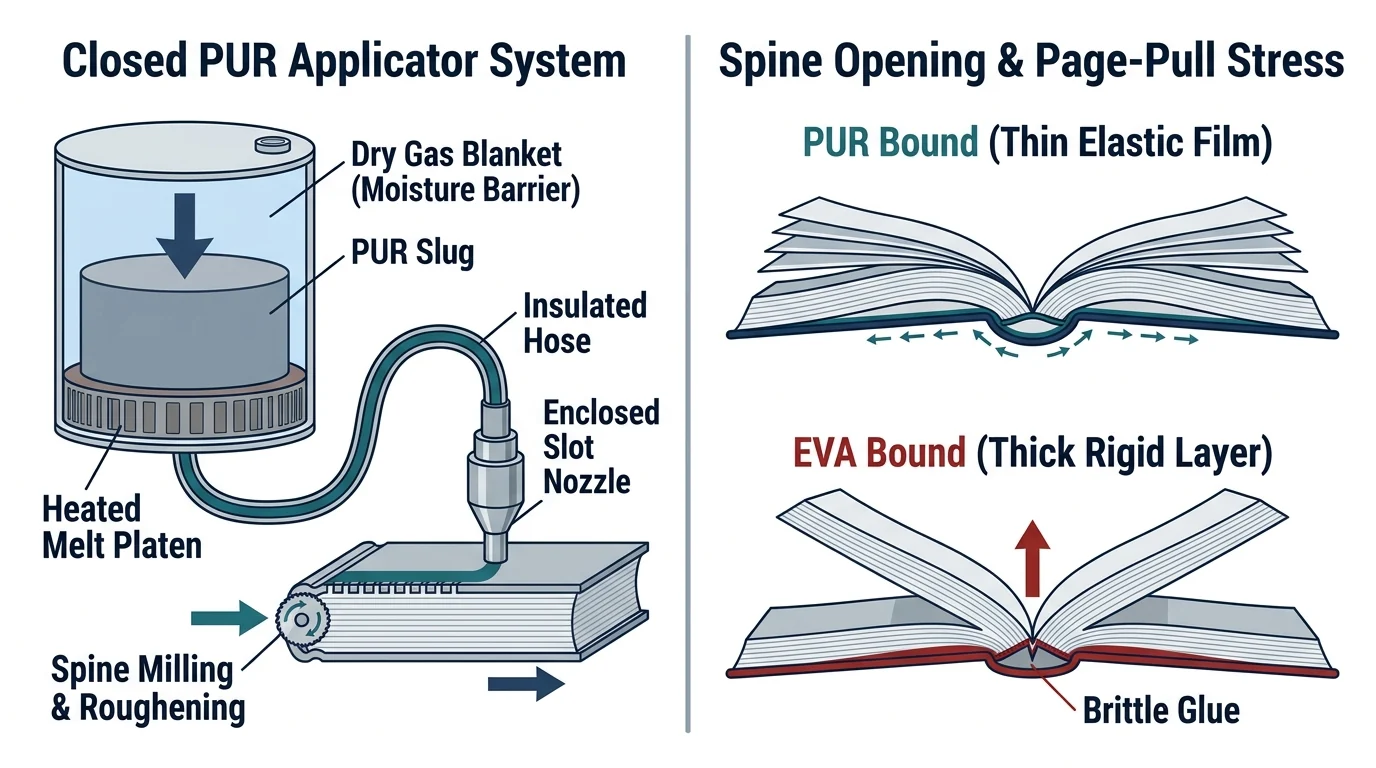
Closed melting systems also protect operators from airborne chemical hazards. According to the U.S. Occupational Safety and Health Administration (OSHA) overview on isocyanates, compounds containing the isocyanate group (-NCO) are the foundational raw materials in polyurethane adhesives and laminated products, and hazardous workplace exposure causes occupational asthma, other lung problems, and irritation of the eyes, nose, throat, and skin. Keeping melter heads enclosed, avoiding thermal degradation of molten polyurethane, and following general-industry workplace exposure controls align with federal isocyanate hazard standards.
How should print buyers weigh PUR curing hold against EVA turnaround?
Print buyers should match the adhesive to substrate difficulty, handling life, and schedule slack rather than defaulting to either chemistry. EVA wins on rapid setting, simpler open-pot equipment, and lower material overhead for short-lived uncoated jobs, whereas PUR justifies higher adhesive and equipment costs whenever coated stocks, flat lay, or wide climate transit dominate.
Reactive PUR is a 100% solid, single-component hot-melt system that eliminates solvent-evaporation ovens and water drying steps, enabling automated single-side application alongside conventional hot-melt binders. However, graphic-arts production research highlights clear operational boundaries: EVA is suited to automatic middle-run jobs where immediate inline trimming and fast throughput matter, while PUR commands higher adhesive cost and dedicated curing-grade application hardware plus post-binding hold time for moisture cross-linking. Choosing the print route and paper stock earlier in the commercial printing workflow—including weighing sheet behavior from flexographic versus offset printing—ensures grain direction, ink coverage across the spine, and cover varnishes are settled before bindery adhesive selection.
Use the job-planning table below to record the binding decision before releasing prepress files and scheduling shipping cartons or booklet versus catalog envelopes.
| Job specification check | Specify PUR hot melt | Specify EVA hot melt |
|---|---|---|
| Interior paper and ink load | Heavy coated, glossy, or dense full-bleed spreads crossing the gutter | Uncoated or lightly inked porous text stocks that allow mechanical penetration |
| Cover construction | Heavy gloss-coated or varnished covers paired with 3/16-inch hinge scores | Standard cover weights on short-lived promotional or trade editions |
| Opening and durability target | Wide lay-flat manuals, reference catalogs, and heavy repeat handling | Standard paperback or short-cycle periodicals with moderate flex demand |
| Climate and freight exposure | Hot trailers, cold winter freight, or humid warehousing (−30 °C to 150 °C range) | Indoor, climate-moderate distribution staying well below 60 °C |
| Turnaround and bindery schedule | Schedule allows post-bind moisture cure hold before heavy stress or packing | Tight same-day trimming and immediate boxing require fast physical set |
| Line capability and safety | Closed drum or cartridge melter, moisture barrier, and isocyanate exposure controls | Standard open-pot hot-melt binder without moisture-barrier melter hardware |
Where else beyond bookbinding is PUR hot melt adhesive used?
Beyond perfect-bound books and catalogs, reactive PUR hot melt serves high-durability bonding across textile lamination, footwear assembly, woodworking, automotive interiors, electronics, filters, and structural packaging lamination. In every sector, converters adopt PUR when solvent-free processing must combine rapid initial fixation with irreversible heat, chemical, and moisture resistance.
Materials studies confirm that reactive PUR is widely used in fabric lamination, railway transportation, automobiles, furniture, and wood processing because its 100% solid, monocomponent chemistry avoids organic solvents while delivering tunable mechanical properties. In double-sided film-and-fabric lamination research, PUR preheated to 130 °C and molded under a 3000 N press load produces flexible composite layers after a 24 h cure.
In packaging converting, a system-level review of packaging adhesives and sealants notes that adhesives act as structural interfacial elements transferring stress across multilayer laminates under mechanical loading, thermal cycling, and environmental exposure. Conventional hot melts—nearly half of EVA volume—dominate high-speed corrugated case and carton flap closing, whereas reactive polyurethane chemistries address demanding lamination and structural interfaces, paralleling the material trade-offs seen when comparing pressure-sensitive versus wet-glue labeling systems. Where packaging contacts or encloses food, U.S. regulation 21 CFR § 175.105 permits specified polyurethane resins and ethylene-vinyl acetate polymers provided the finished adhesive container bears food-packaging labeling and packaging seams or laminates remain firmly bonded without visible separation under normal conditions of use.
Frequently Asked Questions
Can cured PUR hot melt adhesive be remelted to repair a spine?
No. Once excess isocyanate groups react with ambient or paper moisture, PUR transforms into a permanently cross-linked thermoset polymer that will not flow again on reheating, unlike thermoplastic EVA or linear TPU.
Why do standard EVA bindings crack in cold transit or soften in hot storage?
EVA solidifies purely by physical cooling, exhibits low creep resistance under load, stays limited to service temperatures below 60 °C to 80 °C, and turns brittle at lower temperatures and on non-porous coated stocks.
How long should PUR-bound books or laminates condition before heavy stress testing?
Initial handling strength forms during cooling, while moisture cross-linking continues over hours to days. Peer-reviewed test protocols hold PUR film laminates for 24 h and condition bonded peel joints for 72 h at 23 °C and 50% relative humidity.
What workplace hazard makes ventilation and sealed handling essential on PUR lines?
Reactive PUR prepolymers contain free isocyanate groups (-NCO). OSHA identifies isocyanate exposure during polyurethane adhesive manufacturing and heating as a cause of occupational asthma, lung problems, and eye, nose, throat, and skin irritation.
Does federal food-packaging regulation address polyurethane and EVA adhesives?
Yes. Under 21 CFR 175.105, permitted adhesives for food packaging include specified polyurethane resins and ethylene-vinyl acetate polymers, provided packaging seams or laminates stay firmly bonded without visible separation under normal use.
Sources
- Enhanced Green Strength in a Polycarbonate Polyol-Based Reactive Polyurethane Hot-Melt Adhesive (Polymers (PubMed Central))
- Sustainable Reactive Polyurethane Hot Melt Adhesives Based on Vegetable Polyols for Footwear Industry (Polymers (PubMed Central))
- Elasticity and Aging Resistance of Polyvinyl Acetate Bookbinding Adhesive (University of Zagreb Faculty of Graphic Arts (PubMed Central))
- Adhesives and Sealants in Packaging: Functional Roles and System-Level Classification (Part I) (PubMed Central)
- Reactive Polyurethane Hot-Melt Adhesive Performance in Film and Fabric Lamination (PubMed Central)
- Binding Specification for Polyurethane Reactive Perfect Binding (U.S. Government Publishing Office)
- Isocyanates — Overview (Occupational Safety and Health Administration)
- 21 CFR § 175.105 — Adhesives (Electronic Code of Federal Regulations (Cornell LII))
- Hot-melt adhesive — Polymer chemistry and processing overview (Reference technical overview)
- Bookbinding — Commercial perfect binding overview (Reference technical overview)