EnvelopesComparison
Booklet vs. Catalog Envelopes: Open-Side vs. Open-End Flaps, Side Seams, and Expansion Gussets
Compare open-side booklet envelopes, open-end catalog envelopes, side and center seams, paper grain direction, expansion gussets, inserter clearances, and postal flat rules.
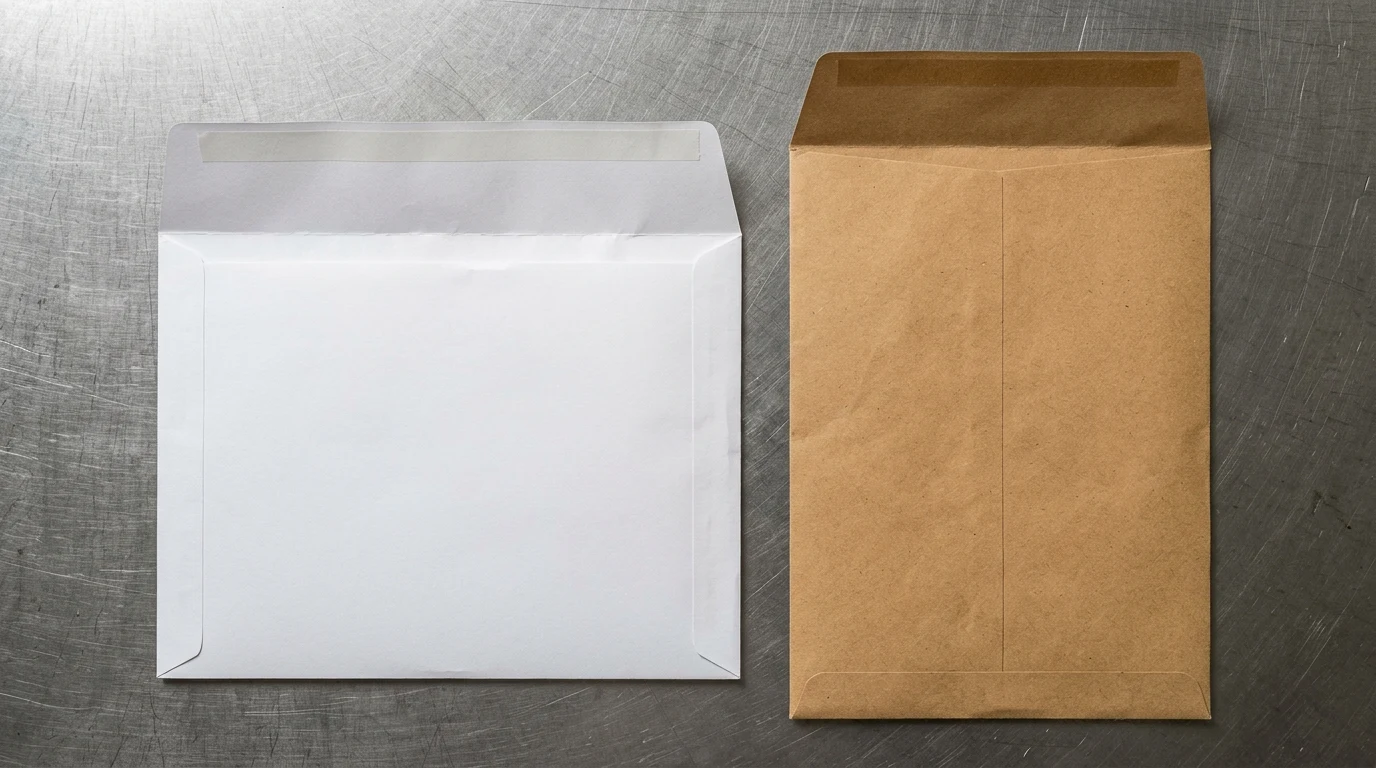
The EMA Guide defines an open side envelope as having the seal flap and opening on the longest side or top of the envelope, and an open-end envelope as having the side (shorter dimension) open. The EMA Glossary defines a Booklet as an open side, double side seam envelope, usually having a wallet style flap, and notes that the most popular size is 9 x 12. The EMA Glossary defines a Catalog Envelope as an open end center seam envelope with the seal flap on the short dimension, noting that catalog envelopes with a single side seam are not commonly used but are available upon special order. Envelopes are measured width first then length, where width is referred to as the end and length as the side; a 6“ x 9“ envelope is six inches wide and nine inches long, a standard #10 is usually open side, and a standard 9“ x 12“ flat is usually open-end. Expansion envelopes are measured using three dimensions (width x length x expansion), where the expansion part is called a gusset and is a separate measure not part of the length of the envelope.
Selecting between open-side booklet pockets, open-end catalog pockets, and gusseted formats requires matching flap orientation, seam construction, paper grain direction, and inserter clearances to the mailing workflow. For background on how paper webs and die-cut blanks are scored, folded, and gummed during production, see the envelope manufacturing and materials overview.
Flap Orientation, Paper Grain Direction, and Converting Routes
Folding against the paper grain can result in cracking and curling; the EMA Guide specifies that paper grain should run the long way on an open end envelope, the short way on an open side booklet envelope, and diagonally on an open side diagonal seam envelope. The EMA Guide states that diagonal seam envelopes are usually cut from a die press and folded on a folding machine, while side seam envelopes are more often created through a web of paper feeding through a die cutting unit mounted on a folding machine. The EMA Guide states that normal machinery variances in the envelope manufacturing industry are +/- 1/16“. Tension explains that open-end envelope flats (typically 9“ x 12“ or 10“ x 13“) have their openings and flap on the shorter dimension and are normally well suited for hand inserted applications, whereas open-side envelope flats have their opening and flap on the longer dimension and, because open-side flaps are typically shorter, are often well suited for automatically inserted applications. For a step-by-step trace of web-fed rotary converting versus blank-fed folding stations, see how envelopes are made, step by step.
Side Seams, Center Seams, and Back-Panel Printing
Closed seam construction has at least three folds and two overlapping edges with seam gumming confined to the overlapping areas, making the entire inside available for insertion and making it the strongest form least susceptible to breaking or popping during mail processing. The EMA Glossary defines Side Seam as a seam that runs perpendicular to the envelope opening, Side Seam Inside as when the side seam folds UNDER the bottom flap, and Side Seam Outside as when the side seam folds OVER the bottom flap. The EMA Glossary defines a Document Envelope (sometimes referred to as legal envelopes) as large, open side, double side seam outside, hex flap envelopes produced from heavy manila or brown kraft stock with heavy seal gum.
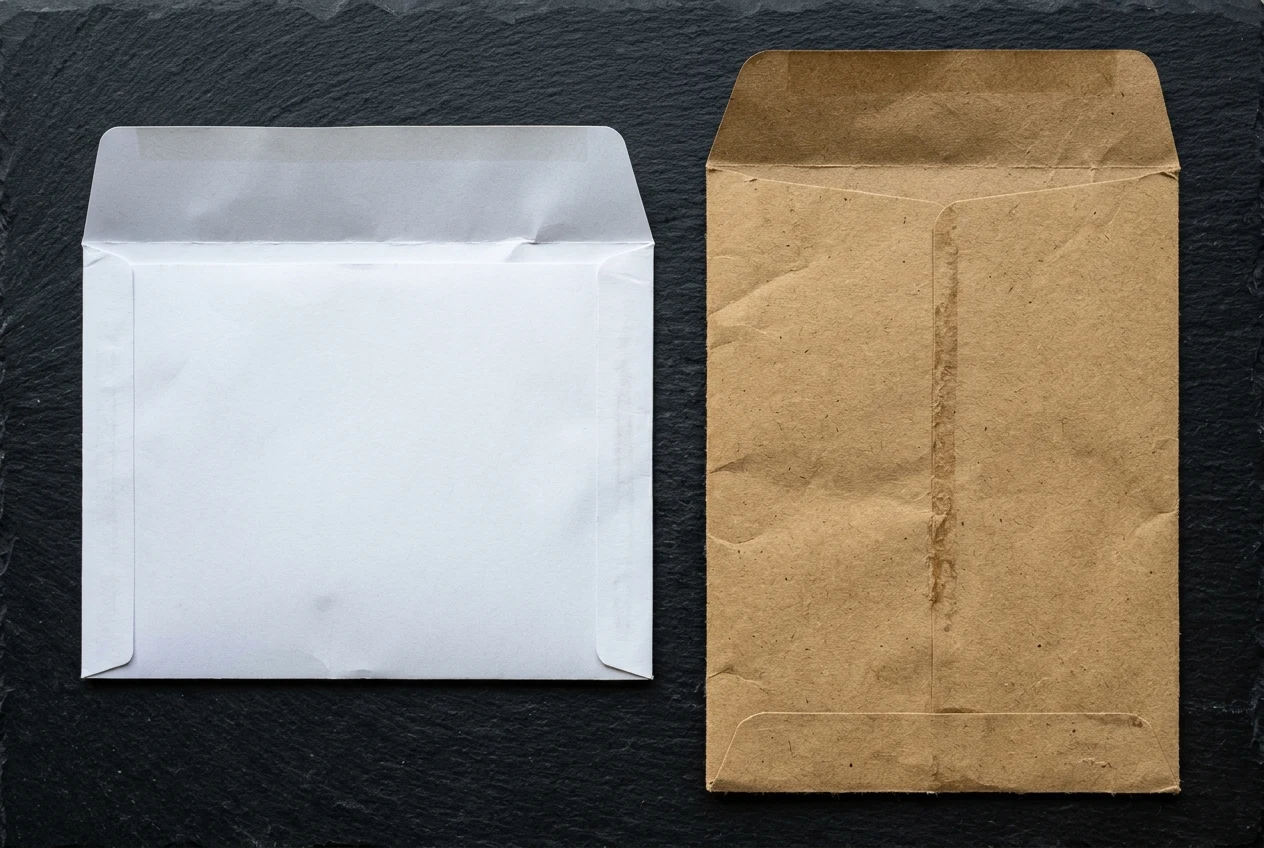
Tension states that double side seams run vertically along the back (insertable) side of an open side envelope and tuck underneath both sides of the back panel, making them ideal for printing transpromotional messages or copy on the outer envelope, and that side seams can be manufactured on either web or die cut converting equipment. On 6x9 envelopes, Tension states that concealed side-seam construction lends itself to overall printing because the entire back of the envelope is dedicated to the message, whereas full-width printing on the back is not possible with diagonal seams. Tension states that diagonal side seams are manufactured on die cut equipment (ideal for smaller order quantities of under 100,000 envelopes) and are not recommended for printing on the back of the envelope because ink can overlay too heavily on the seams.
Tension states that center seams are found on open end envelopes (such as catalog, policy, or coin envelopes) and provide added strength for heavier inserts, while single side seams on open end envelopes allow for a larger back printing area, and that larger open end center seam and side seam envelopes are not ideal for automatic insertion. Sheppard Envelope’s Simple Printing Guidelines for its print-from-stock program specify that copy must have no bleeds, no wraps, no large blocks of color, and no subtle gradients/tints, with halftones at 5% min/80% max density (110 linescreen) and all content at least 1/4“ in from any edge. To compare inline flexographic printing against flat-blank offset lithography for envelope graphics, consult the custom printed envelopes flexo vs. offset litho guide.
| Envelope Style or Seam Type | Seam Fold and Position | Converting or Flap Detail | Printing and Insertion Fit |
|---|---|---|---|
| Booklet Envelope (EMA Glossary) | Open side, double side seam envelope | Usually having a wallet style flap | Most popular size is 9 x 12 |
| Catalog Envelope (EMA Glossary) | Open end center seam envelope; single side seam available upon special order | Seal flap on the short dimension | Single side seam not commonly used |
| Document Envelope (EMA Glossary) | Large, open side, double side seam outside | Hex flap with heavy seal gum | Produced from heavy manila or brown kraft stock |
| Double Side Seam (Tension Seams Guide) | Seams run vertically along the back side and tuck underneath both sides of the back panel | Open side envelope on web or die cut converting equipment | Ideal for printing transpromotional messages or copy on the outer envelope |
| Diagonal Side Seam (Tension Seams Guide) | Seams run diagonally across the back side of an open side envelope to the top of the throat | Manufactured on die cut equipment for smaller order quantities of under 100,000 envelopes | Not recommended for printing on the back of the envelope because ink can overlay too heavily on the seams |
| Center Seam and Open-End Side Seam (Tension Seams Guide) | Center seams on open end envelopes provide added strength; single side seams allow a larger back printing area | Found on catalog, policy, or coin envelopes | Larger open end center seam and side seam envelopes are not ideal for automatic insertion |
Booklet and Catalog Envelope Sizes, Enclosures, and Trade Numbers
Tension’s Booklet Envelopes Size Chart lists the 6 envelope at 5.75 x 8.875 inches with a maximum enclosure of 5.5 x 8.625 inches, the 6-1/2 envelope at 6 x 9 inches with a maximum enclosure of 5.75 x 8.75 inches, and the 6-5/8 envelope at 6 x 9.5 inches with a maximum enclosure of 5.75 x 9.25 inches. Tension’s Booklet Envelopes Size Chart lists the 9 booklet envelope at 8.75 x 11.5 inches (8.5 x 11.25 inches maximum enclosure), the 9-1/2 booklet envelope at 9 x 12 inches (8.75 x 11.75 inches maximum enclosure), and the 10 booklet envelope at 9.5 x 12.625 inches (9.25 x 12.375 inches maximum enclosure). The EMA Guide notes that a 6 x 9 booklet envelope is frequently used as a container for newsletters printed on 8 1/2 x 11 stock and folded in half so they can be sent at a lower cost letter mail rate rather than a higher cost flat rate. Tension states that a 9x12 envelope is typically designed as an open-side, booklet envelope to accommodate bulkier correspondence or full-sized papers and permit high speed, automatic insertion, with options including brown Kraft, white wove, Tyvek, expansions, Touch-N’-Seal latex closures, or Peel ’N Seal closures.
Tension’s Catalog Envelopes Size Chart states that catalog envelopes are open-end, center-seam or single side seam envelopes with the seal flap on the short dimension, and lists three standard sizes: 6 x 9 inches (5.75 x 8.75 inches maximum enclosure), 9 x 12 inches (8.75 x 11.75 inches maximum enclosure), and 10 x 13 inches (9.75 x 12.75 inches maximum enclosure). Tension states that larger 10x13 envelopes can be either an open-end or open-side design with either center or side-seam construction to handle bulky items that cannot be folded, such as catalogs, insurance information, medical files, and X-ray folders. The peer catalog envelope guide maps common open-end catalog sizes to wholesale trade numbers: 6 x 9 in is trade number #55, 6.5 x 9.5 in is #63 (over the 6 1/8 inch letter height, so it mails as a flat), 9 x 12 in is #90 (holding roughly twenty to twenty five sheets of bond), 9.5 x 12.5 in is #93, 10 x 13 in is #97, and 12 x 15.5 in is #110. To compare these booklet and catalog formats against commercial business and announcement pockets, see the commercial envelope sizes guide and the types of mailing envelopes guide.
| Format Category | Finished Envelope Dimensions | Enclosure Dimensions | Reference Scope |
|---|---|---|---|
| Booklet 6, 6-1/2, and 6-5/8 (Tension Size Chart) | 6 at 5.75 x 8.875 inches; 6-1/2 at 6 x 9 inches; 6-5/8 at 6 x 9.5 inches | 5.5 x 8.625 inches (6); 5.75 x 8.75 inches (6-1/2); 5.75 x 9.25 inches (6-5/8) | Maximum enclosure in Tension Booklet Envelopes Size Chart |
| Booklet 9, 9-1/2, and 10 (Tension Size Chart) | 9 at 8.75 x 11.5 inches; 9-1/2 at 9 x 12 inches; 10 at 9.5 x 12.625 inches | 8.5 x 11.25 inches (9); 8.75 x 11.75 inches (9-1/2); 9.25 x 12.375 inches (10) | Maximum enclosure in Tension Booklet Envelopes Size Chart |
| Catalog 6 x 9, 9 x 12, and 10 x 13 (Tension Size Chart) | 6 x 9 inches; 9 x 12 inches; 10 x 13 inches | 5.75 x 8.75 inches (6 x 9); 8.75 x 11.75 inches (9 x 12); 9.75 x 12.75 inches (10 x 13) | Open-end, center-seam or single side seam with seal flap on short dimension |
| Wholesale Catalog Trade Numbers | 6 x 9 in (#55); 6.5 x 9.5 in (#63); 9 x 12 in (#90); 9.5 x 12.5 in (#93); 10 x 13 in (#97); 12 x 15.5 in (#110) | #90 holds roughly twenty to twenty five sheets of bond | #63 is over the 6 1/8 inch letter height, so it mails as a flat |
Automated Mail Inserter Clearances and Throughput
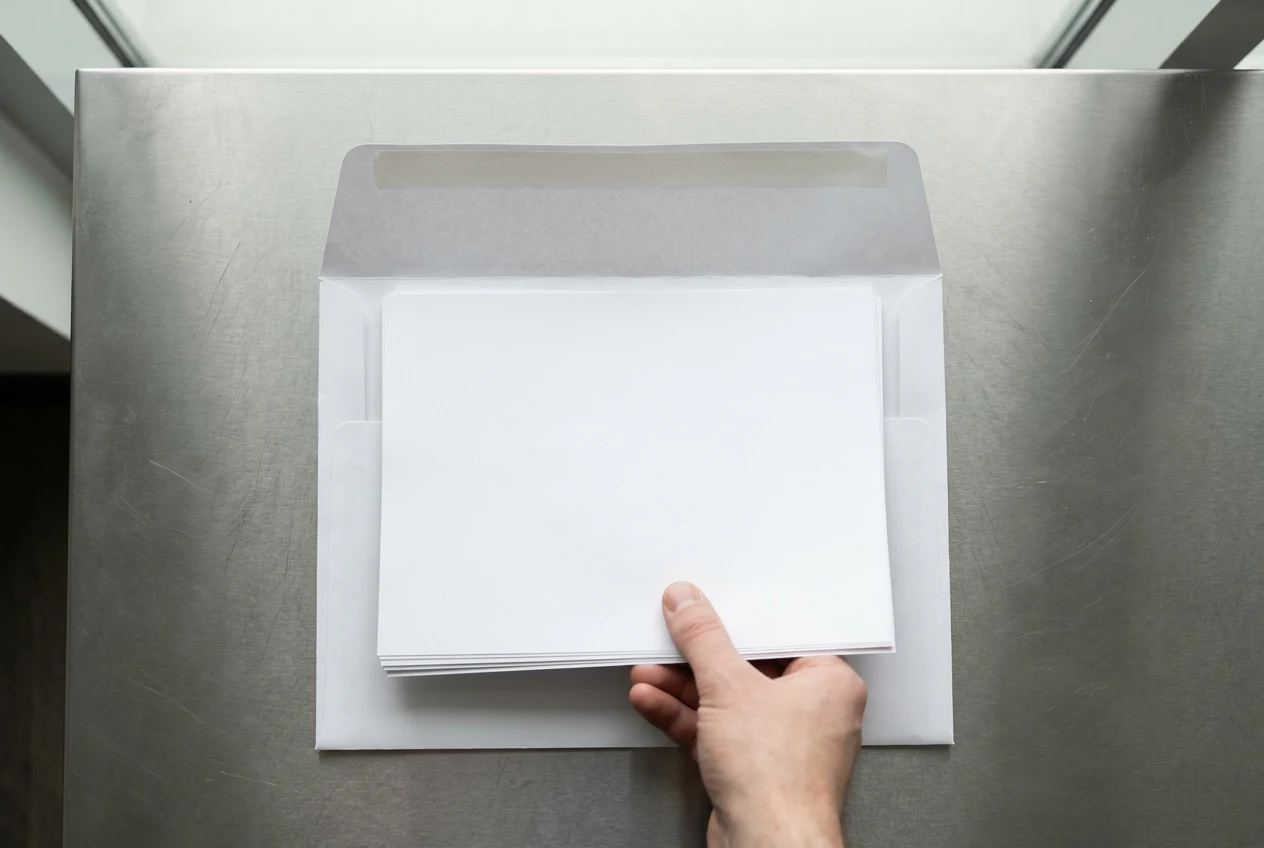
The DMI Inserter specification table lists a speed up to 4000 inserts/hour, filling capacity up to 12 mm (1/2“), envelope size from 105 x 225 mm (4.33“ x 8.8“) to 353 x 353 mm (13.9“ x 13.9“), envelope weight from 75 gsm (20 lb Bond) to 110 gsm (28 lb Bond), and insert size from 89 x 160 mm (3.5“ x 6.3“) to 300 x 315 mm (11.8“ x 12.4“). In the Detailed Envelope Specification table (all measurements in mm and inches), side clearance C is minimum 12 mm, flap length G and H are 27 to 65 mm (1 1/16“ to 2 1/2“), and throat depth I is 5 to 35 mm (up to 1 3/8“). The Filling Capacity formula specifies required envelope width clearance as Clearance = 16 mm (0.63“) (Measurement C) + (thickness of the inserts - 5 mm (0.2“)), where 5 mm (0.2“) insert thickness is default included in the 16 mm (0.63“) measurement C, and for inserts less than 3 mm (.12“), 12 mm clearance is the minimum allowed.
On the Pitney Bowes DI880 DMI inserter (inch-format guidelines), open side envelopes usually perform best: 9 x 12“ envelopes are suggested for 8 1/2 x 11“ inserts (larger if running thicker inserts up to 1/2 inch); for folded 8 1/2 x 11“ or flat 5 1/2 x 8 1/2“ inserts in open side envelopes, envelope width must be at least 9 1/4“ due to measurement C (so 6 x 9“ cannot be used); and for open-end envelopes with 8 1/2 x 11“ inserts, 9 x 12“ envelopes cannot be used due to measurement C (9 1/2 x 12 1/2“ or similar is preferred). For open-end “pocket/catalog” envelopes run on the inserter, centre seam is recommended and throat depth measurement I must be within specification. In the Speed Guidelines table, C4/Flats (Wallet / open-side booklet) run at 3,400 insertions/hour at High Speed (inserts under 1 mm), 2,400 insertions/hour at Medium Speed (1 mm – 3 mm), and 1,700 insertions/hour at Low Speed (over 3 mm), whereas C4/Flats (Pocket / open-end catalog) run at 2,000 insertions/hour at High and Medium Speed and 1,200 insertions/hour at Low Speed. In the Detailed Envelope Specification for Sealing Methods, seal adhesive (gum) activated by moistening is the recommended sealing method; strip and grip (release tape applied over a sticky adhesive) can only be used for inserting in no-sealing mode after testing, and self-adhering latex cannot be used. For a comparison of moisture-activated dextrin gum, two-band latex, and peel-and-seal release liners, see the self-seal vs. gummed envelopes guide.
| Inserter Parameter Group | Dimensional or Speed Range | Weight or Throat Scope | Reference Table |
|---|---|---|---|
| DMI Inserter Envelope and Insert Range | Envelope 105 x 225 mm (4.33“ x 8.8“) to 353 x 353 mm (13.9“ x 13.9“); insert 89 x 160 mm (3.5“ x 6.3“) to 300 x 315 mm (11.8“ x 12.4“) | Speed up to 4000 inserts/hour; filling capacity up to 12 mm (1/2“); envelope weight 75 gsm (20 lb Bond) to 110 gsm (28 lb Bond) | DMI Inserter specification table |
| Detailed Envelope Measurements (C, G, H, I) | Side clearance C minimum 12 mm; flap length G and H 27 to 65 mm (1 1/16“ to 2 1/2“) | Throat depth I 5 to 35 mm (up to 1 3/8“) | Detailed Envelope Specification table |
| C4/Flats Speed Guidelines (Wallet vs. Pocket) | C4/Flats (Wallet) at 3,400 insertions/hour (under 1 mm), 2,400 insertions/hour (1 mm – 3 mm), and 1,700 insertions/hour (over 3 mm) | C4/Flats (Pocket) at 2,000 insertions/hour (High and Medium Speed) and 1,200 insertions/hour (Low Speed) | Speed Guidelines table |
Double Scores and Gusseted Expansion Envelopes
The peer catalog envelope guide states a sizing rule of a half inch larger than the contents in both directions and notes that a plain catalog envelope holds about a quarter inch of paper before the seam takes real strain, past which an expansion envelope with a 1 inch or 2 inch gusset in the sides and bottom should be ordered. Tension’s Glossary defines a Double Score as an additional score line placed 1/8“ to 1/4“ up from the regular seal flap to allow the envelope to accommodate thicker contents, and a Double Side Seam as a seam on an open side envelope where the seams tuck underneath the back panel. Tension’s Glossary defines an Expansion Score as a prepared line on the side seam of an Expansion Envelope to allow it to hold more content, and a Wallet Flap as a straight, deep flap with a wide gummed area that offers reliable document protection.

The EMA Glossary states that gussets in an Expansion Envelope allow it to be expanded to accommodate books, binders, manuscripts, and other bulky items, and that expansion envelopes are made in both open end and open side styles, most commonly of 40lb. Kraft paper. Sheppard Envelope’s Paper Expansion Envelopes Brown Kraft (Open on long dimension) are open-side (“booklet”, opens on long dimension), V-bottom style, 100% recyclable brown kraft envelopes with Peel n Seal closure, priced from $0.780 through $1.816 in stock sizes 4-3/8 x 9-1/2 x 1-1/2, 10 x 12 x 1-1/2, 10 x 12 x 2, 10 x 13 x 2, and 10 x 15 x 2 inches. Sheppard Envelope’s Paper Expansion Envelopes Brown Kraft (Open on short dimension) are open-end (“catalog”, opens on short dimension), V-bottom style, Brown Kraft Sub 40 (100% recyclable) envelopes with Peel n Seal closure, priced from $0.880 through $2.736 in stock sizes including 4-1/8 x 9-1/2 x 2, 9 x 12 x 1, 9 x 12 x 2, 10 x 13 x 1-1/2, 10 x 13 x 2, 10 x 15 x 2, 13 x 16 x 4, and 14 x 18 x 2 inches.
| Expansion or Score Option | Dimensional Scope | Construction and Closure | Price or Material Detail |
|---|---|---|---|
| Double Score (Tension Glossary) | Additional score line placed 1/8“ to 1/4“ up from the regular seal flap | Score line up from the regular seal flap | Allows the envelope to accommodate thicker contents |
| Double Side Seam (Tension Glossary) | Seam on an open side envelope | Seams tuck underneath the back panel | Open side envelope seam construction |
| Expansion Envelope Construction (EMA Glossary) | Gussets allow expansion in both open end and open side styles | Accommodates books, binders, manuscripts, and bulky items | Most commonly made of 40lb. Kraft paper |
| Sheppard Open-Side Brown Kraft Expansion Stock | Stock sizes 4-3/8 x 9-1/2 x 1-1/2, 10 x 12 x 1-1/2, 10 x 12 x 2, 10 x 13 x 2, and 10 x 15 x 2 inches | Open-side (“booklet”, opens on long dimension), V-bottom style, Peel n Seal closure | 100% recyclable brown kraft priced from $0.780 through $1.816 |
| Sheppard Open-End Brown Kraft Sub 40 Expansion Stock | Stock sizes including 4-1/8 x 9-1/2 x 2, 9 x 12 x 1, 9 x 12 x 2, 10 x 13 x 1-1/2, 10 x 13 x 2, 10 x 15 x 2, 13 x 16 x 4, and 14 x 18 x 2 inches | Open-end (“catalog”, opens on short dimension), V-bottom style, Peel n Seal closure | 100% recyclable Brown Kraft Sub 40 priced from $0.880 through $2.736 |
Paper Substance Weight and Postal Physical Thresholds
In the envelope trade, Substance Weight (basis weight) is the weight for 500 sheets (a ream) measuring 17“ wide by 22“ long, so Sub 20 means 500 sheets of 17“ x 22“ paper weighs 20 pounds. Under USPS DMM Commercial Physical Standards (Section 3.2 Paper Weight and Exhibit 3.2), envelopes or letter-size mailpieces sealed along all four sides must be made of paper with a minimum 50 pounds book-grade basis weight (500 25-inch by 38-inch sheets) or equivalent, which corresponds to 20-pound bond-grade paper (17 x 22 inch sheets); in the same table, 60-pound book corresponds to 24-pound bond and 70-pound book corresponds to 28-pound bond.
Under USPS DMM Physical Standards for Letters (Section 1.1 Dimensional Standards for Letters), retail letter-size mail is not less than 5 inches long, 3-1/2 inches high, and 0.007-inch thick (0.009 minimum thickness if more than 6 inches long or 4-1/4 inches high), not more than 11-1/2 inches long, 6-1/8 inches high, or 1/4-inch thick, and not more than 3.5 ounces. Under USPS DMM Physical Standards for Letters (Section 1.2 Nonmachinable Criteria), a retail letter-size piece is nonmachinable if its aspect ratio (length divided by height) is less than 1.3 or more than 2.5, if it has clasps, strings, buttons, or similar closure devices, if it is too rigid (does not bend easily under a 40 pounds transport belt tension around an 11-inch diameter turn), or if the delivery address is parallel to the shorter dimension.
Under USPS DMM Physical Standards for Flats (Section 2.1 General Definition of Flat-Size Mail), flat-size mail is more than 11-1/2 inches long, or more than 6-1/8 inches high, or more than 1/4 inch thick, and not more than 15 inches long, 12 inches high, or 3/4 inch thick, and must be flexible, rectangular (corner radius not exceeding 0.125 inch / 1/8 inch), and uniformly thick. Under USPS DMM Physical Standards for Flats (Section 2.4 Uniform Thickness), flat-size mailpieces must be uniformly thick so that any bumps, protrusions, or other irregularities do not cause more than 1/4-inch variance in thickness (excluding 1 inch from each outside edge when contents do not extend into those edges), and nonpaper contents must be secured to prevent shifting of more than 2 inches.
Under USPS DMM Commercial Physical Standards (Section 4.3 Minimum Flexibility for Flat-Size Pieces), commercial flat-size pieces without a rigid insert are flexible if, when extended halfway off a flat surface along their length and pressed 1 inch from the outer edge, they can bend at least 1 inch vertically without being damaged; flats 10 inches or longer containing a rigid insert must bend at least 2 inches vertically when extended 5 inches off the surface. Under USPS DMM Commercial Physical Standards (Section 4.6 Maximum Deflection for Flat-Size Mailpieces), commercial flat-size mailpieces (except high density, high density plus, saturation, and basic carrier route flats) must meet maximum deflection standards: pieces 10 inches or longer extended 5 inches off a flat surface under a certified 5-pound weight must not droop more than 3 inches vertically at either end, and pieces less than 10 inches long extended half their length must not droop more than 2 inches less than the extended length.
| Postal Category | Primary Dimensional Rule | Secondary Physical Rule | Mailpiece Scope |
|---|---|---|---|
| Retail Letter Dimensional Standards (USPS DMM Section 1.1) | Not less than 5 inches long, 3-1/2 inches high, and 0.007-inch thick (0.009 minimum thickness if more than 6 inches long or 4-1/4 inches high) | Not more than 11-1/2 inches long, 6-1/8 inches high, or 1/4-inch thick, and not more than 3.5 ounces | Retail letter-size mail |
| Retail Letter Nonmachinable Criteria (USPS DMM Section 1.2) | Aspect ratio (length divided by height) less than 1.3 or more than 2.5, or delivery address parallel to the shorter dimension | Clasps, strings, buttons, or too rigid under a 40 pounds transport belt tension around an 11-inch diameter turn | Retail letter-size mail |
| Retail Flat Dimensional Standards (USPS DMM Section 2.1) | More than 11-1/2 inches long, or more than 6-1/8 inches high, or more than 1/4 inch thick | Not more than 15 inches long, 12 inches high, or 3/4 inch thick; flexible, rectangular (corner radius not exceeding 0.125 inch / 1/8 inch), and uniformly thick | Retail flat-size mail |
| Flat Uniform Thickness Standards (USPS DMM Section 2.4) | Bumps, protrusions, or other irregularities must not cause more than 1/4-inch variance in thickness | Excludes 1 inch from each outside edge when contents do not extend into those edges; nonpaper contents secured to prevent shifting of more than 2 inches | Flat-size mailpieces |
| Commercial Flat Minimum Flexibility (USPS DMM Section 4.3) | Without rigid insert: bends at least 1 inch vertically when extended halfway off a flat surface and pressed 1 inch from outer edge | Flats 10 inches or longer with rigid insert: bends at least 2 inches vertically when extended 5 inches off the surface | Commercial flat-size pieces |
| Commercial Flat Maximum Deflection (USPS DMM Section 4.6) | Pieces 10 inches or longer extended 5 inches off a flat surface under a certified 5-pound weight must not droop more than 3 inches vertically | Pieces less than 10 inches long extended half their length must not droop more than 2 inches less than the extended length | Commercial flat-size mailpieces |
Booklet, Catalog, and Expansion Envelope Specification Checklist
Before releasing a print order or loading an inserting line, record the following specification details for the converter, printer, and mailing house:
- Opening Orientation and Flap Style: Specify open-side booklet construction with a long-edge wallet flap or open-end catalog construction with a short-edge flap.
- Seam Geometry and Grain Direction: Specify inside double side seams, outside double side seams, diagonal seams, center seam, or single side seam alongside the matching paper grain direction.
- Finished Size and Inserter Side Clearance: Record width-by-length finished pocket dimensions, enclosure clearance, throat depth, flap length, and side clearance for mechanical inserting.
- Thickness Relief and Expansion Depth: Select plain flat construction, double-scored flap folds, or three-dimension gusseted expansion pockets according to stack bulk.
- Paper Stock and Closure Method: Record wove or kraft basis weight and specify moisture-activated gum, peel-and-seal release tape, or self-adhering latex closure according to the insertion method.
- Postal Category Screening: Screen the filled and sealed sample for letter or flat dimensions, address orientation, uniform thickness, flexibility, and deflection before mailing.
Sources
- Envelope Manufacturers Association, The EMA Guide to Envelopes and Mailing
- Tension Envelope, Common Envelope Sizes and Glossary of Envelope Terms
- Tension Corporation, Envelope Basics Seams, Large Format Envelopes, and Mailing Flats Guides
- Sheppard Envelope, Paper Expansion Envelopes Brown Kraft and Simple Printing Guidelines
- Pitney Bowes, DI880 Mail Inserting System Operator Guide
- United States Postal Service, Domestic Mail Manual Physical Criteria for Retail and Commercial Mail
- Four Over Four, Catalog Envelopes Sizing and Gusset Reference
Frequently Asked Questions
How does an open-side booklet envelope differ from an open-end catalog envelope?
The EMA Guide defines an open side envelope as having the seal flap and opening on the longest side or top of the envelope, and an open-end envelope as having the side (shorter dimension) open.
Which direction does paper grain run on booklet and catalog envelopes?
Folding against the paper grain can result in cracking and curling; the EMA Guide specifies that paper grain should run the long way on an open end envelope, the short way on an open side booklet envelope, and diagonally on an open side diagonal seam envelope.
How does flap orientation affect flat envelope selection on a mechanical mail inserter?
On the Pitney Bowes DI880 DMI inserter (inch-format guidelines), open side envelopes usually perform best: 9 x 12" envelopes are suggested for 8 1/2 x 11" inserts (larger if running thicker inserts up to 1/2 inch); for folded 8 1/2 x 11" or flat 5 1/2 x 8 1/2" inserts in open side envelopes, envelope width must be at least 9 1/4" due to measurement C (so 6 x 9" cannot be used); and for open-end envelopes with 8 1/2 x 11" inserts, 9 x 12" envelopes cannot be used due to measurement C (9 1/2 x 12 1/2" or similar is preferred).
When does a mailing switch from a plain catalog envelope to a gusseted expansion envelope?
The peer catalog envelope guide states a sizing rule of a half inch larger than the contents in both directions and notes that a plain catalog envelope holds about a quarter inch of paper before the seam takes real strain, past which an expansion envelope with a 1 inch or 2 inch gusset in the sides and bottom should be ordered.