LabelsComparison
Thermal Transfer vs Direct Thermal Printing
Compare thermal transfer and direct thermal variable-data barcode printing across leuco-dye and ribbon chemistry, printhead geometry, scan reflectance retention, and line economics.
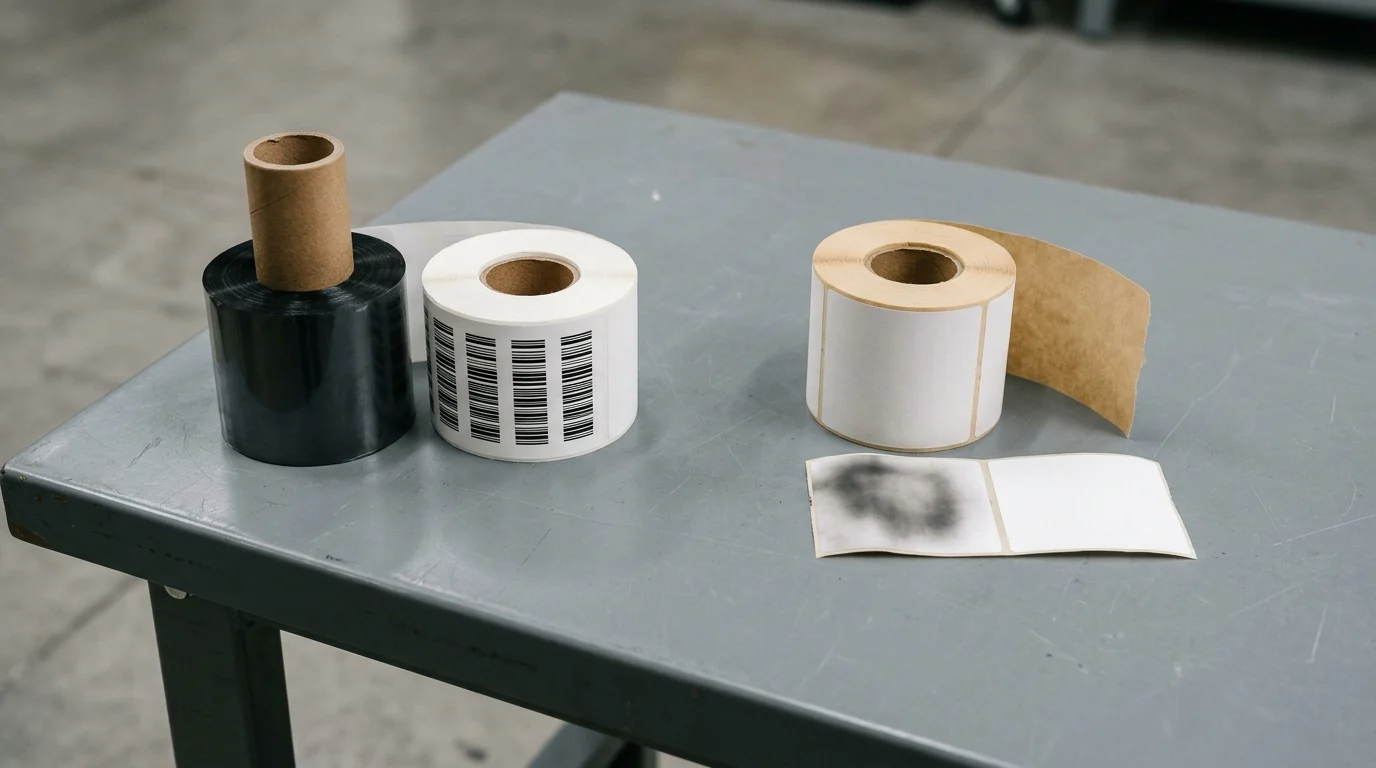
Thermal transfer technology uses a ribbon to transfer an image onto the label material (for indoor or outdoor usage, medium to longterm lifespan, and excellent chemical resistance), whereas direct thermal technology does not require a ribbon and uses a chemically coated heat-sensitive material that produces images as heat is applied to the surface (primarily indoor use, short to medium-term lifespan, minimal chemical resistance). In Zebra’s material naming convention (such as 8000T Piggyback), classification numbers include 500, 1000, 2000, 3000, 4000, 5000, and 8000, while Print Technology is designated by D for Direct thermal and T for Thermal transfer. Zebra media products are classified by their level of performance and cost in the 500-5000 range (where the higher the number, the higher the performance), while 8000 designates specialty products with unique features designed for specialized applications. Zebra R&D laboratories test image abrasion/durability, accelerated outdoor life, adhesion strength on various materials, temperatures from -112ºF / -80ºC to 1,000ºF / 538ºC, material tear strength, harsh chemicals, and printhead life. Zebra converting capabilities include roll-to-roll and fanfolding, RFID inlay insertion, press widths from 7 inches to 17 inches, laminating, die cutting up to three stations, perforations, face slits, back slits, and adhesive deadening and spot coating.
Choosing between ribbon-transfer and ribbonless variable-data printing requires matching the imaging chemistry, printhead geometry, barcode orientation, and adhesive family to the container surface and transit environment. Within our labels and product identification hub, you can pair this printing-process analysis with our sibling guide on direct thermal vs thermal transfer label stock constructions and our substrate overview on paper vs film label materials.
| Process Dimension | Direct Thermal Printing | Thermal Transfer Printing |
|---|---|---|
| Core Imaging Mechanism | Direct thermal technology does not require a ribbon and uses a chemically coated heat-sensitive material that produces images as heat is applied to the surface (primarily indoor use, short to medium-term lifespan, minimal chemical resistance) | Thermal transfer technology uses a ribbon to transfer an image onto the label material (for indoor or outdoor usage, medium to longterm lifespan, and excellent chemical resistance) |
| Zebra Material Naming Convention | Print Technology is designated by D for Direct thermal across classification numbers 500, 1000, 2000, 3000, 4000, 5000, and 8000 | Print Technology is designated by T for Thermal transfer (such as 8000T Piggyback) across classification numbers 500, 1000, 2000, 3000, 4000, 5000, and 8000 |
| Printhead Contact and Lifetime Ratio | Direct thermal requires printhead elements to be in direct contact with the label material, providing an expected lifetime of 25% - 50% of a thermal transfer printhead (replacing the printhead 30 – 60 times across 10 million six-inch long labels) | Thermal transfer uses a ribbon as a buffer between the printhead and the label (many ribbons add a back-coating that reduces static and friction), requiring 15 printhead replacements across 10 million six-inch long labels at an expected thermal transfer printhead life of 4 million inches |
| Linear Printhead Mileage | Typical printhead life spans 1,000,000 to 2,000,000 linear inches (25.4 to 50.8 km), consuming 30 to 60 replacement printheads across 60,000,000 linear inches | A 4.5 um PET ribbon with a 30 to 35 dyn/cm silicone backcoating extends printhead mileage to 2,000,000 to 4,000,000 linear inches (50.8 to 101.6 km), requiring 15 to 30 printhead replacements across 60,000,000 linear inches |
| Media Cost Differential | Eliminating the ribbon eliminates ribbon cost, but direct thermal labels cost more than thermal transfer labels plus ribbon | Total label-plus-ribbon media cost is lower than direct thermal labels, with a cost differential as low as 5% or as high as 50% depending on the media selected, label size, and volumes purchased |
| Healthcare Privacy and Waste Reduction | Direct thermal media is used for prescription labels and patient wristbands to avoid personal information on used ribbon, and a Linerless Kit Option prints self-adhesive labels without backing papers | Patient privacy can be at risk if personal information is available on used thermal transfer ribbon, whereas eliminating poly-based thermal ribbon eliminates ribbon waste |
Thermochemical Leuco-Dye Coatings vs Ribbon Transfer Physics
A conventional thermal recording layer generally contains a color-forming dye, a developer, a binder to hold the coating on the paper, and in some formulations a sensitizer to help control the reaction temperature; when heated by the printhead, the developer donates a proton to the dye, changing its molecular structure and producing a visible image. EPA’s 2014 report identified ODB-2 and Black 305 among common leuco dye examples in thermal paper, noting that formulations vary by grade and supplier. Most leuco dyes are based on lactone structures: in the colorless state the molecular structure is closed and the electron system is limited so no visible color appears, whereas when activated the ring opens, the electron system becomes extended, and the molecule absorbs visible light. In the EU, thermal paper containing BPA at or above 0.02% by weight has been restricted from the market since 2 January 2020 (a concentration restriction rather than a requirement that every product contain zero BPA), and ECHA has reported that BPS has been used as a substitute for BPA.
In direct thermal printing, static discoloration onset begins at 65 to 75 degrees Celsius, while full optical density (OD ≥ 1.30 to 1.50 MacBeth units) develops at 85 to 110 degrees Celsius as the web moves past the printhead at 4 to 10 inches per second (ips), and ambient trailer heat above 55 to 60 degrees Celsius activates the unprinted background. Because the chemical reactants remain inside the paper coating after printing, direct thermal webs are sensitive to environmental heat and organic solvents throughout storage and transit.
Four-Layer Ribbon Architecture, Ink Formulations, and Printhead Geometry
A thermal transfer ribbon comprises four layers: the backcoating closest to the printhead (protecting the printhead from excessive heat, static, and abrasion), the carrier material (the thickest part of the ribbon, offering tear resistance and good heat conductivity), the release coating (bonding the carrier film and the ink so ink transfers evenly and smoothly), and the ink layer (made of wax, resin, or a combination of both). A thermal transfer ribbon comprises a silicone-based backcoating (0.05 to 0.10 um) formulated to a low surface energy of 30 to 35 dyn/cm, a biaxially oriented polyester (PET) carrier film (4.5 um standard for flat-head industrial printers or 4.0 um for near-edge and TTO units up to 2,000 m), a heat-activated release layer (0.1 to 0.5 um), and a pigmented ink layer (2.0 to 4.9 um), bringing total ribbon thickness to 6.6 to 8.6 um.
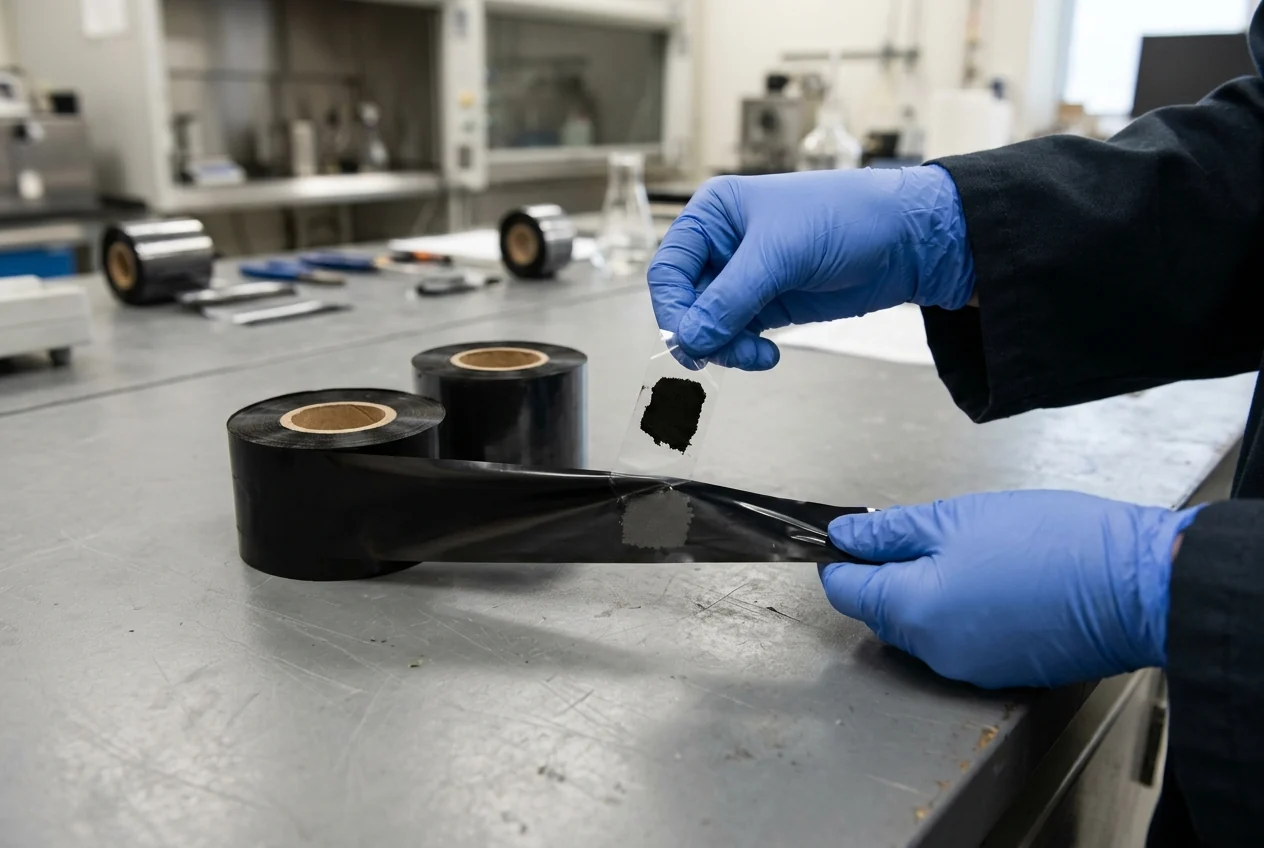
When a thermal transfer ribbon is wound ink side out, the ink is coated on the side of the foil exposed to the outside; when wound ink side in, the ink is coated on the inner part of the foil; when unsure, sticking adhesive tape on each side of the ribbon and pulling it off reveals the ink side where ink sticks to the adhesive (the tape-test). Near-edge and flat-head printers require different ribbons primarily because of the release layer: due to the short exposure time to the printhead, a near-edge ribbon needs to release the ink much faster and is therefore formulated differently from a flat-head ribbon. Thermal transfer ribbons generally come in 4.0 and 4.5 micron base film thicknesses: 4.5 micron is the standard for flat-head ribbons and offers less ribbon breakage when high heat is needed (such as resin ribbons on flat-head printers), whereas 4.0 micron base film for near-edge and TTO ribbons enables longer ribbons up to 2000 meters (less change-overs), higher print sensitivity, higher print speeds, and more than 10% reduction in plastic film waste versus 4.5 micron film. For rotary die-cutting, slitting, and web tension control across these film and paper structures, see our converting equipment overview.
In the Zebra Supplies R&D lab, ribbons are tested on Zebra materials in Zebra printers using a special format that includes small font sizes, intricate regulatory symbols, and rotated barcodes at 203dpi, 300dpi, and 600dpi, and at print speeds from 6ips to 14ips. Zebra Wax ribbons are ideal for paper materials where fast print speeds up to 12ips are required and with little to no chemical/abrasion exposure; Wax/Resin ribbons provide good abrasion and chemical resistance on top-coated paper and matte synthetic materials in moderate to harsh chemical/abrasion exposure; and Resin ribbons provide durability on all synthetic materials and some top-coated labels/tags in harsh to extreme chemical exposure, ultra-high temperatures, and harsh outdoor environments. Full Wax ribbons (2.0 to 3.2 um ink coat, 8.0 um total on Zebra 2100) melt at ~65 degrees Celsius (60 to 80 degrees Celsius) and achieve OD > 1.8 and ~50 rub cycles at 100 g load; Wax/Resin Hybrid ribbons (2.5 to 4.0 um ink coat, 8.6 um total on Zebra 3200) melt at ~75 to 87 degrees Celsius (70 to 90 degrees Celsius) at 6 to 10 ips and achieve OD > 1.8 and ~75 rub cycles at 100 g load; and Full Resin ribbons (2.7 to 4.9 um ink coat, 6.6 um total on Zebra 5100) melt at 95 to 120 degrees Celsius (105 to 112 degrees Celsius typical) at 4 to 6 ips and achieve OD > 1.7 and ~100 rub cycles at 100 g load at 100 degrees Celsius.
Zebra 2100 High-Performance Wax Ribbon has a black ink formulation on a 4.5 microns polyester base film caliper with an 8 microns total caliper, IR and visible light scanning capabilities, and complies with REACH SVHC, RoHS, California Proposition 65, FDA 21 CFR Part 175.300 (Indirect Food Contact), and European Food Directive 1935/2004/EC, and is halogen free, latex free, animal derivatives free, and BP free. In Zebra 2100 Barcode Scannability lab results, 10 or 12 mil normal codes achieve Typical ANSI Grade A up to 304.8mm/sec on coated paper labels/tags and up to 254mm/sec on matte synthetics (and Typical ANSI Grade B up to 152.4mm/sec on uncoated paper), whereas 15 mil rotated codes achieve Typical ANSI Grade B up to 203.2mm/sec on coated paper and up to 152.4mm/sec on matte synthetics. In the high-performance wax ribbon Performance Analysis, barcode scanning received an ANSI Grade B or above after exposure to Glass Cleaner with Ammonia, Formula 409, and Alcohol (90% Isopropyl Alcohol), but dropped to a C to F ANSI grade after Brake Fluid, Gunk Degreaser, and WD-40, with optimal storage conditions of 5°C to 35°C at 20% to 80% RH and a 1 year expected exterior life.
Zebra 3200 Premium Wax/Resin Ribbon has a 4.5 microns polyester base film caliper and 8.6 microns +/- 10% total caliper, IR and visible light scanning capabilities, recommended storage at 72°F (22°C) at 50% RH with a 1 year expected shelf life, and is UL Recognized on Z-Xtreme 4000T (White, Silver, High-Tack), Z-Xtreme 2000T (White, Silver, Clear), and Z-Supreme 3000T White. Zebra 5100 Resin Ribbon has a black resin ink formulation on a 4.5 microns polyester base film caliper with a 6.6 microns +/- 10% total caliper, IR and visible light scanning capabilities, and recommended storage conditions of 72°F (22°C) at 50% RH with a 1 year expected shelf life. On the resin ribbon specification, UL/cUL certified materials include Z-Supreme 2000T, Z-Supreme 3000T, Z-Supreme 4000T, Z-Ultimate 4000T (White, Silver, Removable, High-Tack), Z-Ultimate 3000T (White & Silver), Z-Ultimate 2000T White, and Z-Xtreme 4000T (White, Silver, High-Tack), and the ribbon complies with REACH, RoHS, WEEE, and IEC 61249-2-21 Halogen Free. In the DNP portfolio, R550 resin ribbon (an evolution of R510) produces prints that are resistant for continuous temperatures up to 300°C and are superior in chemical resistance and highly resistant to scratching and abrasion. DNP Imagingcomm America Corporation launched the R380 alcohol-resistant flat-head resin ribbon (engineered for resistance to isopropyl alcohol IPA and ethanol on PET, polyimide, and PVC label materials in medical device and pharmaceutical applications) and the V670 high-performance TTO overprint ribbon (resisting grease, cooking oils, and hot and cold temperature extremes on paper and poly-based flexible packaging substrates).
| Ribbon Specification | Base Film and Total Caliper | Speed, Temperature, or Optical Profile | Durability and Recognition Scope |
|---|---|---|---|
| Ribbon Chemistry Classes (Zebra 2100, 3200, 5100) | Full Wax (2.0 to 3.2 um ink coat, 8.0 um total on Zebra 2100); Wax/Resin Hybrid (2.5 to 4.0 um ink coat, 8.6 um total on Zebra 3200); Full Resin (2.7 to 4.9 um ink coat, 6.6 um total on Zebra 5100) | Full Wax melts at ~65 degrees Celsius (60 to 80 degrees Celsius); Wax/Resin melts at ~75 to 87 degrees Celsius (70 to 90 degrees Celsius) at 6 to 10 ips; Full Resin melts at 95 to 120 degrees Celsius (105 to 112 degrees Celsius typical) at 4 to 6 ips | Full Wax achieves OD > 1.8 and ~50 rub cycles at 100 g load; Wax/Resin achieves OD > 1.8 and ~75 rub cycles at 100 g load; Full Resin achieves OD > 1.7 and ~100 rub cycles at 100 g load at 100 degrees Celsius |
| Zebra 2100 Wax Barcode Scannability | 10 or 12 mil normal codes on coated paper, matte synthetics, and uncoated paper | Typical ANSI Grade A up to 304.8mm/sec on coated paper labels/tags, Grade A up to 254mm/sec on matte synthetics, and Grade B up to 152.4mm/sec on uncoated paper | 15 mil rotated codes achieve Typical ANSI Grade B up to 203.2mm/sec on coated paper and up to 152.4mm/sec on matte synthetics |
| Zebra 3200 Premium Wax/Resin Ribbon | 4.5 microns polyester base film caliper and 8.6 microns +/- 10% total caliper | IR and visible light scanning capabilities; recommended storage at 72°F (22°C) at 50% RH with a 1 year expected shelf life | UL Recognized on Z-Xtreme 4000T (White, Silver, High-Tack), Z-Xtreme 2000T (White, Silver, Clear), and Z-Supreme 3000T White |
| Zebra 5100 Resin Ribbon | Black resin ink formulation on a 4.5 microns polyester base film caliper with a 6.6 microns +/- 10% total caliper | IR and visible light scanning capabilities | Recommended storage conditions of 72°F (22°C) at 50% RH with a 1 year expected shelf life |
| Base Film Caliper (4.5 vs 4.0 Micron) | 4.5 micron is the standard for flat-head ribbons; 4.0 micron base film for near-edge and TTO ribbons | 4.5 micron offers less ribbon breakage when high heat is needed (such as resin ribbons on flat-head printers) | 4.0 micron enables longer ribbons up to 2000 meters (less change-overs), higher print sensitivity, higher print speeds, and more than 10% reduction in plastic film waste versus 4.5 micron film |
Matched Label Facestock Constructions, Peel Adhesion, and Durable Recognition
In Zebra’s adhesive classifications, High-Temp adhesive maintains strong adhesion at high temperatures over 300ºF / 149ºC, Cold-Temp adhesive maintains strong adhesion at low temperatures down to -112ºF / -80ºC, and All-Temp adhesive may be applied to temperatures below freezing (32ºF / 0ºC). Zebra’s Z-Perform 2000D direct thermal white paper label has an all-temperature permanent acrylic adhesive that can be applied to surfaces as cold as -40°F/-40°C and meets FDA 175.105 for indirect food contact requirements, with a protective topcoat delivering optimal print quality when printing up to 8 inches per second while ensuring minimal printhead wear. On this direct thermal paper label (Raw Material Number 65791RM), the facestock is 3.0 mil/76.2 microns direct thermal white smooth coated paper, the adhesive is 0.5 mil/12.7 microns all-temp acrylic adhesive, and the liner is 2.5 mil/63.5 microns 40 lb/59 gsm semi-bleached kraft stock, and it is Not recommended for Acetone, IR Reflow, MEK, TCE, and Xylene. On the Z-Perform 2000D specification, total thickness is 6.0 mil/152.4 microns (+/-10%), it meets FDA 175.105 for food-contact use (dry foodstuffs or functional barrier) and is BPA and latex free, minimum application temperature is -40ºF/-40ºC, service temperature range is -65ºF to 131ºF/-54ºC to 55ºC, and recommended storage is 1 year duration at 72ºF/22ºC at 50% RH. On the Z-Perform 2000D specification, adhesive strength is 17 oz/in (5 minute dwell) and 18 oz/in (24 hour dwell) on corrugate, 49 oz/in (5 minute dwell) on steel, 57 oz/in (5 minute dwell) on polycarbonate, and 26 oz/in (5 minute dwell) and 46 oz/in (24 hour dwell) on polyethylene. In chemical resistance testing for Z-Perform 2000D, Salt Water and Water are rated Test in your application, while Blood, Body Fluid, Window Cleaner, Alcohol, Ammonia, Bleach, IPA, Gasoline, Grease, and Oil are all rated Not recommended.
Zebra Z-Perform 2000T (available in white as 66105RM) is a thermal transfer smooth paper label with a permanent acrylic adhesive, recommended for printing applications up to 14 inches per second, meeting FDA 175.105 for indirect food contact, with a minimum application temperature of 30°F (-1°C), a service temperature of -65°F to 200°F (-54°C to 93°C), optimal storage of 72°F (22°C) at 50% RH, and is Not recommended for outdoor use. On the Z-Perform 2000T specification, the facestock is 2.5 mil white smooth topcoated paper, the adhesive is 0.5 mil permanent acrylic-based adhesive, and the liner is 3.0 mil 40 lb semi-bleached kraft stock for a total thickness of 6.0 mil (±10%), and suggested ribbons are 6000, 2000, and 6100.
Zebra PolyPro 4000T Matte offers wide temperature range performance from -54°C to +120°C, has an adhesive complying with FDA 175.105 for indirect contact with food additives (separated by a functional barrier), is tear and water resistant, and is BPA free and latex free. On the matte polypropylene technical specification, the facestock is 107 microns matte white top coated polypropylene, the adhesive is 25 microns permanent acrylic adhesive, and the liner is 76 microns 62gsm semi-bleached kraft liner for a total caliper of 208 microns ±10%, with Zebra 3200, 4800, and 5095 as recommended ribbons. On the matte polypropylene specification, 180º angle peel adhesion at room temperature (N/m) is 726 N/m (5 min) and 825 N/m (24 hr) on steel, 671 N/m (5 min) and 803 N/m (24 hr) on polycarbonate, and 264 N/m (5 min) and 286 N/m (24 hr) on polyethylene.
Zebra Z-Ultimate 3000T labels paired with Zebra 6200, 5100, or 5095 ribbons resist smearing, scratching, and moderate chemicals (such as alcohol, ammonia, IPA, and bleach), withstand temperatures up to 302°F/150°C once applied, and when combined with Zebra 5100 and 5095 ribbons have been fully tested and certified by UL to the UL 969 standard. Zebra Z-Ultimate 3000T (raw material 05612RM white or 05272RM silver) has a 2.0 mil/50.8 microns thermal transfer gloss polyester facestock, 0.8 mil/20.32 microns high-performance permanent acrylic adhesive, and 3.0 mil/76.2 microns 50 lb/74 gsm semi-bleached kraft liner for a total thickness of 5.8 mil/147.3 microns (+/-10%), supports indoor use and outdoor use up to 3 years, and has a minimum application temperature of 50ºF/10ºC and a service temperature range of -40ºF to 302ºF/-40ºC to 150ºC. On this gloss polyester specification, adhesive strength is 52 oz/in (5 min) and 62 oz/in (24 hr) on stainless steel, 38 oz/in (5 min) and 46 oz/in (24 hr) on polycarbonate, and 4 oz/in (5 min) and 7 oz/in (24 hr) on polyethylene, while facestock tensile strength is 18,000 psi in the machine direction and 22,000 psi in the transverse direction.
In Zebra’s UL/cUL-Recognized Labeling System table, Z-Supreme 2100T White (Polymide) with 5100 or 5095 ribbon is UL/cUL indoor recognized, Z-Supreme 3000T White with 3200 or 5100 ribbon is UL indoor recognized, Z-Supreme 4000T White with 5095, 5100, or 6200 ribbon is UL Indoor recognized, and Z-Ultimate 4100T White (Polyester) with 5095 or 5100 ribbon is UL/cUL indoor / outdoor recognized. In Zebra’s UL/cUL-Recognized Labeling System table, Z-Ultimate 3000T White and Silver (Polyester) with 5095 or 5100 ribbon are UL/cUL indoor / outdoor recognized, Z-Ultimate 2000T White with 5095 or 5100 ribbon is UL indoor recognized, and Z-Xtreme 4000T White and Silver (Polyester) with 5319, 3200, 5586, 5555, 5095, 5100, 6100, or 6200 ribbon are UL/cUL indoor / outdoor recognized. Using Avery Dennison Durst-portfolio UL 969-recognized label materials allows converters to use UL file adoption when submitting printed labels for testing and certification, reducing UL testing costs by up to 75 percent and shortening approval time from approximately 12 weeks to two weeks.
| Label Material Grade | Facestock Layer | Adhesive and Liner Construction | Chemical or Ribbon Scope |
|---|---|---|---|
| Zebra Z-Perform 2000D (65791RM) | 3.0 mil/76.2 microns direct thermal white smooth coated paper | 0.5 mil/12.7 microns all-temp acrylic adhesive and 2.5 mil/63.5 microns 40 lb/59 gsm semi-bleached kraft stock liner | Not recommended for Acetone, IR Reflow, MEK, TCE, and Xylene |
| Zebra Z-Perform 2000T | 2.5 mil white smooth topcoated paper | 0.5 mil permanent acrylic-based adhesive and 3.0 mil 40 lb semi-bleached kraft stock liner for a total thickness of 6.0 mil (±10%) | Suggested ribbons are 6000, 2000, and 6100 |
| Matte Polypropylene Specification | 107 microns matte white top coated polypropylene | 25 microns permanent acrylic adhesive and 76 microns 62gsm semi-bleached kraft liner for a total caliper of 208 microns ±10% | Recommended ribbons are Zebra 3200, 4800, and 5095 |
| Zebra Z-Ultimate 3000T (05612RM / 05272RM) | 2.0 mil/50.8 microns thermal transfer gloss polyester facestock | 0.8 mil/20.32 microns high-performance permanent acrylic adhesive and 3.0 mil/76.2 microns 50 lb/74 gsm semi-bleached kraft liner for a total thickness of 5.8 mil/147.3 microns (+/-10%) | Supports indoor use and outdoor use up to 3 years; minimum application temperature of 50ºF/10ºC and service temperature range of -40ºF to 302ºF/-40ºC to 150ºC |
Barcode Reflectance Verification and Transit Durability
While a barcode scanner is built to read a code under best-case conditions with a forgiving decoding algorithm, a verifier captures a barcode’s reflectance profile under standardized illumination and aperture conditions to measure Decode, Symbol Contrast, Minimum Reflectance, Minimum Edge Contrast, Modulation, Defects, and Decodability on a letter grade from A (best) to F (fail), and retailers, distributors, and logistics partners commonly specify a minimum acceptable grade of C (1.5 on the 0.0-4.0 numeric scale) or higher. In ISO/IEC 15416:2016 Clause 3, bar reflectance (3.1) is the lowest reflectance value in the scan reflectance profile of a bar element, edge contrast (3.3) is the difference between bar reflectance (3.1) and space reflectance (3.14) of two adjacent elements, global threshold (3.5) is the reflectance level midway between maximum and minimum reflectance values, inspection band (3.6) is the band (usually from 10 % to 90 % of the height of a bar code symbol), modulation (3.8) is the ratio of minimum edge contrast (3.3) to symbol contrast (3.15), and symbol contrast (3.15) is the difference between the maximum and minimum reflectance values.
Under Clause 5.2.1 of this barcode print quality specification, measured reflectance values shall be expressed in percentage terms by means of calibration and reference to recognized national standards laboratories, where 100 % should correspond to the reflectance of a barium sulphate or magnesium oxide reference sample. In Table 1 (Guideline for diameter of measuring aperture), an X dimension of 0,100 ≤ X below 0,180 mm uses a 0,075 mm aperture diameter (reference number 03); 0,180 ≤ X below 0,330 mm uses a 0,125 mm aperture diameter (reference number 05); 0,330 ≤ X below 0,635 mm uses a 0,250 mm aperture diameter (reference number 10); and 0,635 below X mm uses a 0,500 mm aperture diameter (reference number 20), where the aperture reference number approximates the measuring aperture diameter in thousandths of an inch. Under Clause 5.2.4 of ISO/IEC 15416:2016, the reference optical geometry for reflectivity measurements shall consist of a uniform source of incident illumination at 45° from a perpendicular to the surface (in a plane perpendicular to the surface and parallel to the bars) and a light collection device perpendicular to the surface collecting reflected light within a 15° cone through a circular measuring aperture at 1:1 magnification. Under ISO/IEC 15416:2016 Figure 2 and Clause 5.2.6, the inspection band is normally 80 % of average bar height (with 10 % of average bar height or the aperture diameter, whichever is greater, above the bottom edge and below the top edge), and the minimum number of approximately equally spaced scans per symbol should normally be 10 (or the inspection band height divided by the measuring aperture diameter, whichever is lower), with the overall quality grade determined by averaging the quality grades of the individual scans.
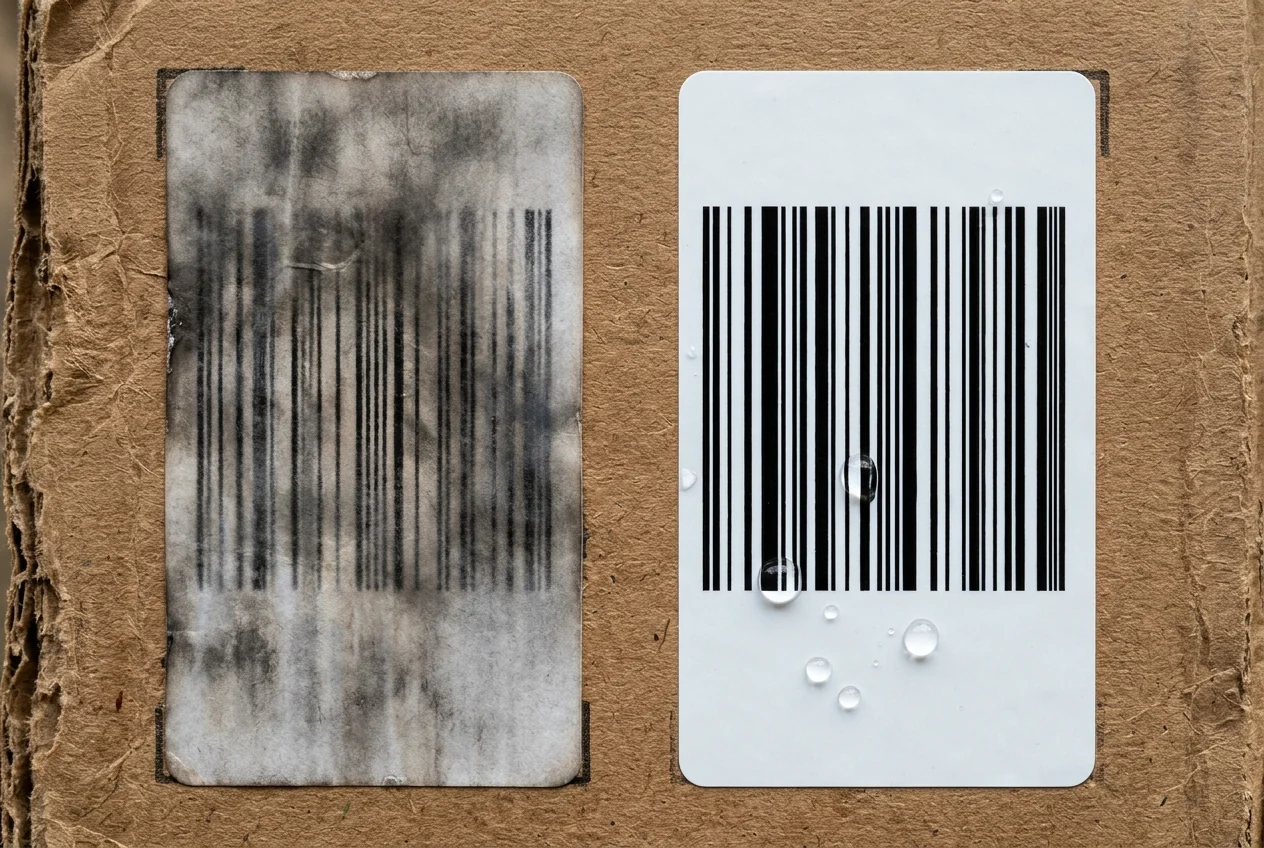
Under ISO/IEC 15416:2016 grading, Symbol Contrast (SC = R_max - R_min) requires ≥ 70% for Grade A (4.0), ≥ 55% to under 70% for Grade B (3.0), ≥ 40% to under 55% for Grade C (2.0 / ≥ 1.5 min), ≥ 20% to under 40% for Grade D (1.0), and under 20% for Grade F (0.0); Minimum Reflectance requires R_min ≤ 0.5 * R_max; Minimum Edge Contrast requires EC_min ≥ 15%; Modulation (MOD = EC_min / SC) requires ≥ 0.70 (A), ≥ 0.60 (B), ≥ 0.50 (C), ≥ 0.40 (D); Defects (ERN_max / SC) requires ≤ 0.15 (A), ≤ 0.20 (B), ≤ 0.25 (C), ≤ 0.30 (D); and Decodability (V) requires ≥ 0.62 (A), ≥ 0.50 (B), ≥ 0.37 (C), ≥ 0.25 (D). In a worked Scan Reflectance Profile comparison, fresh Z-Perform 2000D and Z-Perform 2000T labels both measure R_max = 82% and R_min = 8%, yielding SC = 74% (Grade A / 4.0), GT = 45%, and R_min / R_max = 9.8%; after 48 hours in a 58 degrees Celsius (136 degrees Fahrenheit) summer trailer, Z-Perform 2000T retains R_max = 80%, R_min = 9%, and SC = 71% (Grade A / 4.0), whereas Z-Perform 2000D drops to R_max = 46% and R_min = 16% with SC = 30% (Grade D / 1.0), and at 65 degrees Celsius (149 degrees Fahrenheit) or after a 70% IPA wipe collapses to R_max = 34%, R_min = 18%, SC = 16% (Grade F / 0.0), and R_min / R_max = 52.9% (above 50% Grade F).
| Verification Parameter or Condition | Reflectance or Aperture Specification | Grade Thresholds and Transit Outcome |
|---|---|---|
| Table 1 Measuring Apertures | X dimension 0,100 ≤ X below 0,180 mm uses 0,075 mm aperture diameter (reference number 03); 0,180 ≤ X below 0,330 mm uses 0,125 mm aperture diameter (reference number 05) | 0,330 ≤ X below 0,635 mm uses 0,250 mm aperture diameter (reference number 10); 0,635 below X mm uses 0,500 mm aperture diameter (reference number 20), where the aperture reference number approximates the measuring aperture diameter in thousandths of an inch |
| ISO/IEC 15416:2016 Parameter Grade Cutoffs | Symbol Contrast (SC = R_max - R_min), Minimum Reflectance (R_min ≤ 0.5 * R_max), Minimum Edge Contrast (EC_min ≥ 15%), Modulation (MOD = EC_min / SC), Defects (ERN_max / SC), Decodability (V) | SC ≥ 70% (A / 4.0), ≥ 55% to under 70% (B / 3.0), ≥ 40% to under 55% (C / 2.0, ≥ 1.5 min), ≥ 20% to under 40% (D / 1.0), under 20% (F / 0.0); MOD ≥ 0.70 (A), ≥ 0.60 (B), ≥ 0.50 (C), ≥ 0.40 (D); Defects ≤ 0.15 (A), ≤ 0.20 (B), ≤ 0.25 (C), ≤ 0.30 (D); V ≥ 0.62 (A), ≥ 0.50 (B), ≥ 0.37 (C), ≥ 0.25 (D) |
| Worked Scan Reflectance Profile (Z-Perform 2000D vs 2000T) | Fresh Z-Perform 2000D and Z-Perform 2000T both measure R_max = 82% and R_min = 8%, yielding SC = 74% (Grade A / 4.0), GT = 45%, and R_min / R_max = 9.8% | After 48 hours at 58 degrees Celsius (136 degrees Fahrenheit), Z-Perform 2000T retains R_max = 80%, R_min = 9%, SC = 71% (Grade A / 4.0), whereas Z-Perform 2000D drops to R_max = 46%, R_min = 16%, SC = 30% (Grade D / 1.0), and at 65 degrees Celsius (149 degrees Fahrenheit) or 70% IPA wipe collapses to R_max = 34%, R_min = 18%, SC = 16% (Grade F / 0.0), and R_min / R_max = 52.9% (above 50% Grade F) |
Printhead Tribology, Ribbon Changeover Downtime, and Inline Print-and-Apply
Because direct thermal printing requires printhead elements to be in direct contact with the label material whereas thermal transfer uses a ribbon as a buffer between the printhead and the label (many ribbons add a back-coating that reduces static and friction), direct thermal printheads provide an expected lifetime of 25% - 50% of a thermal transfer printhead: printing 10 million six-inch long labels with an expected thermal transfer printhead life of 4 million inches requires replacing the printhead 15 times in thermal transfer versus 30 – 60 times in direct thermal. In direct thermal mode, typical printhead life spans 1,000,000 to 2,000,000 linear inches (25.4 to 50.8 km), consuming 30 to 60 replacement printheads across 60,000,000 linear inches, whereas in thermal transfer mode a 4.5 um PET ribbon with a 30 to 35 dyn/cm silicone backcoating extends printhead mileage to 2,000,000 to 4,000,000 linear inches (50.8 to 101.6 km), requiring 15 to 30 printhead replacements across 60,000,000 linear inches.
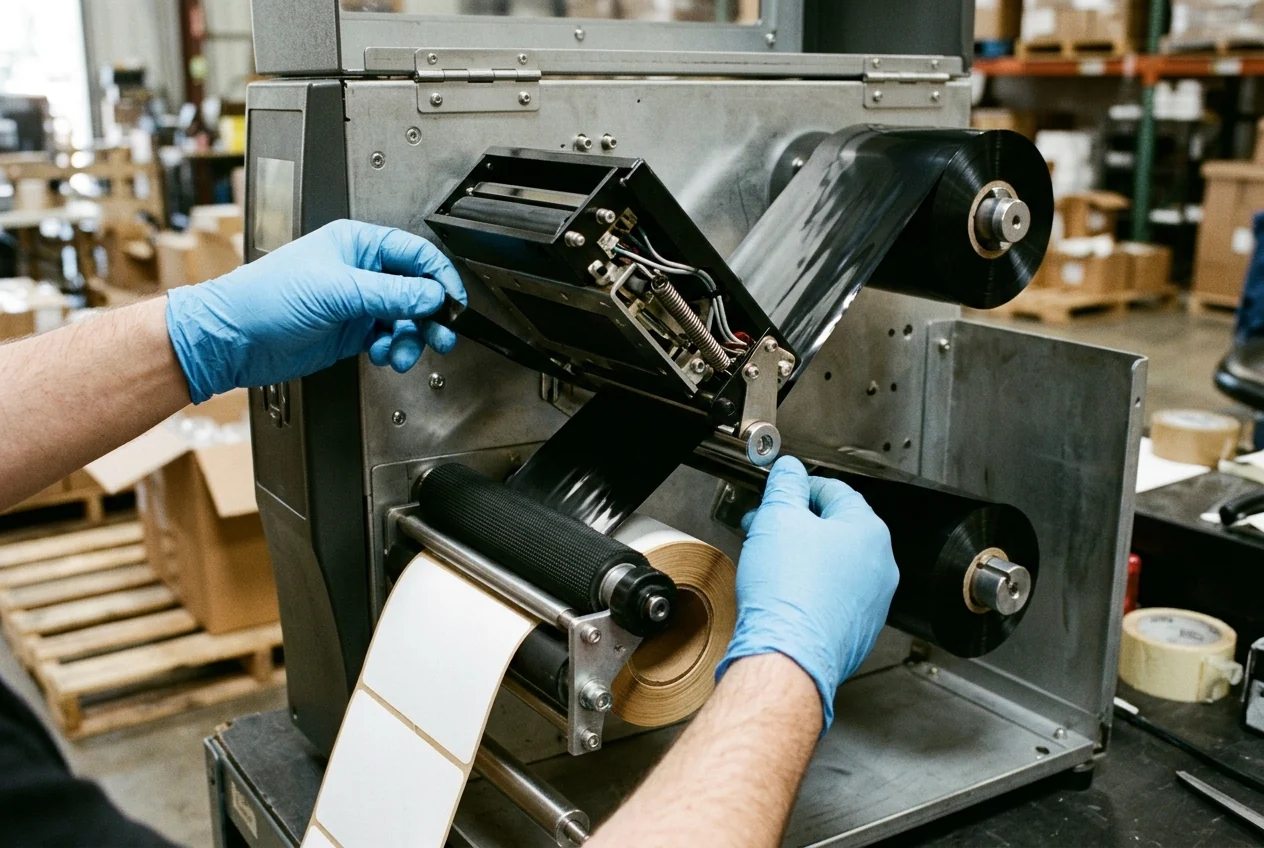
A standard 450 meter roll of ribbon provides about 2,800 six-inch labels, which at 20 products per minute requires several minutes of downtime about every 2.5 hours and results in 144 hours of downtime per year at 20 hours per day average production; SATO’s CLNX thermal printers support ribbon rolls with lengths up to 600m and label rolls with an outer diameter up to 10“ to lower media loading time by as much as 43%. When comparing media costs, eliminating the ribbon eliminates ribbon cost, but as a general rule direct thermal labels cost more than thermal transfer labels plus ribbon, with a cost differential as low as 5% or as high as 50% depending on the media selected, label size, and volumes purchased.
In healthcare, patient privacy can be at risk if personal information is available on used thermal transfer ribbon (leading to increased use of direct thermal media for prescription labels and patient wristbands); eliminating poly-based thermal ribbon also eliminates ribbon waste, and a Linerless Kit Option prints self-adhesive labels without backing papers to reduce consumption and waste. Zebra ZeroLiner Linerless supplies remove the label liner that typically ends up in a landfill and have a significantly shorter manufacturing journey, resulting in overall CO2 savings through less transport and manufacturing. For release liner recycling and adhesive system comparisons, see our guide on pressure-sensitive vs wet-glue labels, and for parcel mailer selection in mailing, inserting and fulfillment workflows, compare rigid mailers vs padded paper mailers and paper mailers vs poly mailers.
HERMA Print and Apply Systems provide a 2-in-1 solution combining label printers and applicators in one unit for late-stage customization of variable data (data matrix, barcode, QR code), integrating industrial print modules from Zebra, SATO, Carl Valentin, and Datamax in either thermal transfer or thermal direct printing via a Windows printer driver or design software (Easylabel, Codesoft, Nicelabel), with HERMA PA4 / PA6 offering resolutions of 200, 300, and 600 dpi. Kyocera’s TPA series thermal printhead for desktop barcode label printing supports speeds up to 250 mm per second using proprietary heating element and film deposition technologies to deliver faster print speeds, expanded mounting tolerances, and reduced wear. Kyocera’s KMH thermal printhead for mobile barcode printers uses proprietary technology to improve the durability of heating elements exposed to repeated electrical pulses, helping maintain stable print quality in refrigerated and frozen environments where higher printing energy is required. To decide when a packaging line needs a standalone printer, a wipe-on labeler, or an integrated print-and-apply unit, consult our label applicator vs printer and print-and-apply comparison.
Variable-Data Thermal Printing Qualification Checklist
Before locking in a desktop printer, industrial print engine, or inline print-and-apply specification, record the following engineering parameters on the line qualification sheet:
- Transit Temperature and Dwell Horizon: Record whether labeled packages clear the distribution network in short indoor cycles or face summer freight trailers, outdoor storage, or high-temperature processing.
- Chemical, Solvent, and Moisture Exposure: Identify whether labels contact water, condensation, alcohol wipes, cleaning agents, oils, or industrial solvents during filling, transit, or end use.
- Printhead Geometry and Ribbon Winding: Confirm whether the print engine uses a flat-head or near-edge printhead and verify whether the ribbon spindle requires ink-side-out or ink-side-in winding via the adhesive tape check.
- Barcode Orientation and Line Speed: Separate picket-fence barcodes from rotated ladder barcodes and match target web speed to the ribbon melt window and substrate smoothness.
- Reflectance Verification Protocol: Specify the measuring aperture diameter for the target barcode module width and verify post-exposure reflectance profiles rather than relying on handheld scanner reads.
- Changeover Labor, Liner Waste, and Data Privacy: Balance printhead replacement intervals against ribbon roll changeover stops, linerless media options, and spent-ribbon data security in clinical or pharmacy workflows.
Sources
- Zebra Technologies, Genuine Supplies Selector Guide and Thermal Transfer Ribbons Brochure
- Zebra Technologies, Direct Thermal and Thermal Transfer Label and Ribbon Technical Data Sheets
- SATO America, Thermal Transfer vs. Direct Thermal White Paper
- DNP Imagingcomm, Thermal Transfer Ribbon Learning Centre and Product Guides
- International Organization for Standardization, Bar Code Print Quality Test Specification for Linear Symbols
- Rosistem Barcode and AIDC Technical Reference, Barcode Verification and Grading Guide
- HERMA, Print and Apply Systems Technical Overview
- Jota Machinery Converting Academy, Leuco Dyes in Thermal Paper Technical Analysis
- INKISH.NEWS, Kyocera Thermal Printhead Series Technical Reports
- Flexographic Technical Association, Avery Dennison Adds UL 969-Recognition to Label Materials in the Durst Portfolio
Frequently Asked Questions
What is the core difference between thermal transfer and direct thermal printing?
Thermal transfer technology uses a ribbon to transfer an image onto the label material (for indoor or outdoor usage, medium to longterm lifespan, and excellent chemical resistance), whereas direct thermal technology does not require a ribbon and uses a chemically coated heat-sensitive material that produces images as heat is applied to the surface (primarily indoor use, short to medium-term lifespan, minimal chemical resistance).
Why do direct thermal labels darken inside hot freight trailers?
In direct thermal printing, static discoloration onset begins at 65 to 75 degrees Celsius, while full optical density (OD ≥ 1.30 to 1.50 MacBeth units) develops at 85 to 110 degrees Celsius as the web moves past the printhead at 4 to 10 inches per second (ips), and ambient trailer heat above 55 to 60 degrees Celsius activates the unprinted background.
How does printhead life compare between direct thermal and thermal transfer modes?
Because direct thermal printing requires printhead elements to be in direct contact with the label material whereas thermal transfer uses a ribbon as a buffer between the printhead and the label (many ribbons add a back-coating that reduces static and friction), direct thermal printheads provide an expected lifetime of 25% - 50% of a thermal transfer printhead: printing 10 million six-inch long labels with an expected thermal transfer printhead life of 4 million inches requires replacing the printhead 15 times in thermal transfer versus 30 – 60 times in direct thermal.
Why can flat-head and near-edge thermal transfer ribbons not be interchanged?
Near-edge and flat-head printers require different ribbons primarily because of the release layer: due to the short exposure time to the printhead, a near-edge ribbon needs to release the ink much faster and is therefore formulated differently from a flat-head ribbon.