LabelsComparison
Direct Thermal vs Thermal Transfer Labels: Ribbon Pairing and ISO 15416 Barcode Retention
Compare direct thermal vs thermal transfer packaging labels on leuco-dye heat graying, wax and resin ribbon pairing, printhead life, and ISO/IEC 15416 barcode grades.
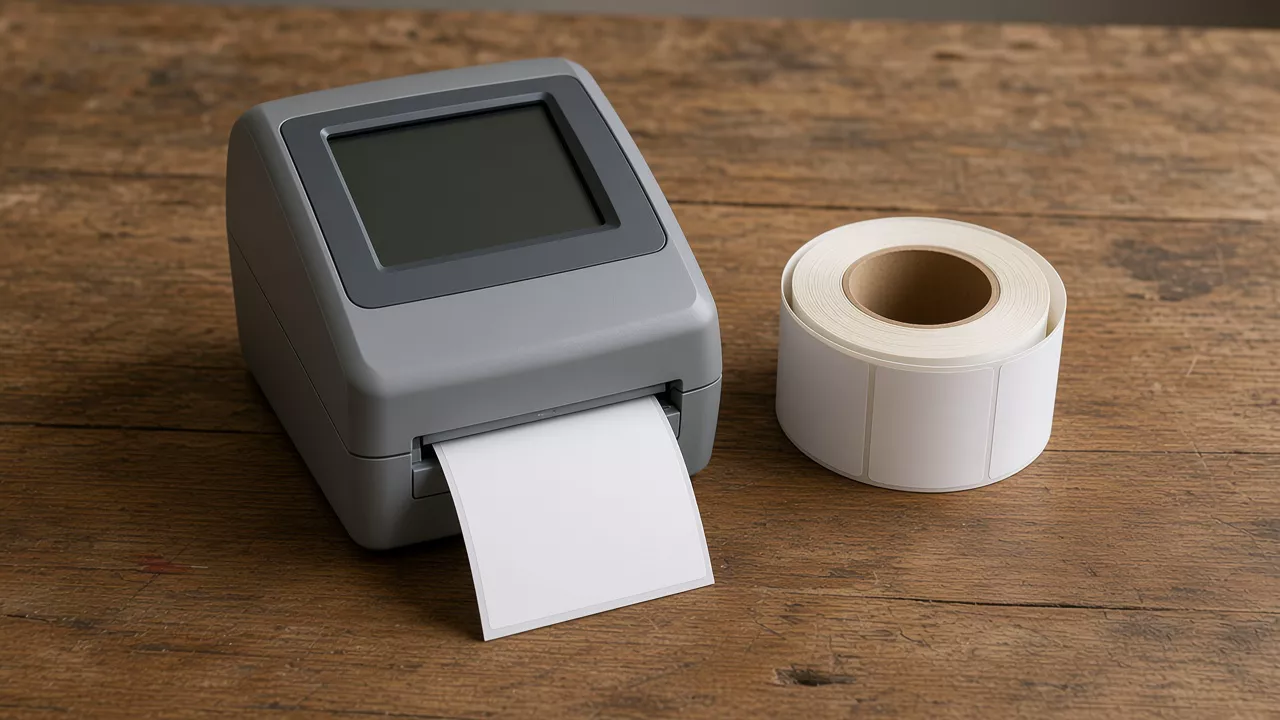
Applying a ribbonless direct thermal label to a pallet staged in a 60 degrees Celsius summer trailer or wiped with isopropyl alcohol causes background graying and barcode scan rejection at the receiving dock, whereas loading a mismatched wax ribbon onto a polypropylene label causes the printed image to smear off under thumb pressure. Selecting between direct thermal vs thermal transfer packaging labels requires matching the thermal imaging mechanism and ribbon binder chemistry to the container substrate, maximum transit temperature, and required ISO/IEC 15416:2016 linear barcode verification grade.
Within our labels and label application engineering hierarchy, both thermal printing modes run on desktop barcode printers and inline print-and-apply applicators detailed in label applicator vs printer and print-and-apply. Once the container geometry and moisture exposure narrow the facestock shortlist in paper vs film label materials, the packaging engineer must specify whether the variable barcode is formed by activating a leuco-dye coating inside the label or by transferring melted wax, wax/resin, or full resin ink from a polyester carrier ribbon.
| Engineering parameter | Direct thermal (DT) packaging labels | Thermal transfer (TT) packaging labels |
|---|---|---|
| Imaging mechanism and active chemistry | Ribbonless solid-state thermochromic reaction: printhead heat melts a sensitizer and acidic developer inside the paper coating, opening the lactone ring of a colorless fluoran leuco dye (ODB-2 or Black 305) at 65 to 75 degrees Celsius onset and reaching full black (OD >= 1.30) at 85 to 110 degrees Celsius (Jota; Zebra) |
Heated ceramic printhead elements (203, 300, or 600 dpi) melt a 2.0 to 4.9 um wax, wax/resin, or full resin ink layer off a 4.5 um polyester (PET) carrier ribbon onto an inert paper or synthetic film facestock (Zebra; DNP; Triton) |
| Representative Zebra construction and caliper | Z-Perform 2000D (65791RM): 3.0 mil (76.2 um) topcoated DT paper + 0.5 mil (12.7 um) all-temp acrylic adhesive + 2.5 mil (63.5 um) 40 lb kraft liner = 6.0 mil (152.4 um) total; Z-Select 4000D (3.2 mil paper + 0.8 mil adhesive) |
Z-Perform 2000T (66105RM): 2.5 mil topcoated paper + 0.5 mil acrylic adhesive + 3.0 mil 40 lb liner = 6.0 mil total; PolyPro 4000T (107 um matte BOPP, 208 um total); Z-Ultimate 3000T (50.8 um gloss PET, 147.3 um total) |
| Maximum service temperature ceiling | -54 to 55 degrees Celsius (-65 to 131 degrees Fahrenheit) on Z-Perform 2000D and 60 degrees Celsius (140 degrees Fahrenheit) on Z-Select 4000D (specialty 8000D High-Temp reaches 90 degrees Celsius); ambient heat above 55 to 60 degrees Celsius darkens unprinted spaces |
Paper (Z-Perform 2000T): -54 to 93 degrees Celsius (-65 to 200 degrees Fahrenheit); BOPP (PolyPro 4000T): -54 to 120 degrees Celsius; PET (Z-Ultimate 3000T): -40 to 150 degrees Celsius; Polyimide (Z-Supreme 4000T): -40 to 260 degrees Celsius |
| UV sunlight, moisture, and solvent durability | Indoor use (< 6 months typical scan retention); UV light yellows the paper and fades bars, while 70% isopropyl alcohol (IPA), hand sanitizer, or PVC stretch-wrap plasticizers fog or bleach the leuco-dye complex (Not recommended on Z-Perform 2000D spec) |
1 year indoor/outdoor on paper + wax; 1 to 2 years outdoors on PolyPro 4000T + 3200 wax/resin; up to 3 years outdoors and UL 969 certified on Z-Ultimate 3000T + 5095 or 5100 resin, resisting IPA, bleach, ammonia, and motor oil |
| Printhead contact physics and mileage | Direct abrasive contact between chemically coated paper web and ceramic printhead glaze; expected printhead life is 1 to 2 million linear inches (25 to 50 km), or 25% to 50% of thermal transfer life (SATO America) |
4.5 um PET ribbon with a 30 to 35 dyn/cm silicone backcoating shields the printhead glaze from paper dust and friction; expected printhead life is 2 to 4 million linear inches (50 to 100 km) |
Printhead replacements per 10M six-inch labels (60M linear in) |
30 to 60 replacement printheads across 60,000,000 linear inches (1,524 km) at 1M to 2M linear inches per head (SATO America benchmark) |
15 to 30 replacement printheads across 60,000,000 linear inches (15 heads at SATO’s rated 4,000,000 linear inches per head) |
| Consumable cost, changeover downtime, and waste | Zero ribbon purchase and zero ribbon-change stops, but chemically reactive DT stock typically costs 5% to 50% more than TT paper plus wax ribbon; single liner waste stream (zero waste with ZeroLiner) and no spent ribbon carrying HIPAA patient data |
Lower base label cost plus ribbon cost; a standard 450 m ribbon roll prints ~2,800 six-inch labels, requiring 3,571 swaps per 10M labels (144 hours/year at 20 labels/min over 20 hr/day); dual waste stream (liner + spent PET ribbon with negative image) |
Imaging physics: leuco-dye direct thermal coatings vs ribbon thermal transfer
Although an industrial thermal printer uses the same ceramic printhead array (typically 8 dots/mm at 203 dpi, 12 dots/mm at 300 dpi, or 24 dots/mm at 600 dpi) for both modes, the image forms through fundamentally different physical mechanisms at the platen roller nip. As documented in the Zebra Genuine Supplies Selector Guide, Zebra designates direct thermal media with the suffix D (chemically coated heat-sensitive media requiring no ribbon) and thermal transfer media with the suffix T (inert facestocks requiring a thermal transfer ribbon).
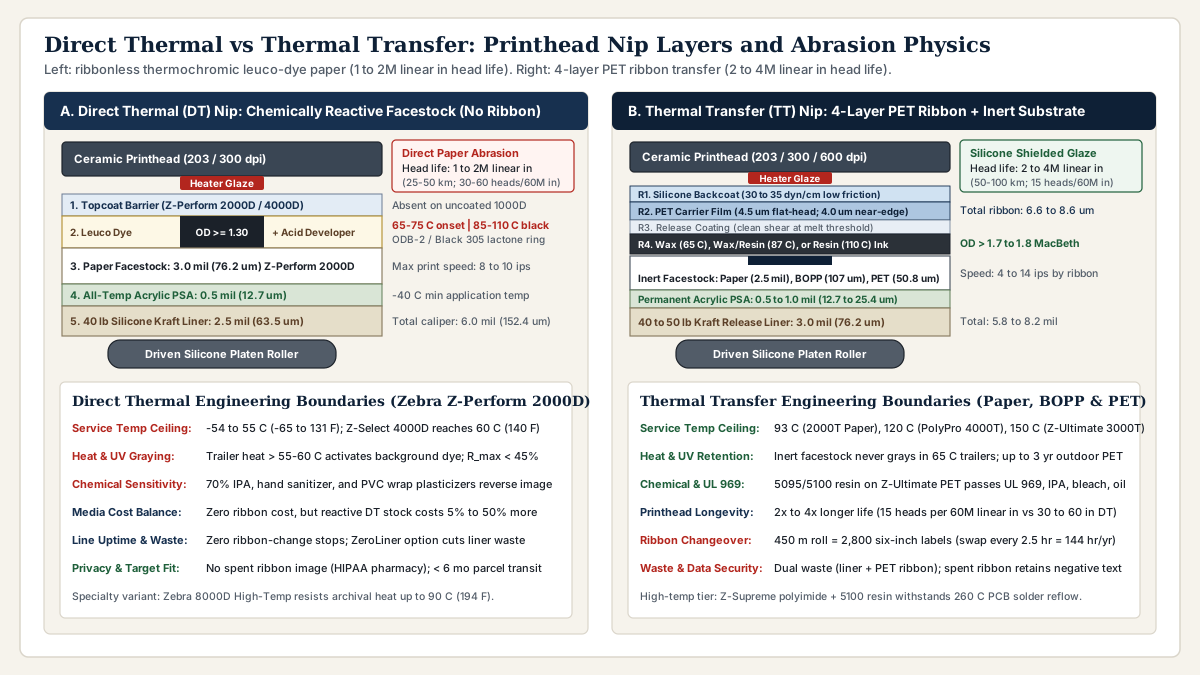
In direct thermal (DT) printing, the label facestock carries a micro-encapsulated thermochromic recording layer coated directly onto the paper or polyolefin web. As explained in Jota Machinery’s technical analysis of leuco dyes in thermal paper, this active coat disperses three solid components inside a water-soluble polymer binder:
- A colorless fluoran leuco dye containing a closed lactone ring, such as 2-anilino-6-dibutylamino-3-methylfluoran (
ODB-2) orBlack 305. In its crystalline neutral state, the closed spirolactone ring blocks electron conjugation across the molecule, so the coating reflects visible light and appears white. - An organic acidic developer (historically bisphenol A, restricted in European Union thermal paper at concentrations of
>= 0.02%by weight since January 2, 2020, and now formulated with bisphenol S, sulfonylurea, or phenol-free organic proton donors). - A low-melting organic sensitizer (such as benzyl-2-naphthyl ether or stearamide wax) that lowers the eutectic melting threshold of the dye-and-developer pair.
When a printhead pixel fires, localized heat melts the sensitizer and acidic developer into a mobile liquid phase. The developer donates a proton (H+) that cleaves the lactone ring of the leuco dye, rearranging the molecule into a planar conjugated system that absorbs visible light and turns jet black. Static discoloration onset begins at 65 to 75 degrees Celsius, while full optical density (OD >= 1.30 to 1.50 MacBeth units) develops at 85 to 110 degrees Celsius as the web moves past the printhead at 4 to 10 inches per second (ips). Because this proton-transfer equilibrium remains active across the entire label surface after printing, ambient trailer heat above 55 to 60 degrees Celsius activates the unprinted background, while organic solvents or polyvinyl chloride (PVC) stretch-wrap plasticizers close the lactone ring and bleach the printed bars.
| Zebra thermal label grade | Mode and substrate tier | Facestock / adhesive / liner caliper | Total thickness (+/-10%) | Service temperature range (min apply) | Max print speed and outdoor / chemical rating |
|---|---|---|---|---|---|
Z-Perform 1000D |
Direct thermal uncoated economy paper | ~3.0 mil uncoated DT paper + permanent acrylic PSA + kraft liner | ~5.8 to 6.0 mil | -40 to 60 degrees Celsius (-40 to 140 degrees Fahrenheit) |
Low speed (<= 6 ips); indoor only; minimal scuff and moisture resistance |
Z-Perform 2000D (65791RM) |
Direct thermal topcoated smooth paper | 3.0 mil (76.2 um) topcoated DT paper + 0.5 mil (12.7 um) all-temp acrylic + 2.5 mil (63.5 um) 40 lb liner | 6.0 mil (152.4 um) | -54 to 55 degrees Celsius (-65 to 131 degrees Fahrenheit; -40 degrees Celsius min apply) |
Up to 8 ips; 1-year dry storage at 22 degrees Celsius / 50% RH; Not recommended for IPA, acetone, MEK, or outdoor UV |
Z-Select 4000D |
Direct thermal premium topcoated paper | 3.2 mil ultra-smooth sealed DT paper + 0.8 mil acrylic PSA + 2.5 mil liner | 6.5 mil (165.1 um) | -54 to 60 degrees Celsius (-65 to 140 degrees Fahrenheit) |
Up to 10 ips; topcoat seals against light moisture and food-scale condensation |
Z-Perform 2000T (66105RM) |
Thermal transfer topcoated paper | 2.5 mil (63.5 um) smooth TT paper + 0.5 mil (12.7 um) permanent acrylic + 3.0 mil (76.2 um) 40 lb liner | 6.0 mil (152.4 um) | -54 to 93 degrees Celsius (-65 to 200 degrees Fahrenheit; -1 degree Celsius min apply) |
Up to 14 ips with 2000 / 6000 wax ribbon; 38 degrees Celsius higher heat ceiling than Z-Perform 2000D |
PolyPro 4000T |
Thermal transfer matte BOPP film | 4.2 mil (107 um) Kimdura BOPP + 1.0 mil (25 um) acrylic PSA + 3.0 mil (76 um) 62 gsm liner | 8.2 mil (208 um) | -54 to 120 degrees Celsius (-65 to 250 degrees Fahrenheit; 7 degrees Celsius min apply) |
1 to 2 years outdoor durability; tear- and water-resistant; resists alcohol, ammonia, and bleach with 3200 wax/resin |
Z-Ultimate 3000T (05612RM) |
Thermal transfer gloss polyester (PET) | 2.0 mil (50.8 um) gloss PET (18,000 psi MD / 22,000 psi TD) + 0.8 mil (20.32 um) acrylic + 3.0 mil (76.2 um) 50 lb liner |
5.8 mil (147.3 um) | -40 to 150 degrees Celsius (-40 to 302 degrees Fahrenheit; 10 degrees Celsius min apply) |
Up to 3 years outdoors; UL 969 recognized with 5095 or 5100 resin ribbon; resists IPA, bleach, and salt water |
To slow environmental degradation on direct thermal paper, converters add a clear polymer barrier over the leuco-dye coat. On the Zebra Z-Perform 2000D specification sheet, a 3.0 mil (76.2 um) topcoated direct thermal paper facestock is paired with 0.5 mil (12.7 um) all-temp permanent acrylic adhesive and a 2.5 mil (63.5 um) 40 lb (59 gsm) semi-bleached kraft liner (6.0 mil / 152.4 um total caliper), supporting print speeds up to 8 ips and cold application down to -40 degrees Celsius. Even with a protective topcoat, Z-Perform 2000D is capped at a maximum service temperature of 55 degrees Celsius (131 degrees Fahrenheit). By comparison, the Zebra Z-Perform 2000T thermal transfer paper specification uses an inert 2.5 mil smooth paper facestock at the same 6.0 mil total caliper, prints at up to 14 ips with wax ribbons, and withstands service temperatures up to 93 degrees Celsius (200 degrees Fahrenheit). Where labels face outdoor weather or chemical washdowns, Zebra PolyPro 4000T matte BOPP (107 um Kimdura polypropylene, 208 um total caliper) extends service heat to 120 degrees Celsius, and Zebra Z-Ultimate 3000T gloss polyester (50.8 um PET, 147.3 um total caliper) reaches 150 degrees Celsius.
Takeaway: Specify direct thermal (Z-Perform 2000D or Z-Select 4000D) only when the package stays below 55 degrees Celsius and clears the supply chain within 6 months; specify thermal transfer (Z-Perform 2000T, PolyPro 4000T, or Z-Ultimate 3000T) whenever heat, UV sunlight, or solvent contact is present.
Thermal transfer ribbon chemistry and facestock compatibility matrix
A thermal transfer label is a two-part system in which the ribbon ink binder must anchor mechanically into paper fibers or fuse chemically with a synthetic film topcoat. As detailed in the Zebra Thermal Transfer Ribbons brochure, DNP Imagingcomm’s ribbon architecture guide, and Triton’s thermal ribbon technical overview, every thermal transfer ribbon comprises four precision-coated layers wound either coated-side-in (CSI) or coated-side-out (CSO, verifiable by pressing adhesive tape to the outer roll wrap to see which side lifts black ink):
- A silicone-based backcoating (
0.05 to 0.10 um) touching the ceramic printhead, formulated to a low surface energy of30 to 35 dyn/cmto dissipate static electricity, reduce friction, and prevent melted PET buildup on the heating elements. - A biaxially oriented polyester (PET) carrier film that conducts thermal pulses uniformly while resisting tensile web snap (
4.5 umstandard caliper for flat-head industrial printers;4.0 umthinner caliper for near-edge and thermal transfer overprintingTTOunits to boost heat sensitivity, extend roll length up to2,000 m, and cut plastic waste by more than 10%). - A heat-activated release layer (
0.1 to 0.5 umwax or resin surfactant) that bonds the ink to the PET carrier during winding and shears cleanly when the printhead fires. - A pigmented ink layer (
2.0 to 4.9 um) compounded from carbon black (or colored pigments) dispersed in a wax, wax/resin, or pure synthetic resin binder, bringing total ribbon thickness to6.6 to 8.6 um.
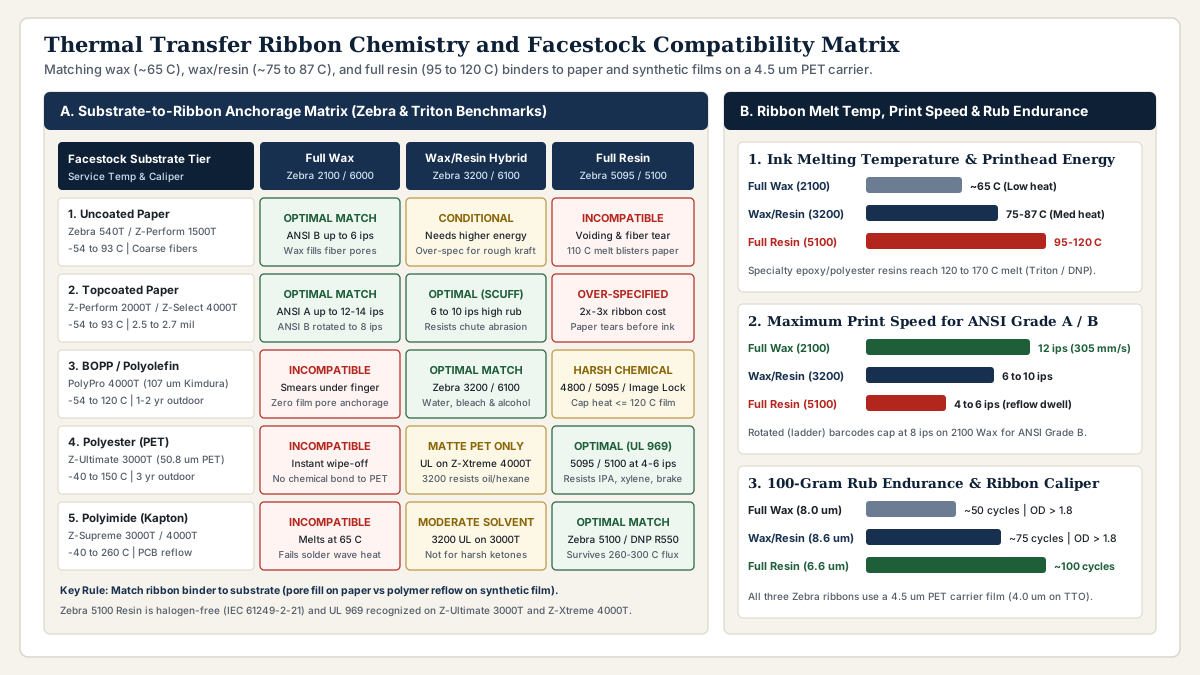
Converters and packaging engineers classify thermal transfer ribbons into three binder families according to melting temperature, printhead energy requirement, and substrate anchorage mechanism. Narrow-web slitting and roll tension controls for these webs follow the principles in our converting equipment overview.
| Ribbon class and Zebra benchmark | Binder chemistry and caliper on 4.5 um PET |
Ink melt point and print speed window | MacBeth OD and 100 g rub endurance |
Compatible label facestocks (Optimal match) | Incompatible facestocks (Failure mode) |
|---|---|---|---|---|---|
Full Wax (Zebra 2100 High-Performance Wax, 1600, 2000, 5319, 6000) |
Paraffin, carnauba, and polyethylene waxes + carbon black; 2.0 to 3.2 um ink coat; 8.0 um total caliper (Zebra 2100) |
~65 degrees Celsius (60 to 80 degrees Celsius); low printhead darkness; up to 12 ips (304.8 mm/s) normal / 8 ips rotated on coated paper (6 ips on uncoated) |
OD > 1.8; ~50 rub cycles at 100 g load; visible and infrared (IR) scannable; fails brake fluid, degreaser, and WD-40 (Grade C to F) |
Uncoated vellum (Zebra 540T, 1500T) and smooth topcoated paper (Z-Perform 2000T, Z-Select 4000T) for dry indoor cartons |
Non-porous films (PolyPro BOPP, PE, Z-Ultimate PET, Z-Supreme polyimide): melted wax sits on smooth plastic and smears off under finger rub |
Wax/Resin Hybrid (Zebra 3200 Premium Wax/Resin, 3400, 5555, 5586, 6100) |
Blend of paraffin/PE waxes with EVA, polyamide, acrylic, or polyurethane resins; 2.5 to 4.0 um ink coat; 8.6 um total caliper (Zebra 3200) |
~75 to 87 degrees Celsius (70 to 90 degrees Celsius range); moderate printhead energy; 6 to 10 ips print speed |
OD > 1.8; ~75 rub cycles at 100 g load; resists chute scuffing, water, alcohol, ammonia, bleach, hexane, and motor oil on matched films |
Topcoated/gloss paper (Z-Select 4000T, 8000T), polyolefin (PolyO 3000T), matte/gloss BOPP (PolyPro 3000T/4000T), and matte PET (Z-Xtreme 2000T/4000T, UL 969) |
Rough uncoated paper (insufficient ink flow into coarse fibers at moderate heat) and un-topcoated film exposed to harsh ketones (acetone, MEK) |
Full Resin (Zebra 5100 Resin, 4800, 5095, 6200, Image Lock; DNP R510/R550) |
Cross-linked polyester, acrylic, polyurethane, or epoxy polymers + carbon black; 2.7 to 4.9 um ink coat; 6.6 um total caliper (Zebra 5100, halogen-free IEC 61249-2-21) |
95 to 120 degrees Celsius (105 to 112 degrees Celsius typical; up to 170 degrees Celsius specialty); high printhead heat; 4 to 6 ips to allow polymer reflow |
OD > 1.7; ~100 rub cycles at 100 g load at 100 degrees Celsius; withstands IPA, xylene, gasoline, brake fluid, and 150 to 300 degrees Celsius service heat |
Gloss/matte topcoated PET (Z-Ultimate 2000T/3000T/4000T, Z-Xtreme 4000T), polyimide (Z-Supreme 2100T/3000T/4000T), cast vinyl (Z-Endure), and 8100T Image Lock (UL 969) |
Uncoated and standard economy paper (Z-Perform 2000T): high printhead heat blisters paper coatings, causes incomplete transfer voids, and wastes 2x to 3x ribbon cost |
On the Zebra 2100 High-Performance Wax Ribbon specification sheet, the 8.0 um ribbon (4.5 um PET base film) melts around 65 degrees Celsius and achieves a typical ANSI/ISO Grade A on 10 to 12 mil normal (“picket-fence”) barcodes at print speeds up to 304.8 mm/s (12 ips) on coated paper labels (Z-Perform 2000T, Z-Select 4000T). When the barcode is rotated 90 degrees into a “ladder” orientation, each printhead element must turn on and off at every bar edge rather than holding steady down a bar length; 2100 Wax is rated for ANSI Grade B on 15 mil rotated barcodes up to 203.2 mm/s (8 ips) on coated paper, and ANSI Grade B on normal barcodes up to 152.4 mm/s (6 ips) on uncoated paper.
When cartons face chute abrasion, cold-chain condensation, or outdoor staging, engineers step up to the Zebra 3200 Premium Wax/Resin Ribbon (8.6 um total caliper on a 4.5 um PET carrier). Its synthetic resin fraction raises the ink melt window to 75 to 87 degrees Celsius, bonding cleanly to PolyPro 4000T BOPP (-54 to 120 degrees Celsius) and achieving UL 969 recognition on Z-Xtreme 2000T/4000T matte polyester and Z-Supreme 3000T polyimide against isopropyl alcohol, ethanol, hexane, motor oil, engine coolant, and gasoline. For extreme solvent washdowns, medical device UDI wipes, and appliance nameplates, the Zebra 5100 Resin Ribbon (6.6 um total caliper, halogen-free under IEC 61249-2-21) runs at 4 to 6 ips and 95 to 120 degrees Celsius melt heat to reflow into Z-Ultimate 3000T/4000T gloss polyester (-40 to 150 degrees Celsius, UL/cUL Recognized indoor and outdoor without a protective laminate).
Takeaway: Never pair a full wax ribbon with synthetic BOPP or PET film labels, and reduce print speed to 4 to 6 ips when firing full resin ribbons onto polyester or polyimide so the polymer ink can reflow into the topcoat.
ISO/IEC 15416 barcode verification grades under heat, UV, and chemical exposure
Passing a handheld scanner check at the packing table does not prove a shipping or pallet barcode will scan at a distribution center after 48 hours in transit. As explained in Rosistem’s ISO/IEC 15416 verification reference and the normative ISO/IEC 15416:2016 linear barcode quality standard (Clause 5.2), a calibrated verifier grades linear symbologies (GS1-128, SSCC-18, ITF-14, Code 128, and UPC/EAN) by measuring diffuse reflectance against a 100% barium sulfate (BaSO4) or magnesium oxide (MgO) reference standard. The verifier illuminates the barcode at 45 degrees from perpendicular, collects reflected light within a 15-degree normal cone through a defined circular measuring aperture, and records 10 equally spaced scan paths across the central 80% inspection band (from 10% to 90% of bar height).
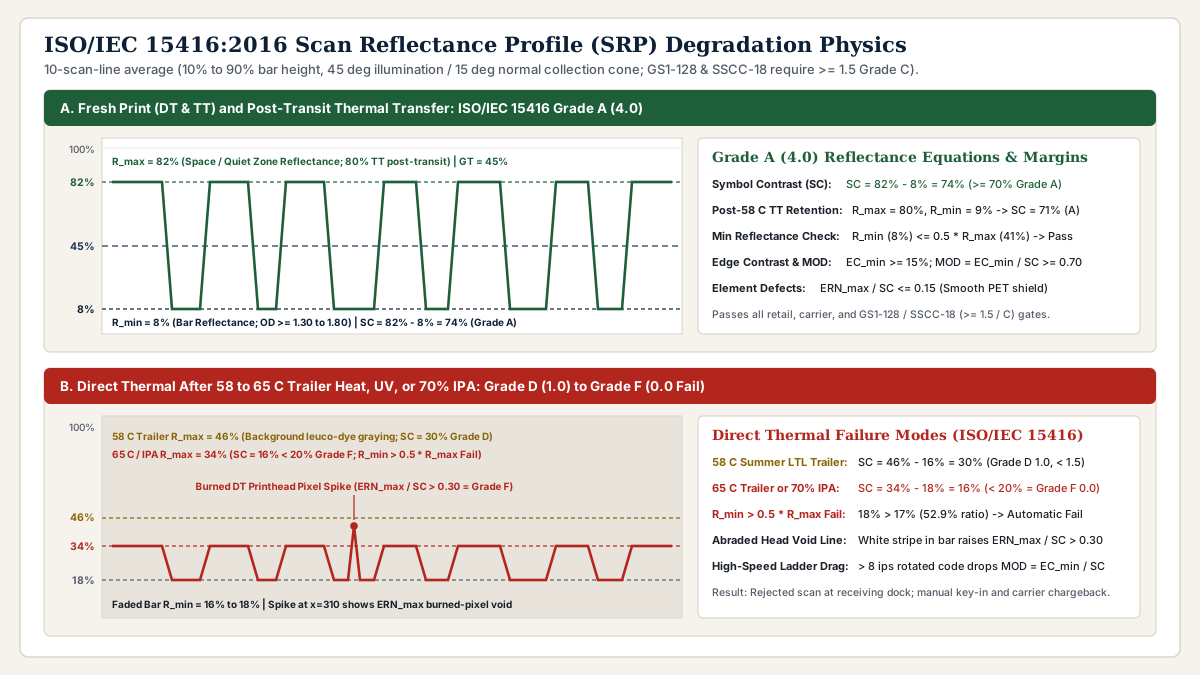
Each of the 10 scan lines generates a continuous Scan Reflectance Profile (SRP) governed by six core reflectance and geometric equations under Clauses 3 and 4 of ISO/IEC 15416:2016:
- Symbol Contrast (
SC): the difference between the highest space or quiet-zone reflectance (R_max) and the lowest dark bar reflectance (R_min) along the scan path:SC = R_max - R_min - Global Threshold (
GT): the reflectance midpoint dividing dark bar elements (belowGT) from light space elements (aboveGT):GT = (R_max + R_min) / 2 - Minimum Reflectance (
R_minlimit): dark bars must absorb at least half as much light as the brightest space (R_min <= 0.5 * R_maxfor Grade A4.0;R_min > 0.5 * R_maxtriggers an automatic Grade F0.0failure). - Minimum Edge Contrast (
EC_min): for every adjacent space reflectance (R_s) and bar reflectance (R_b), the local transitionEC = R_s - R_bmust satisfyEC_min >= 15%(Grade A); any single transition withEC_min < 15%receives Grade F (0.0). - Modulation (
MOD): the ratio of the weakest local edge transition to overall symbol contrast, which penalizes ink spread (thermal blooming) inside narrow spaces:MOD = EC_min / SC - Defects (
ERN_max / SC): the maximum Element Reflectance Non-uniformity (ERN_max, the peak-to-valley reflectance swing inside a single bar, space, or quiet zone caused by a burned printhead pixel or substrate void) divided by Symbol Contrast:Defects = ERN_max / SC
Each scan path receives the lowest numeric grade (4.0 for A, 3.0 for B, 2.0 for C, 1.0 for D, or 0.0 for F) among its individual parameters, and the symbol’s overall ISO/IEC 15416 grade is the arithmetic mean of all 10 scan paths reported to one decimal place (4.0 to 0.0). Retail compliance programs, automated parcel hubs, and GS1 SSCC-18 / GS1-128 pallet specifications mandate a minimum verified grade of 1.5 (Grade C) at the point of receipt.
| ISO/IEC 15416:2016 parameter | Grade A (4.0) |
Grade B (3.0) |
Grade C (2.0 / >= 1.5 min) |
Grade D (1.0) |
Grade F (0.0 fail) |
Dominant thermal printing failure mechanism |
|---|---|---|---|---|---|---|
Symbol Contrast (SC = R_max - R_min) |
>= 70% |
>= 55% to < 70% |
>= 40% to < 55% |
>= 20% to < 40% |
< 20% |
Summer LTL trailer heat (> 55 to 65 degrees Celsius) or dock UV sunlight activates unprinted DT leuco dye, dropping R_max from 82% to < 45% while bars fade (R_min > 16%) |
Minimum Reflectance (R_min vs R_max) |
R_min <= 0.5 * R_max |
Pass/Fail gate | Pass/Fail gate | Pass/Fail gate | R_min > 0.5 * R_max |
70% IPA sanitizer wipe, PVC stretch-wrap plasticizer migration, or under-heated high-speed DT printing bleaches bars while graying spaces until R_min exceeds half of R_max |
Minimum Edge Contrast (EC_min) |
>= 15% |
Pass/Fail gate | Pass/Fail gate | Pass/Fail gate | < 15% |
Wax ribbon smear on incompatible BOPP/PET film or localized scuffing on uncoated Z-Perform 1000D wipes a single bar-to-space transition below 15% |
Modulation (MOD = EC_min / SC) |
>= 0.70 |
>= 0.60 to < 0.70 |
>= 0.50 to < 0.60 |
>= 0.40 to < 0.50 |
< 0.40 |
Excessive printhead darkness causes thermal bar growth (blooming), or printing rotated ladder codes above 8 ips drags thermal tail into narrow spaces |
Defects (ERN_max / SC) |
<= 0.15 |
> 0.15 to <= 0.20 |
> 0.20 to <= 0.25 |
> 0.25 to <= 0.30 |
> 0.30 |
Abraded or burned DT printhead elements leave a continuous white void line down a black bar (ERN_max spike), or ribbon wrinkles leave unprinted streaks |
Decodability (V) |
>= 0.62 |
>= 0.50 to < 0.62 |
>= 0.37 to < 0.50 |
>= 0.25 to < 0.37 |
< 0.25 |
Worn silicone platen roller slip or mismatch between printer dpi (203 vs 300 dpi) and barcode module X-dimension distorts bar/space width ratios |
A worked Scan Reflectance Profile calculation demonstrates why direct thermal labels fail in summer freight corridors while thermal transfer labels maintain Grade A:
- At the packing station (freshly printed at 203 or 300 dpi), both a
Z-Perform 2000Ddirect thermal label and aZ-Perform 2000Tthermal transfer label printed with2100 WaxmeasureR_max = 82%space reflectance andR_min = 8%bar reflectance. Both yieldSC = 82% - 8% = 74%(Grade A / 4.0, above the70%cutoff),GT = (82% + 8%) / 2 = 45%, andR_min / R_max = 8 / 82 = 9.8%(<= 50%pass). - After 48 hours inside a
58 degrees Celsius(136 degrees Fahrenheit) summer LTL freight trailer followed by cross-dock sunlight staging, the inertZ-Perform 2000Tthermal transfer label (rated to93 degrees Celsius) retainsR_max = 80%andR_min = 9%, holdingSC = 80% - 9% = 71%(Grade A / 4.0). - On the
Z-Perform 2000Ddirect thermal label (whose service ceiling is55 degrees Celsius), trailer heat initiates background proton transfer in the leuco-dye coat, dropping space reflectance toR_max = 46%, while dock UV light fades the printed bars toR_min = 16%. Symbol Contrast plunges toSC = 46% - 16% = 30%(Grade D / 1.0), failing theGS1 >= 1.5(Grade C) receiving gate. - If roof-zone trailer temperatures reach
65 degrees Celsius(149 degrees Fahrenheit) or a worker wipes the label with70% IPAhand sanitizer,R_maxdarkens to34%andR_minrises to18%. Symbol Contrast collapses toSC = 34% - 18% = 16%(< 20%,Grade F / 0.0), and the reflectance ratio reachesR_min / R_max = 18 / 34 = 52.9%(> 50%), triggering a second automaticGrade Ffailure on Minimum Reflectance.
Takeaway: Verify barcodes with an ISO/IEC 15416 verifier rather than a handheld scanner, and require post-aging Symbol Contrast SC >= 40% (Grade C / 1.5 minimum) across your worst-case transit temperature and chemical exposure profile.
Printhead abrasion, ribbon changeover downtime, and total cost of ownership
Evaluating direct thermal versus thermal transfer on label roll price alone masks three operational cost drivers: printhead replacement frequency, ribbon changeover labor, and media cost inversion. In SATO America’s engineering white paper on thermal transfer vs direct thermal printing, SATO models a high-volume fulfillment operation printing 10,000,000 standard six-inch (4 by 6 inch) shipping labels, which equals 60,000,000 linear inches (5,000,000 linear feet or 1,524 km) of media travel through the printhead nip.
Because a direct thermal web drags its unlubricated paper surface and slitter dust directly across the heated ceramic glaze, SATO documents that direct thermal printheads achieve only 25% to 50% of the operating mileage of a thermal transfer printhead:
- In direct thermal mode, typical printhead life spans
1,000,000 to 2,000,000 linear inches(25.4 to 50.8 km). Printing60,000,000 linear inchesconsumes60,000,000 / 2,000,000 = 30to60,000,000 / 1,000,000 = 60replacement printheads, plus the maintenance technician downtime required to install, align, and calibrate each assembly. - In thermal transfer mode, the
4.5 umPET ribbon’s30 to 35 dyn/cmsilicone backcoating forms a continuous sacrificial bearing between the ceramic glaze and the label stock, extending printhead mileage to2,000,000 to 4,000,000 linear inches(50.8 to 101.6 km). At SATO’s4,000,000 linear inchbenchmark, the same60,000,000 linear inchworkload requires60,000,000 / 4,000,000 = 15printhead replacements (or30heads at a conservative2,000,000 linear inchrating), cutting printhead hardware consumption by half to three-quarters.
Operational TCO factor (10,000,000 six-inch labels = 60M linear in / 1,524 km) |
Direct thermal (DT) line calculation | Thermal transfer (TT) line calculation | Operational engineering lever |
|---|---|---|---|
| Expected printhead mileage per unit | 1,000,000 to 2,000,000 linear inches (25.4 to 50.8 km) due to direct paper-to-glaze abrasion and burned dust |
2,000,000 to 4,000,000 linear inches (50.8 to 101.6 km) shielded by 30 to 35 dyn/cm silicone ribbon backcoat |
Specify topcoated DT paper (Z-Perform 2000D) over uncoated 1000D to reduce abrasive glaze wear |
Printhead replacements across 60M linear inches |
30 to 60 printheads (60M / 2M = 30 to 60M / 1M = 60 per SATO America benchmark) |
15 to 30 printheads (60M / 4M = 15 at SATO rated life; 30 at 2M life) |
Keep darkness/heat at the lowest setting that achieves ISO/IEC 15416 Grade A (SC >= 70%) |
| Consumable media cost balance | Zero ribbon cost, but chemically coated DT labels cost 5% to 50% more than TT paper + wax ribbon (SATO) |
Lower inert label cost (Z-Perform 2000T) + wax ribbon (2100/6000); synthetic film + resin costs more |
Request combined cost per 1,000 printed inches (label + ribbon + amortized printhead) |
| Ribbon roll yield and changeover frequency | 0 ribbon swaps (continuous label-only web feed) |
450 m (17,716 in) ribbon roll prints ~2,800 six-inch labels (3,571 roll swaps across 10M labels) |
Upgrade to 600 m ribbons (~3,730 labels/roll) and 10-inch OD label rolls to cut swaps by up to 43% |
Annual ribbon changeover downtime (20 labels/min, 20 hr/day) |
0 hours/year of ribbon-threading line stops |
Swap every 2.5 hours (140 min runtime/roll) = 144 hours/year of line downtime (SATO America) |
Use dual-applicator redundant print-and-apply heads on high-speed automated conveyor lines |
| Waste streams and HIPAA / data privacy | Single silicone kraft liner stream (or zero waste with ZeroLiner linerless DT); zero ribbon data residue |
Dual waste stream: silicone liner + spent PET ribbon retaining a negative readable image of printed data | Specify DT for pharmacy vials, hospital wristbands, and high-speed ecommerce parcel mailers |
Printhead savings in thermal transfer must be weighed against ribbon changeover labor and waste. A standard 450-meter (1,476 ft / 17,716 in) thermal transfer ribbon roll yields approximately 2,800 six-inch labels after accounting for leader, trailer, and inter-label gap feed. Across 10,000,000 labels, operators must execute 10,000,000 / 2,800 = 3,571 ribbon roll replacements (requiring 148.8 hours of hands-on labor at 2.5 minutes per ribbon threading and calibration cycle). On an automated fulfillment line applying 20 labels per minute, a 450 m ribbon roll depletes every 2,800 / 20 = 140 minutes (approximately 2.5 hours). Across a 20-hour production day over one year, SATO calculates that ribbon changes accumulate 144 hours per year of line downtime, which can be reduced by up to 43% by specifying 600-meter ribbon rolls alongside 10-inch outer-diameter (OD) label rolls.
Consumable pricing also surprises buyers who assume eliminating the ribbon lowers material spend: SATO documents that the multi-component leuco-dye coating makes direct thermal paper stock 5% to 50% more expensive per thousand labels than an equivalent inert thermal transfer paper label plus a wax ribbon. However, direct thermal eliminates the spent polyester ribbon waste stream and leaves only the siliconized kraft liner (whose collection under the TLMI US Liner Recycling Initiative and FINAT CELAB is detailed in pressure-sensitive vs wet-glue labels, or eliminated entirely with Zebra ZeroLiner linerless direct thermal rolls). For high-velocity ecommerce shipments packed in rigid mailers vs padded paper mailers or paper mailers vs poly mailers across mailing, inserting and fulfillment operations where transit completes in 24 to 72 hours, direct thermal remains the standard choice because zero ribbon threading keeps pack stations moving. Direct thermal is also mandatory in hospital pharmacies and clinical labs where a spent thermal transfer ribbon roll would carry a complete negative readable transcript of patient names and prescription barcodes.
Takeaway: Calculate total cost per 1,000 printed labels by summing the label web, the ribbon (if thermal transfer), the operator hours spent threading 450 m or 600 m ribbon rolls, and the amortized printhead replacement cost over 60,000,000 linear inches.
Packaging and fulfillment thermal label specification record
Warehouse, fulfillment, and packaging engineers can copy the qualification matrix below into a supplier RFQ or line validation protocol to lock in the thermal imaging mode, ribbon-to-facestock pairing, and barcode verification grade before purchasing bulk media.
| Qualification check | Engineering parameter to record | Acceptance gate and test method |
|---|---|---|
| 1. Supply-chain dwell and transit window | Short-turnaround parcel transit (< 6 months indoor) vs long-term pallet storage, returnable tote, or durable nameplate (> 6 months to 3+ years) |
Specify Direct Thermal (Z-Perform 2000D / Z-Select 4000D) only for < 6 month indoor/parcel loops; specify Thermal Transfer for >= 6 months |
| 2. Peak ambient and application temperature | Minimum application surface temperature (-40 degrees Celsius freezer vs > 7 degrees Celsius ambient) and peak transit/process heat (55, 93, 120, 150, or 260 degrees Celsius) |
Switch from DT (55 degrees Celsius ceiling on 2000D) to TT paper (93 degrees Celsius), PolyPro 4000T (120 degrees Celsius), Z-Ultimate 3000T (150 degrees Celsius), or Z-Supreme (260 degrees Celsius) if heat exceeds 50 degrees Celsius |
| 3. UV, moisture, and chemical contact | Direct dock sunlight, freezer condensation, PVC stretch-wrap contact, 70% IPA sanitizer, bleach, ammonia, motor oil, or xylene | Match 2100 Wax to dry paper, 3200 Wax/Resin (8.6 um) to BOPP/matte PET (~75 rubs at 100 g), and 5100 Resin (6.6 um, UL 969) to gloss PET/polyimide (~100 rubs at 100 degrees Celsius) |
| 4. Printhead resolution, speed, and orientation | Printer resolution (203, 300, or 600 dpi), normal picket-fence vs 90-degree rotated ladder barcode, and target line speed (ips) |
Cap rotated ladder barcodes at <= 8 ips on wax/DT to preserve MOD >= 0.50; cap 5100 full resin ribbons at 4 to 6 ips for polymer reflow |
| 5. ISO/IEC 15416 post-exposure barcode grade | 10-scan-line average SC = R_max - R_min, R_min <= 0.5 * R_max, EC_min >= 15%, MOD = EC_min / SC, and Defects = ERN_max / SC |
Condition printed sample at peak transit heat (58 to 65 degrees Celsius for 48 hr) and verify ISO/IEC 15416 Grade >= 1.5 (C) (SC >= 40%) |
| 6. Line TCO, ribbon roll length, and privacy | Printhead replacement interval (1 to 2M linear in DT vs 2 to 4M linear in TT), ribbon roll length (450 m vs 600 m), CSI/CSO wind, and HIPAA privacy |
Audit annual changeover hours (144 hr/yr baseline on 450 m rolls at 20 labels/min) and prohibit TT ribbons on unshredded HIPAA prescription lines |
Takeaway: Qualify every thermal label and ribbon pairing by conditioning printed barcode samples at the highest expected trailer temperature and verifying an ISO/IEC 15416 grade of 1.5 (Grade C) or higher before approving production rolls.
Frequently Asked Questions
Why do direct thermal shipping labels turn gray and fail barcode scans inside hot freight trailers?
Direct thermal facestock carries a colorless leuco dye and an organic acid developer embedded directly in the paper coating. While the thermal printhead drives full black image formation at 85 to 110 degrees Celsius, background activation begins around 65 to 75 degrees Celsius. When summer parcel trailers or cross-dock staging areas exceed 55 to 60 degrees Celsius, the unprinted spaces darken, dropping maximum reflectance (R_max) and pushing ISO/IEC 15416 Symbol Contrast (SC = R_max minus R_min) below the 40 percent threshold needed for a passing Grade C (1.5) scan.
How do wax, wax/resin, and full resin ribbons pair with paper and synthetic thermal transfer labels?
Full wax ribbons melt at approximately 65 degrees Celsius and anchor into porous uncoated or matte-coated paper labels (such as Zebra Z-Perform 2000T and Z-Select 4000T) at print speeds up to 12 inches per second for dry indoor cartons. Wax/resin hybrid ribbons melt at 75 to 87 degrees Celsius and bond to gloss-coated paper, BOPP polypropylene (PolyPro 4000T), and polyethylene labels exposed to condensation or carton rub. Full resin ribbons melt at 95 to 120 degrees Celsius at 4 to 6 inches per second, fusing with topcoated polyester (Z-Ultimate 3000T) or polyimide (Z-Supreme) for UL 969 compliance and isopropyl alcohol or solvent exposure.
Why does direct thermal printing wear out printheads twice as fast as thermal transfer printing?
In direct thermal printing, the chemically coated paper web drags directly against the ceramic glaze of the heated printhead elements, trapping paper dust and abrasive fillers at the nip and limiting typical printhead life to 1 to 2 million linear inches (25 to 50 km). In thermal transfer printing, a 4.5-micrometer polyester (PET) ribbon with a low-friction silicone backcoating (30 to 35 dyn/cm surface energy) runs between the printhead and the label stock, extending typical printhead life to 2 to 4 million linear inches (50 to 100 km).
When are direct thermal labels preferred over thermal transfer labels despite their shorter service life?
Direct thermal labels are specified for high-turnover parcel shipping labels (24 to 72 hour transit windows), fresh food weigh-scale labels, and linerless fulfillment lines where eliminating ribbon stock removes 144 hours per year of ribbon changeover stops. They are also specified in hospital pharmacies and patient wristbands because direct thermal printing leaves no spent ribbon roll carrying a negative readable image of protected health information.
Sources
- Zebra Genuine Supplies Selector Guide (Zebra Technologies)
- Zebra Certified Supplies: Thermal Transfer Ribbons Brochure (Zebra Technologies)
- Z-Perform 2000D Direct Thermal Paper Label Product Spec Sheet (Zebra Technologies)
- Z-Perform 2000T Thermal Transfer Paper Label Materials Spec Sheet (Zebra Technologies)
- PolyPro 4000T Matte Polypropylene Thermal Transfer Label Technical Specifications (Zebra Technologies)
- Z-Ultimate 3000T Gloss Polyester Thermal Transfer Label Product Spec Sheet (Zebra Technologies)
- 2100 High-Performance Wax Ribbon Product Spec Sheet (Zebra Technologies)
- 3200 Premium Wax/Resin Ribbons Materials Spec Sheet (Zebra Technologies)
- 5100 Resin Ribbon Product Spec Sheet (Zebra Technologies)
- Thermal Transfer vs. Direct Thermal: Five Key Considerations (SATO America)
- Thermal Transfer Ribbon Learning Centre (DNP Imagingcomm Europe B.V.)
- ISO/IEC 15416:2016 Automatic Identification and Data Capture Techniques: Bar Code Print Quality Test Specification: Linear Symbols (ISO/IEC JTC 1/SC 31)
- Barcode Verification and Grading Under ISO/IEC 15416 (Rosistem Barcode & AIDC Technical Reference)
- What Are Leuco Dyes in Thermal Paper? The Real Chemistry Behind Every Receipt (Jota Machinery Converting Academy)
- What Are Thermal Ribbons? A Complete Overview for Your Printing Needs (Triton Labelling & Identification Technical Guide)