LabelsGuide
Tamper Evident Labels: Destructible Vinyl, VOID and Seals
Tamper evident labels show visible evidence if breached or missing. Match total-transfer VOID, no-residue VOID, destructible vinyl, or a paper face to the surface.
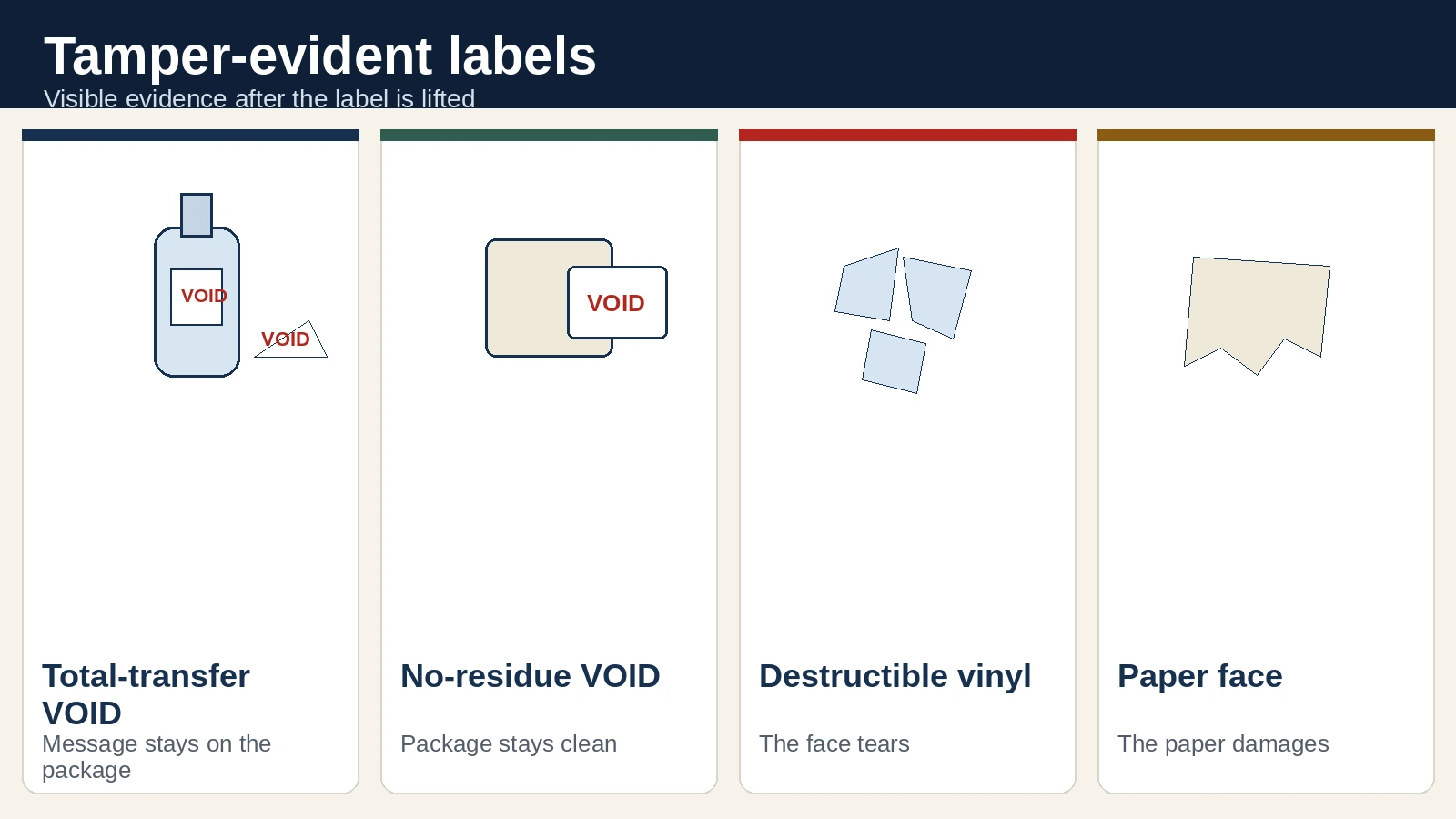
Tamper evident labels give visible evidence if they are breached or missing. Specify a total-transfer VOID polyester when the message has to stay on the package, a no-residue self-void film when the package has to stay clean, a destructible cast vinyl when the face has to tear, or a paper face that damages on removal.
Under 21 CFR 211.132, a tamper-evident package has one or more indicators or barriers to entry which, if breached or missing, can reasonably be expected to provide visible evidence to consumers that tampering has occurred. The Cornell text uses that same sentence. Distinctive by design means the packaging cannot be duplicated with commonly available materials or through commonly available processes. The package may be the immediate container and closure, a secondary carton, or a combination of those systems. The feature is designed to remain intact when handled in a reasonable manner during manufacture, distribution, and retail display.
What does tamper-evident mean?
The final rule changed FDA’s regulatory wording from tamper-resistant to tamper-evident. FDA said those words underscore consumer awareness of evidence of tampering, rather than implying that a package is difficult to breach or is tamper-proof. Labeling is unacceptable if it implies that the product is tamper resistant or tamper proof. FDA said a tamper-proof package is impossible, so the program depends in part on consumers’ attentiveness. The regulation does not mandate the specific term tamper-evident on the package labeling.
The FDA consumer page says tamper-evident packaging works by providing visible evidence if the package has been disturbed, and that OTC packaging cannot be 100 percent tamper-proof. It tells the buyer to be alert to the tamper-evident features on the package before opening it, and says those features are described on the label. The encyclopedia defines tamper-evident as a device or process that makes unauthorized access to the protected object easily detected. It also says no single solution can be considered tamper proof.
The retail package statement must identify all tamper-evident features and any capsule sealing technologies used to comply. The statement is placed so that it will be unaffected if the feature is breached or missing. A dermatological, dentifrice, insulin, or lozenge product is excepted from the retail package rule in that paragraph. A two-piece hard gelatin capsule covered by the section must also be sealed with an acceptable tamper-evident technology. The labels section does not cover tamper-evidence testing.
The tamper-indicating label sheet says no tamper-indicating feature is 100% tamper proof, and these labels are not recommended as the sole means where tampering could cause injury, loss of life, or significant monetary loss. Mail-Well.com is an independent site and is not connected with the former company or its successors.
How does a VOID label leave its message?
A pressure-sensitive adhesive is applied with light pressure, without activation or heat. PSA labels often have release liners which protect the adhesive and assist label handling.
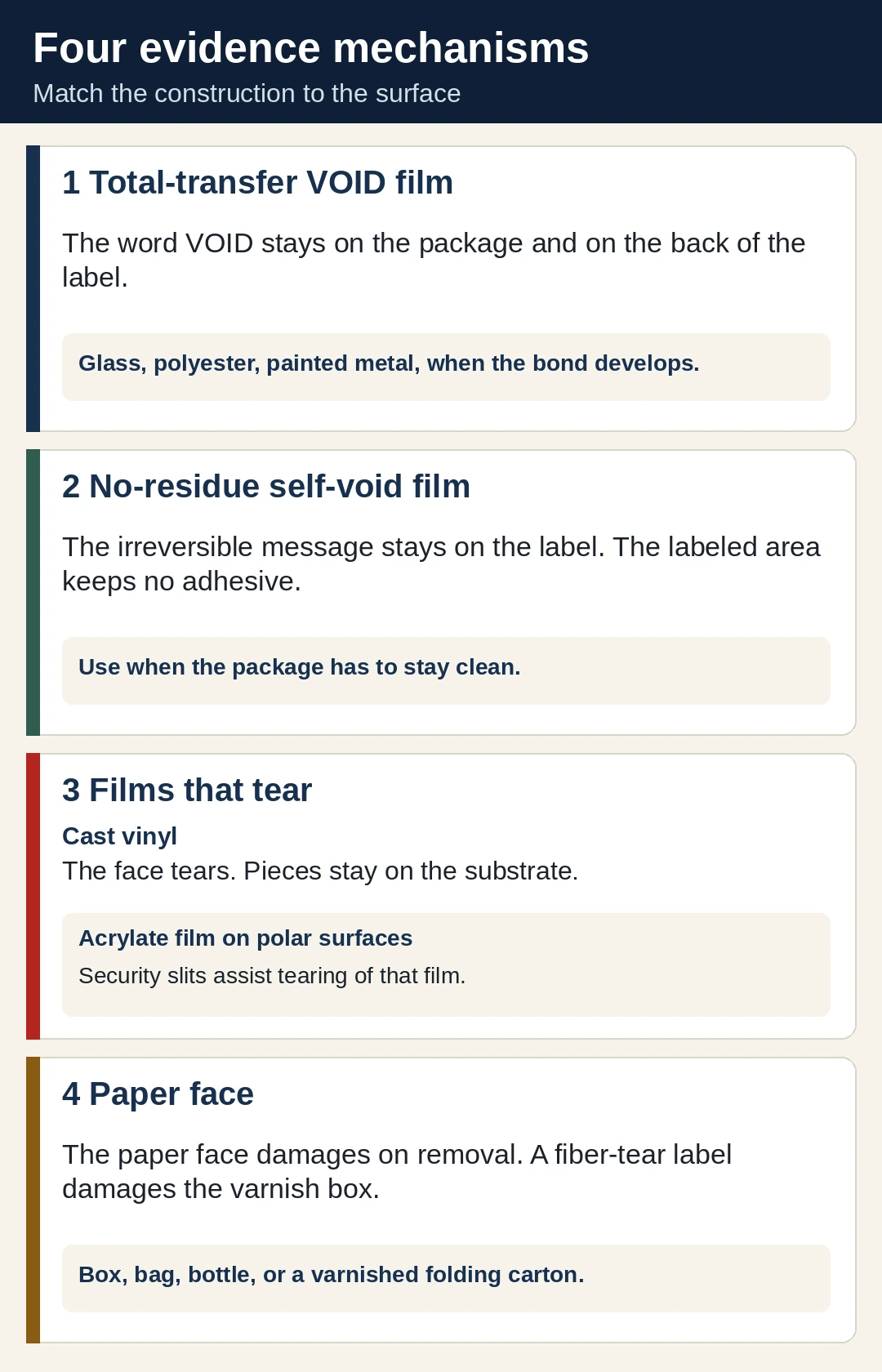
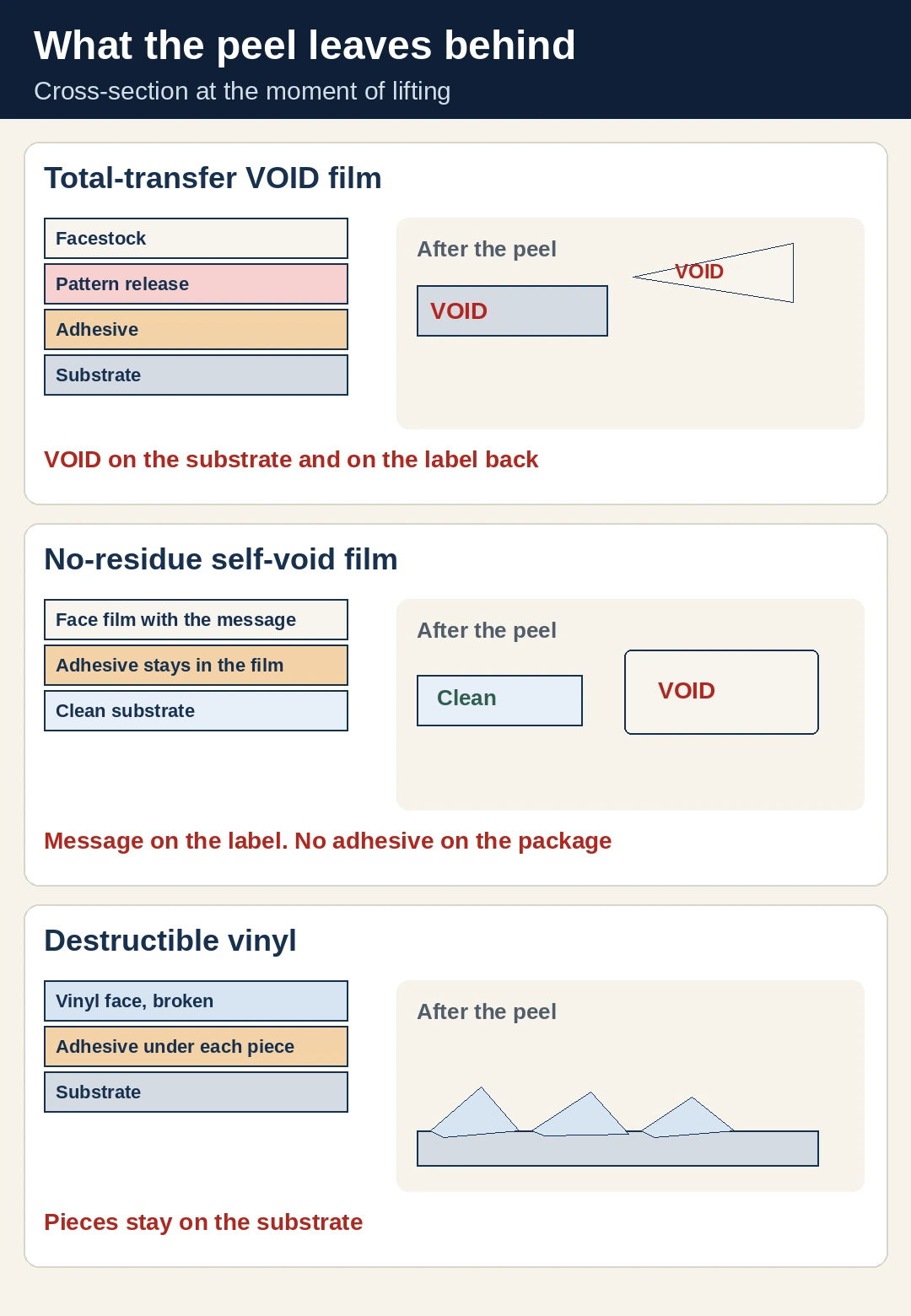
Avery Dennison describes a void label as a pattern-release adhesive that, if the label is removed, leaves the word VOID on both the product substrate and the back of the label. That is the total-transfer construction. Wet-peel VOID is not meant to be removed. Removal leaves a permanent message on the substrate and a visible negative of that message on the label, so the label cannot be applied elsewhere. Dry-peel VOID leaves a permanent VOID message on both the label and the packaging, as a non-tacky film on the substrate, and the removed label loses all tack so it cannot be reapplied. No-residue VOID leaves an irreversible void message on the label and no traces of adhesive on the labeled area.
The ADS1438 sheet leaves the word VOID on the facestock itself. Its adhesive is described as a transferable permanent with medium initial tack, offering a bond to high, medium, and low surface energy substrates and to powder coat painted substrates. That sheet says the pressure-sensitive material should be tested under end-use conditions for the specific application.
On the tamper-indicating label sheet, non-transferable means the label is nonreusable. The void message appears on the facestock when removal is attempted, and a void message is also transferred to the substrate. The transferred message can be removed by hand rubbing or by a solvent. UPM Raflatac said void films leave a text, pattern, or logo when the label is partly or fully removed, and they cannot be smoothed back down undetected. Its standard voids leave a sticky residue on the labelled substrate. Its No Tack voids leave a smooth message that does not attract dust or dirt.
The void message on both the facestock and the substrate depends on adequate adhesion. A sufficient bond may not develop on a low-surface-energy, contaminated, or textured surface. Any surface contaminant adversely affects adhesion and the destruct message and must be removed before application. Sufficient application pressure and dwell time are required so the void message appears on both the facestock and the substrate when removal is attempted. A check after 10 minutes dwell is possible. Final judgement on that sheet is 72 hours dwell at room temperature. The converter check laminates a label to an untreated polyester film test surface.
The adhesive on a tamper-evident label must hold when exposed to the heat often used to open packaging illicitly.
Asset-numbering labels are often designed to leave a serial number or the word VOID if peeled, and a blow dryer or heat gun can make removal and reapplication easier.
Once an electronics security label is removed, an irreversible checkerboard footprint detaches from the face film, and the label cannot be reapplied without visible proof of tampering.
Which face tears on removal?
A frangible label is an engineered film and a specially designed adhesive that fragments into tiny pieces which remain adhered to the substrate when removal is tried. The ultra-destructible film in the Europe guide is matte and semi-gloss white cast vinyl, cadmium-free, coated with an extra permanent adhesive. The portfolio lists Tamperfas satin vinyl under the type frangible. SharpTear film tears in a single direction, and small notches added at die-cutting start that tear. Those notches are a tear starter in the film.
UPM Raflatac’s white acrylate ultra-destructible sheet says the brittle face is difficult to remove in one piece without visible evidence, once it is adhered. Face destruction on removal requires a specific adhesion and is typically a tearing type. Security slits should be added to assist tearing of that face film on polar surfaces. The parameters it names are substrate, temperature, application pressure, and dwelling time.
A security paper, free of optical brightening agents, uses a permanent adhesive so the label cannot be removed without damaging the paper face. A semi-gloss or direct thermal paper facestock with a permanent adhesive can seal a box, a bag, or a bottle, and the face can carry a security message such as Sealed for your protection. A fiber-tear label damages the underlying varnish box packaging if the label is removed. S799P is described as engineered for different cardboard varnishes and for boxes in which medicines are packaged. Each folding box may use a different varnish, and that challenges adhesion.
The face is the sheet you are choosing, and it is not the whole label. Vinyl is a synthetic face and sits on the film side of the comparison in Paper vs film label materials. Adhesive grade is out of scope on that page. A training slide says a permanent label cannot be removed from the substrate without damage to the label or the substrate, and a removable label can.
What can seal a bottle or a carton?
The Compliance Policy Guide says manufacturers may use any packaging system as long as the tamper-resistant standard in the regulations is met. Using one of the listed packaging technologies does not, by itself, constitute compliance. The feature must be properly designed and appropriately applied.
A heat-shrink band or wrapper is securely applied, usually at the juncture of the cap and the container. It must be cut or torn to open the container and cannot be worked off and reapplied without visible damage. Cellulose wet shrink seals are not acceptable, because the knowledge to remove and reapply them without evidence of tampering is widespread. A container-mouth inner seal of paper, plastic film, foil, or a combination sits under the cap. It must be torn or broken, and it cannot be removed and reapplied without visible evidence of entry. Polystyrene foam container-mouth seals applied with a pressure-sensitive adhesive are no longer effective, because they can be removed and reapplied in their original state with no visible evidence of entry.
Tape seals that can be removed and reapplied with no visible evidence of entry do not meet the requirement. Later adhesives may not permit that removal and reapplication, and a tape seal may contain a feature that makes removal apparent. The seal must still employ an identifying characteristic that cannot be readily duplicated. An imprinted neck band is the guide’s example of an identifying characteristic, and that characteristic needs to be referenced in the labeling statement.
Paperboard cartons sealed by gluing the end flaps are not capable of meeting the requirement. The guide allows that later technology may produce sealed paperboard packages that do. Sealed capsules are not the package. They must sit inside a package system that uses a minimum of one tamper-resistant feature. A statement that sits only on a bottle cap is unacceptable where another cap can be substituted with no apparent sign of tampering. If the feature is on an outer carton, the inner bottle needs a statement that the bottle should be in a carton at the time of purchase, where that bottle might otherwise be displayed alone.
Is a serial number the evidence?
Asset labels are usually tamper-evident, permanent, or frangible, and usually contain a barcode for electronic identification. A white void polyester is listed under the application product serial number, and the type listed on that row is void. Void seals can carry warranty numbers and expiry dates. AB176 says that on removal an irreversible void footprint, formerly invisible, detaches from the face film, and the label cannot be reapplied without visible proof of tampering. The face material on that sheet is suitable for thermal transfer printing.
The directive says safety features should allow verification of authenticity and identification of individual packs, and provide evidence of tampering. It places, with that identification, a device allowing verification of whether the outer packaging has been tampered with.
Which surface gets which construction?
HDPE, LDPE, and PP are usually difficult to label with standard adhesives because of low bonding capability. HDPE and PP need an adhesive with higher initial tack. The same tamper-indicating sheet lists clean polypropylene and HDPE among the surfaces the material adheres to, together with polyester, glass, and painted metal.
Security White PE splits internally when removed. The face is noticeably damaged, a residue that is difficult to conceal is left, and the construction is meant to stop the label and its information being transferred to other goods. It takes from several hours to days for the adhesive to develop its full tamper-evident functionality.
Painted high-surface-energy substrates can lose their cohesive properties and then need an adhesive engineered for that surface. For a very small diameter wrap, the training slide says no varnish at the overlap portion. Security tint and tamper evidence address different failures. Tint on a security envelope does not establish how the seal behaves when opened. Fiber-tear on that page is damage to the paper when a bonded envelope area is separated.
Container and carton surface checklist
Copy the row that names the surface you have. Leave the sample result for the trial on that surface.
| Surface you can name | Construction to sample | Evidence if the label is lifted | Check named on the sheet |
|---|---|---|---|
| Clean glass, polyester, or painted metal, where the message should remain | Total-transfer VOID polyester | The word VOID on the substrate and on the back of the label | A check after 10 minutes dwell is possible, and final judgement is 72 hours dwell at room temperature. The converter check surface is untreated polyester film. |
| A package that should stay free of adhesive traces | No-residue VOID | An irreversible void message on the label and no adhesive traces on the labeled area | Dry-peel leaves a non-tacky film on the substrate and the label loses all tack. Standard voids can leave a sticky residue. No Tack voids leave a smooth message that does not attract dust. |
| Gloss white polyester whose face itself shows VOID | ADS1438 pattern-release sheet | The word VOID on the facestock itself | Test that pressure-sensitive material under end-use conditions. The adhesive is described as a transferable permanent. |
| A polar surface where the face should tear | Cast vinyl ultra-destructible film, or brittle acrylate film with security slits in that film | Film pieces stay on the substrate. Security slits assist tearing of the acrylate face film on polar surfaces. | The named parameters are substrate, temperature, application pressure, and dwelling time. |
| A varnished folding carton | Security paper that damages the paper face, or a fiber-tear label, with an adhesive such as S799P for cardboard varnishes | Damage to the paper face, or damage to the underlying varnish box | Each folding box may use a different varnish. |
| Untreated HDPE, LDPE, or PP | An adhesive with higher initial tack, then a void or destructible face after that bond is shown | The void on both sides depends on adequate adhesion | These plastics are usually difficult with standard adhesives. Clean polypropylene and HDPE are also on one adhesion list. |
| A contaminated or textured surface | Remove the contaminant before any of these films | The void on both sides needs a sufficient bond | Any surface contaminant must be removed before application. |
| Overlap on a very small diameter wrap | Film with no varnish at that overlap | No varnish at the overlap portion | The training slide gives that note for a very small diameter wrap. |
Takeaway: Name the surface first, then the evidence you need to see if the label is lifted, then the dwell the sheet actually prints.
Sources
- Tamper-evident package rule (eCFR)
- Same package definition (Cornell Law School)
- Terminology final rule (Federal Register)
- OTC medicines page (FDA)
- Packaging policy guide (FDA)
- Label (Wikipedia)
- Tamper-evident technology (Wikipedia)
- Falsified medicines directive (EUR-Lex)