EnvelopesComparison
Window vs Non-Window Envelopes: Sample Approval Sheet
Choose a window or a printed envelope address, then record the folded sample: visible area, insert shift, exposed lines, and the reprint path.
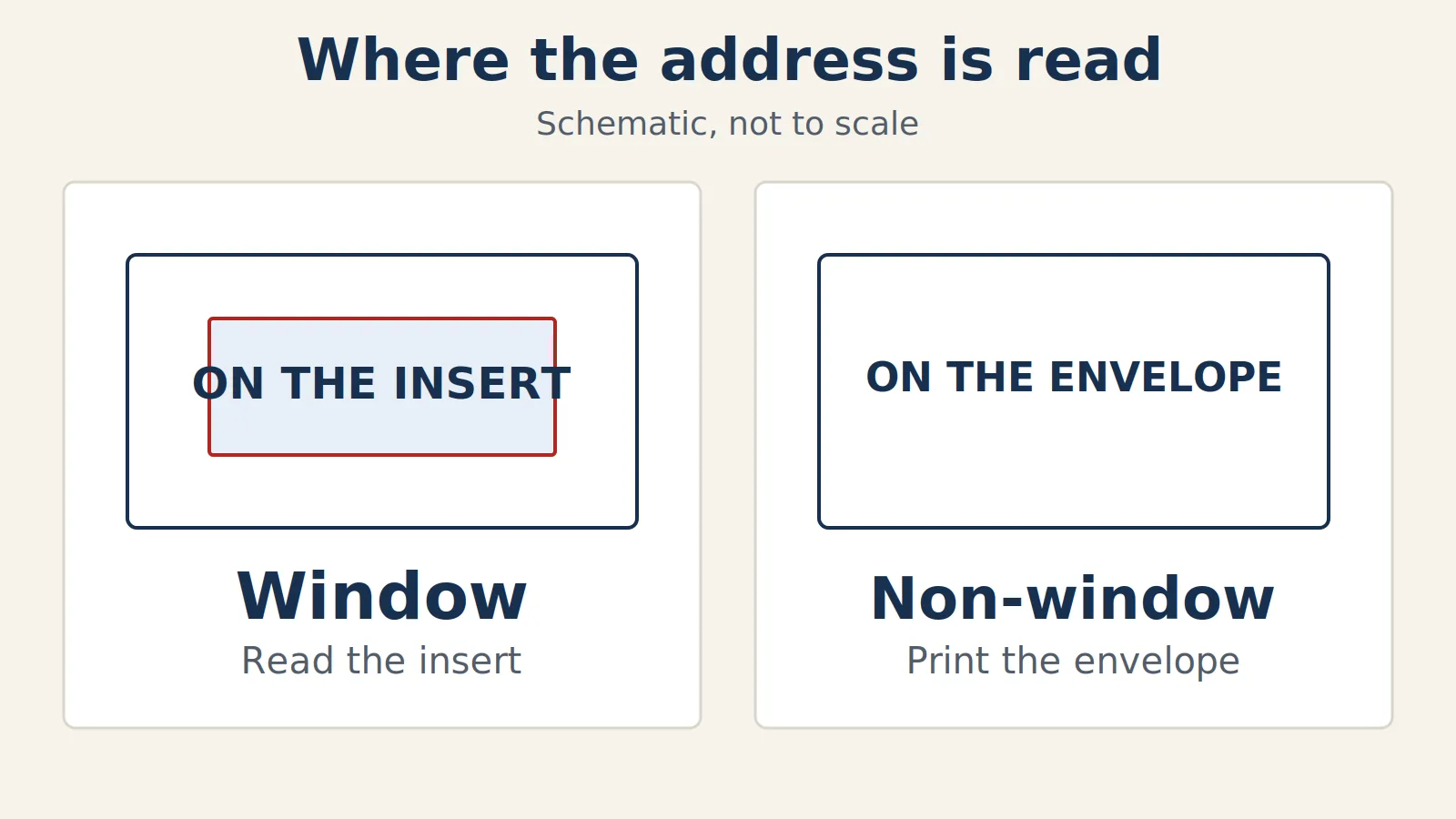
Show the delivery address through a window, or print it on the envelope. A window piece fails when the insert shifts and hides part of the address, and that piece is not ready to approve. Approve a window vs non-window envelopes job only after you fold the real insert into the real envelope and write the result on the sheet below.
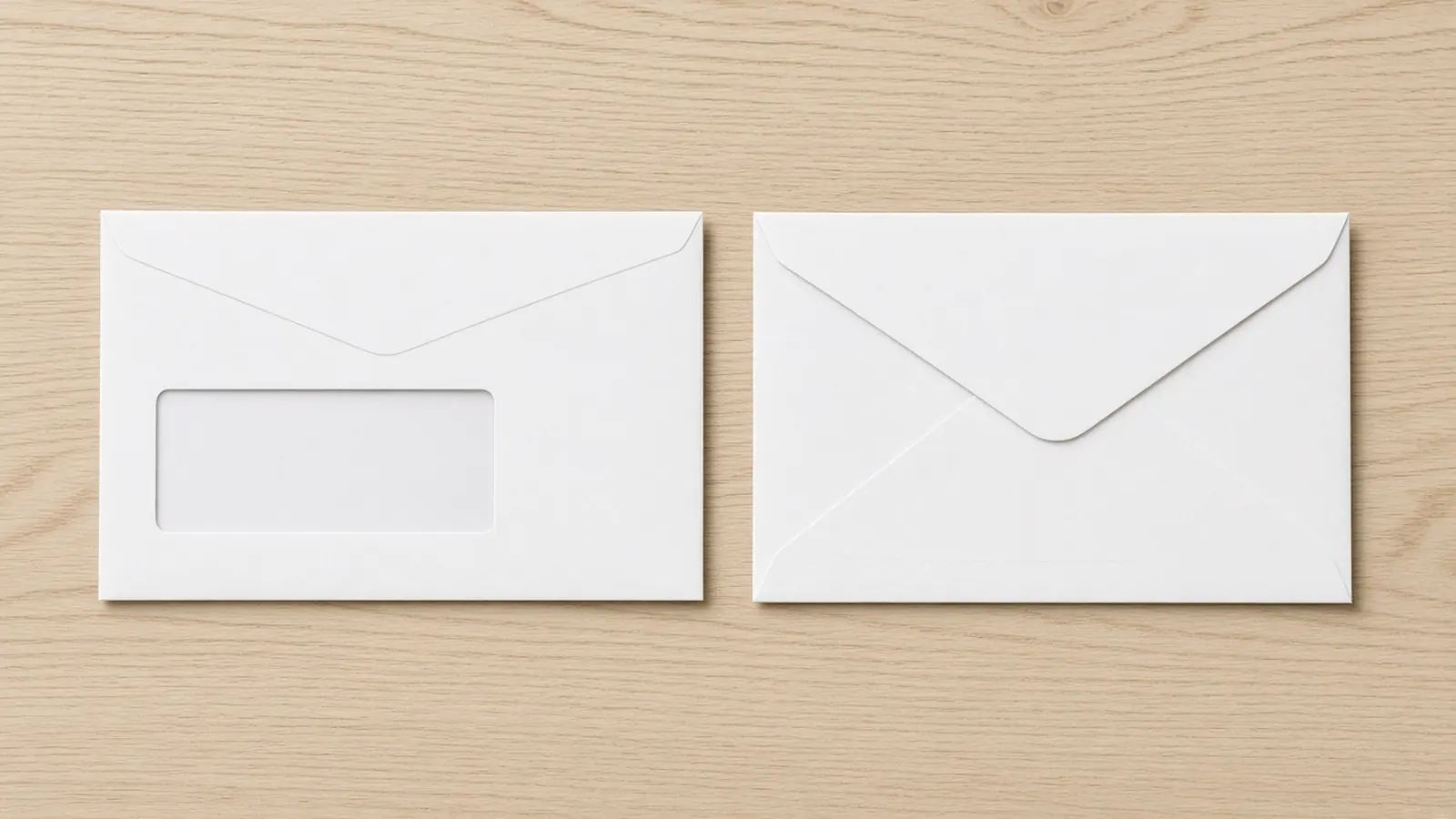
For letter-size and flat-size window mail, every character in the delivery address has to stay completely visible through the window when the insert moves to its limits. That rule is DMM 601 section 6.3, read on Postal Explorer on 12 October 2026. Types of mailing envelopes already says to check insert position. This page is the job record and the blank approval sheet.
Job conditions for window vs non-window envelopes
“Window envelopes vs paper envelopes” is the same choice under another name. Both pieces here are paper envelopes. One has an opening that shows the insert. The other is printed with the delivery address.
| Condition | Window envelope | Non-window envelope |
|---|---|---|
| Where the address is read | On the insert, through the opening | Printed on the envelope |
| Insert movement | Can hide characters. Section 6.3 requires every character to stay visible at each limit of movement | Does not cover the address printed on the envelope |
| Clearance | At least 1/8 inch between the address block and each window edge, still there at each limit | No window clearance. Confirm the printed address is complete |
| Other text in view | A neighboring line on the insert can slide into the opening | Insert text stays behind the paper. The face shows what you print |
| Wrong address | Reprint the insert, refold, and repeat the four-limit check | Reprint the envelope address and confirm the face |
| Later correction | Reprint the corrected insert and repeat the four-limit check | Reprint the corrected envelope address and confirm the face |
Takeaway: Choose the column that matches where you will print the address, then prove that column on a folded sample.
Visible address area
Section 6.3 applies to all letter-size and flat-size mail in window envelopes. Every character in the delivery address, including any postal barcode, marking, or endorsement, must be completely visible through the window throughout the full range of movement of the insert that bears the delivery address.
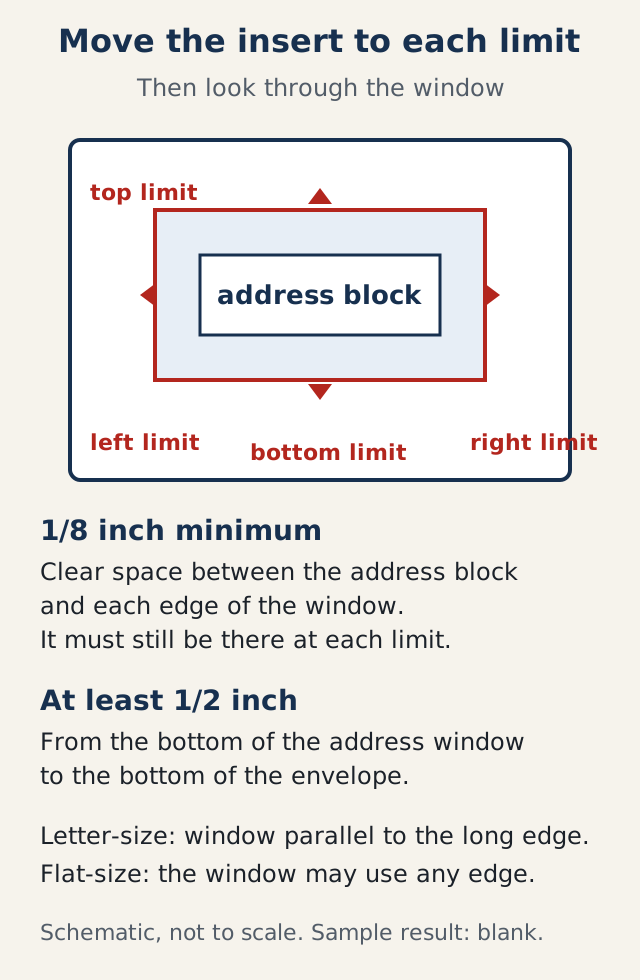
A clear space of at least 1/8 inch is required between the address block and the top, bottom, left, and right edges of the address window. The address block includes any optional endorsement line. That clear space must remain when the insert is moved to its full limits in each direction inside the envelope.
The address, and any barcode visible through the window, must be printed on white paper or paper of a very light color.
For letter-size mail, the delivery address window must be parallel with the longest edge of the envelope. For flat-size mail, the address window may be parallel with any edge. The bottom edge of an address window must be at least 1/2 inch from the bottom edge of the envelope.
Three further pointers sit in the same section. They are not copied onto this sheet:
- When the address block contains a barcode, barcode clearances are in DMM 202.5.1 for letters and 202.5.2 for flats.
- For nonautomation mail, the bottom edge of the address window must not extend more than 1/8 inch into the barcode clear zone defined in DMM 202.5.3d. A letter-size envelope with a window that intrudes into that zone is not eligible for NCOALinkMPE system processing options for the Move Update standard. Read the zone from the current text of 202.5.3d before you fill the sheet.
- Window envelopes used for letter-size or flat-size mail claimed at automation prices, and letter-size mail claimed at Enhanced Carrier Route high density or saturation prices, must also meet the barcoding standards for letters and flats in DMM 204.1.0.
If a cover is used over the address window, section 6.3 requires a nontinted clear or transparent material. It names cellophane and polystyrene as examples, allows glassine, and requires every edge of the cover to be glued securely to the envelope. The address, viewed through that material, must meet the print contrast ratio standards in DMM 204.1.4. Film-to-film comparison is outside this record. For Registered Mail, the opening must be covered as described in DMM 503.2.3.5.
Common mistake: Signing a flat proof, or a sample that sits neatly in the center. Section 6.3 is written for the full range of movement. A centered insert can look fine and still fail when it shifts.
Insert shift
Push the folded insert until it stops against the envelope in each direction: left, right, up, and down. At each stop, look through the window.
On the sheet, write whether every delivery-address character is still inside, and whether the 1/8 inch space is still there on every side. Leave those cells blank until the sample is in your hands. A drawing, including the diagram above, is not a result.
A non-window envelope does not use this shift test for the delivery address. That address is on the envelope. You still read the filled piece and confirm the printed address is complete.
Takeaway: Record four limits for a window piece, not one resting position.
What else can show through the window
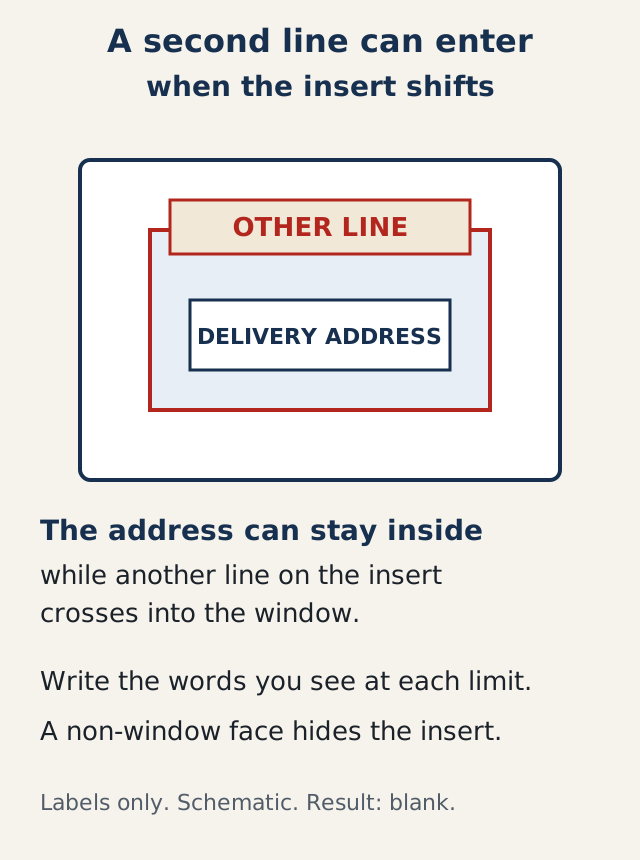
The opening shows whatever part of the insert sits behind it. A line beside or above the address can enter the window when the insert moves, even if the address itself stays inside. Write down the words you see at each limit.
A non-window envelope keeps the insert behind paper. The face shows the delivery address you print there, and anything else you print there.
This row is a sample check. It does not review security tints or other security features, and it does not rate inserter settings.
Reprint, and reprint after a correction
Section 6.3 states what the finished window piece must show. It does not name a shop reprint method. Reprint the piece that carries the bad address, then check the new folded sample. An earlier approval does not cover the reprinted piece.
| When | Window job | Non-window job |
|---|---|---|
| The address on this sample is wrong | Reprint the insert, refold it, and repeat the four-limit check. Keep the envelope only if the window itself still passes. | Reprint the address on the envelope and confirm the new face. Keep the insert only if the corrected address is not printed on it. |
| The address is corrected later | Reprint the corrected insert and repeat the four-limit check. | Reprint the corrected address on the envelope and confirm the face. |
| The window fails and the address is fine | The envelope is the piece that failed. A replacement envelope has to pass the same sheet. | There is no address window to fail. Treat a bad face layout as an envelope reprint. |
If the shop will use a method other than a straight reprint, write that method on the sheet and run it on a sample before you approve it. An untested method stays a blank, not a pass.
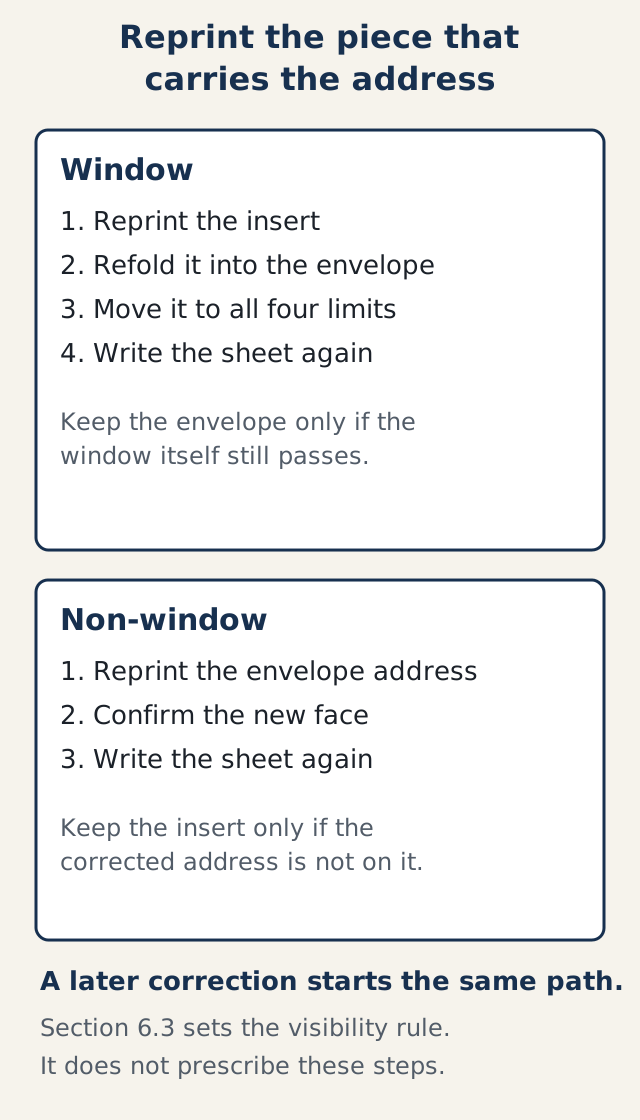
Takeaway: After a correction, fill the sheet again from the new piece.
Sample approval sheet
Copy this table into the job file. The result column stays blank until you measure the folded sample.
| Field | What to write | Result |
|---|---|---|
| Job | Name or job number | blank |
| Choice | Window or non-window | blank |
| Shape | Letter-size or flat-size, as you intend to mail it | blank |
| Address file | Insert file, or envelope print | blank |
| Fold | How the insert is folded | blank |
| At rest | Are all delivery-address characters inside the window? | blank |
| Left limit | Same question, insert fully left | blank |
| Right limit | Insert fully right | blank |
| Top limit | Insert fully up | blank |
| Bottom limit | Insert fully down | blank |
| 1/8 inch | Does the clear space remain on all four sides at each limit? | blank |
| Other text | Non-address lines visible at each limit | blank |
| 1/2 inch | Distance from the bottom of the address window to the bottom of the envelope | blank |
| Direction | Letter-size: is the window parallel to the longest edge? Flat-size: which edge? | blank |
| Paper color | Color of the paper that carries the address seen through the window | blank |
| Cover | If a cover is used, can you read every character through it? | blank |
| Barcode zone | Does the bottom of the window extend more than 1/8 inch into the barcode clear zone in DMM 202.5.3d? | blank |
| Reprint now | Piece you will reprint if this sample fails, and the repeat-check result | blank |
| Reprint after correction | Piece you will reprint after a later address change, and that repeat-check result | blank |
| Decision | Approve or hold | blank |
| Signed | Name and date | blank |
Empty results are intentional. This page has no measured envelope.
Window films, machine-compatibility specifications, and security features are outside this record. So are postage prices.
Corrections
The window rules on this page are from DMM 601 section 6.3 as published on Postal Explorer on 12 October 2026. That live text matched the copy of section 6.3 saved for this page. Recheck DMM 601 before a mailing. The manual can change, and sections 202, 204, and 503 are only pointed to here, not quoted in full.
To report an error, use the corrections section of the editorial policy. That section tells you to write through the Contact page, and it states that a wrong published statement is corrected on the page.
Frequently Asked Questions
What must a window envelope sample show before you approve it?
On letter-size and flat-size mail, DMM 601 section 6.3 requires every character of the delivery address, including any postal barcode, marking, or endorsement, to stay completely visible through the window while the insert moves through its full range. At least 1/8 inch of clear space has to remain between the address block and each edge of the window at those limits. Write the result from the folded sample. This page does not fill it in.
Does a non-window envelope use the same insert-shift test?
No. The shift test in DMM 601 section 6.3 applies to mail in window envelopes, because the delivery address is read through the opening. On a non-window envelope the delivery address is printed on the envelope, so moving the insert does not cover it. You still confirm that the printed address is complete, and you reprint that envelope printing if it is wrong.
Sources
- DMM 601 Mailability (USPS Postal Explorer)