EnvelopesGuide
Remittance Envelopes Guide: Full-Face Wallet Flaps, Perforated Stubs, and Return Insert Fit
Compare remittance envelope sizes, Style A wallet flaps, Style B drop-seal reply stubs, bangtail mailers, inserter clearances, and postal return layout rules.
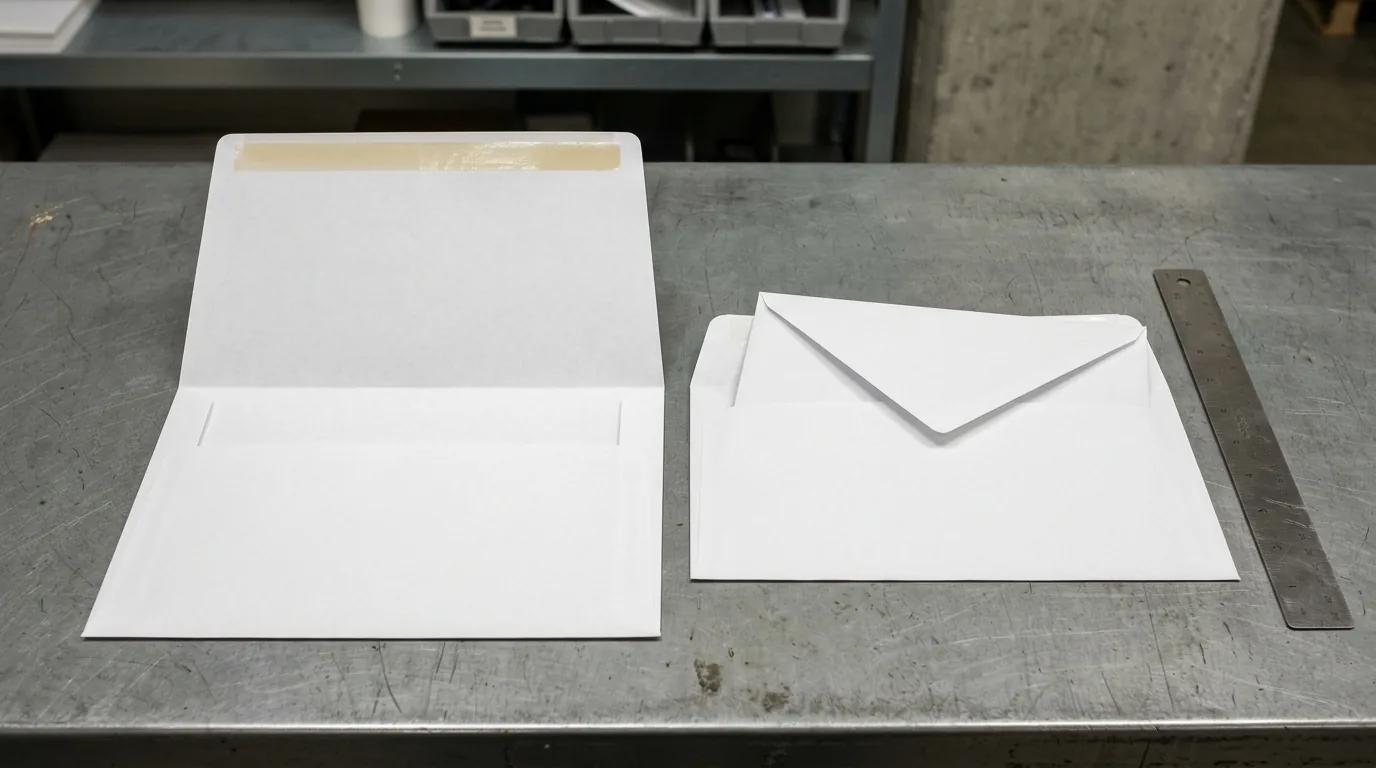
In the EMA Guide Glossary, a remittance envelope is a booklet or side seam style envelope with a long wallet type seal flap covering most of the back of the envelope. The most common remittance envelope sizes are commercial and official sizes #6 ¼, # 6 ¾, and #9, and they are boxed with flaps extended. In the EMA Guide flap classification, the Remittance Style flap is like the Wallet Flap and is the deepest of all, extending almost to the bottom of the envelope. The Remittance Style flap is designed to be printed with remittance information and is perforated so the flap can be torn off and inserted into the envelope before mailing. In the Tension Envelope Glossary, a Booklet Envelope is an open side, double side seam envelope, usually with a wallet-style flap.
Selecting a remittance envelope for donation appeals, billing statements, or reply mailings requires coordinating the pocket size designation, the flap adhesive position, the converter print zones, the flap packing state, the mechanical inserter clearances, and the postal reply layout. For background on how side-seam pockets and seal gums are converted from paper webs and blanks, see the envelope manufacturing and converting overview.
Remittance Envelope Size Designations and Enclosure Clearances
Common designations of remittance envelopes in the EMA Guide are 6¼ (3½x6), 6½ (3½x6¼), 6¾ (3 5/8 x 6 ½), and 9 (3 7/8 x 8 7/8). The two most popular sizes of Sheppard remittance envelopes (also referred to as Kost Kuts) are # 6-3/4 (3-5/8” x 6-1/2”) and #9 (3-7/8” x 8-7/8”).
In the Tension Envelope Size Charts, a 6-1/4 business envelope measures 3-1/2 x 6 inches with a maximum enclosure of 3-1/4 x 5-3/4 inches, and a 6-3/4 envelope measures 3-5/8 x 6-1/2 inches with a maximum enclosure of 3-3/8 x 6-1/4 inches. In the same business envelope chart, a 9 business envelope measures 3-7/8 x 8-7/8 inches with a maximum enclosure of 3-5/8 x 8-5/8 inches, and a 10 envelope measures 4-1/8 x 9-1/2 inches with a maximum enclosure of 3-7/8 x 9-1/4 inches. Print buyers should also note how the fractional designation changes by category: in the booklet envelope category of the Tension Envelope Size Charts, a 6-1/2 envelope measures 6 x 9 with a maximum enclosure of 5.75 x 8.75. To compare these dimensions against other commercial, announcement, and catalog formats, consult the commercial and booklet envelope sizes guide.
| Size Designation | Finished Envelope Dimensions | Maximum Enclosure Dimensions | Reference Category |
|---|---|---|---|
| 6-1/4 Business Envelope | 3-1/2 x 6 inches | 3-1/4 x 5-3/4 inches | Business envelope chart in Tension Envelope Size Charts |
| 6-3/4 Business Envelope | 3-5/8 x 6-1/2 inches | 3-3/8 x 6-1/4 inches | Business envelope chart in Tension Envelope Size Charts |
| 9 Business Envelope | 3-7/8 x 8-7/8 inches | 3-5/8 x 8-5/8 inches | Business envelope chart in Tension Envelope Size Charts |
| 10 Business Envelope | 4-1/8 x 9-1/2 inches | 3-7/8 x 9-1/4 inches | Business envelope chart in Tension Envelope Size Charts |
| 6-1/2 Booklet Envelope | 6 x 9 | 5.75 x 8.75 | Booklet envelope category in Tension Envelope Size Charts |
Full-Face Wallet Flap Remittance Construction (Style A)
In the EMA Guide, an inside side seam remittance envelope of 6¾” length is frequently used when a mailer wants a tear-off remittance document attached to the envelope. Converters produce distinct flap architectures for donation remittance envelopes and statement returns depending on whether the flap stays attached during return mailing or separates as a perforated flap return envelope along a score and perforation line. Sheppard manufactures remittance envelopes with the seal gum at the end of the flap in the normal position, or with the seal gum up close to the throat (called drop seal) and a perforation so the reply stub can be removed and returned inside the envelope.
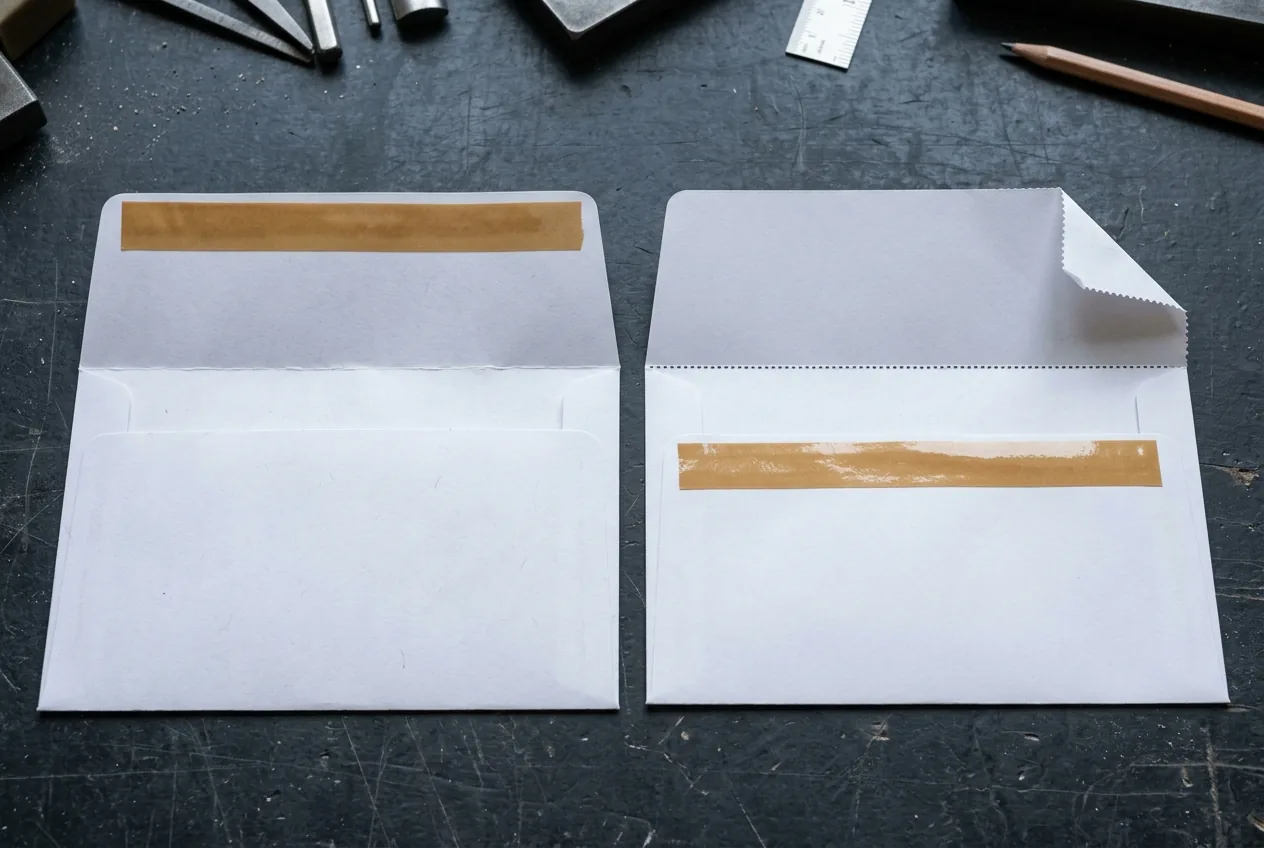
Style A Full-Flap Remittance Construction
Sheppard 6-3/4 Kost Kut Remittance Envelopes have the seal gum at the edge of the seal flap and are shipped with flaps extended for easy imprinting. When the recipient folds the deep wallet flap down and moistens the bottom edge, the full flap covers the donor or account form printed on the inside surface. On Style A 3-5/8” x 6-1/2” Remittance Envelopes, the extended flap is 3-3/8” deep with a 2-7/8” x 5-3/4” outside flap print area and a 2-3/4” x 5-3/4” inside flap print area. On Style A 3-5/8” x 6-1/2” Remittance Envelopes, the inside back print area is 2-3/8” x 5- 13/16” and the outside face print area is 3-1/8” x 6”. Sheppard Style A Kost Kut Remittance Envelopes have a weight per 1000 of 9#. For applications requiring interior opacity tints or tamper-indicating closures alongside full-flap coverage, review the security envelope features guide.
Style B Drop-Seal Perforated Stub Construction
Style B Remittance Envelopes are called Drop Seal because the seal gum is dropped down from the edge of the seal flap. Instead of sealing the full extended flap over the back of the pocket, the sender detaches the printed coupon along the perforation, places the stub and payment inside the pocket, and seals the short remaining flap. On Style B 3-5/8” x 6-1/2” Drop Seal Remittance Envelopes, the tear-off reply stub is 2-1/2” deep with a 2-1/8” x 5-3/4” print area, and the remaining seal flap is 7/8” deep with a 3/8” x 5-3/4” outside print area. On Style B 3-5/8” x 6-1/2” Drop Seal Remittance Envelopes, the inside back print area is 2-3/8” x 5-7/8” and the outside face print area is 3-1/8” x 6”.
| Sheppard Configuration | Flap and Stub Depth | Flap and Stub Print Areas | Pocket Print Areas |
|---|---|---|---|
| Style A 3-5/8” x 6-1/2” Flap Specification | 3-3/8” deep extended flap | 2-7/8” x 5-3/4” outside flap; 2-3/4” x 5-3/4” inside flap | Full wallet flap with seal gum at the outer edge |
| Style A 3-5/8” x 6-1/2” Body Specification | Standard pocket panels | Seal gum at outer flap edge | 2-3/8” x 5- 13/16” inside back; 3-1/8” x 6” outside face |
| Style B 3-5/8” x 6-1/2” Drop Seal Flap Specification | 2-1/2” deep tear-off reply stub; 7/8” deep remaining seal flap | 2-1/8” x 5-3/4” stub print area; 3/8” x 5-3/4” outside remaining flap | Dropped seal gum with perforated reply stub |
| Style B 3-5/8” x 6-1/2” Drop Seal Body Specification | Drop Seal pocket panels | Perforated reply stub removed before sealing | 2-3/8” x 5-7/8” inside back; 3-1/8” x 6” outside face |
Bangtail Envelopes and Two-Way Reusable Mailers
When a mailing needs a detachable coupon on the back panel rather than on the seal flap, or when a two way remittance mailer must travel outbound and return, converters offer bangtail and Hitch-Hiker constructions. For a broader comparison of open-side and open-end pocket geometries, see the types of mailing envelopes guide.
Bangtail Perforated Coupon Envelopes
In the Tension Envelope Glossary, a Bangtail Envelope is an open side envelope with a perforated piece of paper attached to the top of the back panel. Custom bangtail envelopes offer a choice of single, double, or triple perforated coupons for responding to a donation request. Tension bangtail envelopes come with a regular flap or remittance style flap, in sizes ranging from 3 1/2” x 5” to booklet size. On Sheppard #9 Bangtail envelopes (3-7/8″ x 8-7/8”), single bangtails are in stock and shipped with flaps extended, while double bangtails must be custom manufactured and are shipped flaps folded.
Hitch-Hiker and Two-Way Remittance Mailers
In the EMA Guide Glossary, a Hitch-Hiker Envelope is a dual purposed envelope for use in both outbound and return response mailing. In the same glossary, a Coupon Hitch-Hiker is a remittance envelope with a perforated coupon extending from the flap and a perforated tail extending from the back flap. On Tension two-way envelopes, the indicia is printed on the correspondence insert that appears through the window, leaving the return postage area clean to apply a First Class stamp for a second mailing. Under postal mailability rules, when a reusable mailpiece is reconfigured for return from the recipient to the originator, the piece must show only one complete delivery address and, if used, the corresponding barcode; the appropriate postage; and any required marking, endorsement, and FIM.
Extended Versus Folded Flaps and Imprinting Safe Zones
How a remittance envelope is boxed at the converter determines how it feeds through commercial offset presses, digital envelope presses, and subsequent folding stations.
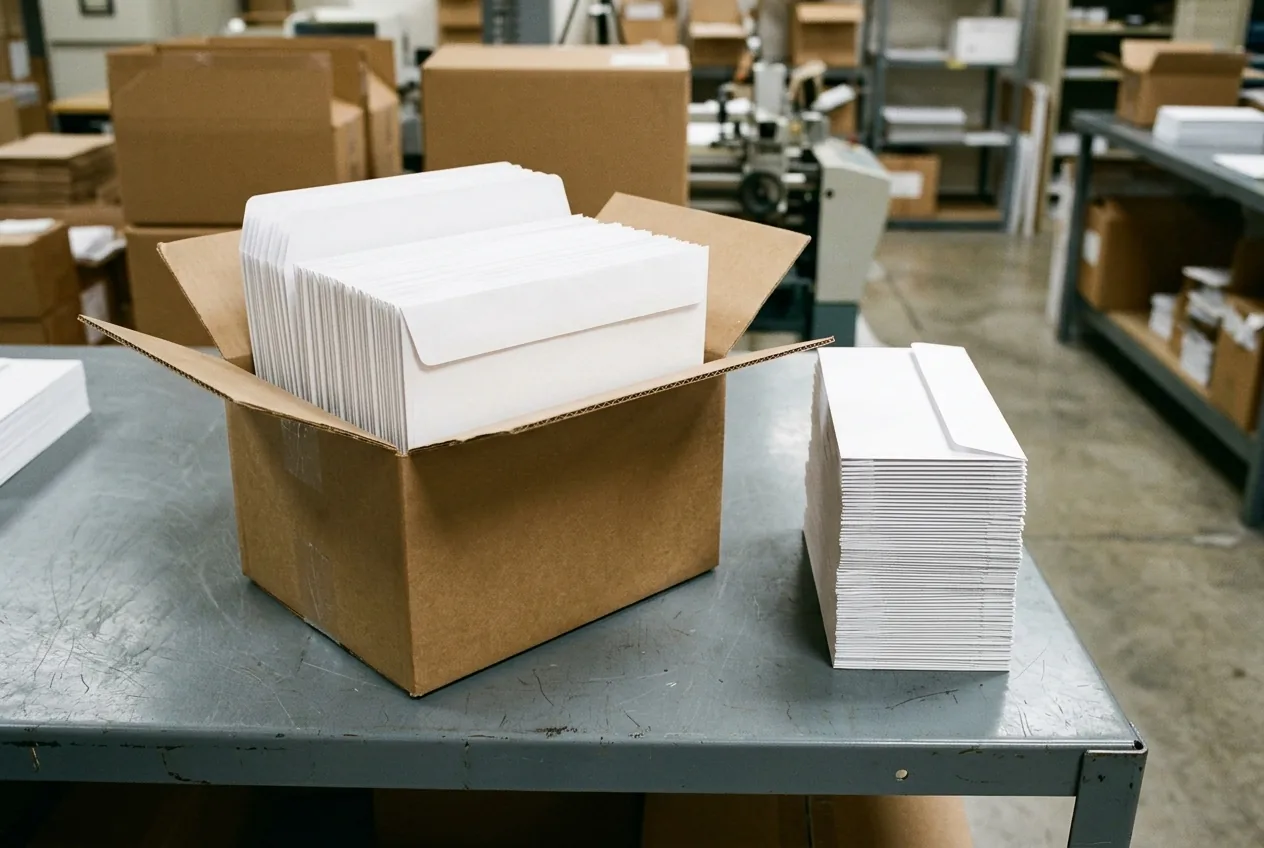
Sheppard maintains plain unprinted remittance envelopes with flaps extended for 3- 5 day turnaround with one or two color printing, and printed envelopes are shipped flaps extended with folded flaps as an option. For Simple Printing on folded Kost Kut Remit Envelopes, halftones are accepted at 5% min/80% max density (using 110 linescreen) and all content must be at least 1/4” in from any edge.
Return Insert Fit in Outbound Envelopes and Mail Inserter Clearances
When a remittance or reply envelope rides inside an outbound carrier envelope, both the nested enclosure dimensions and the mechanical inserter specifications govern feeding reliability. Tension #9 reply envelopes are designed to insert seamlessly into outbound envelopes, and double side seam construction is compatible with automated extraction equipment.
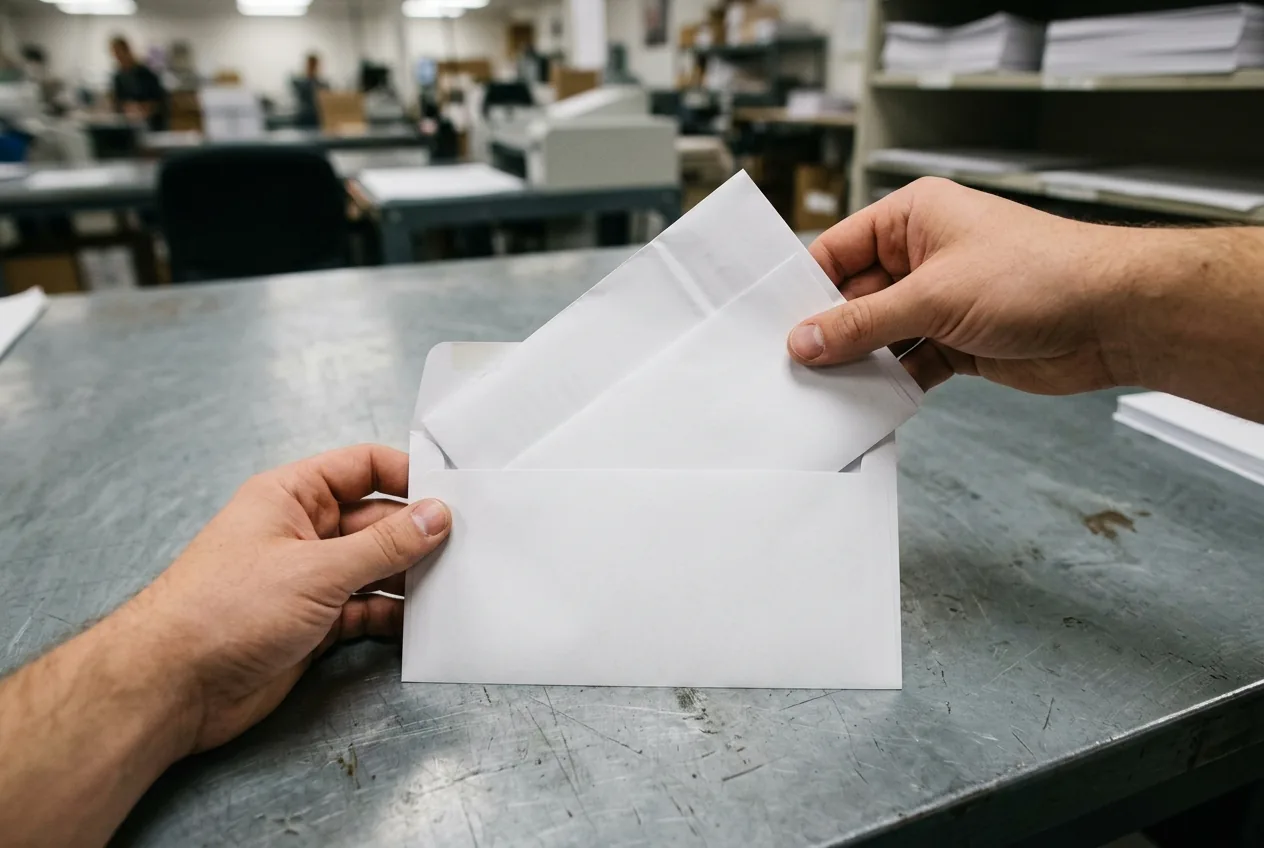
For the DMI mail inserting system, the envelope size range is Min 105 x 225 mm (4.33” x 8.8”) to Max 353 x 353 mm (13.9” x 13.9”), and envelope weight is Min 75 gsm (20 lb Bond) to Max 110 gsm (28 lb Bond). For the DMI mail inserting system, the insert size range is Min 89 x 160 mm (3.5” x 6.3”) to Max 300 x 315 mm (11.8” x 12.4”), and paper weight is Min 60 gsm (40 lb Book) to Max 200 gsm (125 lb TAG).
In the Detailed Envelope Specification, insert length (A) is 8 5/16” Min to 12 3/8” Max, insert height (B) is 3 11/16” Min to 11 13/16” Max, and minimum side clearance (C) is 19 /32”. In the Detailed Envelope Specification, envelope height (D) is 4 1/8” Min to 13 29/32” Max, envelope length (E) is 8 7/8” Min to 13 29/32” Max, flap length (G and H) is 1 1/16” Min to 2 1/2” Max, and throat depth (I) is 1 /4” Min to 1 3/8” Max. On the Pitney Bowes DMI mail inserting system, inserts smaller than measurement A minimum could be accepted provided that they are placed between inserts that are larger than measurement A minimum.
Filling capacity clearance is calculated as Clearance = 16 mm (0.63”)(Measurement C) + (thickness of the inserts – 5 mm (0.2”)), where 5 mm (0.2”) insert thickness is default included. For inserts that are less than 3 mm (.12”) thick, 12 mm clearance is the minimum amount allowed.
| Inserter Parameter Group | Dimensional Range | Basis Weight or Clearance | Operational Scope |
|---|---|---|---|
| DMI Carrier Envelope Range | Min 105 x 225 mm (4.33” x 8.8”) to Max 353 x 353 mm (13.9” x 13.9”) | Min 75 gsm (20 lb Bond) to Max 110 gsm (28 lb Bond) | General envelope specification for the DMI mail inserting system |
| DMI General Insert Range | Min 89 x 160 mm (3.5” x 6.3”) to Max 300 x 315 mm (11.8” x 12.4”) | Min 60 gsm (40 lb Book) to Max 200 gsm (125 lb TAG) | General insert specification for the DMI mail inserting system |
| Detailed Insert Dimensions (A, B, C) | Insert length (A) 8 5/16” Min to 12 3/8” Max; insert height (B) 3 11/16” Min to 11 13/16” Max | Minimum side clearance (C) of 19 /32” | Detailed envelope specification for standalone inserts |
| Detailed Carrier Envelope Dimensions (D, E, G, H, I) | Envelope height (D) 4 1/8” Min to 13 29/32” Max; envelope length (E) 8 7/8” Min to 13 29/32” Max | Flap length (G and H) 1 1/16” Min to 2 1/2” Max; throat depth (I) 1 /4” Min to 1 3/8” Max | Detailed envelope specification for carrier pockets |
Postal Machinability, Business Reply Mail, and Window Clearances
Once the donor or customer seals the remittance envelope and drops it into the mailstream, the return piece must meet postal physical standards, Business Reply Mail artwork clearances, and window positioning limits.
Machinable Letter Dimensions and Paper Basis Weight
Machinable letter-size mail must be not less than 5 inches long, 3-1/2 inches high, and 0.007-inch thick (or 0.009 minimum thickness for pieces more than 4-1/4 inches high or 6 inches long). Machinable letter-size mail must be not more than 11-1/2 inches long, or more than 6-1/8 inches high, or greater than 1/4-inch thick. Machinable letters must have an aspect ratio (length divided by height) of 1.3 to 2.5, inclusive. Automation-compatible envelopes, or letter-size mailpieces sealed along all four sides, must be made of paper with a minimum 50 pounds paper basis weight or equivalent.
Business Reply Mail and Window Envelope Standards
On letter-size Business Reply Mail, there must be at least a 1/2-inch clearance between the ZIP Code and the horizontal bars. On letter-size Business Reply Mail, FIM B must be used with BRM without a barcode, and FIM C must be used with any BRM printed with a barcode.
When a remittance return envelope or two-way mailer uses an address window, the window patch and insert shift must be verified before press approval; see the window vs. regular envelopes guide for physical tap-test procedures. On window envelopes, a clear space of at least 1/8 inch is required between the address block and the top, bottom, and left and right edges of the address window. On window envelopes, all edges of the window cover material must be glued securely to the envelope, and the bottom edge of an address window must be at least 1/2 inch from the bottom edge of the envelope.
| Postal Standard Category | Dimensional or Material Requirement | Secondary Limit or Condition | Mailpiece Scope |
|---|---|---|---|
| Minimum Machinable Letter Size | Not less than 5 inches long, 3-1/2 inches high, and 0.007-inch thick | 0.009 minimum thickness for pieces more than 4-1/4 inches high or 6 inches long | Machinable letter-size mail |
| Maximum Machinable Letter Size | Not more than 11-1/2 inches long, or more than 6-1/8 inches high | Not greater than 1/4-inch thick | Machinable letter-size mail |
| Machinable Letter Aspect Ratio | Aspect ratio (length divided by height) of 1.3 to 2.5, inclusive | Machinable letter-size mail | |
| Automation Envelope Paper Weight | Minimum 50 pounds paper basis weight or equivalent | Letter-size mailpieces sealed along all four sides | Automation-compatible envelopes |
| Business Reply Mail Bar Clearance | At least a 1/2-inch clearance between the ZIP Code and the horizontal bars | Letter-size Business Reply Mail | Return face layout |
| Business Reply Mail FIM Selection | FIM B used with BRM without a barcode; FIM C used with any BRM printed with a barcode | Letter-size Business Reply Mail | Facing Identification Mark |
| Window Address Block Clearance | Clear space of at least 1/8 inch between the address block and top, bottom, left, and right window edges | All address window formats | Window envelopes |
| Window Cover Gluing and Bottom Margin | All edges of window cover material glued securely; bottom edge of address window at least 1/2 inch from bottom edge of envelope | All address window formats | Window envelopes |
Remittance Envelope Specification Worksheet
Before releasing artwork or purchasing remittance stock, record the following specification parameters for the converter, printer, and mail house:
- Target Size Designation and Pocket Style: Specify the commercial or official remittance size designation, finished pocket dimensions, and side-seam construction.
- Flap Architecture and Adhesive Position: Specify full-face wallet flap (Style A with outer-edge gum), perforated drop-seal stub (Style B with throat gum and tear-off reply coupon), bangtail back-panel coupon, or two-way reusable Hitch-Hiker format.
- Die-Line Print Zones and Edge Margins: Verify outside face, inside back, outside flap, and inside flap print areas, and hold required edge margins and halftone screen limits when printing on folded stock.
- Flap Packing State: Specify flaps extended for flat press imprinting or flaps folded for direct inserter loading.
- Outbound Carrier Fit and Inserter Nesting: Verify maximum enclosure clearance inside the outbound carrier envelope, confirm inserter side clearance, and place short remittance inserts between full-length enclosure sheets when required by the inserting machine.
- Postal Reply Layout: Confirm machinable letter dimensions, aspect ratio, paper basis weight, Business Reply Mail FIM selection and bar clearance, and address window edge clearances.
Sources
- Envelope Manufacturers Association, The EMA Guide to Envelopes and Mailing
- Tension Envelope, Envelope Size Charts and Glossary of Envelope Terms
- Tension Corporation, Bangtail Envelopes, Return Envelopes, and Two-Way Reusable Envelopes Technical Specifications
- Sheppard Envelope, Remittance Envelopes, Kost Kut Style A, Style B Drop Seal, Bangtail Envelopes, and Simple Printing Guide
- Pitney Bowes, DMI Mail Inserting System Operator Guide
- United States Postal Service, Domestic Mail Manual, Physical Standards for Commercial Letters, Return Services, and Mailability
Frequently Asked Questions
What are the standard remittance envelope size designations?
Common designations of remittance envelopes in the EMA Guide are 6¼ (3½x6), 6½ (3½x6¼), 6¾ (3 5/8 x 6 ½), and 9 (3 7/8 x 8 7/8).
How does a drop-seal remittance flap differ from a standard full-face wallet flap?
Sheppard manufactures remittance envelopes with the seal gum at the end of the flap in the normal position, or with the seal gum up close to the throat (called drop seal) and a perforation so the reply stub can be removed and returned inside the envelope.
Can a small remittance envelope feed on an automated mail inserting system?
On the Pitney Bowes DMI mail inserting system, inserts smaller than measurement A minimum could be accepted provided that they are placed between inserts that are larger than measurement A minimum.
What address rule applies when a two-way remittance mailer returns through the mail?
When a reusable mailpiece is reconfigured for return from the recipient to the originator, the piece must show only one complete delivery address and, if used, the corresponding barcode; the appropriate postage; and any required marking, endorsement, and FIM.