EnvelopesComparison
Tyvek vs. Kraft Paper Envelopes: Tear Propagation, Moisture Resistance, and Ink Adhesion
Compare flash-spun HDPE (Tyvek Type 10) and 24–32 lb kraft envelopes on tear propagation, moisture resistance, 14 lb basis-weight math, peel-and-seal closures, and ink adhesion.
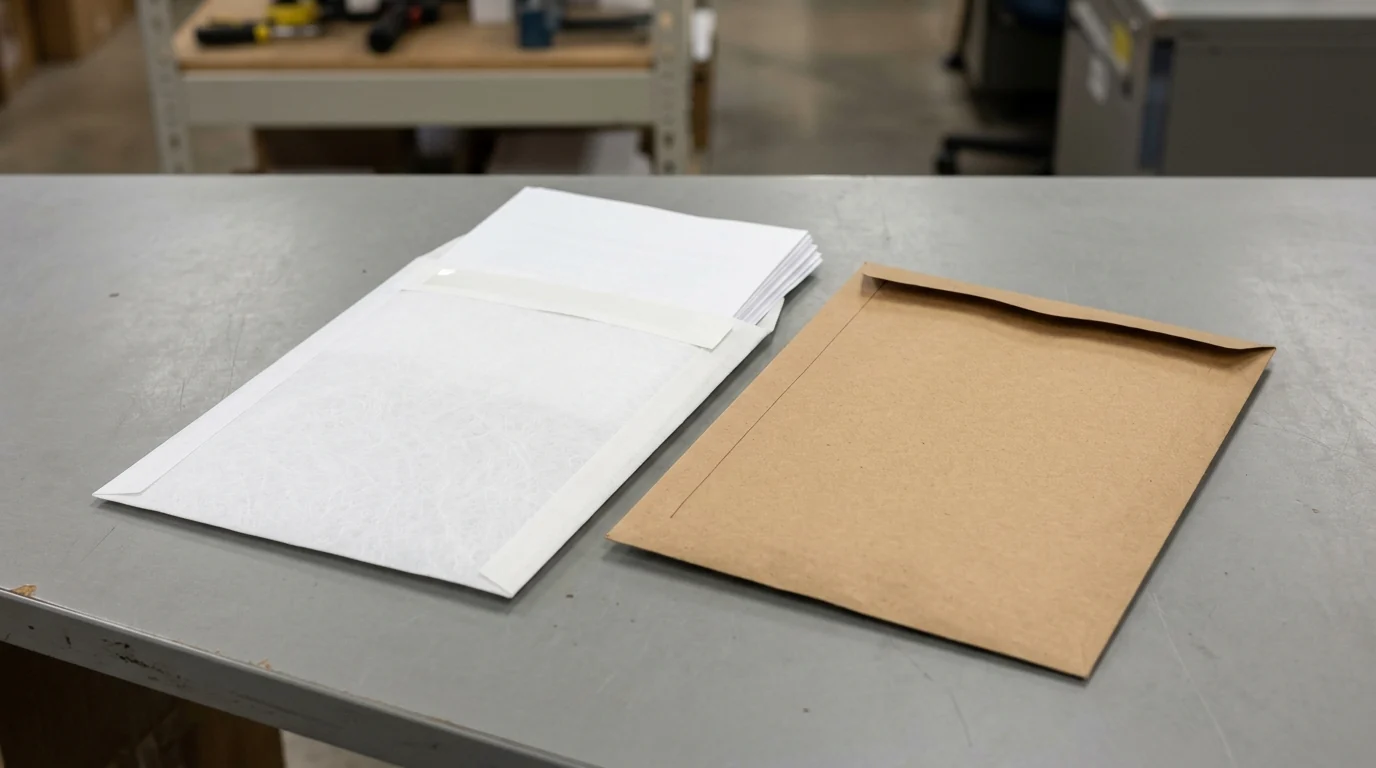
Heavy documents with sharp binder clips, metal fasteners, or thick corner stacks routinely split standard kraft catalog seams along the paper grain or damage enclosed pages when exposed to rain on delivery routes. Selecting between a flash-spun high-density polyethylene tyvek envelope and a heavy 24–32 lb kraft paper mailer requires matching five physical variables: multidirectional vs. grain-aligned tear propagation, wet vs. dry tensile retention, USPS letter vs. flat weight-step rules, non-porous seam and flap adhesives, and press ink and thermal limits.
Specify DuPont™ Tyvek® Type 10 hard-structure (1025DR, 1056DR “14 lb”, or 1073D “18–20 lb”) catalog or expansion envelopes when bulky packets, sharp edges, or wet transit conditions threaten seam integrity, or when cutting empty envelope tare weight by roughly 40% to 50% keeps a filled USPS First-Class Mail Flat (DMM 101 §2.0) below the next whole-ounce rate boundary (DMM 133 §1.2). Retain 24–32 lb unbleached or white kraft paper for dry routine domestic flats, automated remoistenable-gum inserting lines, multi-stop interoffice clasp envelopes, curbside paper recovery, or letter-size (#10) mailings where a non-paper exterior incurs the DMM 101 §1.2 nonmachinable surcharge. When custom printing Type 10 Tyvek®, specify corona- and antistat-treated D or R styles (38–42 dynes), sheet-fed offset inks with less than 3% volatile solvent, and flexo dryer web temperatures at or below 175°F (79°C) under <0.75 lbf/in (1.4 N/cm) tension.
| Engineering parameter | DuPont™ Tyvek® Type 10 hard structure | Heavy envelope kraft paper (24–32 lb) | Selection and production impact |
|---|---|---|---|
| Substrate architecture | 100% flash-spun high-density polyethylene (HDPE) continuous filaments, bonded by heat and pressure without binders | Unbleached or bleached wood-pulp cellulose fibers, hydrogen-bonded on a Fourdrinier wire | Non-directional HDPE web resists tear propagation; kraft tears straighter parallel to the machine grain |
| Density & bulk ratio | 0.38 g/cm³ (23.72 lb/ft³) — half the weight of paper volume-for-volume |
Approximately 2× the mass of Type 10 Tyvek® at equivalent sheet volume |
Cuts substrate basis weight by 48.5–55.0% (1056DR vs. 28–32 lb kraft) and typical empty envelope tare by ~40–50% |
| Standard grades & basis weight | 1025DR: 42.4 g/m² (1.25 oz/yd², 5.8 mil)1056DR (“14 lb”): 54.2 g/m² (1.60 oz/yd², 6.9 mil)1073D (“18–20 lb”): 74.6 g/m² (2.20 oz/yd², 8.3 mil) |
24 lb (17 × 22 in, 500 sheets): 90.2 g/m² (4.8–5.1 mil)28 lb: 105.3 g/m² (5.2–5.7 mil)32 lb: 120.3 g/m² (heavy catalog / expansion) |
Order Tyvek® by both the converter pound rating and the DuPont style code (ASTM D3776) |
| Tensile & Elmendorf tear (MD / CD) | 1056DR: 28 / 28 lbf/in tensile (ASTM D5035); 1.2 / 1.1 lbf tear (ASTM D1424)1073D: 42 / 44 lbf/in tensile; 1.1 / 1.2 lbf tear |
Anisotropic; stronger in the machine/grain direction; tears straighter with the grain; cracks if folded across the grain | Converters must orient kraft grain by envelope style; Tyvek® folds in any axis (>20,000 MIT flex cycles) |
| Moisture & RH stability | Equal strength wet or dry at 73.4°F (23°C); <0.01% dimensional change across 0–100% RH; >50 in. H₂O (127 cm H₂O) hydrostatic head on B styles (reduced ~30% on D/R styles) |
Hydrophilic; absorbs liquid water, loses wet burst/tensile strength, and expands/curls with RH swings | Specify Tyvek® for wet/outdoor routes; test sealed flap corners because neither envelope is submersible |
| USPS machinability & weight steps | Letters (DMM 101 §1.2): non-paper exterior triggers nonmachinable surcharge (DMM 133 §1.7). Flats (DMM 101 §2.0): no surcharge; 1 oz steps (DMM 133 §1.2) |
Machinable at both letter and flat sizes when flexible, rectangular, and without metal clasps | Use Tyvek® on 9 × 12 and 10 × 13 flats when tare savings avoid the next ounce step |
| Seam & closure adhesives | Non-porous HDPE; EVA, polyurethane, or hot-melt seams + liner-backed peel-and-seal PSA flap (screened above 90°F / 32°C) |
Porous cellulose; aqueous starch/dextrin back seams + remoistenable gum, latex, peel-and-seal, or clasp | Peel-and-seal Tyvek® requires manual liner removal; remoistenable kraft runs on automated sealing inserters |
| Press & addressing limits | D/R corona treated (38–42 dynes); offset <3% VOC ink; flexo web ≤175°F (79°C) at <0.75 lbf/in; melts at 275°F (135°C) (no laser printers) |
Absorbs aqueous/offset inks rapidly; tolerates offset IR dryers, hot-air flexo ovens, and office laser fusers | Never feed Tyvek® into office laser printers or run high-solvent (27% VOC) quick-dry paper offset inks |
For how web-fed and blank-fed converting machines cut, score, fold, and gum standard paper blanks, see the envelope manufacturing and materials overview.
How Do Flash-Spun HDPE Filaments and Kraft Paper Grain Change Tear Propagation?
Unbleached kraft paper and DuPont™ Tyvek® resist puncture and tear propagation through fundamentally different fiber mechanics. In the Envelope Manufacturers Association’s EMA Guide to Envelopes and Mailing, paper strength is governed by the length and orientation of cellulosic wood-pulp fibers laid down on the Fourdrinier wire. Because fibers align predominantly in the machine direction (the grain), kraft paper is orthotropic: it tears in a straight line parallel to the grain and roughens or cracks along the outer spine if folded across the grain.
To prevent fold cracking and maximize seam tear resistance, envelope converters must align paper grain with the envelope geometry:
- Open-end catalog envelopes: grain runs the long way (parallel to the long side seams).
- Open-side booklet envelopes: grain runs the short way.
- Diagonal-seam envelopes: blanks are die-cut at an angle so the grain runs diagonally across the sheet.
Despite proper grain orientation, once a sharp binder clip, staple, or heavy document corner initiates a nick in a 24 lb or 28 lb kraft envelope, tensile stress concentrates at the tip of the notch and propagates a tear between the hydrogen-bonded cellulose fibers.
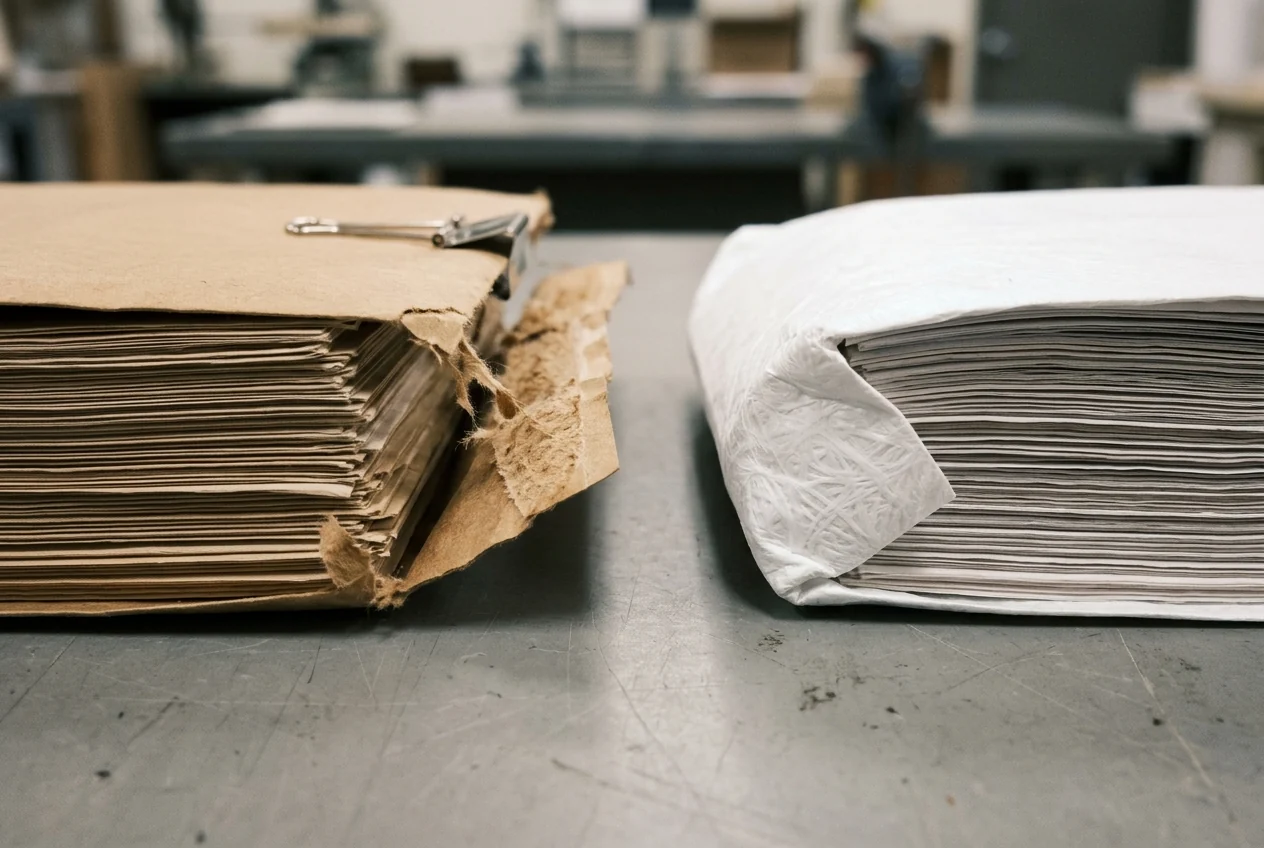
By contrast, while commercial searchers and the EMA Guide often group tear resistant tyvek mailers under synthetic or spunbonded olefin substitutes, DuPont manufactures Tyvek® specifically by flash-spinning continuous, very fine high-density polyethylene (HDPE) filaments, laying them into a random multidirectional web on a moving bed, and bonding the intersecting filaments with heat and pressure without binders or fillers (DuPont™ Tyvek® Envelopes FAQ; DuPont™ Tyvek® Graphics Printing & Technical Guide, K-29939). Envelope and graphics converters use Type 10 hard-structure styles (designated by style numbers beginning with 10 or 41, as opposed to soft, fabric-like Type 14 garment styles beginning with 14).
Because continuous HDPE filaments interlock in every direction, Type 10 hard-structure sheets exhibit nearly isotropic mechanical properties between the machine direction (MD) and cross direction (CD). In DuPont’s Tyvek® for Graphics Product Properties Specification Sheet (K-29944, March 2019), the primary Type 10 hard-structure grades compare as follows:
| DuPont™ Type 10 style | Basis weight (ASTM D3776) | Controlled release range (ASTM D3776) | Nominal thickness (ASTM D1777 / EN ISO 534) | Tensile breaking strength, MD / CD (ASTM D5035) | Elmendorf tear, MD / CD (ASTM D1424) | Opacity, % (TAPPI T425) |
|---|---|---|---|---|---|---|
| 1025DR | 1.25 oz/yd² (42.4 g/m²) |
1.18–1.31 oz/yd² (40.0–44.4 g/m²) |
5.8 mil (147 µm) |
22 / 21 lbf/in (98 / 93 N/2.54 cm) |
0.9 / 0.9 lbf (4.1 / 4.1 N) |
93 |
| 1056DR (“14 lb” envelope stock) | 1.60 oz/yd² (54.2 g/m²) |
1.53–1.67 oz/yd² (51.9–56.6 g/m²) |
6.9 mil (175 µm) |
28 / 28 lbf/in (125 / 125 N/2.54 cm) |
1.2 / 1.1 lbf (5.3 / 5.0 N) |
96 |
| 8740D | 2.00 oz/yd² (67.8 g/m²) |
1.92–2.11 oz/yd² (65.1–71.6 g/m²) |
8.1 mil (206 µm) |
37 / 40 lbf/in (165 / 178 N/2.54 cm) |
1.3 / 1.3 lbf (5.8 / 5.8 N) |
97 |
| 1073D (“18–20 lb” heavy stock) | 2.20 oz/yd² (74.6 g/m²) |
2.10–2.30 oz/yd² (71.2–78.0 g/m²) |
8.3 mil (211 µm) |
42 / 44 lbf/in (187 / 196 N/2.54 cm) |
1.1 / 1.2 lbf (5.1 / 5.4 N) |
96 |
| 1079 (cold-embossed cambric) | 2.85 oz/yd² (96.6 g/m²) |
2.75–2.93 oz/yd² (93.2–99.4 g/m²) |
8.3 mil (211 µm) |
62 / 68 lbf/in (280 / 300 N/2.54 cm) |
0.7 / 0.6 lbf (3.3 / 3.0 N) |
92 |
| 1085D | 3.20 oz/yd² (108.5 g/m²) |
3.07–3.42 oz/yd² (104.1–116.0 g/m²) |
10.5 mil (267 µm) |
64 / 72 lbf/in (285 / 320 N/2.54 cm) |
1.2 / 1.1 lbf (5.4 / 5.0 N) |
96 |
DuPont notes in K-29944 that basis weight (ASTM D3776) and delamination (ASTM D2724, ranging from 0.3 lbf/in / 1.3 N/2.54 cm on 1025DR and 1056DR to 0.4 lbf/in / 1.9 N/2.54 cm on 1073D) are controlled specification properties released within the stated minimum and maximum limits, whereas thickness, opacity, Elmendorf tear, and tensile strength are typical roll averages subject to normal process drift.
In addition to multidirectional tear resistance, Type 10 Tyvek® takes a sharp dead fold and exceeds 20,000 cycles on an MIT folding endurance tester (TAPPI T-423, K-29939 Section 1.3.8). That flex life allows gusseted Tyvek® expansion envelopes (with 1 in. to 5 in. side gussets) and reusable interdepartmental mailers to be creased and opened repeatedly without splitting along the score lines.
Rule of thumb: If an unpadded catalog or expansion mailer carries metal binder rings, plastic comb bindings, or unboxed stacks exceeding 1/4 in. thickness that shift during sortation, specify 1056DR (54.2 g/m²) or 1073D (74.6 g/m²) Tyvek® rather than increasing kraft paper weight from 28 lb to 32 lb.
Takeaway: Specify grain direction on kraft envelopes to avoid fold cracking, and switch to Type 10 Tyvek® (1056DR or 1073D) when sharp corners or bulky inserts require multidirectional tear arrest.
How Do Moisture Exposure and Relative Humidity Affect Wet Strength and Seam Stability?
Cellulosic kraft paper is hydrophilic. When liquid rain, snowmelt, or condensation contacts an uncoated kraft envelope, water molecules penetrate the porous sheet and disrupt the hydrogen bonds holding wood-pulp fibers together. The wetted paper swells, cockles, and loses a major fraction of its dry tensile and burst strength, allowing heavy contents to push through the softened wall. Even without liquid water, wide warehouse relative humidity (RH) swings cause paper fibers to expand and contract—inducing sheet curl, seam buckling, or premature reactivation of remoistenable dextrin flap gum (blocking), as detailed in the EMA Guide (Section 3, pages 24–25).
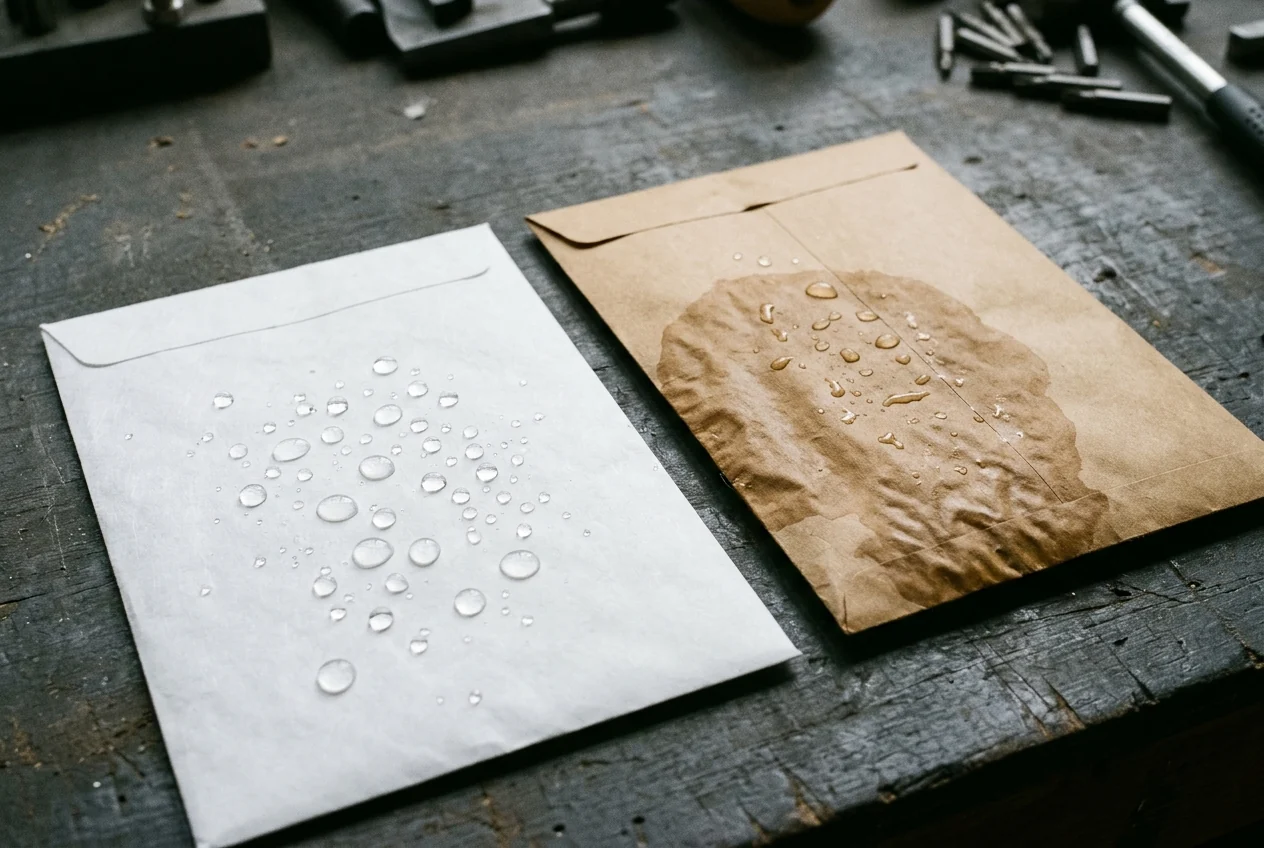
Because DuPont™ Tyvek® is 100% high-density polyethylene, its polymer filaments do not absorb moisture. According to DuPont’s Graphics Printing & Technical Guide (K-29939, Sections 1.3.5 and 1.3.24):
- Equal wet and dry strength: Tyvek® maintains identical tensile and tear strength whether wet or dry at ambient temperature (
73.4°F / 23°C). - Humidity dimensional stability: Between
0%and100%relative humidity, Tyvek® sheet dimensions change by less than0.01%, eliminating humidity-driven curl or seam distortion in unconditioned mailrooms. - Neutral pH and mildew resistance: Tyvek® has a neutral pH of
7(even on corona- and antistat-treated styles), will not rot or mildew, and retains toughness and flexibility down to the glass transition temperature of HDPE at-100°F (-73°C)(K-29939, Sections 1.3.13, 1.3.15, and 1.3.22). - Hydrostatic head (liquid water pressure threshold): Untreated Type 10
Bstyles (such as1059Band1073B) withstand an average hydrostatic head exceeding50 in. H₂O(127 cm H₂O). Because topical antistatic and corona treatments increase surface wettability, applying antistatic treatment alone reduces average hydrostatic head by approximately20%, and combined corona plus antistatic treatment (DandRgraphics/envelope styles such as1025DR,1056DR, and1073D) reduces hydrostatic head by approximately30%. - Vapor breathability: While blocking liquid water at normal rain pressures, Tyvek® remains permeable to gases and moisture vapor, with a moisture vapor transmission rate (MVTR) similar to coated papers and much higher than solid extruded plastic films (K-29939, Section 1.3.14).
Buyers must distinguish substrate hydrostatic head from whole-package immersion resistance. A converted Tyvek® envelope is highly water-resistant against rain and wet mail tubs, but it is not hermetically sealed: liquid water can still enter through unsealed corner pinholes under the top flap or along stitched seams. When comparing document envelopes with heat-sealed polyethylene parcel bags or cushioned mailers, see paper mailers vs poly mailers.
Takeaway: Use Type 10 Tyvek® when mailpieces face rain, condensation, or unconditioned storage (0–100% RH), and verify full flap seal contact because water can still enter unsealed corner gaps.
Why Is 54.2 g/m² Tyvek Sold as “14 lb” Stock, and When Does It Lower USPS Postage?
When comparing tyvek vs kraft catalog envelopes, procurement teams frequently see standard Tyvek® mailers listed as “14 lb” (or heavy-duty Tyvek® listed as “18 lb” or “20 lb”) alongside 24 lb, 28 lb, or 32 lb brown kraft envelopes. That pound rating is not the tear strength of the envelope, nor is it a DuPont style number—it is an envelope-converter conversion into the US bond/kraft paper basis-weight scale.
Converting 17 × 22 in paper basis weight (lb) to g/m²
As explained in the EMA Guide (Section 1, page 17) and Tension Envelope’s The Basics of Paper Weights (August 2025), the basis weight (substance weight or sub weight) of bond, wove, and kraft envelope paper is the weight in pounds of 500 sheets (1 ream) cut to the 17 × 22 in basic sheet size. The total area of 500 sheets of 17 × 22 in paper is:
A_ream = 500 × 17 in × 22 in = 120.645 m²
Each 1 lb of basis weight on the 17 × 22 in scale equals:
1 lb basis weight = 3.760 g/m²
Conversely, converting any substrate’s metric grammage (g/m²) into an equivalent 17 × 22 in 500-sheet pound rating follows:
Equivalent basis weight (lb) = Mass per unit area (g/m²) / 3.760
- Example calculation (comparing
1056DRTyvek® against28 lband32 lbkraft): DuPont specifies Type 10 hard-structure density at0.38 g/cm³(23.72 lb/ft³), which is half the weight of paper volume-for-volume (K-29939, Section 1.3.9). For standard envelope style1056DR(54.2 g/m²at6.9 milcaliper), dividing by3.760 g/m² per lbyields54.2 / 3.760 = 14.4 lb(marketed across converter catalogs as “14 lb Tyvek”). By comparison,28 lbkraft paper (5.2–5.7 milnominal caliper per Tension Envelope’s chart) equals28 × 3.760 = 105.3 g/m², and32 lbkraft equals32 × 3.760 = 120.3 g/m². Substituting1056DR(54.2 g/m²) for28 lb(105.3 g/m²) or32 lb(120.3 g/m²) kraft reduces substrate mass per unit area by48.5%to55.0%(while finished empty-envelope tare savings typically run~40%to50%, depending on envelope size, flap geometry, peel-and-seal liner, and clasp hardware).
| Grade / DuPont style designation | Underlying material / DuPont style | 17 × 22 in (500-sheet) basis weight |
Metric mass per unit area (g/m²) |
Nominal thickness (caliper) | Documented converter & graphics applications |
|---|---|---|---|---|---|
DuPont™ Tyvek® 1025DR (light graphics grade) |
DuPont™ Tyvek® 1025DR (1.25 oz/yd²) |
Specified by DuPont style 1025DR |
42.4 g/m² (40.0–44.4 g/m² release range) |
5.8 mil (147 µm) |
Forms, reinforcing tape, and garment/textile or law/security tags (K-29939 Table 1) |
| “14 lb” Standard Tyvek® | DuPont™ Tyvek® 1056DR (1.60 oz/yd²) |
14.4 lb equivalent |
54.2 g/m² (51.9–56.6 g/m² release range) |
6.9 mil (175 µm) |
6 × 9, 9 × 12, 9.5 × 12.5, 10 × 13, 10 × 15, 12 × 15.5 catalog, booklet & expansion mailers |
| “18 lb” / “20 lb” Heavy Tyvek® | DuPont™ Tyvek® 8740D (2.00 oz/yd²) or 1073D (2.20 oz/yd²) |
18.0 lb (8740D) to 19.8 lb (1073D) |
67.8 g/m² (8740D) or 74.6 g/m² (1073D) |
8.1 mil (206 µm) to 8.3 mil (211 µm) |
Heavy-duty 10 × 13 / 12 × 16 open-end & 1–5 in. gusseted expansion mailers |
| 24 lb Bond / Kraft | Unbleached or white wove/kraft paper | 24.0 lb |
90.2 g/m² |
4.8–5.1 mil |
Standard #10 commercial, 6 × 9 and 9 × 12 light catalog/booklet |
| 28 lb Heavy Kraft | Unbleached brown or bleached kraft paper | 28.0 lb |
105.3 g/m² |
5.2–5.7 mil |
Standard 6 × 9, 9 × 12, 10 × 13, and 10 × 15 open-end catalog & clasp envelopes |
| 32–40 lb Extra-Heavy Kraft | Heavy-duty unbleached sack/catalog kraft | 32.0–40.0 lb |
120.3 g/m² (32 lb) |
>5.7 mil (varies by mill bulk) |
Heavy catalog mailers and paper gusseted expansion envelopes |
USPS Letter vs. Flat eligibility (DMM 101) and ounce-step math (DMM 133)
Whether that ~40% to 50% empty-envelope tare reduction lowers USPS postage depends on two separate sections of the Domestic Mail Manual (DMM):
- Letter-size pieces (
#10and6 × 9under1/4 in.thick) — Nonmachinable Surcharge Hazard: Under USPS DMM 101 §1.1, letter-size mail measures5 to 11-1/2 in.long,3-1/2 to 6-1/8 in.high, and0.007 to 1/4 in.thick (up to3.5 oz). Under DMM 101 §1.2b, any letter-size piece that is “polybagged, polywrapped, enclosed in any plastic material, or has an exterior surface made of a material that is not paper” is classified as nonmachinable and incurs the per-piece nonmachinable surcharge under DMM 133 §1.7. Consequently, mailing a letter-size#10Tyvek® envelope triggers the nonmachinable surcharge because its exterior is HDPE rather than paper (just as a letter-size kraft envelope with a metal clasp triggers the surcharge under DMM 101 §1.2c). - Flat-size large envelopes (
9 × 12,10 × 13,12 × 15.5, and pieces over1/4 in.up to3/4 in.thick) — Ounce-Boundary Advantage: Under USPS DMM 101 §2.1–2.4, flat-size mailpieces (exceeding at least one letter maximum up to15 in.long,12 in.high, and3/4 in.thick, rectangular, flexible, and uniformly thick within1/4 in.variance) impose no paper-exterior requirement. Under DMM 133 §1.2, First-Class Mail Flats (up to13 ozmaximum per DMM 101 §6.1) are priced per whole ounce or fraction thereof, while USPS Ground Advantage — Retail parcels under1 lbare priced at4 oz,8 oz,12 oz, and15.999 ozincrements.
- 10-piece sample weight verification (DMM 133 §1.5):
Finished empty-envelope mass is not fixed by DuPont or USPS—it varies with dimensions (
6 × 9,9 × 12,10 × 13, or expansion gusset depth), flap geometry, peel-and-seal release liner, and clasp hardware (for example, converter catalog comparisons list an empty9 × 1214 lbTyvek® peel-and-seal envelope at roughly~0.3 ozversus an equivalent9 × 1228 lbbrown kraft clasp envelope at roughly~0.6 oz, a~0.3 oztare difference). Under DMM 133 §1.5, mailers determine the single-piece weight of identical-weight pieces by weighing a random sample of at least 10 filled pieces, dividing the total sample weight by10, and expressing the result in decimal pounds rounded to four decimal places:- Boundary-crossing case: Record the 10-piece filled kraft weight (
[____] lb ÷ 10 = [____] lb) and the 10-piece filled Tyvek® weight ([____] lb ÷ 10 = [____] lb). Switching to Tyvek® lowers First-Class Mail Flat postage under DMM 133 §1.2 only when the filled kraft piece marginally exceeds a whole-ounce mark (for instance, sitting just above2.00 ozsuch that the~0.3 ozconverter tare savings pulls the filled Tyvek® piece down to≤ 2.00 oz), or crosses a4 oz,8 oz,12 oz, or15.999 ozUSPS Ground Advantage step. - Non-crossing case: Whenever both 10-piece sample averages fall inside the same whole-ounce bracket (for instance, both at or below
2.00 oz), both pay the identical 2-ounce First-Class Mail Flat rate and the postage delta is zero.
- Boundary-crossing case: Record the 10-piece filled kraft weight (
For a broader breakdown of open-end catalog vs. open-side booklet geometries and USPS dimensional tables, see types of mailing envelopes.
Takeaway: Quote Tyvek® by both its commercial pound equivalent (“14 lb” or “18 lb”) and its DuPont style code (1056DR or 1073D), and weigh a 10-piece filled flat sample (DMM 133 §1.5) to verify whether the tare savings cross a postage ounce boundary.
Why Do Non-Porous HDPE Seams and Flaps Require Synthetic Glues and Peel-and-Seal Closures?
Adhesive chemistry must match substrate porosity. As documented in the EMA Guide (Section 1, page 21, and Section 3, pages 24–25), conventional paper envelopes rely on aqueous starch/dextrin blends for back seams and remoistenable dextrin/resin gums for front seal flaps. When moistened and pressed onto porous kraft paper, water wicks into the cellulose network and the gum dries rapidly into a paper-tearing bond.
On DuPont™ Tyvek®, water cannot wick into the hydrophobic HDPE filaments, and the nonwoven sheet does not tear like paper. Standard remoistenable paper gums dry slowly on Tyvek® and can peel open cleanly under tension unless specialized synthetic formulations are used.
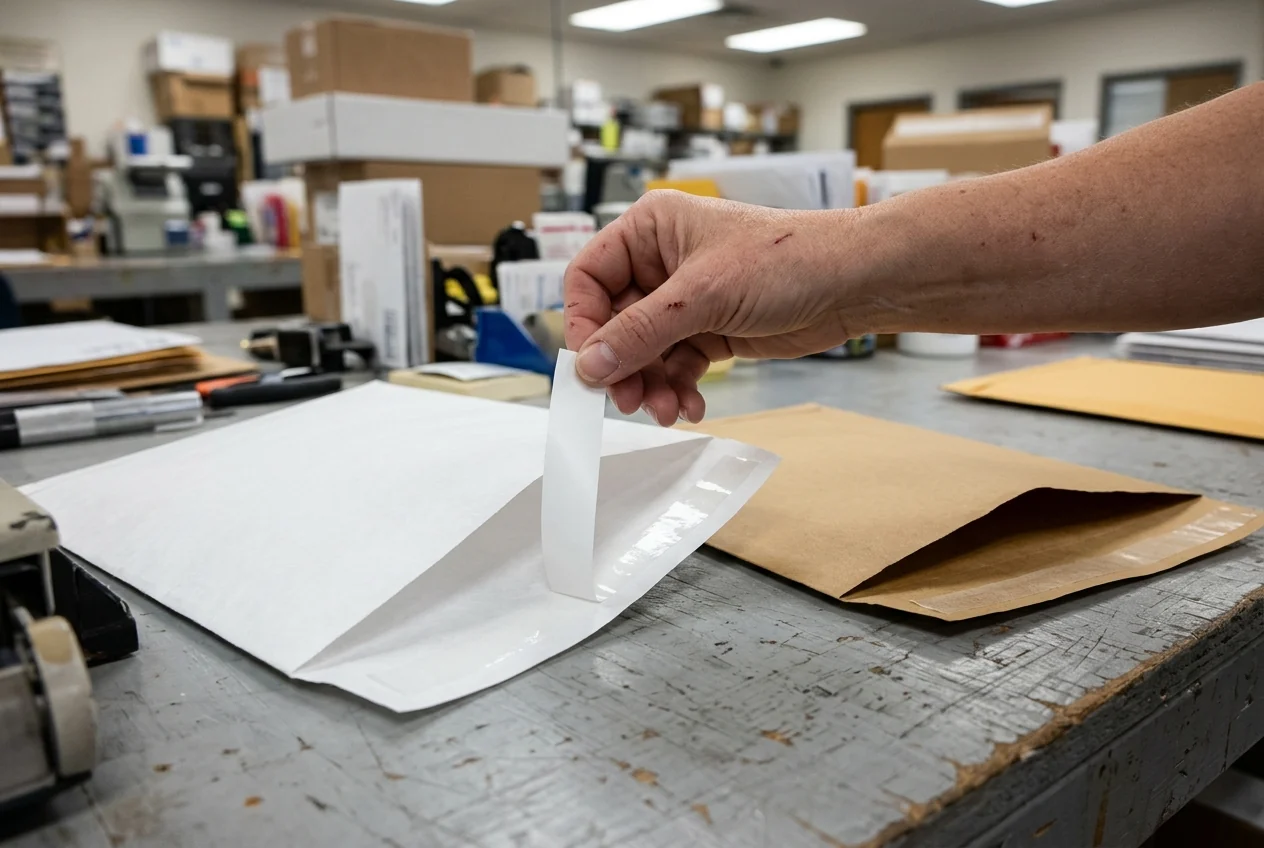
To match the tear strength of the HDPE sheet, envelope converters specify synthetic seam and flap adhesives engineered for polyolefins (K-29939, Sections 1.3.18 and 3.6; EMA Guide, page 25):
- Back and bottom seam adhesives: Water-based ethylene vinyl acetate (EVA) lattices, hot-melt adhesives, and polyurethane adhesives (which DuPont notes provide optimum lap and shear adhesion, flexibility, and water resistance when bonding Tyvek® to itself).
- Front seal flap closures (Peel-and-Seal PSA): Stock and custom Tyvek® catalog envelopes almost universally use an aggressive pressure-sensitive adhesive (PSA)—either acrylic or hot-melt synthetic rubber—protected by a removable silicone-coated release liner. Peeling the strip and pressing the flap creates an immediate tamper-evident bond without water.
- High-temperature PSA storage distortion check (
>90°F / 32°C): In K-29939 (Section 1.3.18, page 11), DuPont warns that low-molecular-weight components in certain adhesives migrate into HDPE and cause delayed swelling or wrinkling weeks after converting. Specifically, low-molecular-weight polybutylacrylate used in some pressure-sensitive adhesives causes wrinkling and distortion of Tyvek® within 24 to 48 hours if stored where temperatures exceed90°F (32°C), whereas high-molecular-weight polybutylacrylate remains compatible with Tyvek® up to212°F (100°C). DuPont’s lab screening protocol coats~1 mil(0.025 mm) of dry adhesive onto an aluminum plate (oven-dried at300°F / 150°Cfor10 minutes), laminates Tyvek® for24 hours, and ramps oven temperature by20°F/hour(10°C/hour) to150°F (65°C)to verify zero sheet distortion.
When planning mailroom fulfillment workflows, compare closure handling and equipment compatibility across self-seal vs gummed envelopes:
- Automated inserting lines: Standard office inserters wet remoistenable paper gum inline and cannot strip release liners from peel-and-seal Tyvek® flaps (requiring fill-only mode with sealing switched off, followed by manual liner removal).
- Reusable interoffice routing: Peel-and-seal Tyvek® closures form a permanent single-use bond (Tyvek® Envelopes FAQ), whereas kraft interdepartmental envelopes use string-and-button or metal clasp hardware for multi-stop routing.
Takeaway: Specify EVA, polyurethane, or hot-melt seams with a high-molecular-weight peel-and-seal PSA flap on Tyvek® envelopes, and confirm manual sealing workflows before ordering.
What Causes Ink Rub-Off, Sheet Swelling, and Web Stretching When Printing or Addressing Tyvek Envelopes?
Treating spunbond hdpe envelope printing (or more precisely, flash-spun Type 10 HDPE printing) with standard kraft paper inks and dryer temperatures causes three immediate production failures: poor ink wetting and rub-off on untreated stock, severe sheet buckling from volatile offset solvents, and web stretching or fuser meltdown under heat. DuPont’s Graphics Printing & Technical Guide (K-29939, Sections 1.3.17–1.3.22 and 2.1–2.8) defines four mandatory process controls.
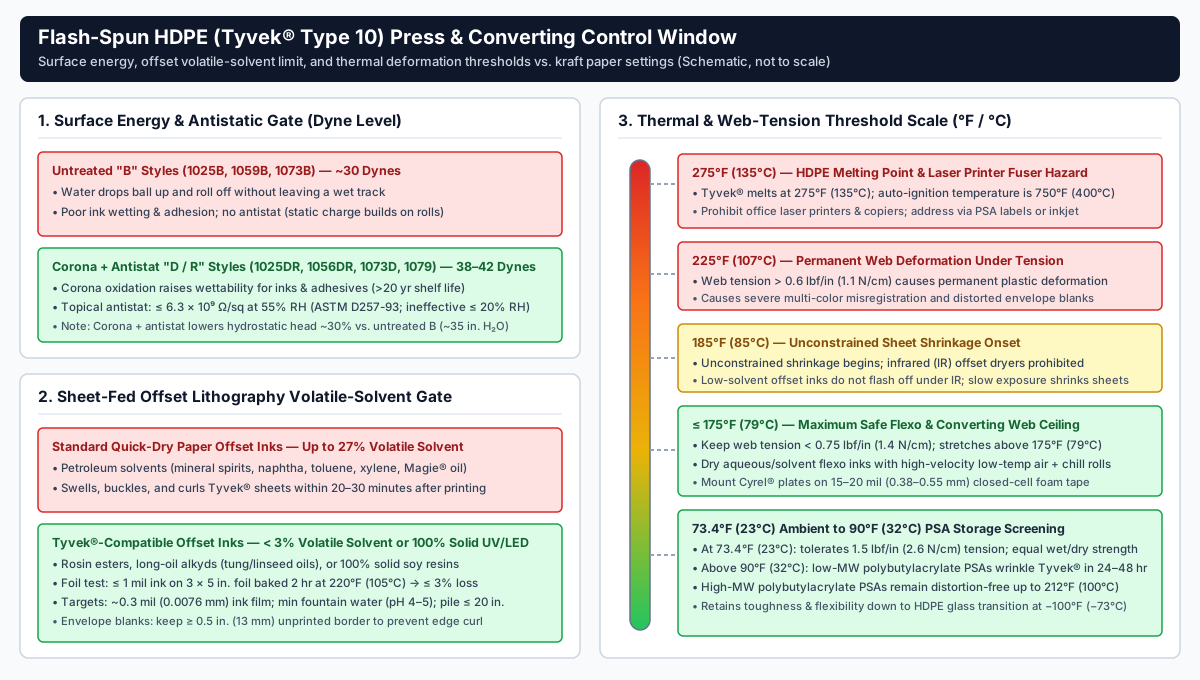
1. Surface energy and static control: D/R styles (38–42 dynes) vs. B styles (~30 dynes)
Untreated polyethylene (B suffix styles such as 1025B, 1059B, and 1073B, used for FDA food-contact applications with limitations) has a surface energy of about 30 dynes and carries no antistatic agent. On an untreated B sheet, a drop of water remains a spherical bead and rolls off without leaving a wet track, printing inks fail to wet out or adhere, and static electricity builds rapidly on rolls and cut blanks.
For envelope printing and gluing, always specify Type 10 styles with a D or R suffix (1025DR, 1056DR, 8740D, 1073D, 1085D, or 4173D) plus 1079:
- Corona treatment (
38–42 dynes): Mill corona discharge oxidizes the HDPE surface to raise surface energy to38–42 dynes. Unlike extruded polyethylene film whose dyne level decays rapidly, corona treatment on Tyvek® lasts more than 20 years when properly stored (K-29939, Section 1.3.4 and page 16). - Antistatic treatment (
≤ 6.3 × 10⁹ Ω/sq): Styles with anA,D, orRfirst-letter suffix (plus1079) carry a water-soluble topical antistatic coating yielding a maximum surface resistivity of6.3 × 10⁹ ohm/squareunder ASTM D257-93 at55%relative humidity (K-29939, Section 1.3.20). Antistatic performance works best at50% RHor higher; if pressroom humidity drops at or below20% RH, the topical agent loses effectiveness and sheet feeding requires grounded copper tinsel or active static eliminator bars.
2. Sheet-fed offset lithography: the <3% volatile solvent rule and drying controls
While kraft paper absorbs offset ink vehicles quickly, non-porous HDPE reacts strongly to non-polar petroleum and aliphatic hydrocarbon solvents. Many standard quick-drying sheet-fed paper offset inks contain up to 27% volatile hydrocarbon solvents (such as mineral spirits, VM&P naphtha, toluene, xylene, or Magie® oils listed in K-29939 Appendix 5). Running those inks on Tyvek® causes the sheet to swell, buckle, and curl within 20 to 30 minutes after printing, ruining multi-color registration and envelope blank flatness.
To print Tyvek® cleanly by sheet-fed offset lithography (K-29939, Section 2.7):
- Require
<3%volatile solvent or100%solid UV/LED inks: Specify oxidative offset inks formulated specifically for Tyvek® using rosin esters, long-oil alkyds diluted with tung (chinawood) or linseed drying oils,100%solid soy-based resins, or instantly cured100%solid UV/LED-curable offset inks. DuPont’s ink acceptance test coats a≤1 mil(0.025 mm) ink film onto a pre-weighed3 × 5 in.(7.6 × 12.7 cm) aluminum foil, bakes it for2 hours at 220°F (105°C), and verifies that weight loss is3%or less (K-29939, Section 2.7.3). - Control ink film, dampening water, and pile height: Because Tyvek® has a high surface area, it requires up to
15%more ink than uncoated paper to hit equal color density, yet thick ink films prolong oxidative drying and cause distortion. Use extra-strong pigments at an optimum ink film thickness of0.3 mil(0.0076 mm), add3–4 mil(0.08–0.10 mm) of extra squeeze between the medium-hardness blanket and impression cylinder to compensate for sheet compressibility, minimize fountain dampening solution (pH 4–5) to prevent ink emulsification and washed-out color, and cap delivery piles at20 in.(0.5 m) with winding at6, 12, and 18 hourson heavy coverage (K-29939, Sections 2.7.1 and 2.7.5). - Avoid Rubine Red #52, Red Lake 2C, and Alkali Blue: These offset pigments can shift color (“burn out”) on Tyvek® under heat and humidity unless pre-tested (K-29939, Section 2.3.3).
- Leave a
≥ 0.5 in.(13 mm) unprinted border on envelope blanks: Heavy edge-to-edge ink coverage followed by die-cutting into envelope blanks causes edge curling; leave at least a0.5 in.(13 mm/1–2 cm) unprinted margin and print major coverage on the rough side when possible (K-29939, Section 2.2, pages 16–17). - Do not use infrared (IR) offset dryers: Low-solvent inks do not flash off under IR lamps, and slowing the press under an IR dryer heats the sheet past its
185°F (85°C)shrinkage onset (K-29939, Section 2.7.6).
3. Flexographic web printing: aqueous/solvent inks and the 175°F (79°C) web ceiling
Flexography is widely used for inline and roll-to-roll envelope printing; for general anilox cell volume (BCM) bands and ink-film split mechanics on paper stock, see flexo versus offset litho on custom envelopes. On corona-treated (D/R) Tyvek®, three flexo ink families perform well (K-29939, Section 2.5):
- Pigmented polyamide-alcohol solvent inks (highest adhesion and rub resistance);
- Water-based (aqueous) flexo inks (high print quality and regulatory compliance, though drying takes longer than on absorbent kraft paper because HDPE absorbs no water);
- UV- and LED-curable flexo inks (LED lamps are preferred over high-heat UV lamps to avoid hot spots).
The critical failure mode in aqueous or solvent flexographic printing on Tyvek® occurs when operators raise dryer oven temperatures to match paper drying speeds. Because Tyvek® is thermoplastic under web tension:
- Keep web tension below
0.75 lbf/in(1.4 N/cm) with short unsupported spans and a floppy web entering/exiting the nip (K-29939, Section 2.5.3). - Maintain web temperature at or below
175°F (79°C). Under tension, Tyvek® stretches once web temperature exceeds175°F (79°C). Unconstrained shrinkage starts at185°F (85°C), tension exceeding0.6 lbf/in(1.1 N/cm) causes permanent deformation at225°F (107°C), and the sheet melts at275°F (135°C)(K-29939, Sections 1.3.19, 1.3.22, and 2.5.3). - Use high-velocity, low-temperature air with air diffusers, install chilled backup rollers inside each heating station, and run a chill roll before windup to prevent ink blocking.
- Mount DuPont™ Cyrel® photopolymer plates (
45 mil/1.14 mmat75° Shore A, or67–100 milplates) on15–20 mil(0.38–0.55 mm) closed-cell foam sticky-back tape with a65 lines/in.(26 lines/cm) screen on hard structure to bridge Tyvek’s inherent caliper profile without crushing thin spots (K-29939, Section 2.5.3).
4. Mailroom addressing: why office laser printers and copiers are prohibited
While 24–28 lb kraft envelopes run through office laser printers (provided window films and remoistenable gums are laser-rated per the EMA Guide, pages 19 and 24), never feed standard Tyvek® envelopes through an office laser printer or electrostatic copier (DuPont™ Tyvek® Envelopes FAQ; K-29939, Section 2.4.4). Laser fuser rollers operate above Tyvek’s 185°F (85°C) shrinkage and 275°F (135°C) melting thresholds, which will melt the HDPE envelope onto the fuser rollers and damage the printer.
Instead, address and personalize Tyvek® mailers using one of four verified methods:
- Laser-printed pressure-sensitive address labels printed on standard label stock and applied to the Tyvek® envelope face (Tyvek® Envelopes FAQ).
- Inkjet addressing and barcoding using solvent-, oil-, or wax-based inks, or selected pigmented water-based inks with appropriate dryer settings (K-29939, Section 2.4.3).
- Low-temperature digital presses such as HP Indigo or UV-curable digital presses that do not use high-heat fusers (K-29939, Section 2.4).
- Thermal transfer barcode printing on calendered Tyvek® Brillion®
4173D(2.24 oz/yd²/76.0 g/m²,6.1 milper K-29944); direct thermal printing is not recommended on Tyvek® (K-29939, Sections 1.2.6 and 2.4.1).
Takeaway: Order corona- and antistat-treated D/R styles (38–42 dynes), restrict offset inks to <3% volatile solvent, cap flexo web temperature at 175°F (79°C) under <0.75 lbf/in tension, and never run Tyvek® envelopes through office laser printers.
Heavy-Duty Document Mailer Material Selection & Pre-Order Specification Matrix
Copy the verification matrix below into procurement specifications or print/mailroom job tickets before ordering custom or stock catalog and expansion envelopes. Leave the rightmost column blank until verified with the converter spec sheet and a 10-piece filled sample check.
| Verification gate | Target condition for DuPont™ Tyvek® Type 10 | Target condition for heavy kraft paper (24–32 lb) |
Project / sample record (fill in before release) |
|---|---|---|---|
| 1. Payload & transit risk | Sharp edges (binder rings, clips, thick spines), heavy multi-page legal/medical/financial packets, or wet/outdoor delivery routes | Flat dry paper inserts, routine domestic office mail, or multi-stop interoffice routing using reusable string/clasp closures | |
| 2. Envelope format & USPS shape (DMM 101) | Flat size (DMM 101 §2.0): 6 × 9 (>1/4 in. thick), 9 × 12, 10 × 13, 12 × 15.5 up to 15 × 12 × 3/4 in. (flexible, ≤1/4 in. bump variance). Avoid #10 letter size unless budgeting the DMM 101 §1.2b nonmachinable surcharge |
Letter (DMM 101 §1.1) or Flat (DMM 101 §2.0): machinable in both categories when rectangular, flexible, and free of metal clasps (DMM 101 §1.2c) | |
| 3. 10-piece sample weight & postage step (DMM 133 §1.2 & §1.5) | Weigh ≥10 filled pieces (total weight / 10 in decimal lb to 4 places); confirm whether the ~40–50% empty tare reduction keeps the flat under a 1.0 oz First-Class step or 4 / 8 / 12 / 15.999 oz Ground Advantage step |
Weigh ≥10 filled pieces; use kraft when the filled mailpiece sits well below the next ounce boundary where tare weight does not change the postage bracket |
|
| 4. Substrate grade, basis weight & grain | Specify DuPont Type 10 corona/antistat grade: 1025DR (42.4 g/m²), 1056DR (54.2 g/m² / “14 lb”, 28 lbf/in tensile), or 1073D (74.6 g/m² / “18–20 lb”, 42 / 44 lbf/in tensile). Isotropic (no grain constraint) |
Specify 17 × 22 in (500-sheet) basis weight: 24 lb (90.2 g/m²), 28 lb (105.3 g/m²), or 32–40 lb (120.3 g/m² at 32 lb). Verify grain runs lengthwise on open-end catalogs and widthwise on booklets |
|
| 5. Seam & closure adhesive specification | EVA, polyurethane, or hot-melt seams; liner-backed acrylic or hot-melt synthetic-rubber peel-and-seal PSA flap. Confirm high-MW PSA stability above 90°F (32°C) (K-29939 §1.3.18) and manual liner removal workflow |
Starch/dextrin or resin back seams; choose remoistenable dextrin/resin gum for automated sealing inserters, or peel-and-seal / latex / clasp for hand fulfillment | |
6. Custom printing & press controls (K-29939) |
Verify 38–42 dyne corona treatment (D/R style) and ≥50% RH feed static control (<20% RH requires ionizers). Offset: <3% volatile solvent ink (0.3 mil film, ≤20 in. pile, ≥0.5 in. unprinted blank border, no IR dryer). Flexo: ≤175°F (79°C) web temp, <0.75 lbf/in tension, 15–20 mil foam plate tape, chill rolls |
Standard aqueous flexo or quick-dry sheet-fed offset inks; compatible with standard hot-air flexo ovens and offset IR dryers | |
| 7. Mailroom addressing method | Prohibit office laser printers and copiers (275°F / 135°C melt hazard). Apply laser-printed PSA labels, or run solvent/oil/wax/pigmented inkjet or HP Indigo / UV digital |
Direct laser printing (with laser-compatible window film and non-blocking gum), inkjet addressing, or pressure-sensitive labels | |
| 8. End-of-life recovery route | 100% HDPE (#2 plastic): keep out of paper recycling bins; route to DuPont’s nationwide Tyvek® recycling program or compatible #2 HDPE drop-off |
Cellulose fiber: route plain unbleached/white kraft envelopes (without plastic bubble liners or metal clasps) to curbside paper recycling |
Takeaway: Complete all eight specification gates—including a 10-piece filled sample weighing and press/addressing sign-off—before releasing an envelope purchase order.
Reference documents
- Flash-spun HDPE composition, Type 10 styles, mechanical properties, adhesive screening, and printing/thermal thresholds: DuPont de Nemours, Inc., DuPont™ Tyvek® Graphics Printing & Technical Guide, Volume 11 (North America), Document K-29939 (December 2018); DuPont™ Tyvek® for Graphics: Product Properties Specification Sheet, Document K-29944 (March 2019); and DuPont™ Tyvek® Envelopes Frequently Asked Questions (FAQs) (2020).
- Paper basis weight (
17 × 22 in, 500 sheets), caliper ranges, grain orientation, synthetic paper substitutes, and envelope adhesive classes: Envelope Manufacturers Association (EMA), The EMA Guide to Envelopes and Mailing (pages 17–25); and Tension Envelope, The Basics of Paper Weights (August 22, 2025). - USPS retail letter and flat dimensional standards, nonmachinable criteria, single-piece 10-sample weight calculation, and price increments: United States Postal Service, Domestic Mail Manual (DMM) 101 §§1.1–1.2, 2.0, and 6.1; and DMM 133 §§1.1–1.2, 1.5, and 1.7.
Frequently Asked Questions
Why are Tyvek envelopes labeled as 14 lb or 18 lb when DuPont specifies styles like 1056DR and 1073D?
Envelope catalogs translate sheet weight into the US paper basis-weight scale (500 sheets of 17 × 22 in paper, where 1 lb equals approximately 3.76 g/m²). DuPont Tyvek style 1056DR has a nominal mass per unit area of 54.2 g/m² (1.60 oz/yd²), which equals 14.4 lb on the 17 × 22 in scale and is sold as 14 lb Tyvek. Heavier style 1073D at 74.6 g/m² (2.20 oz/yd²) equals 19.8 lb and is sold as 18 lb or 20 lb Tyvek.
Can you run Tyvek envelopes through an office laser printer or copier?
No. Standard Tyvek is 100% high-density polyethylene (HDPE) that begins unconstrained shrinkage at 185°F (85°C) and melts at 275°F (135°C). Office laser printer and electrostatic copier fuser rollers operate above those thresholds and will soften or melt the envelope onto the fuser assembly. Address Tyvek mailers by applying laser-printed pressure-sensitive labels or using compatible inkjet addressing equipment.
Do Tyvek envelopes always lower USPS First-Class Mail postage compared with 28 lb kraft?
No. At letter size (up to 11-1/2 × 6-1/8 × 1/4 in and 3.5 oz, such as a #10 envelope), USPS DMM 101 §1.2 classifies any non-paper exterior as nonmachinable, adding a per-piece surcharge under DMM 133 §1.7. At flat size (such as 9 × 12 and 10 × 13 catalog envelopes under DMM 101 §2.0), there is no non-paper surcharge, and First-Class Mail Flats are billed per whole ounce under DMM 133 §1.2—so Tyvek lowers postage only when its lower tare weight keeps the filled mailpiece from crossing into the next ounce bracket.
How are used Tyvek envelopes and heavy kraft envelopes recycled?
Plain unbleached or white kraft paper envelopes without plastic bubble liners or metal clasps go into residential and commercial curbside paper recycling. Tyvek envelopes are 100% high-density polyethylene (#2 HDPE) without binders; they must not enter paper recycling bins, and instead are mechanically recycled through DuPont's nationwide Tyvek recycling program or designated #2 HDPE collection streams.