EnvelopesGuide
Security Envelopes: Tint, Fiber-Tear and Closure Features
Understand security envelopes by interior tint, fiber-tear evidence and closure behavior, with sample checks that separate privacy from evidence of opening.
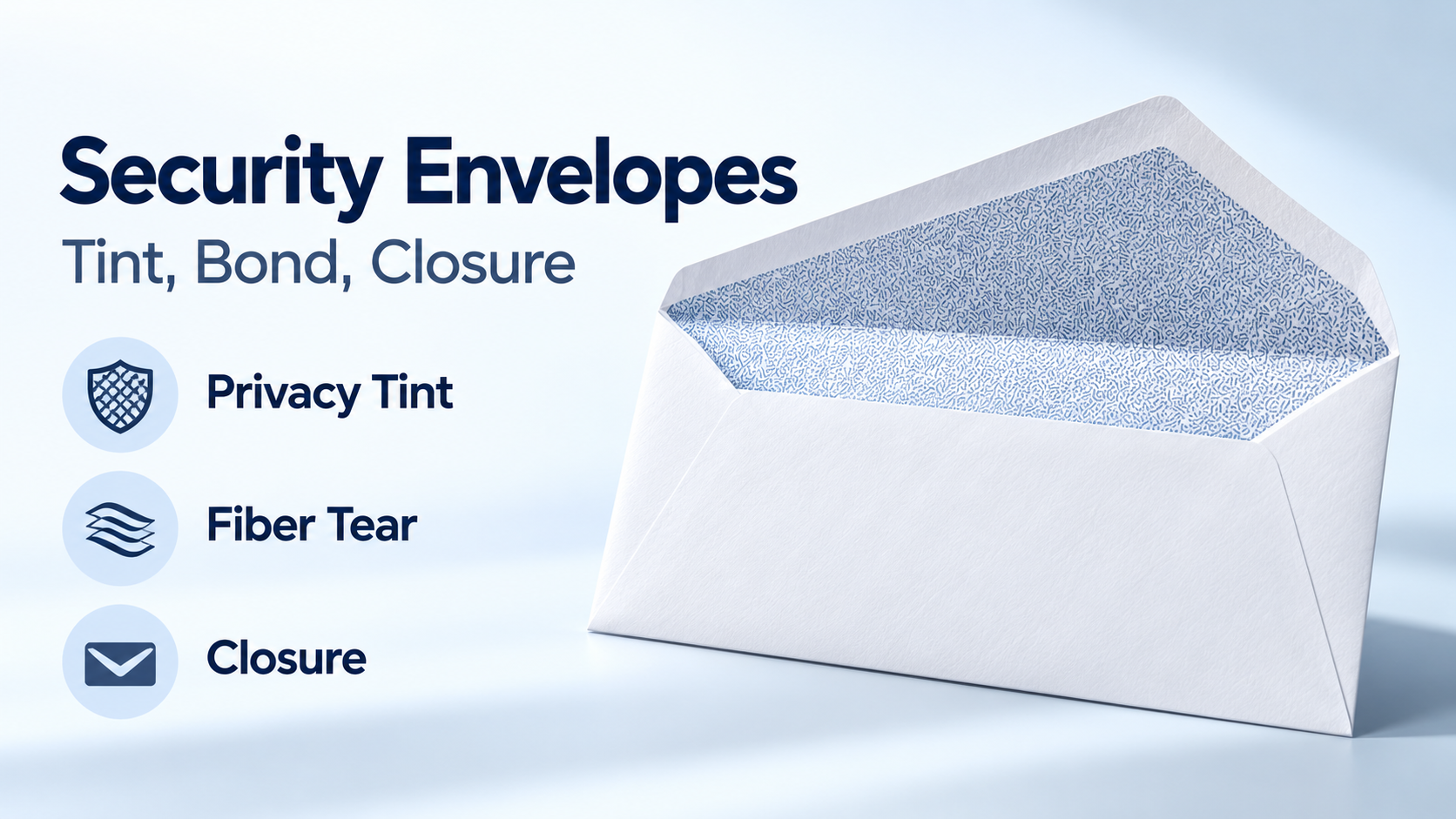
A security envelope that conceals a statement but opens and recloses without a visible change risks unnoticed disclosure of its contents. Choose security envelopes by separate features: interior tint for visual privacy, a documented destructive bond where opening evidence is needed, and a closure matched to the filling and sealing process.
Security tint and tamper evidence address different failures. Tint is printing inside the paper envelope; it does not establish how the seal behaves when opened. Fiber-tear describes damage to the paper at a bonded area, while a release liner describes how the adhesive is exposed before sealing. Specify the required result, then check the exact filled construction under its documented sealing and conditioning instructions. The envelope materials and manufacturing overview gives the wider construction context.
Quick specs: what the security description must identify
An exact stock description and an observable opening result are more useful than an unsupported security grade. The source documents below were retrieved on 19 October 2026; they do not establish a universal opacity percentage, peel force or compliance rating for security envelopes.
| Input or item | Typical value or source | Why it matters |
|---|---|---|
| Interior tint | Patterned opaque printing inside the envelope (Tension glossary, “Security Tint”) | Addresses visibility through the paper |
| Fiber-tear evidence | Paper damage at a bonded seam or flap; Henkel describes this for its paper-mailer adhesive systems | Describes the opening failure to look for |
| Closure mechanism | Remoistenable, mating latex bands or liner-backed pressure-sensitive adhesive (EMA guide, “Selecting the Right Gum (Adhesive)”) | Defines the sealing actions |
| Material and conditioning | Paper absorbency, adhesive drying, temperature and humidity (H.B. Fuller, “Factors to Consider”) | Performance depends on the construction and conditions |
| Product-specific limits | Obtain the stock’s instructions and applicable test method | No numeric security threshold can be inferred from the name |
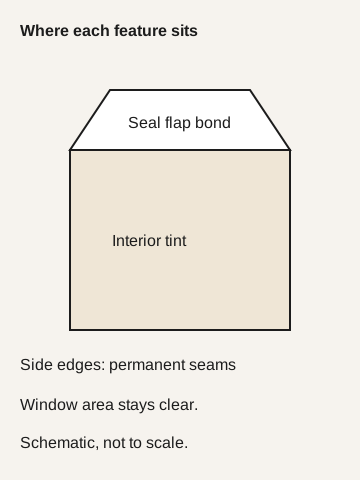
Schematic, not to scale. Tint sits on the inside paper. The drawing does not show a measured adhesive lane or a certified coverage.
Interior tint: check privacy on the filled envelope
Security tint is an interior printed pattern. Tension’s glossary defines it as opaque patterned printing for added security; that definition supplies no measured light-transmission limit or protection against every light source.
For sample approval, place a representative document containing dummy sensitive fields inside the proposed stock. Examine the filled paper panels and folds under the lighting relevant to the mailing’s handling. Record whether the fields remain readable and where. This is an editorial screening procedure, not a standardized opacity test; obtain a documented method if a quantified opacity requirement is part of the job.
A clear address window creates a separate exposure path. Tint on the paper cannot conceal information behind the transparent opening. Move the actual folded insert through its available travel and check that only the intended address information becomes visible. The EMA guide’s window-film section requires clear, securely attached film; the privacy check must therefore include document position, rather than relying on tint around the window. No universal window clearance is assumed here.
Window area (mm²) = width (mm) × height (mm).
Worked example from the EMA guide, printed page 9, retrieved 19 October 2026: the UK DL Banker window is 39 mm by 93 mm, so 39 × 93 = 3,627 mm². That area stays clear. Interior tint on the surrounding paper does not cover it. The stated position, 20 mm from the left and 18 mm from the bottom, is a UK example, not a US postal window rule.
Fiber-tear: examine the paper, flap and seams
Fiber-tear means the paper is damaged when the bonded area is separated, rather than the adhesive simply releasing cleanly. Henkel’s paper-mailer discussion describes pressure-sensitive and side-seam adhesive systems intended to produce that failure at both the closing flap and side seam. This supports a construction-specific mechanism; it does not establish that every paper envelope or adhesive does the same.
Inspect the permanent seams as well as the user-sealed flap. A destructive flap bond leaves an access route unchecked if a pocket seam releases cleanly. Record the location and appearance of disturbed paper, whether the opening permits access, and whether pressing it closed hides that disturbance.
Paper and adhesive must be considered together. The EMA guide, printed page 21, warns that treated and synthetic papers can require special adhesives and may not develop a fiber-tearing bond. H.B. Fuller also identifies paper absorbency, drying time and environmental exposure as adhesive-selection factors. Set the conditioning and waiting time from the exact product’s instructions; no universal cure time or peel-force target is established by these documents.
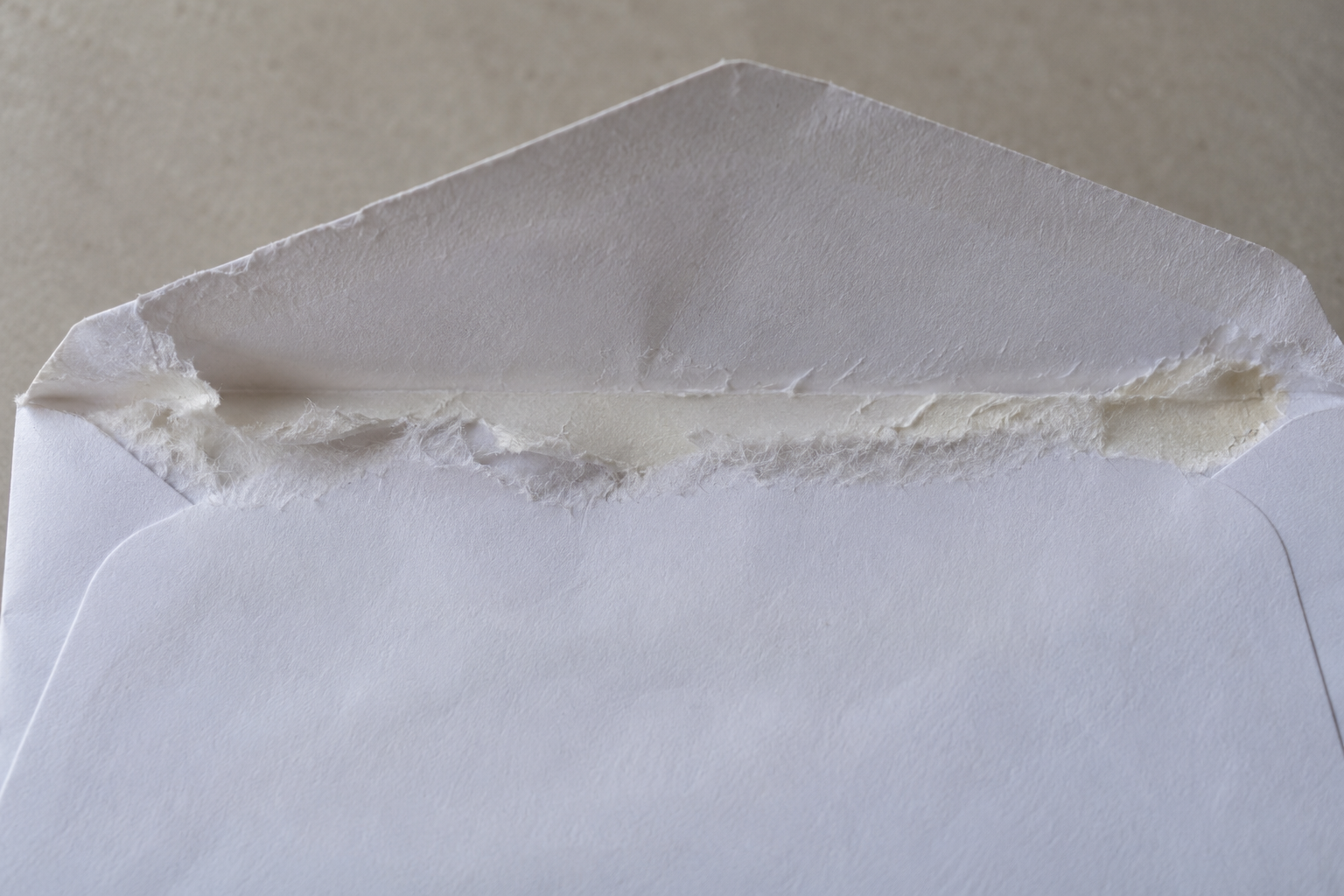
An example of disturbed paper at an opened bond. The photograph is not a peel-force test, a humidity result or a passed security grade.
Compare features by the failure they address
Use the comparison to write a sample-approval record, rather than ranking security by a closure name. Prevention steps are editorial recommendations based on the mechanisms in the retrieved documents.
| Feature or construction | What the documents support | Dominant Failure Mode & Prevention |
|---|---|---|
| Interior security tint | A printed visual barrier inside the paper | Sensitive text remains readable → evaluate the filled panels, folds and intended lighting |
| Clear window with tinted body | A transparent opening remains part of the construction | Insert shifts confidential fields into view → check the full available insert movement |
| Fiber-tearing paper bond | Opening can visibly damage the bonded paper | A seam or flap releases cleanly → qualify both areas on the exact paper and adhesive |
| Resealable pressure-sensitive closure | Tension documents a product intended for repeated opening | Routine resealing leaves no useful opening signal → require evidence appropriate to the intended use |
| Single-use or liner-backed closure | Tension documents single-use gum and release-lined adhesive separately | Convenience label substituted for opening evidence → examine the actual sealed sample |
The Tension closure guide distinguishes a resealable product from a single-use product. A peel-off liner alone establishes neither behavior. For the sealing actions and equipment checks, use self-seal vs gummed envelopes.
Threshold rule: If an evaluated sample can be opened enough to access the contents and reclosed without visible disturbance after the specified sealing and conditioning steps, hold the affected stock. This is an editorial stop rule dated 19 October 2026, not an industry sampling plan or compliance grade. A small sample does not establish a lot-wide failure rate.
Bound the replacement work before releasing the mailing
Keep destructively opened samples out of the outgoing batch, and record failed sealing separately from deliberate opening checks. If the privacy screen or required opening evidence fails, hold the affected stock and correct the documented construction or process before continuing. Do not treat an undocumented extra adhesive as an approved repair.
Count replacement stock from the job record. The EMA guide, printed page 24, says adhesives normally account for 2–3 percent of the materials cost of an envelope, and that adhesive-related issues are the leading cause of customer returns at most converters. That share is a materials-cost figure. It is not a reject rate, and the guide does not give a return percentage to multiply by a batch.
Add the actual labor for reopening, reconciling inserts and resealing, plus replacement stock and any interrupted inserting time. Keep this record with the approved sample and lot identity. The direct-mail production workflow explains where printing, inserting and reconciliation meet; that is the boundary at which an envelope change should trigger a new sample approval.
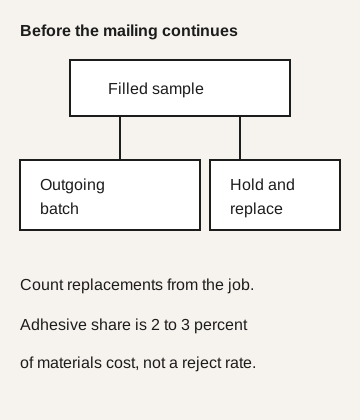
The split is a job-record step. The 2 to 3 percent figure is the EMA materials-cost share for adhesives, not a reject rate.
Sources and method
Source review: 19 October 2026. Tension supplies the tint definition and documented closure distinctions; EMA explains adhesive mechanisms, the UK DL Banker window, the 2–3 percent materials-cost share, and the limits of fiber-tear on treated or synthetic papers. Henkel supplies a paper-mailer example of flap and seam fiber-tear, and H.B. Fuller identifies material and environmental selection factors. Sample checks and the hold rule are editorial planning methods. None of these documents establishes a compliance grade for the envelope being selected.
Sources
- Glossary of Envelope Terms: Security Tint (Tension)
- Envelope Basics: Closures (Tension)
- The EMA Guide to Envelopes and Mailing (Envelope Manufacturers Association)
- Tamper Evidence for E-commerce Packaging (Henkel Adhesives)
- Envelope Adhesives: Selection Factors (H.B. Fuller)