EnvelopesGuide
Coin Envelope Sizes #1–#7: Seams, Bulge and Mailing Limits
Compare coin envelope sizes in inches and millimeters, center and side seams, 24 lb and 28 lb kraft, filled-part fit checks and USPS mailing limits.
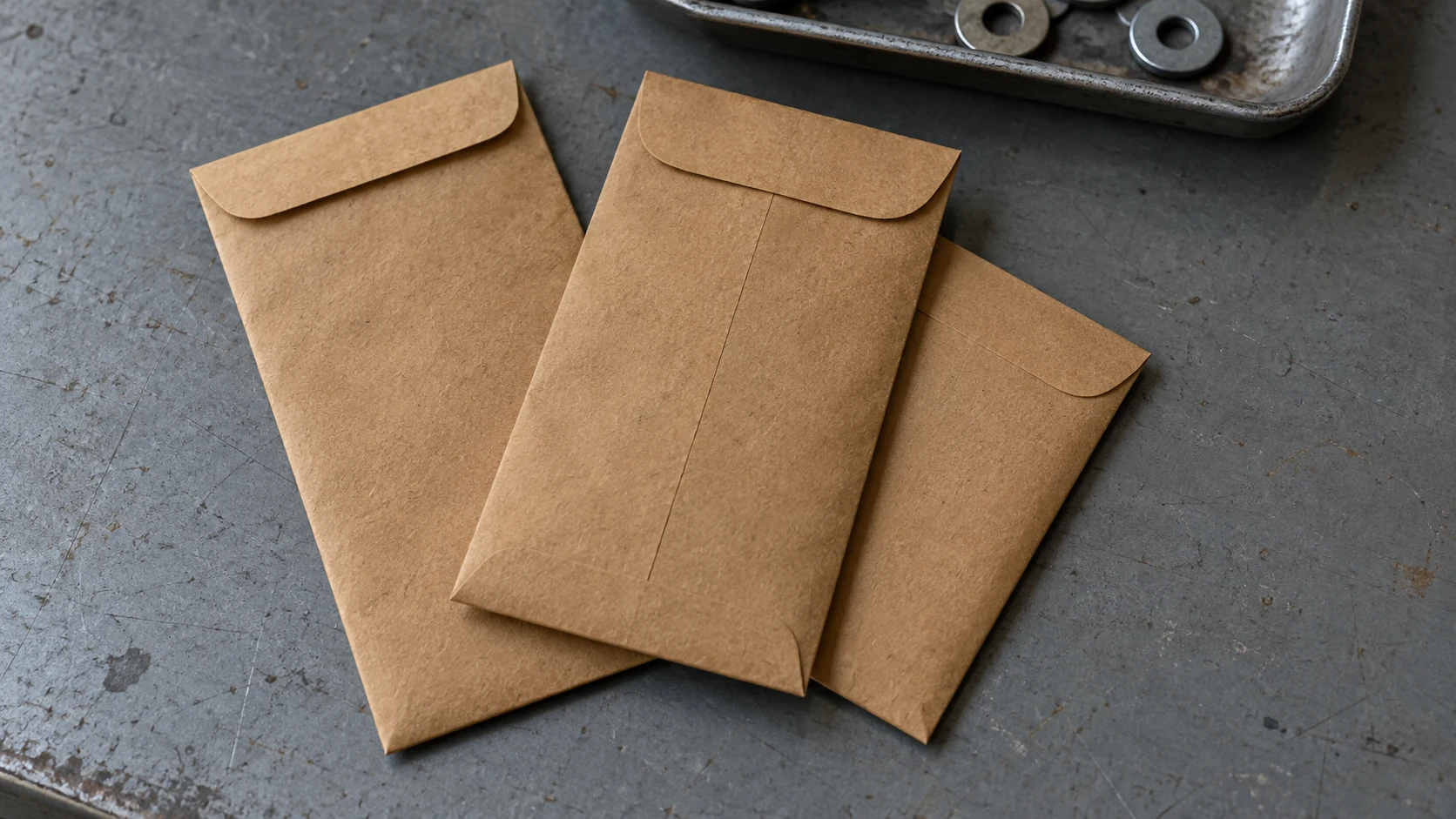
A coin envelope is a small paper pocket that opens on its short end, used to organize coins, seeds and small parts. Choose its actual dimensions first, then check the contents, bulge and closure on a filled sample before selecting an outer mailing package.
Coin envelope sizes in the chart below run from #1 at 2¼ × 3½ inches to #7 at 3½ × 6½ inches, with intermediate and fractional sizes. Use those nominal dimensions to shortlist a pocket; include the part’s thickness and protective wrap when checking fit. For U.S. mailing, the ¼-inch letter thickness maximum applies to the complete sealed mailpiece. The envelope’s number, paper weight and ability to close each answer a different part of the selection decision.
Coin envelope size chart: #1 through #7
Select by the short-side × long-side dimensions, then confirm the supplier’s SKU and usable opening. The main chart follows JBM’s Open End Envelopes Defined size list, with corroborating sizes in the Mac Papers converter catalog. The postal column compares those dimensions with USPS DMM 101 §1.1, with the address parallel to the long side.
| Size | Nominal dimensions, inches | Converted dimensions, mm | Meets letter length and height minimums? |
|---|---|---|---|
| #1 | 2¼ × 3½ | 57.15 × 88.90 | No |
| #3 | 2½ × 4¼ | 63.50 × 107.95 | No |
| #4 | 3 × 4½ | 76.20 × 114.30 | No |
| #4½ | 3 × 4⅞ | 76.20 × 123.83 | No |
| #5 | 2⅞ × 5¼ | 73.03 × 133.35 | No: height under 3½ in |
| #5½ | 3⅛ × 5½ | 79.38 × 139.70 | No: height under 3½ in |
| #6 | 3⅜ × 6 | 85.73 × 152.40 | No: height under 3½ in |
| #7 | 3½ × 6½ | 88.90 × 165.10 | Yes, for length and height |
Millimeters are converted at 25.4 mm per inch and rounded to two decimal places. Measure the usable opening and filled sample separately from these catalog dimensions. Notice that #5 is longer but narrower than #4: increasing the size number does not increase both dimensions.
Where is #2? Numbering varies by supplier. Linton’s Coin Envelopes catalog lists #2AA at 2½ × 3½ inches; a Corbett listing for Supremex #2 uses 2½ × 4½ inches. Specify the dimensions and code together, especially when changing suppliers.
For letter sheets and larger inserts, use the commercial envelope sizes guide to compare the format with its enclosure limit.
Center seam or side seam: what should you inspect?
A center seam places the joined side flaps down the back of the pocket; a side seam moves that join toward an edge. JBM offers both constructions. In either case, the short-end seal flap closes the opening and a bottom flap closes the opposite end.
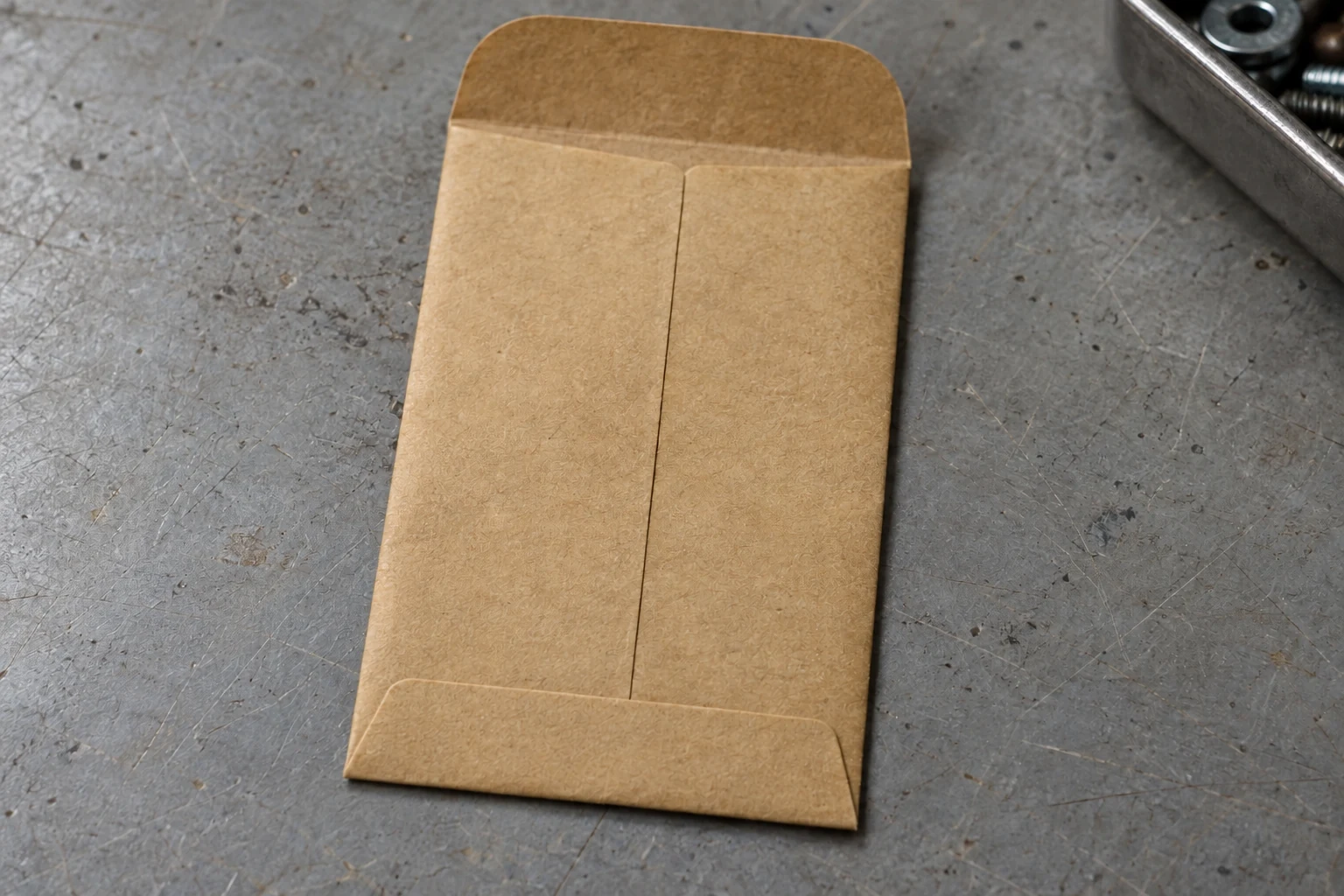
| Construction detail | What it changes | Filled-sample check |
|---|---|---|
| Center seam | Position of the overlap on the back | Check that contents enter smoothly and the join stays bonded |
| Side seam | Position of the overlap near an edge | Check insertion along that edge and inspect the full join |
| Bottom flap | Closure of the pocket’s lower end | Look for lifting, gaps or corner damage after filling |
| Seal flap and adhesive | Contact area that closes the mouth | Confirm full intended adhesive contact without pulling the flap tight |
Treat the bottom fold as a closure. For contents that need depth, choose a package designed for that depth and verify its filled dimensions. The envelope construction and materials guide explains the folds, throat and adhesives behind these checks.
Choosing 24 lb or 28 lb kraft for small parts
For small parts kraft coin envelopes, record the paper grade and basis weight alongside the size, seam and closure. Linton lists 24 lb and 28 lb kraft options in several coin sizes; JBM’s #7 stock specification lists 24 lb paper. These are useful purchasing specifications for matching repeat orders.
Evaluate each stock with the actual part count, edges and wrap. A compact stack, an angular fastener and a broad flat piece load the pocket differently. Ask for the stock’s caliper and relevant strength data when those properties drive the choice, and retain an approved filled sample so a later paper substitution can be checked against it.
For seed packets, include the intended seed quantity in the fit check and examine the bottom corners for gaps. Specify any required moisture barrier or preservation properties separately when selecting the packaging material.
How much thickness can a coin envelope hold?
Determine usable thickness from the selected pocket and the complete contents, including any holder or wrapping. Approve a sample that loads easily, closes across the intended adhesive area and keeps its seams and corners intact. Bulging, a stretched flap or lifting at a join calls for a change in size, arrangement or package construction.
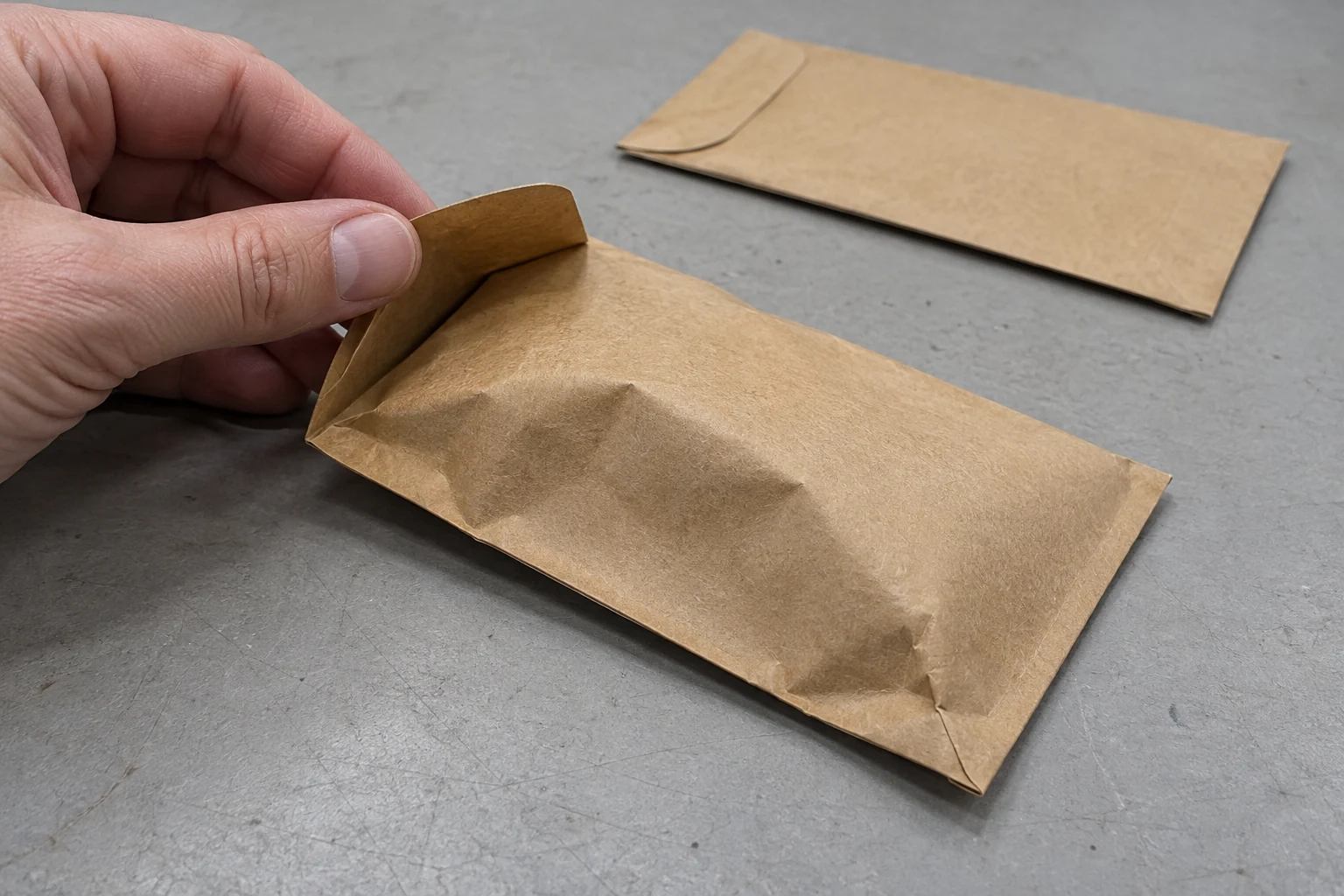
Use this sequence when comparing samples:
- Describe the contents. Record the part or seed type, count, dimensions and total mass. Identify sharp edges and projections.
- Include protection. Add the intended wrap or holder before checking the pocket opening and fit.
- Load the proposed stock. Check insertion and removal through the throat without forcing the contents past a seam.
- Close and inspect. Follow the closure instructions; examine adhesive contact, the back join, bottom flap and corners. Change the sample if a part protrudes or a seam lifts.
- Measure the assembled package. Record the sealed dimensions, thickest point and weight. Repeat after placing the pocket in its intended outer mailer or box.
USPS DMM 601 §3.1 requires packaging that withstands normal transit and prevents the contents from shifting. Apply that requirement to the complete mailing package, including how the inner pocket is restrained.
Can you mail a coin envelope by itself?
Check size, preparation and machinability in that order. In the chart above, #7 is the only format whose nominal length and height reach the retail letter minimums. Smaller pockets can serve as inner organizers in a suitable outer package.
First, check the finished letter dimensions
USPS DMM 101 §1.1 gives these retail letter limits:
| Measurement | Minimum | Maximum |
|---|---|---|
| Length, parallel to the address | 5 in | 11½ in |
| Height | 3½ in | 6⅛ in |
| Total thickness | 0.007 in; see larger-letter condition below | ¼ in (6.35 mm) |
| First-Class Mail letter weight | — | 3.5 oz |
A #7 addressed along its 6½-inch dimension reaches the length and height thresholds. Measure the finished sample because its nominal 3½-inch height sits at the minimum. Letters longer than 6 inches or higher than 4¼ inches need at least 0.009-inch thickness to avoid the thin-piece nonmachinable criterion in DMM 101 §1.2.
Measure the thickest point of the sealed mailpiece, including paper, wrapping and contents. A part that is itself ¼ inch thick leaves no room within the letter maximum for the surrounding package.
Next, secure and wrap odd-shaped contents
DMM 601 §3.3 requires odd-shaped items such as key rings and similar objects in letter-size or flat-size paper envelopes to be wrapped within the other contents. The wrapping must streamline the package and prevent damage during processing. Loose keys, coins and similar objects can make a paper-envelope letter nonmailable.
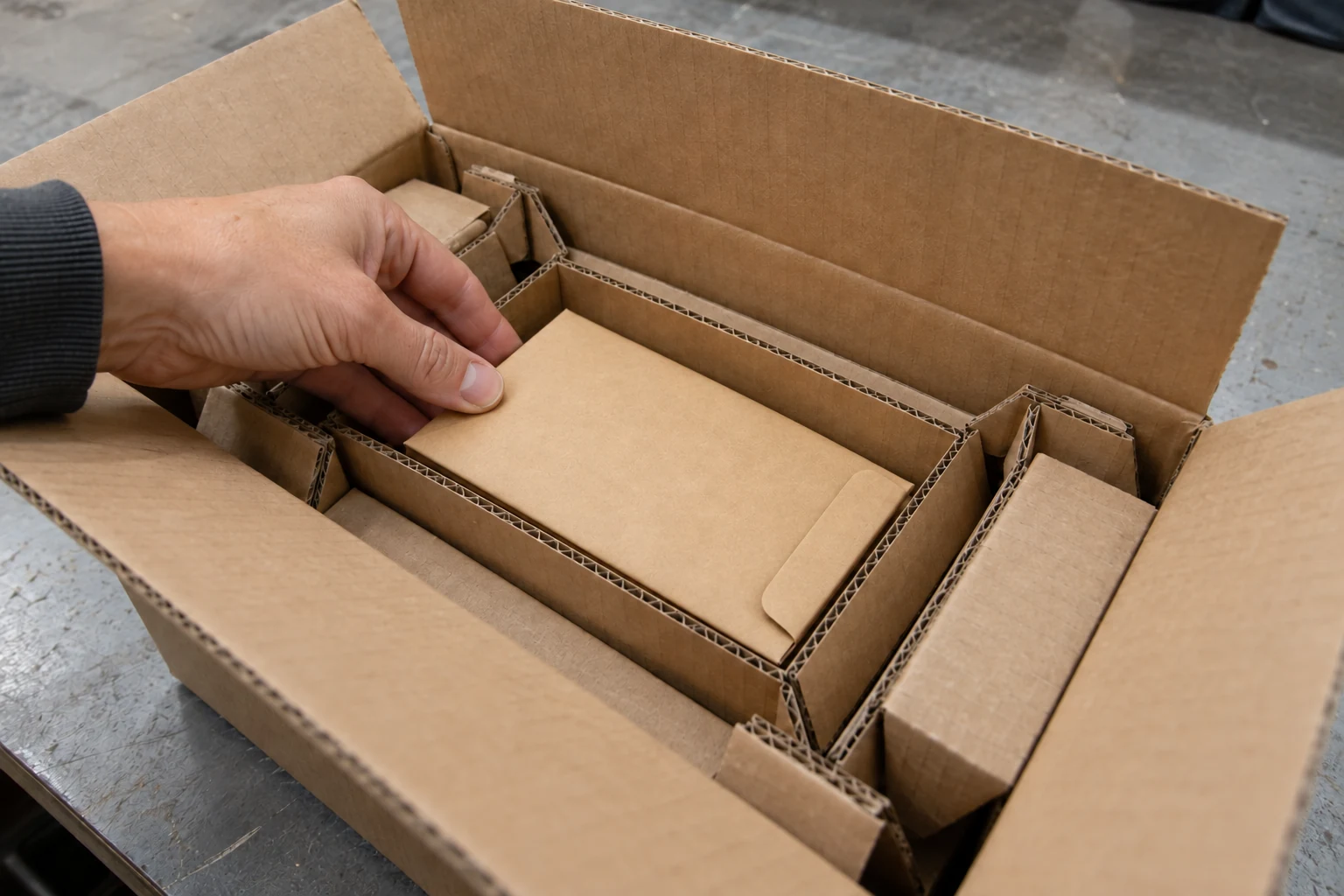
For small hardware, use the coin envelope to organize the parts, then select an outer package with suitable restraint and cushioning. Compare mailing envelope types when deciding whether an outer mailer suits the contents or a box is needed.
Finally, assess machinability and postage
Uneven contents, excessive rigidity, loose objects or an address parallel to the short side can trigger USPS nonmachinable treatment under DMM 101 §1.2. Thickness below ¼ inch still leaves those other checks to make.
The domestic First-Class Mail letter nonmachinable surcharge is $0.49 per piece in USPS Notice 123, effective October 4, 2026. It is added to applicable letter postage. Paying it addresses the price classification; the piece must also satisfy dimensional and packaging requirements. Check the current Notice 123 before purchasing postage.
For automation letter mailings, DMM 201 §3.10 prohibits rigid items such as keys. It conditionally permits coins and tokens when firmly affixed and wrapped within the contents and when the mailpiece meets the flexibility standards. Have USPS assess an uncertain production design before committing the mailing.
If the finished package exceeds the letter thickness limit, reassess the mail category. Flats must also meet flexibility, shape and uniform-thickness requirements under DMM 101 §2.0. A rigid or lumpy package may require parcel packaging and prices.
Coin envelope sample-approval checklist
Keep the selected stock specification and filled sample together. Use this checklist for a small-parts or seed packet order, then record the mailing decision for the outer package.
| Record | What to enter or check |
|---|---|
| Contents | Part/SKU or seed type, count, dimensions, mass, edges and projections |
| Protection | Wrap or holder, cushioning and method of restraining movement |
| Envelope | Supplier SKU, nominal dimensions and usable opening |
| Paper | Grade, basis weight, and supplier-specified gsm/caliper where relevant |
| Construction | Center or side seam, bottom closure and seal-flap adhesive |
| Filled fit | Smooth loading, adhesive contact, seams, corners and protrusions |
| Finished pocket | Sealed dimensions, maximum thickness and weight |
| Outer package | Container, restraint, cushioning, sealed dimensions and weight |
| Mailing decision | Letter/flat/parcel assessment, machinability and current postage |
| Approval | Sample identifier, decision, date and changes to check on repeat orders |
Download the coin envelope selection checklist (CSV) to record the specification and sample results.
Reference documents
Dimensions and construction: JBM, Coin Envelopes and Open End Envelopes Defined; Mac Papers, Envelopes converter catalog, June 10, 2019, printed page 24. Supplier-specific numbering and stock options: Linton, Coin Envelopes catalog; Corbett, Supremex #2 listing; JBM, #7 stock specification.
Postal requirements: USPS Domestic Mail Manual 101 §§1.1–1.2 and 2.0; 601 §§3.1 and 3.3; 201 §§3.10 and 3.12; 133 §1.7. Price: USPS Notice 123, effective October 4, 2026, domestic First-Class Mail letter nonmachinable surcharge.
Frequently Asked Questions
Is a #2 coin envelope always the same size?
Order by dimensions and supplier code together. Linton lists #2AA at 2½ × 3½ inches, while a Corbett/Supremex #2 listing uses 2½ × 4½ inches. JBM’s numbered chart skips #2. Confirm the pocket opening with the intended contents.
Does 28 lb kraft let me pack thicker parts than 24 lb?
Choose the paper stock and pocket dimensions together, then evaluate a filled sample. Basis weight describes the paper specification; usable fit also depends on the opening, seams, closure, part shape and protective wrap. Keep the approved stock and sample with the order specification.
Can I mail a #7 coin envelope with a regular stamp?
A nominal #7 meets the minimum letter length and height when addressed along its 6½-inch side. Postage still depends on the finished piece’s weight and machinability. Loose hardware, uneven thickness or rigidity can change acceptance and pricing; prepare and assess the complete package before buying postage.