EnvelopesGuide
Envelope Sizes Guide: Commercial Formats and USPS Limits
Compare commercial envelope sizes, #10 and 6 × 9 formats, enclosure limits and USPS letter-versus-flat rules before printing or inserting a mailing.
Wrong envelope sizes can turn a finished print run into refolding, torn stock or a mailing that misses its planned postal category. Choose a commercial envelope from its documented finished dimensions and enclosure limit, then check the filled piece against USPS rules; a #10 and a 6 × 9 can both fit letter geometry, but neither name guarantees eligibility.
For business and direct mail, envelope size means the finished envelope dimensions, while the enclosure limit describes what the converter says can fit inside. Start with the folded insert and all accompanying pieces, choose a documented format, and approve a filled sample before committing the mailing. For letter-size screening, align the address with the long edge and record that orientation alongside the dimensions. The broader envelope manufacturing and materials guide explains the construction choices behind that sample.
Quick specs: the dimensions that decide the job
Use catalog dimensions to shortlist stock and USPS dimensions to screen the completed mailpiece. All measurements below are in inches unless stated otherwise; postal limits were retrieved on 19 October 2026.
| Input or item | Typical value or source | Why it matters |
|---|---|---|
| Finished envelope and maximum insert | Converter chart; selected formats below | Outside size is not usable pocket space |
| Retail letter dimensions | Length 5–11½ in; height 3½–6⅛ in; thickness 0.007–¼ in (DMM 101 §1.1) | Screens the filled piece for letter size |
| Larger letters: minimum machinable thickness | 0.009 in when length exceeds 6 in or height exceeds 4¼ in (DMM 101 §§1.1–1.2) | A piece can be too thin as well as too thick |
| Commercial machinable letters | Aspect ratio 1.3–2.5, dimensionless; maximum 3.5 oz for Presorted First-Class Mail and USPS Marketing Mail (DMM 201 §§1.1.1–1.1.3) | Size alone does not establish machinability or automation eligibility |
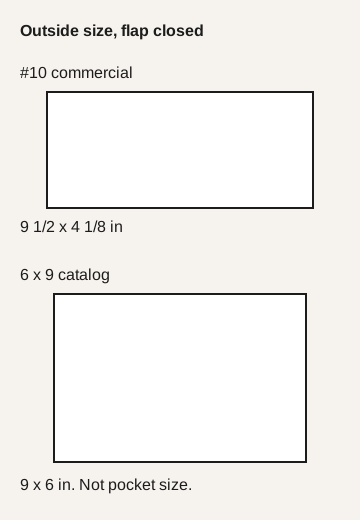
Outside sizes with the flap closed, drawn in proportion from the Tension chart. These are not pocket sizes.
Commercial envelope sizes and maximum enclosures
The chart below gives selected business and direct-mail formats from Tension’s size charts, retrieved 19 October 2026. Dimensions follow the chart’s short-side × long-side order, with the flap folded closed. They are illustrative converter sizes, not a universal manufacturing tolerance or an inserter approval.
| Format | Finished dimensions, in | Published maximum enclosure, in |
|---|---|---|
| Business #9 | 3⅞ × 8⅞ | 3⅝ × 8⅝ |
| Business #10 | 4⅛ × 9½ | 3⅞ × 9¼ |
| Business #12 | 4¾ × 11 | 4½ × 10¾ |
| Booklet 6½, commonly described by its dimensions | 6 × 9 | 5¾ × 8¾ |
| Catalog 6 × 9 | 6 × 9 | 5¾ × 8¾ |
| Catalog 9 × 12 | 9 × 12 | 8¾ × 11¾ |
| Catalog 10 × 13 | 10 × 13 | 9¾ × 12¾ |
The same dimensions can describe different openings. Specify booklet or catalog as well as size; the types of mailing envelopes guide explains opening edges and seams.
Choose the format around the insertion failure
Choose the smallest documented format that accepts the complete insert set without forcing it, then verify the intended filling process. The failure modes and prevention steps below are planning recommendations, not measured reject rates.
| Format or choice | Useful starting point | Dominant Failure Mode & Prevention |
|---|---|---|
| Commercial business envelope | Folded correspondence and transactional inserts | Folded stack catches at the throat → verify the final fold and complete insert set in a sample |
| Booklet opening | A wide loading edge | Wrong opening specified despite matching dimensions → mark the opening edge on the job record |
| Catalog opening | Short-edge loading for a document packet | Stock accepted by size but unsuitable for the inserter → obtain the exact machine’s envelope requirements |
| Larger envelope to avoid folding | Inserts that must remain flat | Postal category assumed from the empty stock → measure, weigh and check flexibility after filling |
The EMA guide’s section on mechanical insertion explains why equipment requirements must be checked: some systems accept a range of styles, while others require precise envelope specifications. A catalog maximum enclosure is not a machine clearance specification. Pocket depth, seam intrusion, flap geometry and stack allowance remain unknown until documented for the chosen stock or checked with a sample.
Does a 6 × 9 envelope mail as a letter or a flat?
A 6 × 9 in paper envelope can fit letter dimensions when the address runs parallel to the 9 in side: postal length is then 9 in and height is 6 in. Under DMM 101 §§1.1–1.2, the filled piece must also satisfy thickness, weight, rigidity and other conditions. Retail First-Class Mail letters above 3.5 oz pay flat-size prices. Turning the address parallel to the short side makes a retail letter nonmachinable.
The aspect-ratio calculation is an early screen, not a postal approval:
Aspect ratio, dimensionless = postal length (in) ÷ postal height (in).
Worked example, using the retrieved converter dimensions and an address parallel to the long side: 9 in ÷ 6 in = 1.50, within the 1.3–2.5 commercial machinable-letter range in DMM 201 §1.1.1 (retrieved 19 October 2026).
A compliant ratio does not override a rigid insert, clasp closure or unsuitable thickness. Commercial machinable letters also have to meet DMM 201 §3.0; use the standards for the actual class and preparation you intend to claim.
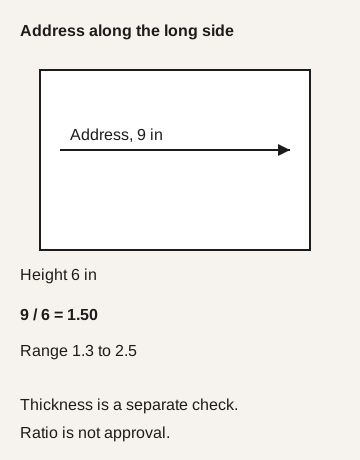
The ratio uses the converter’s outside dimensions and an address along the long side. It is not a postal approval, and filled thickness is a separate check.
Threshold rule: If the completed piece exceeds 11½ in in length, 6⅛ in in height, or ¼ in in thickness, it exceeds retail letter geometry. Evaluate flat eligibility before choosing postage or releasing the print job. These are DMM 101 §§1.1 and 2.1 limits retrieved 19 October 2026; exceeding a letter limit does not itself establish flat eligibility.
For ordinary retail flats, DMM 101 §2.1 sets maxima of 15 in long × 12 in high × ¾ in thick, together with flexibility, rectangular shape and uniform thickness. Section 2.4 allows no more than ¼ in thickness variation, subject to its edge exclusions. A rigid document packet in a large envelope cannot be classified from dimensions alone; DMM 101 §2.5 sends pieces failing the flat standards to applicable parcel prices.
Set the waste boundary before printing and inserting
Stop the job before volume printing if the actual insert set does not fit the documented enclosure limit or the filled sample misses the intended postal requirements. A forced fit is a reason to change the fold, stock or format; it is not evidence that the envelope will feed reliably.
Record the folded insert dimensions, total stack thickness, chosen opening, intended address orientation and the sample’s postal assessment. Keep the sample with the job record. If an insert, fold or envelope changes, check that boundary again before continuing.
Track rejected envelopes, replacement inserts, refolding time and machine restart time separately. The relevant comparison is the completed mailing, including rework, rather than envelope unit cost alone. The direct-mail production workflow places that sample approval before inserting and postal preparation, where late changes become harder to contain.
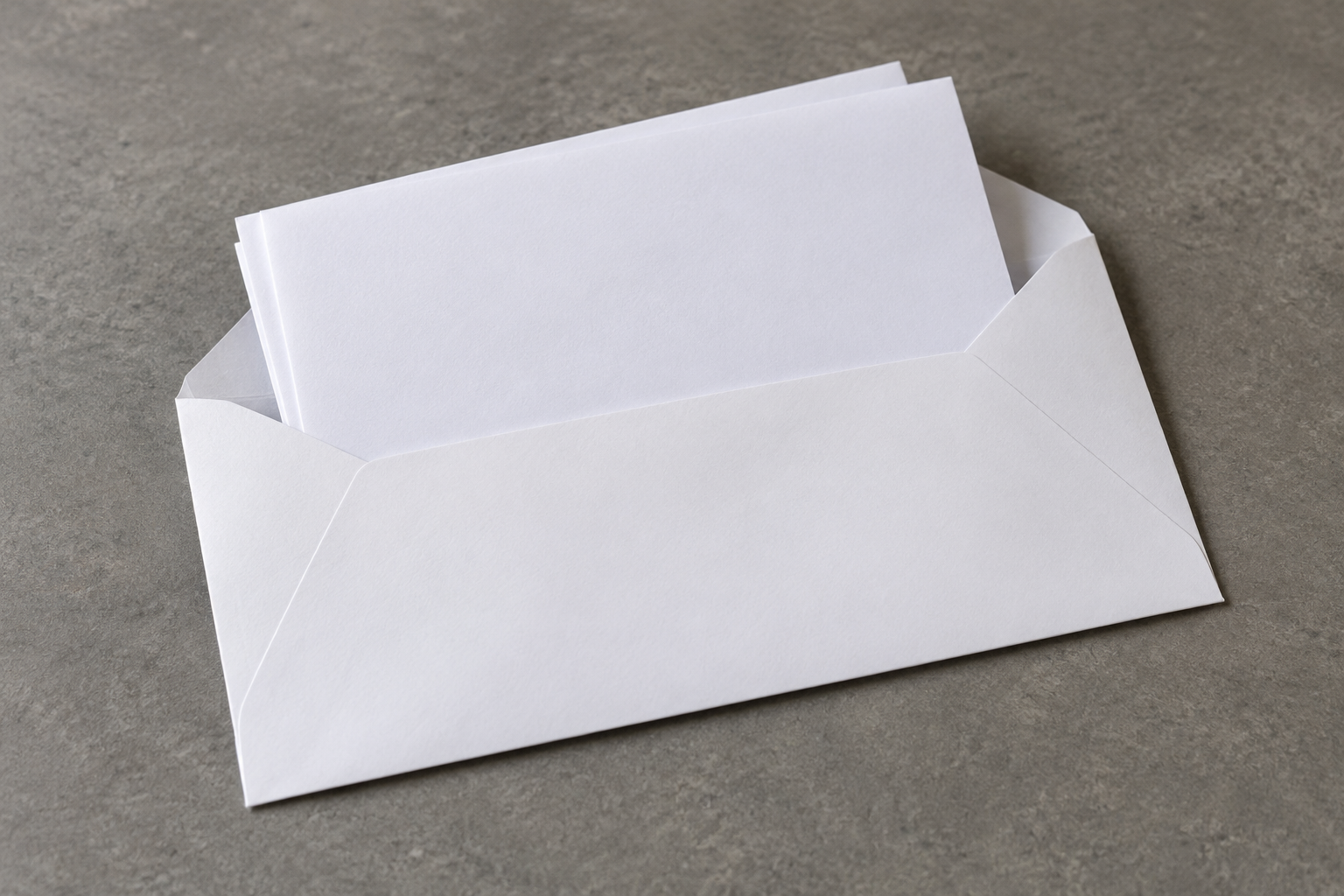
A fit check before printing. The photograph does not show a measured enclosure, a machine clearance or a passed sample.
Sources and method
Source review: 19 October 2026. Converter chart values identify candidate sizes; current USPS DMM 101 and 201 text supplies the postal limits. The aspect-ratio example is arithmetic using the stated dimensions and orientation. No pocket geometry, stack capacity, postage price or equipment clearance is inferred from a catalog name. The format comparison and stop rules are editorial planning recommendations.
Sources
- Common Envelope Sizes: Envelope Size Charts (Tension)
- DMM 101: Retail Physical Standards (USPS Postal Explorer)
- DMM 201: Commercial Physical Standards (USPS Postal Explorer)
- The EMA Guide to Envelopes and Mailing (Envelope Manufacturers Association)