EnvelopesGuide
Business Reply Envelope Layout: FIM, Indicia & IMb
Letter-size business reply envelopes require a permit legend, FIM B or C, a 1-3/4 in imprint, a 4-3/4 by 5/8 in barcode zone, and a 1.3 to 2.5 ratio.
A business reply envelope is a preaddressed return envelope formatted under USPS Business Reply Mail (BRM) standards so a permit holder receives First-Class Mail, USPS Ground Advantage Retail, or Priority Mail back from customers and pays postage plus a per-piece fee only on returned pieces. Every letter-size face coordinates four fixed zones under Domestic Mail Manual (DMM) sections 202 and 505: an upper-right “NO POSTAGE NECESSARY IF MAILED IN THE UNITED STATES” imprint extending no more than 1-3/4 inches from the right edge, with a vertical column of horizontal bars printed directly below that imprint, a capital-letter “BUSINESS REPLY MAIL” legend (at least 3/16 inch high) stacked over the permit line, addressee-payment endorsement, and preprinted BRM ZIP+4 address, a Facing Identification Mark (FIM B without a barcode or FIM C with a barcode) inside an unprinted clear zone from 3 inches to 1-3/4 inches off the right edge and 5/8 inch down, and a lower-right barcode clear zone measuring 4-3/4 inches wide by 5/8 inch high.
To qualify as machinable mail under DMM 201, the sealed piece must measure 5 to 11-1/2 inches long, 3-1/2 to 6-1/8 inches high, and 0.007 to 1/4 inch thick (rising to at least 0.009 inch thick whenever height exceeds 4-1/4 inches or length exceeds 6 inches), constructed from at least 50-pound book-grade basis weight paper with length divided by height between 1.3 and 2.5. For paper grain, seam gluing, and flap gums across all styles in the envelopes technical hub, pair these postal face coordinates with commercial pocket dimensions in the envelope sizes guide and outbound addressing and traying checks in the direct mail production workflow guide.
What is a business reply envelope vs a courtesy reply envelope?
A business reply envelope returns under a USPS Business Reply Mail permit in which the addressee guarantees return postage and a per-piece charge only for returned pieces, whereas Courtesy Reply Mail (CRM) consists of preaddressed cards or envelopes with no permit fees required because the respondent affixes postage before mailing. Under federal regulation 39 CFR 111.1, which incorporates the USPS Domestic Mail Manual updated November 2, 2026 and effective November 4, 2026, any mailer distributing BRM must obtain a permit beforehand and print the permit number, issuing city, and state on every piece, after which permit holders may distribute BRM cards, envelopes, self-mailers, flats, cartons, and labels in any quantity for return to any Post Office in the United States, its territories and possessions, and overseas military Post Offices.
Respondents never write a recipient address in the delivery block: under DMM 505 section 1.5.6, the permit holder’s complete name, street or delivery address, city, state, and USPS-assigned BRM ZIP+4 must be preprinted on the piece (unless displayed through an approved window or address label), and that address may never be altered to redirect the envelope elsewhere. Qualified Business Reply Mail (QBRM) applies to automation-compatible First-Class Mail cards or letters weighing 3.5 ounces or less that carry the USPS-assigned unique ZIP+4 code and matching Intelligent Mail barcode (IMb). Under Quick Service Guide 505 and Publication 25 Chapter 6, proofs for regular BRM should be approved by the USPS before printing, proofs for Qualified Business Reply Mail must be approved and must bear an Intelligent Mail barcode, and before final printing or electronic distribution the Postal Service must approve a proof for regular BRM or QBRM, both of which must include the applicable Intelligent Mail barcode, with camera-ready PDF and EPS artwork available through the USPS Automated Business Reply Mail (ABRM) tool, and delivery point barcodes are prohibited on BRM and QBRM pieces.
| Reply Mail Option | Who Pays Return Postage | Permit & Proof Rule | Barcode & FIM Rule | QSG 505 Annual Return Fit |
|---|---|---|---|---|
| Courtesy Reply Mail (CRM) | Respondent applies postage before mailing with no BRM fees | No BRM permit required | FIM A (110010011) when printed with a preprinted barcode | Preaddressed customer-stamped replies |
| Basic BRM | Permit holder pays postage plus per-piece charge on returned pieces | BRM permit required, with proof approval recommended before printing and required before final printing or electronic distribution | Optional IMb, using FIM B without barcode or FIM C with barcode | Fewer than 993 returned pieces expected annually |
| High-Volume BRM | Permit holder pays via advance deposit account plus annual permit and maintenance fees | BRM permit and advance deposit account at returning Post Office | Optional IMb (FIM B on unbarcoded pieces, FIM C on barcoded pieces) | Approximately 993 or more returned pieces expected annually |
| Basic QBRM | Permit holder pays QBRM postage plus per-piece charge via advance deposit account | QBRM authorization and mandatory USPS proof approval | Mandatory IMb matching assigned BRM ZIP+4 with FIM C | Approximately 610 or more returned letters or 610 or more cards annually |
| High-Volume QBRM | Permit holder pays QBRM postage plus per-piece charge with annual maintenance and consecutive 3-calendar-month quarterly fee | QBRM authorization, advance deposit account, and mandatory USPS proof sign-off | Mandatory IMb encoding assigned QBRM ZIP+4 with FIM C | Approximately 44,444 or more pieces quarterly or 177,778 or more pieces annually |
Where do the no-postage imprint, permit legend, and horizontal bars go?
The “NO POSTAGE NECESSARY IF MAILED IN THE UNITED STATES” imprint prints in the upper-right corner of the address side extending no more than 1-3/4 inches from the right edge, with the vertical column of horizontal bars stacked directly below it and the capital-letter “BUSINESS REPLY MAIL” legend, permit line, and addressee endorsement stacked above the delivery address. Under DMM 505 section 1.5.1, every BRM piece must follow these format rules, and the USPS may revoke a BRM permit for format errors under section 1.2.6.
Handwriting, typewriting, and hand stamping may not be used to prepare BRM, whereas any legible printing process is acceptable when the finished ink and paper meet the reflectance standards in DMM 204.1.3. Printed borders are not permitted on letter-size BRM and are permitted only on envelopes greater than 6-1/8 inches high, 11-1/2 inches long, or 1/4 inch thick, although the permit holder may enclose the business reply legend, permit number line, and postage endorsement inside a rule or box border.
| Face Element | Required Position on Address Side | Dimensional & Clearance Rule (DMM 505.1.5) |
|---|---|---|
| Postage imprint | Upper-right corner of the address side | Prints “NO POSTAGE NECESSARY IF MAILED IN THE UNITED STATES” no more than 1-3/4 inches from the right edge |
| Business reply legend | Above the delivery address | Prints “BUSINESS REPLY MAIL” or “BUSINESS REPLY LABEL” in capital letters at least 3/16 inch high (optional rule border allowed) |
| Permit & payment lines | Directly beneath the business reply legend | Prints “FIRST-CLASS MAIL PERMIT NO. [NO., CITY, STATE]” in capitals, with “POSTAGE WILL BE PAID BY ADDRESSEE” in capitals immediately below |
| Preprinted delivery address | Below the endorsement stack | Complete permit-holder name, delivery address, city, state, and USPS-assigned BRM ZIP+4, keeping at least 1/2 inch clearance between ZIP Code and horizontal bars on letter-size BRM |
| Horizontal bar column | Directly below the “NO POSTAGE NECESSARY” imprint | Evenly spaced uniform bars parallel to piece length, at least 1 inch long and 1/16 to 3/16 inch thick, stopping at or above delivery address line on nonbarcoded letters, stopping at least 5/8 inch from bottom edge on barcoded BRM, or omitted on letter-size BRM and cards bearing an IMb |
| Company logo | Address face away from required elements | On barcoded letter-size BRM, no lower than 5/8 inch from the bottom edge, and on nonbarcoded BRM, outside the OCR read area (DMM 202.2.1) |
Which FIM pattern and clear zone fit barcoded vs unbarcoded reply mail?
Letter-size Business Reply Mail and letter-size business reply labels must print FIM C (binary 110101011) whenever the piece carries a barcode and FIM B (binary 101101101) when printed without a barcode, placed inside an otherwise unprinted upper-right FIM clear zone. Every letter-size business reply mail fim barcode layout depends on matching that nine-bit vertical-bar pattern (where a printed bar represents binary 1 and an unprinted placeholder space represents binary 0) to the exact mail class and barcode state in DMM 202 section 8.2.
| FIM Code | Nine-Bit Binary Pattern (1 = Bar, 0 = Space) | Authorized Mailpiece Application (DMM 202.8.2) |
|---|---|---|
| FIM A | 110010011 | Courtesy Reply Mail (CRM) and Meter Reply Mail (MRM) bearing a preprinted barcode |
| FIM B | 101101101 | Business Reply Mail without a preprinted BRM ZIP+4 barcode |
| FIM C | 110101011 | Business Reply Mail with a preprinted BRM ZIP+4 barcode, plus Permit Reply Mail with a preprinted delivery-point barcode |
| FIM D | 111010111 | Letter-size First-Class Mail bearing Information-Based Indicia (IBI) printed directly on the envelope in nonfluorescent ink |
| FIM E | 101000101 | Postcard-size and letter-size First-Class Mail prepared for customized services |
Under DMM 202 section 8.3, the FIM clear zone sits at the upper right of the address side bounded on the left at 3 inches from the right edge, on the right at 1-3/4 inches from the right edge, at the top by the top edge, and at the bottom 5/8 inch down from the top edge; no printing other than the FIM may enter this zone. Individual FIM bars measure 5/8 inch (plus or minus 1/8 inch) high and 1/32 inch (plus or minus 0.008 inch) wide, with the right edge of the rightmost bar positioned 2 inches (plus or minus 1/8 inch) from the right edge of the piece. Bar tops must start no lower than 1/8 inch from the top edge and may wrap over the top fold onto the back flap provided at least 1/2 inch of bar height stays on the address side, while bar bottoms must touch the 5/8-inch floor or stay within 1/8 inch above or below it. Combined positional skew of the pattern and rotational skew of individual bars cannot exceed plus or minus 5 degrees from perpendicular to the top edge, and FIM ink must achieve at least a 30% print reflectance difference against the envelope stock in both the red and green portions of the optical spectrum on a USPS or USPS-licensed envelope reflectance meter. Enlarging or reducing camera-ready FIM artwork, bridging spaces between bars with ink, missing dimensional tolerances, or printing weak ink coverage renders FIM-required mail nonmailable.
What are the Intelligent Mail barcode clear zone and reflectance limits?
An Intelligent Mail barcode on Business Reply Mail sits either inside the delivery address block or inside the lower-right 4-3/4 by 5/8 inch barcode clear zone, printed on a uniform background reflecting at least 50 percent red and 45 percent green light with at least a 30% print reflectance difference between paper and ink. Under DMM 204 section 1.2.1 and DMM 505 section 1.5.10, the Intelligent Mail barcode consists of 65 vertical four-state bars (full bar, ascender, tracker, and descender) encoding 31 digits split into a 20-digit tracking code and an 11-digit routing code; on BRM, it must carry the barcode ID, service type ID, and USPS-assigned unique BRM ZIP+4 code, never a delivery point barcode.
Under DMM 202 sections 5.1 and 5.3, barcode placement depends on whether the mailer uses the lower-right corner or the address block:
- Lower-right corner placement (printed directly on the mailpiece or on a window insert): the barcode clear zone extends 4-3/4 inches from the right edge to the right edge and 5/8 inch up from the bottom edge (where vinyl tabs and cellophane tape closures are prohibited under DMM 201 section 3.11), and a directly printed barcode must keep its leftmost bar between 3-1/2 inches and 4-1/4 inches from the right edge and sit vertically between 3/16 inch and 1/2 inch from the bottom edge.
- Address-block placement (printed directly on the piece, on a window insert, or on an affixed address label, with ABRM camera-ready artwork supporting placement above the address block or in the lower-right clear zone): the barcode is prohibited anywhere between the recipient-name line and the city, state, and ZIP Code line, requiring at least 0.028 inch vertical clearance to adjacent text lines, at most 0.625 inch (5/8 inch) separation from the top or bottom address-block line, and at least 0.125 inch (1/8 inch) side clearance. Across the mailpiece face, the rightmost bar stays at least 1/2 inch from the right edge, the leftmost bar stays less than 10-1/2 inches from the right edge and at least 1/2 inch from the left edge, bar tops sit less than 4 inches from the bottom edge, and the bottom of the address block (including the barcode) sits at least 5/8 inch above the bottom edge.
In either position, DMM 204 section 1.4.1 limits combined positional and rotational barcode skew to plus or minus 5 degrees from perpendicular to the bottom edge, with individual bars offset vertically by no more than 0.015 inch from the average baseline. Under DMM 204 section 1.3, print reflectance difference (PRD) equals background reflectance minus barcode ink reflectance and must reach at least 30% in both red and green light over a uniform background reflecting at least 50 percent in the red portion and 45 percent in the green portion of the optical spectrum. Paper opacity must keep interior security tints or enclosed print showing through the barcode clear zone or address-block barcode area at or below a 15% print contrast ratio (PCR) in red and green light, and dark paper fibers or background patterns exceeding 15% PCR are prohibited in those barcode zones on automation letter-size pieces. When pairing confidential return statements with QBRM envelopes, select low-contrast interior patterns using the security envelope features guide.
What USPS letter size requirements and aspect ratio govern machinable mail?
Under USPS letter size requirements in DMM 201 and Quick Service Guide 505, a machinable letter measures at least 5 inches long by 3-1/2 inches high and at most 11-1/2 inches long by 6-1/8 inches high, stays between 0.007 inch and 1/4 inch thick (at least 0.009 inch thick once height exceeds 4-1/4 inches or length exceeds 6 inches), uses at least 50-pound book-grade paper basis weight, and keeps its aspect ratio from 1.3 to 2.5, inclusive. Under DMM 202 section 1.1, postal length is the dimension parallel to the delivery address as read, and postal height is the dimension perpendicular to that length, so rotating the address parallel to the shorter side swaps length and height and can render an otherwise standard pocket nonmachinable.
DMM 201 section 1.2.1 illustrates the aspect-ratio calculation (length divided by height) with a worked sheet-cutting exception: quartering an 11-inch by 8.5-inch sheet into four identical-size postcards produces pieces measuring 5.5 inches divided by 4.25 inches, which equals an aspect ratio of 1.294. While DMM 201 grants a specific postcard exception for that 1.294 cut (and bounds card-price BRM pieces at 3-1/2 by 5 inches up to 4-1/4 by 6 inches and 0.007 to 0.016 inch thick), business reply envelopes receive no aspect-ratio exception and must stay between 1.3 and 2.5 inclusive for both machinable processing and QBRM automation compatibility.
| Physical Parameter | Machinable & QBRM Envelope Requirement | Governing DMM / QSG Clause |
|---|---|---|
| Overall length & height | 5 to 11-1/2 inches long (parallel to address) by 3-1/2 to 6-1/8 inches high | DMM 201.1.1.1, DMM 202, QSG 505 |
| Sealed thickness | 0.007 inch minimum up to 4-1/4 by 6 inches, rising to 0.009 inch minimum if over 4-1/4 inches high or 6 inches long, up to 1/4 inch maximum | DMM 201.1.1.1, QSG 505 |
| Aspect ratio (length / height) | 1.3 to 2.5, inclusive (unlike the 11 by 8.5 inch four-up postcard cut at 5.5 / 4.25 = 1.294) | DMM 201.1.1.1, 201.1.2.1, 201.3.7 |
| Paper basis weight | Minimum 50 pounds or equivalent, measured on 500 book-grade sheets at 25 by 38 inches | DMM 201.3.2, DMM 505.1.4.1 |
| Maximum machinable / QBRM weight | 3.5 ounces (0.2188 pound) for QBRM letters and Presorted First-Class or Marketing Mail machinable letters | DMM 201.1.1.2, DMM 505.1.6.1 |
How do window business reply envelopes compare vs adhesive reply labels?
Covered-window and open-panel window envelopes are both valid Business Reply Mail formats provided the FIM prints directly on the outer envelope stock, whereas standalone adhesive BRM labels measure at least 2-5/8 by 4-1/4 inches, prohibit window envelopes altogether, and disqualify the return piece from QBRM prices. Under DMM 505 section 1.4.5, covered vs open-panel construction determines whether the indicia and legend can ride on the internal reply slip or must print on the outer pocket; see window vs regular envelopes for window patch films and insert-shift checks, and remittance envelope flap and insert design for deep wallet flaps and perforated coupon stubs.
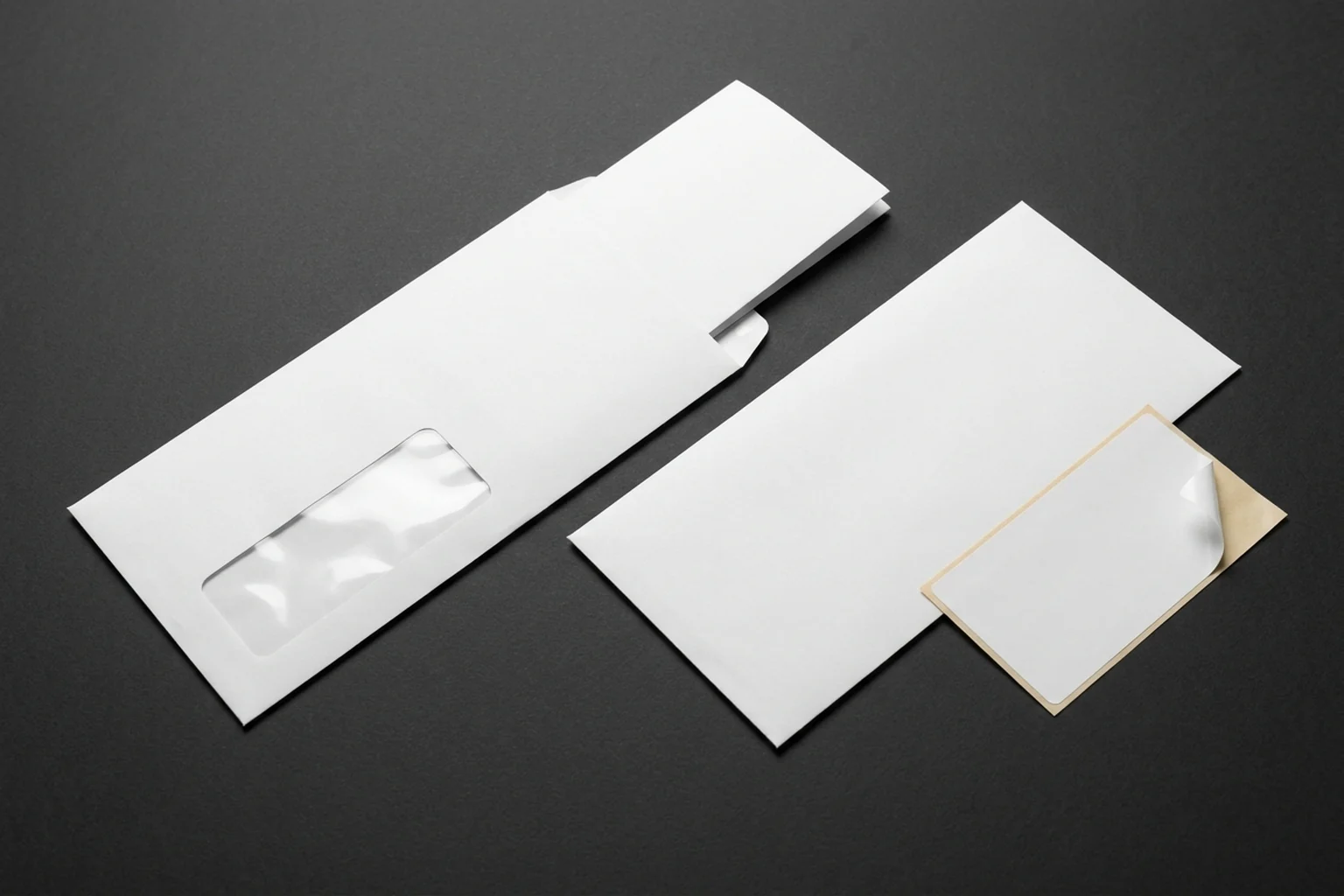
| Reply Format | Where FIM, Imprint, Legend & Bars Print | Size, Barcode and Eligibility Constraints (DMM 202.5.1.5) |
|---|---|---|
| Covered-window BRM envelope | FIM prints on the envelope; “No Postage Necessary” imprint, legend, and horizontal bars print on the envelope or on the insert showing through the covered window | Covered-window information area must measure at least 2 inches high by 4-1/4 inches long; IMb may sit in address block or lower-right corner; horizontal bars omitted only with letter-size IMb |
| Open-panel window BRM envelope | FIM, “No Postage Necessary” imprint, business reply legend, and horizontal bars must all print directly on the envelope | Uncovered cutout displays insert address; horizontal bars omitted only when letter-size BRM carries an IMb |
| Adhesive letter-size BRM label | All BRM format elements including FIM print on a permanent-adhesive label; horizontal bars measure at least 3/4 inch high unless omitted with an IMb | Label minimum 2-5/8 inches high by 4-1/4 inches long; user diagram and instructions must forbid window envelopes, envelopes less than 1 inch higher than label, envelopes over 4-1/2 inches high, non-return-address printing, and tape; ineligible for QBRM prices |
Prepress four-zone clearance and aspect-ratio check
Before final printing or electronic distribution, verify each zone on the proof and obtain Postal Service approval for regular BRM or QBRM, both of which must include the applicable Intelligent Mail barcode, with camera-ready PDF and EPS artwork available from the USPS ABRM tool:
| Prepress Check Zone | Pass Specification | Nonmailable / Permit-Risk Trigger |
|---|---|---|
| Facing Identification Mark (FIM) | FIM B (101101101) without barcode or FIM C (110101011) with barcode in an unprinted 3 to 1-3/4 in (from right) by 5/8 in (from top) clear zone; bars 5/8 in (plus or minus 1/8 in) high, 1/32 in (plus or minus 0.008 in) wide, rightmost bar at 2 in (plus or minus 1/8 in), skew within 5 degrees, PRD at least 30% red and green | Scaling camera-ready FIM art up or down, ink bridging between bars, stray border or tint inside clear zone, or using FIM A on BRM |
| Upper-right imprint & legend stack | “NO POSTAGE NECESSARY IF MAILED IN THE UNITED STATES” within 1-3/4 in of right edge; capital “BUSINESS REPLY MAIL” at least 3/16 in high above capital permit number, city, and state line, “POSTAGE WILL BE PAID BY ADDRESSEE”, and preprinted BRM ZIP+4 address | Perimeter border printed on a letter-size envelope, handwriting or stamping, or altering the preprinted return address |
| Horizontal bars & logo floor | Uniform bars at least 1 in long and 1/16 to 3/16 in thick with at least 1/2 in clearance from ZIP Code; stop at or above delivery address line (nonbarcoded) or at least 5/8 in from bottom edge (barcoded), or omit on IMb letters and cards; logo at least 5/8 in above bottom edge on barcoded letters | Extending nonbarcoded bars alongside city, state, and ZIP line or dropping a company logo into the lower 5/8-inch strip |
| Barcode clear zone & reflectance | 65-bar IMb with assigned BRM ZIP+4 (never a delivery point barcode) in address block (at least 0.028 in vertical, 0.125 in side clearance) or 4-3/4 by 5/8 in lower-right clear zone (3-1/2 to 4-1/4 in from right, 3/16 to 1/2 in from bottom); background at least 50 percent red and 45 percent green, PRD at least 30%, show-through and fiber PCR at most 15%, skew within 5 degrees, baseline shift at most 0.015 in | Encoding an 11-digit delivery point barcode on BRM, placing barcode between recipient name and city, state, and ZIP, dark interior tint show-through over 15% PCR, or vinyl and cellophane closures in clear zone |
| Physical envelope & aspect ratio | 5 to 11-1/2 in long by 3-1/2 to 6-1/8 in high, 0.009 to 1/4 in thick (above 4-1/4 by 6 in), at least 50 lb book-grade stock (500 sheets of 25 by 38 in), weight at most 3.5 oz, length divided by height between 1.3 and 2.5 | Rotating address parallel to short side, sealed thickness under 0.009 in on standard envelopes, or aspect ratio below 1.3 or above 2.5 |
Frequently Asked Questions
Do respondents write their own delivery address on a business reply envelope?
No, under USPS Domestic Mail Manual section 505.1.5.6, the permit holder's complete return name, street or delivery address, city, state, and USPS-assigned BRM ZIP+4 must be preprinted on the envelope (or displayed through an approved window or label), and no one may alter that block to redirect the piece elsewhere.
When do horizontal bars have to appear on Business Reply Mail, and when can prepress omit them?
DMM 505 section 1.5.7 requires a vertical column of evenly spaced horizontal bars at least 1 inch long and 1/16 to 3/16 inch thick directly beneath the upper-right postage imprint on unbarcoded pieces, stopping at or above the delivery address line, whereas mailers may omit horizontal bars altogether on letter-size BRM and cards that carry a compliant Intelligent Mail barcode.
Should a business reply envelope carry FIM B or FIM C?
Print FIM B (binary 101101101) on letter-size Business Reply Mail prepared without a preprinted BRM ZIP+4 barcode, and print FIM C (binary 110101011) whenever the piece carries a preprinted BRM ZIP+4 barcode.
Can an adhesive business reply label be applied to a window envelope or claim QBRM prices?
No, under DMM 505 section 1.4.9, permit-holder instructions accompanying a letter-size business reply label must warn users never to place the label on a window envelope, an envelope less than 1 inch taller than the label, or an envelope exceeding 4-1/2 inches high, and labeled pieces are ineligible for Qualified Business Reply Mail prices.
Sources
- 39 CFR 111.1 - Incorporation by Reference; Mailing Standards of the United States Postal Service, Domestic Mail Manual (Electronic Code of Federal Regulations (incorporating USPS Domestic Mail Manual section 505, updated November 2, 2026 and effective November 4, 2026; consulted alongside USPS Publication 25, Chapter 6))