Mailing & FulfillmentProcess guide
Direct Mail Production Workflow: Stage Handoffs & Sign-Offs
Stage-by-stage direct mail production workflow from address coding and press finishing to inserting and USPS entry, with a handoff sign-off record table.
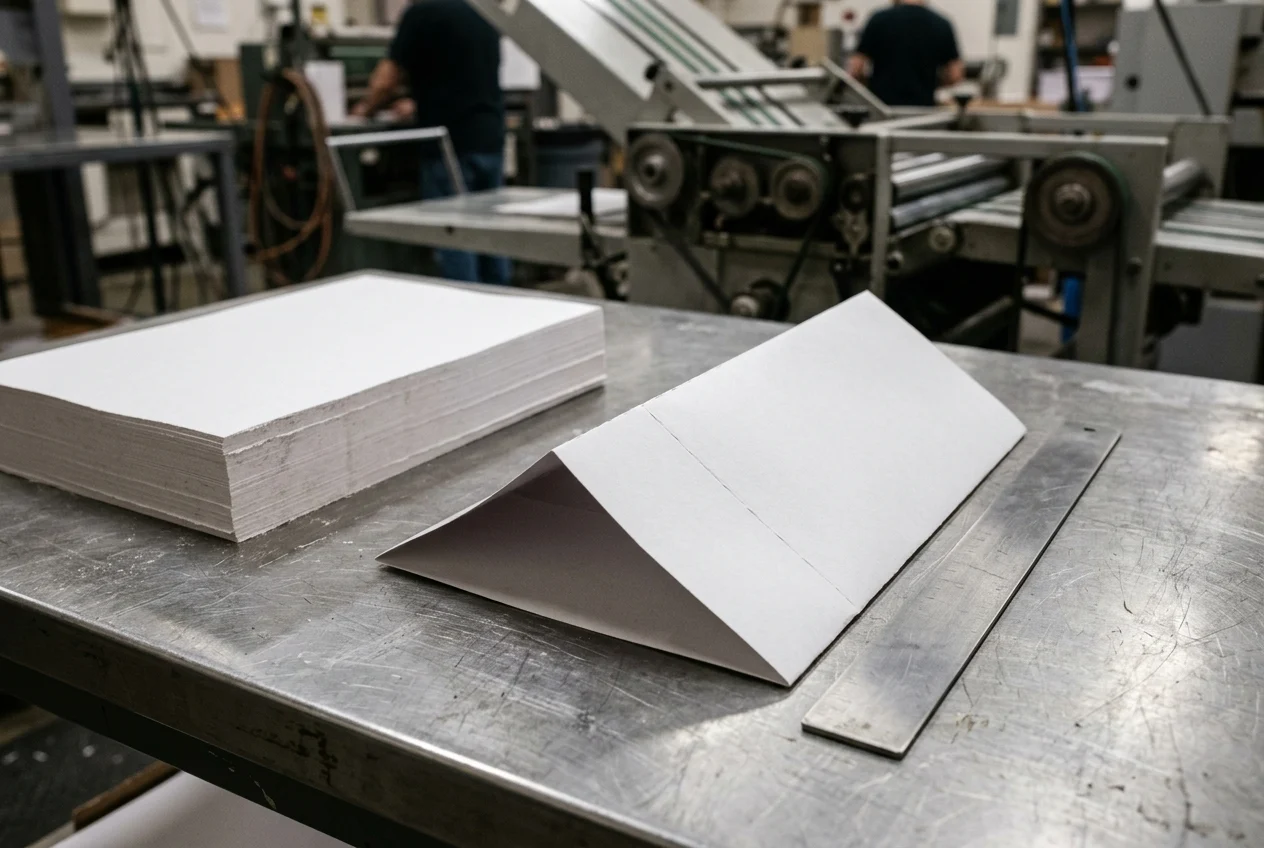
Releasing a print file or address list before checking downstream fold panels, envelope clearance and container rules causes jammed inserters, rejected trays and wasted stock. A direct mail production workflow sequences five operational handoffs—address hygiene and presort coding, prepress and press production, bindery scoring and folding, mechanical inserting or tabbing, and postal container entry—so each station receives verified inputs from the one before it.
This page maps those stage-by-stage handoffs and provides a sign-off record table for print buyers, direct-mail production coordinators and lettershop operators. It is an independent technical reference based on the USPS Domestic Mail Manual (DMM, read October 17, 2026) and published converting and mailing documentation. It does not quote postage rates, rank equipment brands or provide legal advice. Machine speeds, feeder capacities and carrier price figures that depend on a specific line or tariff are marked Unknown / verify on the unit.
| Stage & gate | Incoming inputs | Inspection checks before release | Responsible role | Hold / pause condition (stop the job if…) |
|---|---|---|---|---|
| 1. List hygiene & presort coding [1, 4] | Raw recipient file, target mail class, mailpiece weight and dimensions | Verify Move Update completion within 95 days of mailing; run CASS address coding; generate presort sequence, Intelligent Mail barcode (IMb) fields and USPS Qualification Report [1, 4] |
Data processing / list specialist | Move Update date exceeds 95 days; CASS coding fails on required automation fields; presort piece count does not match input control total |
| 2. Prepress & press production [3, 5] | Coded presort file, print-ready artwork, specified paper grade and basis weight | Check fonts, bleeds, margins, color separations and variable-data field mapping; confirm 5/8 in bottom barcode clear zone on non-window pieces; obtain written soft or hard proof sign-off [3, 5] |
Prepress & press operator / print buyer | Variable address block or IMb encroaches into the barcode clear zone; customer proof is unsigned; paper grain direction conflicts with planned fold direction [6] |
| 3. Post-press cutting, scoring & folding [2, 5, 6] | Printed press sheets or web rolls, approved folding dummy, bindery job ticket | Verify cut trim dimensions, mechanical score placement on heavy stock, fold panel order, and self-mailer tab/glue closure placement (no staples or paper clips) [2, 5, 6] | Bindery supervisor | Folded panel cracks along the spine; address panel lands upside down or inside the fold; folded insert width or height exceeds envelope throat clearance |
| 4. Mechanical inserting & sealing [2, 6, 7, 8] | Folded inserts, reply pieces, closed-seam outer envelopes with remoistenable gum | Perform right-jog window clearance check with real inserts; confirm camera or optical mark set-integrity reading on multi-page sets; verify sealed thickness (<= 1/4 in), weight (<= 3.5 oz) and aspect ratio (1.3 to 2.5) [2, 6, 8] |
Lettershop / inserter operator | Any character of the address or IMb hides behind the window frame when jogged; envelopes arrived with liner-backed peel-and-seal flaps; sealed packet exceeds 1/4 in letter limit |
| 5. Bundling, traying & postal entry [4] | Sealed mailpieces in presort sequence, tray labels, USPS Qualification Report, electronic postage statement |
Face all pieces in the same read direction; strap letter bundles by thickness rule (1 in threshold); fill 2-foot or 1-foot trays; reconcile physical tray and piece counts to documentation [4] |
Mailroom dispatch lead | Pieces are unfaced or mixed in read direction; rubber bands are used on flat-size bundles; physical tray count diverges from the USPS Qualification Report |
For how this letter and flat workflow fits alongside lightweight merchandise packing, see the mailing and fulfillment overview.
Gate 1: Address hygiene, CASS coding and presort sequence
In commercial US mailings, data preparation sets both the variable-data print order and the physical tray structure before a single sheet reaches the press. Under USPS DMM 602 (read October 17, 2026), commercial First-Class Mail presorted or automation prices and USPS Marketing Mail prices must satisfy the Move Update standard: every address and associated addressee must be updated within 95 days before the mailing date through a USPS-approved method such as Address Change Service (ACS), the National Change of Address Linkage System (NCOALink), or Ancillary Service endorsements where permitted [1].
Any mailing claiming an automation price must also be produced from address lists standardized and coded with current Coding Accuracy Support System (CASS)-certified software [1]. CASS processing matches recipient records against USPS master files to standardize street and directional elements and append ZIP+4, delivery point, and carrier route codes [1]. Under DMM 602 Section 1.0, every domestic mailpiece requires at least a recipient name or delivery address line and a city, state, and ZIP Code line (5-digit ZIP or ZIP+4) [1].
Once addresses are coded, presort software orders the records into bundle and tray groupings and produces the supporting documentation required by DMM 203—specifically the electronic postage statement and standardized documentation titled the USPS Qualification Report [4]. USPS tests presort software and hardware through the Presort Accuracy Validation and Evaluation (PAVE) program, but DMM 602 Section 8.0 explicitly states that PAVE certification of software does not by itself guarantee acceptance of customer mail prepared with it [1]. If the physical mailpieces violate barcode clear zones, aspect ratio rules or tray-banding rules downstream, the postal entry unit can reject the discount or hold the mailing regardless of the software certificate.
| Addressing & face rule | USPS DMM requirement (read October 17, 2026) | Synthetic layout check before press |
|---|---|---|
| Minimum domestic address lines | Recipient name or delivery address line, plus city, state and 5-digit or ZIP+4 line (DMM 602 Section 1.0) [1] |
JANE DOE / 100 EXAMPLE AVE APT 4B / SPRINGFIELD IL 62701-1234 (synthetic example) |
| Move Update window | Updated within 95 days before the mailing date for commercial First-Class presort/automation and Marketing Mail (DMM 602 Section 5.0) [1] |
Compare NCOALink or ACS processing date against scheduled postal entry date |
| Address placement on machinable letters | Entire delivery address placed within the top half of the mailpiece where required, parallel to the length dimension (DMM 202 Section 2.1) [3] | Confirm address block runs parallel to the long edge so aspect ratio stays between 1.3 and 2.5 [2, 3] |
| Barcode clear zone on non-window letters | Rectangular area at the lower right corner measuring 5/8 inch up from the bottom edge and 4-3/4 inches from the right edge (DMM 202 Section 5.1) [3] |
Keep background ink, return addresses, permit boxes and decorative rules out of this zone |
| Presort documentation output | Electronic postage statement plus USPS Qualification Report listing piece counts by sort level and destination ZIP (DMM 203 Sections 1.0–3.0) [4] |
Lock presort record sequence before generating variable-data print files |
Hold condition at Gate 1: Pause file release if the Move Update processing date will be more than 95 days old on the scheduled entry date, or if variable-data pagination splits the presort sequence without tray-break markers for the bindery.
Takeaway: Freeze the CASS-coded, presorted record sequence before generating variable print files so press sheets come off the line in tray order.
Gate 2: Prepress preflight, press route and bindery finishing
After the data file is locked, production moves through preflight, customer proof sign-off, press printing and post-press bindery finishing. Mailing.com’s breakdown of direct mail printing separates these steps because errors introduced in prepress or cutting cannot be corrected at the inserter [5]:
- Preflight inspection: Prepress staff check that artwork files include all fonts, high-resolution images, bleed allowances, margin clearances and color separations, and verify that variable-data fields map cleanly to the presorted record layout [5].
- Proof approval: The buyer approves either a digital soft proof on a screen or a physical hard proof on paper before press plates are imaged or digital queues start [5].
- Press selection: Offset lithography transfers ink from metal plates via a rubber blanket onto paper webs or sheets and suits high-volume static shells or long press runs [5]. Digital toner or high-speed inkjet presses print directly from electronic files without plates, enabling piece-by-piece variable text, personalized offers and inline Intelligent Mail barcodes [5]. For a broader comparison of press families, see the commercial printing overview and flexographic vs offset printing.
- Post-press cutting, scoring and folding: Printed sheets move to guillotine cutters, scoring wheels and buckle or knife folders to become finished inserts or folded self-mailers [5].
The Envelope Manufacturers Association (EMA) guide emphasizes that paper grain direction and mechanical scoring govern how cleanly paper folds [6]. Folding heavy stock against the paper grain without a prepared score line causes fiber cracking along the spine and spring-back curl that jams downstream inserter tracks [6].
When the mailpiece is a folded self-mailer (mailed without an outer envelope), bindery finishing must also satisfy USPS DMM 201 Section 3.14 physical rules (read October 17, 2026) [2]:
- Paper basis weight: Folded self-mailers generally require a minimum
20 lbpaper basis weight (17 x 22 inchesby 500 sheets), rising to at least28 lbpaper for pieces weighing over1.5 ouncesup to3.0 ounces[2]. - Closure method: Panels must be secured with tabs (wafer seals) or glue lines/spots placed according to panel orientation and mailpiece weight; DMM 201 Section 3.14 explicitly prohibits staples or paper clips as self-mailer closures [2].
Hold condition at Gate 2: Stop the bindery run if folded panels crack along the crease, if trim variation shifts the address block out of position, or if a self-mailer layout specifies staples or fewer wafer tabs than DMM 201 Section 3.14 requires.
Takeaway: Require a trimmed, scored and folded physical dummy from the bindery before running the full press lot through the folders.
Gate 3: Envelope compatibility, mechanical inserting and set integrity
For enveloped mailings, collated or folded inserts meet the outer envelope at the folder-inserter line. Production inserters feed sheets, reply envelopes and buck slips from separate hoppers, fold or nest them into a packet, open the outer envelope throat, push the packet inside and moisten-seal the flap [6, 8]. In transactional and personalized direct mail runs, lines use optical marks, 2D barcodes or camera vision systems alongside vacuum or gripper feeders to verify that multi-page variable sets stay matched to the right recipient and that double-feeds stop the track immediately [8].
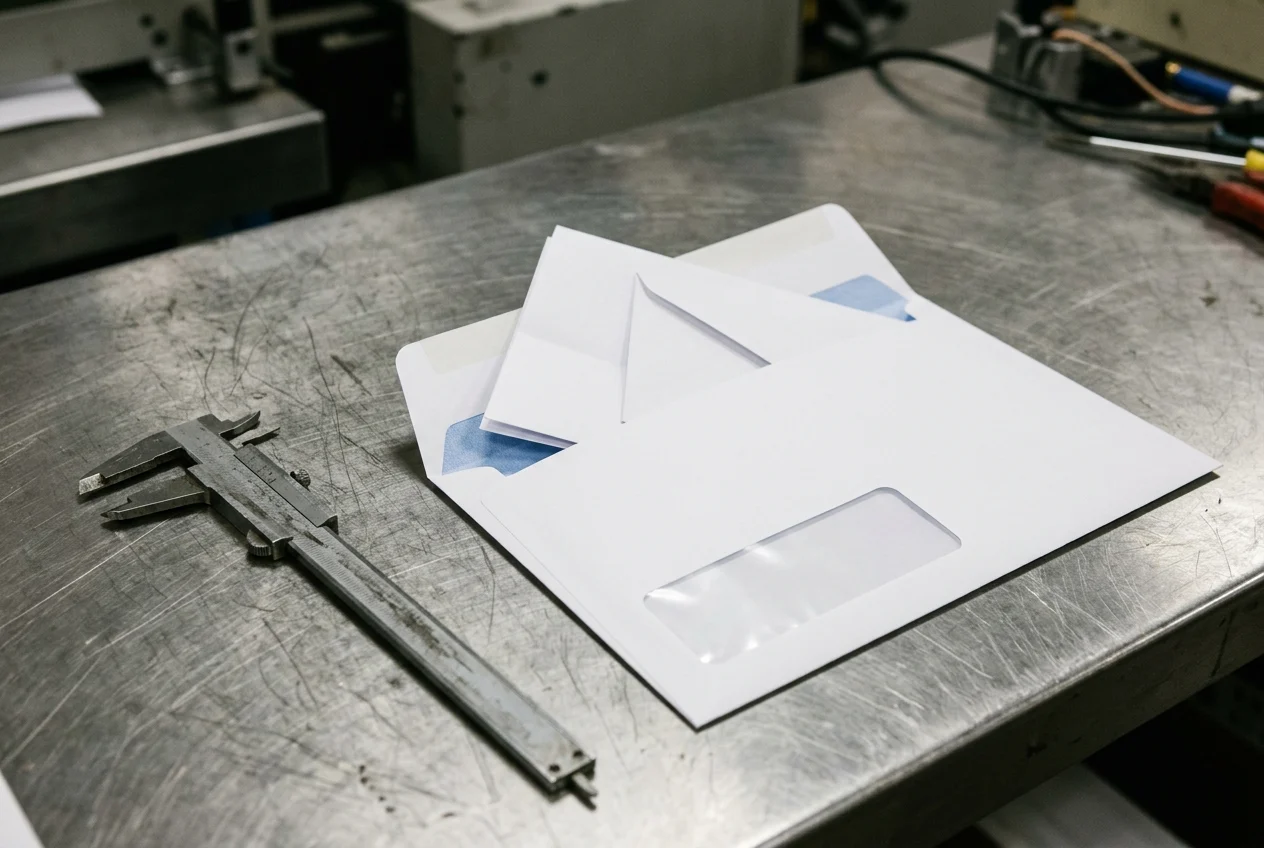
Three physical checks must pass before an automated inserting run begins:
- Envelope seam construction and flap adhesive: The EMA guide notes that inserting machine specifications call for closed-seam (side-seam) envelopes—where the side flaps are folded in beneath the bottom flap—because open-side or exposed interior seams can catch incoming inserts [6]. For inline sealing, the EMA guide and Tension Envelope’s closure guide state that moisture-activated (remoistenable) gum is the standard choice for automatic inserting machines, whereas liner-backed peel-and-seal closures are not compatible with automated inserters [6, 7]. Compare construction details in how envelopes are made, types of mailing envelopes, and self-seal vs gummed envelopes.
- Prototype right-jog window check: Never approve window alignment from a digital PDF or a photocopied layout, because copiers can shift image position [6]. Following the EMA guide’s prototype check, slide the actual folded insert packet into a real production envelope, tap the packet all the way to the right and bottom edges, and confirm that every character of the longest address line and the full Intelligent Mail barcode remain visible inside the window opening [3, 6]. For window film and patch rules, see window vs regular envelopes and the envelopes overview.
- USPS machinable letter geometry: Under USPS DMM 201 Section 1.1 and DMM 202 Section 2.1 (read October 17, 2026), a filled, sealed machinable letter must be rectangular and stay within strict dimensional limits [2, 3]:
- Length (the dimension parallel to the delivery address as read):
5 inchesto11-1/2 inches[2, 3]. - Height (perpendicular to the length):
3-1/2 inchesto6-1/8 inches[2, 3]. - Thickness:
0.007 inchto1/4 inch(0.25 inch) [2]. - Maximum weight:
3.5 ounces[2]. - Aspect ratio (length divided by height): between
1.3 and 2.5[2]. Printing the delivery address parallel to the short edge of an envelope inverts length and height, dropping the aspect ratio below1.3and triggering nonmachinable surcharges [3].
- Length (the dimension parallel to the delivery address as read):
Hold condition at Gate 3: Hold the inserting run if the right-jog test clips any character of the address or barcode, if the filled envelope thickness exceeds 1/4 inch, or if the camera integrity reader flags a sequence mismatch between variable sheets.
Takeaway: Test actual folded inserts inside actual production envelopes for throat clearance, right-jog window visibility and sealed caliper before starting high-speed insertion.
Gate 4: Facing, bundling, traying and postal entry documentation
Once envelopes are sealed or self-mailers are tabbed, the mailroom converts the presorted stream into USPS-compliant bundles and trays and reconciles the physical containers against the electronic paperwork. Under USPS DMM 203 (read October 17, 2026), bundle and tray preparation follows specific physical rules that differ between letters and flats [4]:
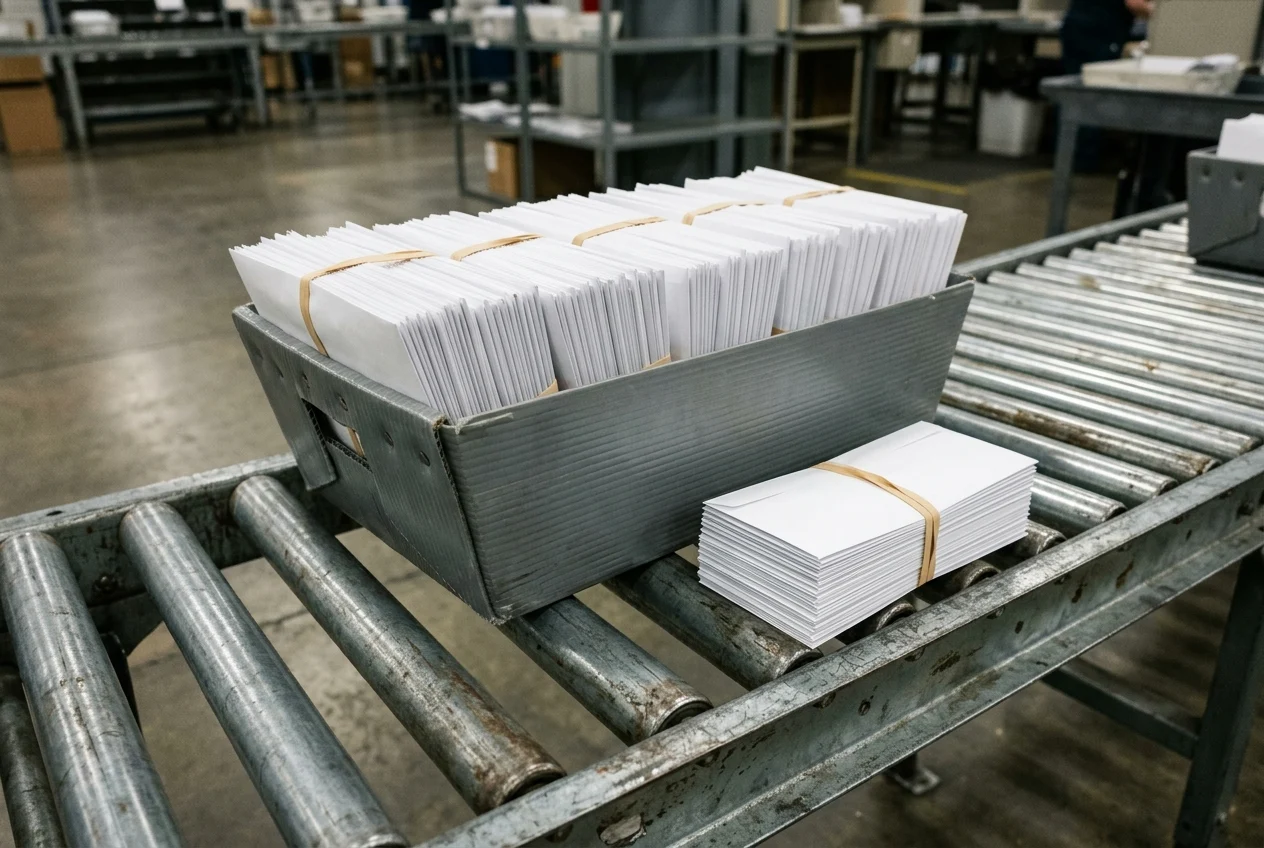
- Facing and bundle thickness limits: Every piece inside a bundle must be “faced”—oriented with all delivery addresses in the same read direction and a visible address on the top piece [4]. Under DMM 203 Section 4.0, maximum bundle thickness is
4 inchesfor carrier route letters and6 inchesfor other letter-size bundles [4]. - Letter banding vs flat strapping: For card-size pieces and letter-size pieces placed in less-than-full trays, DMM 203 Section 4.3 requires securing bundles with rubber bands, USPS-approved elastic strapping, flat plastic strapping or string: bundles up to
1 inchthick require at least one band around the girth, while bundles over1 inchthick require at least two bands (one around the length and one around the girth) [4]. By contrast, DMM 203 Section 4.5 requires flat-size bundles to be cross-strapped with plastic bands or shrink-wrapped, and explicitly forbids twine, string, rubber bands, wire or metal banding on flat bundles [4]. - Letter tray selection (
2-footvs1-foot): Under DMM 203 Section 5.0, mailers load letter-size pieces into standard2-footor1-footplastic letter trays according to volume, keeping pieces faced in the same direction and sleeving and strapping trays as required for transport [4]. - Reconciling entry documentation: Commercial presorted or automation mailings must arrive at the USPS acceptance unit with a completed electronic postage statement and the
USPS Qualification Reportshowing exact piece counts by sortation level and destination ZIP Code [4].
When a job involves bulky catalogs, sample kits or rigid items that exceed letter (1/4 inch thick, 3.5 ounces) or flat machinability limits, production leaves the envelope-inserter workflow and moves to fulfillment packing; see paper mailers vs poly mailers and label applicators vs print-and-apply systems.
Hold condition at Gate 4: Hold dock dispatch if physical tray counts or weight-verified piece counts do not match the USPS Qualification Report, or if flat-size bundles were secured with rubber bands instead of plastic strapping or shrink wrap.
Takeaway: Reconcile physical tray counts, bundle banding and facing orientation against the USPS Qualification Report before the truck leaves the mailroom dock.
Worked synthetic sign-off record for a production job ticket
Copy the table below into a production job ticket to track sign-offs across data, prepress, bindery, inserting and dispatch. All job identifiers and recipient address elements in the sample column are synthetic examples; replace them with real job records and verify machine-specific limits on the actual production unit.
| Sign-off field | Target rule or source reference | Synthetic job ticket entry (illustrative example) | Signed off by & date |
|---|---|---|---|
| Job ID & mail class | Internal job control + DMM price category [1, 4] | JOB-2026-0418 / USPS Marketing Mail Automation Letters |
Data lead — 2026-10-17 |
| Move Update method & date | Within 95 days before mailing date (DMM 602 Section 5.0) [1] |
NCOALink processing completed 14 days before scheduled entry |
Data lead — 2026-10-17 |
| CASS & PAVE software status | Current CASS coding + PAVE-validated presort output (DMM 602 Sections 8.0–9.0) [1] | CASS ZIP+4 & DPV coded; USPS Qualification Report generated |
Data lead — 2026-10-17 |
| Synthetic address & clear-zone check | DMM 602 Section 1.0 + DMM 202 Section 5.1 (5/8 in x 4-3/4 in clear zone) [1, 3] |
JANE DOE, 100 EXAMPLE AVE APT 4B, SPRINGFIELD IL 62701-1234 — clear zone verified |
Prepress — 2026-10-17 |
| Press route & proof type | Offset vs digital variable print; soft vs hard proof (Mailing.com) [5] | Static shell offset printed; variable letter inkjet; hard proof signed |
Print buyer — 2026-10-17 |
| Folded insert & score check | Grain-parallel fold or mechanical score; no spine cracking (EMA Guide) [6] | 8.5 x 11 in sheet tri-folded to 8.5 x 3.66 in; score clean |
Bindery lead — 2026-10-17 |
| Outer envelope specification | Closed-seam side-seam construction; remoistenable seal-flap gum (EMA, Tension) [6, 7] | #10 closed-seam window envelope; remoistenable dextrin flap gum |
Lettershop lead — 2026-10-17 |
| Prototype right-jog window test | Full address and IMb visible at right/bottom jog extremes (EMA Guide) [6] | Passed with 3-piece dummy packet (letter + reply env + buck slip) |
Lettershop lead — 2026-10-17 |
| Filled piece dimensions & aspect ratio | Length 5–11.5 in, height 3.5–6.125 in, thickness <= 0.25 in, weight <= 3.5 oz, aspect ratio 1.3–2.5 (DMM 201/202) [2, 3] |
9.5 in L x 4.125 in H (aspect ratio 2.30); 0.11 in thick; 0.85 oz |
QC inspector — 2026-10-17 |
| Inserter cycle speed & feeder limits | Equipment manual / live stock trial | Unknown / verify on the unit |
Operator — ________ |
| Bundle banding & tray count | DMM 203 Sections 4.3 & 5.0 (1 in banding split; 2-ft / 1-ft trays) [4] |
Faced; 2 rubber bands (length + girth) on >1 in bundles; 18 x 2-ft trays matched to Qualification Report |
Dispatch lead — 2026-10-17 |
| Postage rate & transit time | Current USPS price list & service standard | Unknown / verify on the unit |
Postal clerk — ________ |
Takeaway: Keep the signed physical dummy attached to this record until the postal entry unit clears the USPS Qualification Report.
When this workflow does not apply
- Postage budgeting and discount calculations. Postage prices, minimum presort quantities and fee schedules change regularly; consult current USPS price tables rather than hardcoding rates into a static workflow.
- Non-US postal systems. The 95-day Move Update window, CASS/PAVE programs,
1.3 to 2.5aspect ratio rule and DMM 203 tray standards apply to United States domestic commercial mailings. - Parcel and thick merchandise fulfillment. Items exceeding
1/4 inchletter thickness or flat machinability rules run on fulfillment packaging and labeling lines rather than folder-inserters; see the mailing and fulfillment overview. - Corporate history of the former Mail-Well, Inc. Mail-Well.com is an independent technical publication and is not affiliated with the historical Mail-Well, Inc. or Cenveo; see the Mail-Well, Inc. corporate archive.
Sources and method
This process guide was prepared and updated on October 17, 2026 from publicly accessible sections of the USPS Domestic Mail Manual (DMM 201, DMM 202, DMM 203 and DMM 602), the Envelope Manufacturers Association’s EMA Guide to Envelopes and Mailing (PDF metadata dated 2015, used for closed-seam envelope construction, grain/scoring behavior and the right-jog window test, not postal rates), Tension Envelope’s closure documentation, Mailing.com’s production breakdown, and Mailing Systems Technology (May 22, 2025). No inserting machines or commercial lettershops were physically audited for this page. See about this publication and the editorial policy for how technical sources are selected and maintained.
Frequently Asked Questions
What is the sequence of stages in a commercial direct mail production workflow?
A commercial direct mail workflow runs through five sequential gates: address hygiene and presort coding, prepress proofing and press production, post-press cutting, scoring and folding, mechanical inserting and flap sealing (or self-mailer tabbing), and presort bundling, traying and postal entry documentation. Each gate depends on verified output from the previous stage.
How early before mailing must a commercial address list meet the USPS Move Update rule?
Under USPS DMM 602 Section 5.0 (read October 17, 2026), commercial First-Class Mail presorted or automation prices and USPS Marketing Mail prices require addresses to be updated within 95 days before the mailing date using a USPS-approved method such as Address Change Service (ACS) or NCOALink.
Does PAVE presort software certification guarantee that the post office will accept a mailing?
No. USPS DMM 602 Section 8.0 states that PAVE certification evaluates software and hardware sorting accuracy, but PAVE certification alone does not guarantee acceptance of customer mail prepared with that software. The physical mailpieces, barcodes, bundles and trays must still pass acceptance checks at the postal entry unit.
Why do lettershop operators test window envelopes with a physical folded insert before production?
Drawing measurements or photocopies can shift slightly during printing and folding. The Envelope Manufacturers Association (EMA) guide advises placing the actual folded insert inside a prototype window envelope and pushing it to the right edge to verify that every character of the longest address line and the Intelligent Mail barcode stay completely visible.
Sources
- DMM 602 Addressing (USPS Postal Explorer)
- DMM 201 Physical Standards for Commercial Letters, Cards, Flats, and Parcels (USPS Postal Explorer)
- DMM 202 Elements on the Face of a Mailpiece (USPS Postal Explorer)
- DMM 203 Basic Postage Statement, Documentation, and Preparation Standards (USPS Postal Explorer)
- A Start to Finish Breakdown of Direct Mail Printing (Mailing.com)
- The EMA Guide to Envelopes and Mailing (Envelope Manufacturers Association)
- Envelope Basics: Closures (Tension Envelope)
- Scale Smart: Precision Mail Inserters Drive Growth (Mailing Systems Technology)