LabelsComparison
Die Cut Stickers vs Kiss Cut: Liner Depth & Peeling
Compare die cut stickers vs kiss cut liners on blade depth, custom roll labels, flatbed die cutting, dispenser peeling speed, and transfer-cut lettering.
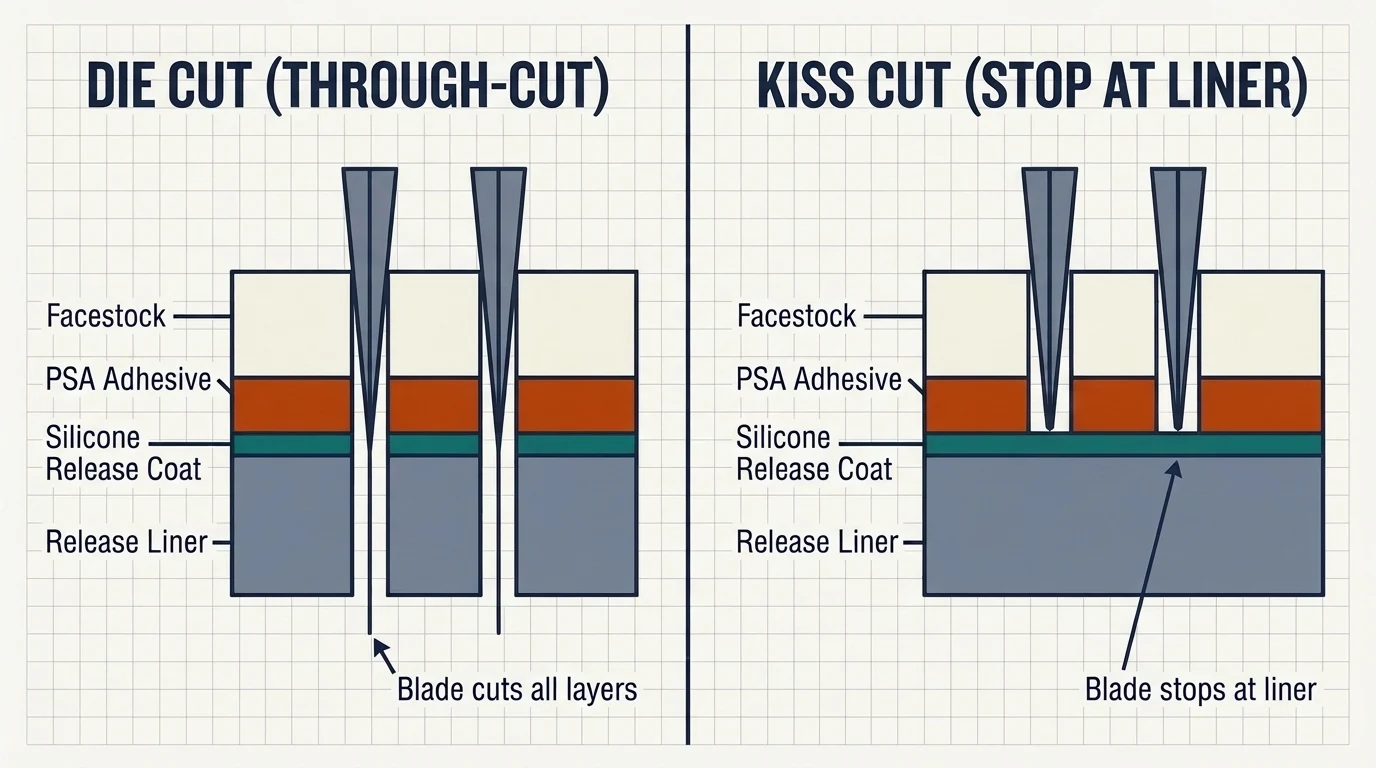
Die-cut stickers shear completely through the facestock, pressure-sensitive adhesive, and release liner to produce independent custom-shaped pieces, whereas kiss-cut stickers and labels slice only through the top facestock and adhesive while leaving the backing liner intact. Keeping that continuous liner unbroken protects intricate edges and enables high-speed peeling on benchtop dispensers and automated roll applicators.
Within the broader labels and label application workflow, blade depth determines whether a finished pressure-sensitive laminate behaves as a standalone promotional piece or as a continuous carrier web for packaging lines. Once face stock durability is narrowed using paper vs film label materials, buyers must match cut depth and liner continuity to how operators or machines actually peel and apply each piece.
| Construction format | Blade penetration depth | Release liner state | Matrix weeding and transfer layer | Peeling and dispensing behavior |
|---|---|---|---|---|
| Singled die-cut sticker (through-cut) | Full depth through facestock, PSA adhesive, and backing | Cut flush to the custom artwork contour | No surrounding border; finished piece stands alone | Manual hand peeling only; cannot feed through peeler-plate dispensers |
| Bordered kiss-cut single | Selective depth through facestock and PSA only | Intact rectangular or wide backing frame around the design | Optional border left intact around the cut silhouette | Fast thumb-peeling from backing edge; protects delicate tips before application |
| Multi-up kiss-cut sticker sheet | Selective depth through facestock and PSA only | Intact flat sheet (commonly 2“x6”, 6“x12”, or 12“x12”) | Excess matrix stripped or left around multiple shapes | Manual picking from organized sheets for kits, retail packs, or kitting benches |
| Kiss-cut custom roll labels | Selective depth stopping cleanly at silicone release coat | Continuous unbroken web wound on a core | Surrounding waste matrix weeded away before rewinding | Runs on manual dispensers, semi-automatic dispensers (over 2,000/hr), and automated applicators |
| Transfer-cut vinyl decal | Selective kiss cut through adhesive vinyl only (typically up to 1 mm max machine depth) | Intact backing liner carrying isolated letters | Negative vinyl weeded away; adhesive transfer tape or paper pre-mask laminated on top | Transfers multiple separate letters and fine strokes onto a surface in alignment |
What is a die-cut sticker when the blade cuts through both facestock and backing?
A die-cut sticker is a pressure-sensitive label sheared cleanly through its facestock, adhesive, and backing liner so the finished piece matches the outer contour of the artwork. Because the backing ends flush with the printed perimeter, every custom silhouette stands alone as a ready-to-hand-out piece without an extra surrounding border.
In commercial labeling terminology, a sticker is a subset of pressure-sensitive labels—plastic, vinyl, or paper carrying temporary or permanent pressure-sensitive adhesive (PSA) on one side that bonds under light pressure without heat or water activation. Self-adhesive stickers were first created by R. Stanton Avery in 1935 and entered commercial sale in 1940 as Kum Kleen Price Stickers for labeling goods and products. Every PSA construction pairs the printed face and adhesive with a release liner (backing liner) coated on one or both sides with a low-surface-energy release agent so the adhesive cannot stick prematurely during storage and handling.
As illustrated in the cross-section above, through-cut die cutting severs the facestock, pressure-sensitive adhesive, silicone release coat, and backing liner completely, whereas kiss cutting stops cleanly at the silicone release layer so the carrier liner stays continuous underneath.
Geometry directly affects how well a flush-cut sticker stays bonded after application. Adhesive bonding performance depends on outline shape because pointed corners begin detaching first, whereas rounding corners improves holding strength. On singled through-cut stickers, sharp unrounded spikes are also exposed during shipping and hand handling because no excess backing border shields the perimeter before peel-off.
Takeaway: Specify a flush through-cut die cut with rounded outer corners when the piece is handed out individually and never needs to feed through a dispenser.
Why is it called die cut in commercial label and decal converting?
Commercial converters call the process die cutting because a shaped metal die shears webs of paper, plastic film, or pressure-sensitive adhesive tape into repeatable contours, a technique originating in mid-19th-century shoe leather cutting. Modern converting runs those dies either on flatbed presses for lower-cost short runs or inline on rotary die cutters.
Web die cutting encompasses both through-cutting and selective single-layer kiss cutting. In everyday retail ordering, buyers often treat “die cut” as shorthand for through-cut singles and “kiss cut” as a separate category, even though kiss cutting is technically a depth-controlled form of die cutting that penetrates only one layer of a laminate—widely used for labels, postage stamps, and stickers.
| Converting press type | Die tooling architecture | Speed and inline registration | Best-fit production profile |
|---|---|---|---|
| Flatbed die cutting | Formed strips of hardened steel (steel rule) set into a slotted plywood dieboard with rubber ejectors for part release | Slower press cycle than rotary converting; separate sheet or intermittent web pass | Smaller production runs where lower tooling cost outweighs lower press speed |
| Rotary die cutting (RDC) | Cylindrical tooling: solid engraved tool-steel dies (highest tolerance), adjustable removable-blade dies, or magnetic plate tooling on magnetic cylinders | High-speed continuous web often run inline with printing; geared synchronization plus optional automatic eye registration for tight tolerances | Medium-to-high volume custom roll labels and multi-station converting requiring tight print-to-cut alignment |
| Dinking die cutting | Hollow sharpened metal cutters with edges typically beveled at about 20 degrees pressed against a wood or soft metal block | Mechanical press or manual strike punching through stack or sheet material | Specialized through-cut blanks where hollow punch geometry clears material cleanly |
Choosing between flatbed die cutting and rotary die cutting comes down to tooling amortization and liner precision. Flatbed presses use less expensive steel-rule tooling suited to short runs where a cylindrical rotary die is harder to absorb. High-volume label production relies on a rotary die cutter (RDC) whose gears lock cylinder rotation to press web speed and whose solid engraved tool-steel dies hold tighter depth tolerances—preventing the blade from scoring the release liner across long roll runs.
Takeaway: Ask converters whether your order runs on flatbed steel-rule tooling or inline rotary engraved tooling when tight kiss-cut depth control and print-to-cut registration matter.
How do die cut, kiss cut, and transfer-cut constructions differ on intricate lettering?
Through-cut die cuts require one continuous outer shape, bordered kiss cuts shelter delicate tips inside an uncut release liner border, and transfer-cut vinyl decals combine kiss cutting with weeding and an adhesive transfer tape or paper pre-mask so separate letters lift and install together in exact alignment without hand-placing each character.
Is a decal the same thing as a sticker?
A traditional decal is not the same construction as a pressure-sensitive sticker. Historically derived from decalcomania, a decal transfers a printed pattern onto another surface upon contact, usually with the aid of water or heat—such as water-slide transfers printed on water-resistant paper with water-soluble adhesive. By contrast, a dry peel-and-stick graphic made with standard pressure-sensitive adhesive is technically an adhesive-backed sticker or vinyl-cut decal rather than a wet or heat transfer.
Blade depth, weeding, and paper pre-mask for disconnected lettering
When artwork consists of thin script, floating dots, or separate words rather than a single solid badge, converters use computer-controlled cutting systems or vinyl cutters with blade pressure control capable of sub-millimeter precision. On vinyl cutters, cutting depth typically does not exceed 1 mm, and calibrating that depth is critical: if the blade sits too shallow, the vinyl fails to separate cleanly; if it travels too deep, it slices through the release liner and damages the underlying surface.
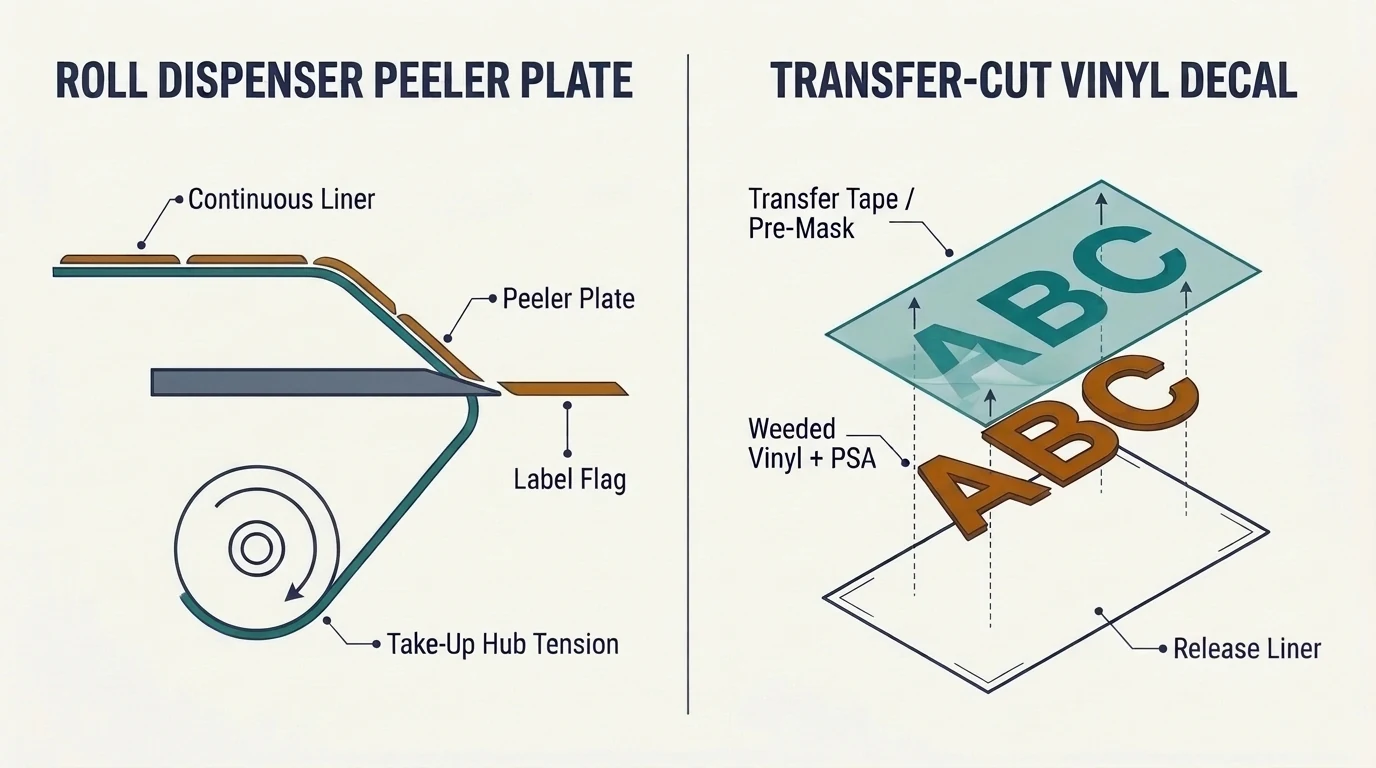
Once the kiss cut traces the vector outlines without cutting through the liner, production follows two finishing steps:
- Weeding: Excess vinyl outside the positive letters (or inside counter-spaces) is stripped away from the release liner, leaving only the intended shapes adhered to the backing.
- Transfer tape or paper pre-mask lamination: An adhesive-backed transfer tape (carrier sheet) or paper pre-mask is rolled across the top of the weeded design. During installation, the transfer sheet lifts all disconnected letters off the release liner simultaneously so they apply onto glass, metal, or painted panels with exact spacing intact.
Takeaway: Use a bordered kiss cut for fragile single-piece outlines and specify a weeded transfer-cut vinyl construction with paper pre-mask whenever separate letters must install without a background film.
When should buyers order kiss-cut custom roll labels instead of singled die-cut pieces?
Buyers should specify kiss-cut custom roll labels whenever production moves beyond occasional hand giveaways into repetitive benchtop or inline packaging. Leaving the release liner intact lets a dispenser or automated applicator pull the backing around a tight-radius peeler plate, raising manual envelope output from roughly 500 labels per hour to over 2,000 per hour.
Peeler-plate physics and dispensing throughput
Manual label dispensers, electric semi-automatic dispensers, and fully automated applicators all depend on the exact same mechanical principle: the release liner is thinner than the label above it and sits underneath. When the continuous liner is pulled sharply around a tight-radius peeler plate or strip bar, the stiffer kiss-cut label cannot follow the sharp bend and lifts cleanly away from the backing, protruding straight forward without the natural curl caused by peeling labels off a liner with fingers.
In bulk mailing operations, switching from hand peeling (averaging roughly 500 labels per hour per employee) to an electric semi-automatic label dispenser raised output to over 2,000 labels per hour—more than fourfold throughput—while letting the operator grab each presented label with one hand and position envelopes or cartons with the other. Early electric semi-automatic machines accommodated 4-up multiple-row label webs up to 16 inches wide, advancing the next row automatically as soon as a limit switch or photodetector sensed the final label leaving the strip plate.
At production-line scale, fully automated label applicators advance the label stock over the peeler plate until a leading portion, called the flag, projects into the path of the oncoming package, reaching speeds from modest inline rates up to hundreds or thousands of labels per minute. While standard opaque roll labels are detected economically with photoelectric sensors (electric eyes), transparent clear film labels break no light beam reliably and require capacitive or ultrasonic label-edge sensors. For choosing between standalone dispensing heads and print-and-apply units on conveyor lines, see label applicator vs printer-applicator.
Release liner substrates that prevent web breaks under tension
On semi-automatic dispensers and high-speed applicators equipped with a motorized take-up hub, the spool pulls tensile stress directly through the continuous liner as it stretches across the strip plate. If kiss-cut blade depth is calibrated too deep and scores or nicks the backing, that tensile load propagates a tear and snaps the web—halting the packaging line.
Between 400 and 500 companies globally manufacture or supply industrial release liners coated with crosslinkable silicone or other low-surface-energy release agents. Converters select the backing substrate to balance smoothness, dimensional stability, and web tensile strength:
| Release liner substrate | Material construction | Regional or application profile |
|---|---|---|
| SCK (Super Calendered Kraft) | Dense, smooth calendered kraft paper carrying a silicone release coat | Standard paper release liner typically used for pressure-sensitive labels in the United States |
| Glassine | Super calendered kraft paper typically finished with a polyvinyl alcohol (PVOH) top coat | Smooth, dense translucent paper liner typically used for labels in Europe |
| CCK (Clay Coated Kraft) | Coated kraft paper substrate | Smooth coated paper backing used for sheeted or flat-lying release applications |
| Poly-coated Kraft (MFK base) | Machine-finished kraft (MFK) paper coated on one or both sides with polyolefin | Smooth, moisture-resistant, and dimensionally stable liner for humid handling or flat sheets |
| BO-PET (Biaxially Oriented Polyester) | Tough, high-temperature-resistant biaxially oriented PET film | High-strength film liner resisting die-cut strike-through and web breaks on demanding lines |
| BOPP (Biaxially Oriented Polypropylene) | Extruded biaxially oriented PP plastic film liner | Moisture-resistant plastic film alternative to paper release liners |
Lines evaluating whether to stay with pressure-sensitive liner webs or eliminate liner waste altogether on high-volume bottle lines can compare attachment routes in pressure-sensitive vs wet-glue labels.
Takeaway: Order kiss-cut custom roll labels on an uncut SCK, Glassine, or film liner whenever operators apply hundreds of pieces per shift or packages run through a peeler-plate dispenser.
How do you choose between singled die-cut handouts, bordered kiss cuts, and sticker sheets?
Choose singled die-cut pieces for standalone retail or promotional handouts, bordered kiss-cut singles when delicate outlines need faster thumb-peeling, multi-design sticker sheets for multi-graphic kits, and kiss-cut rolls whenever dispensers or applicators handle application. Before committing to a bulk run, verify liner release force and peel uniformity under standard ASTM test methods.
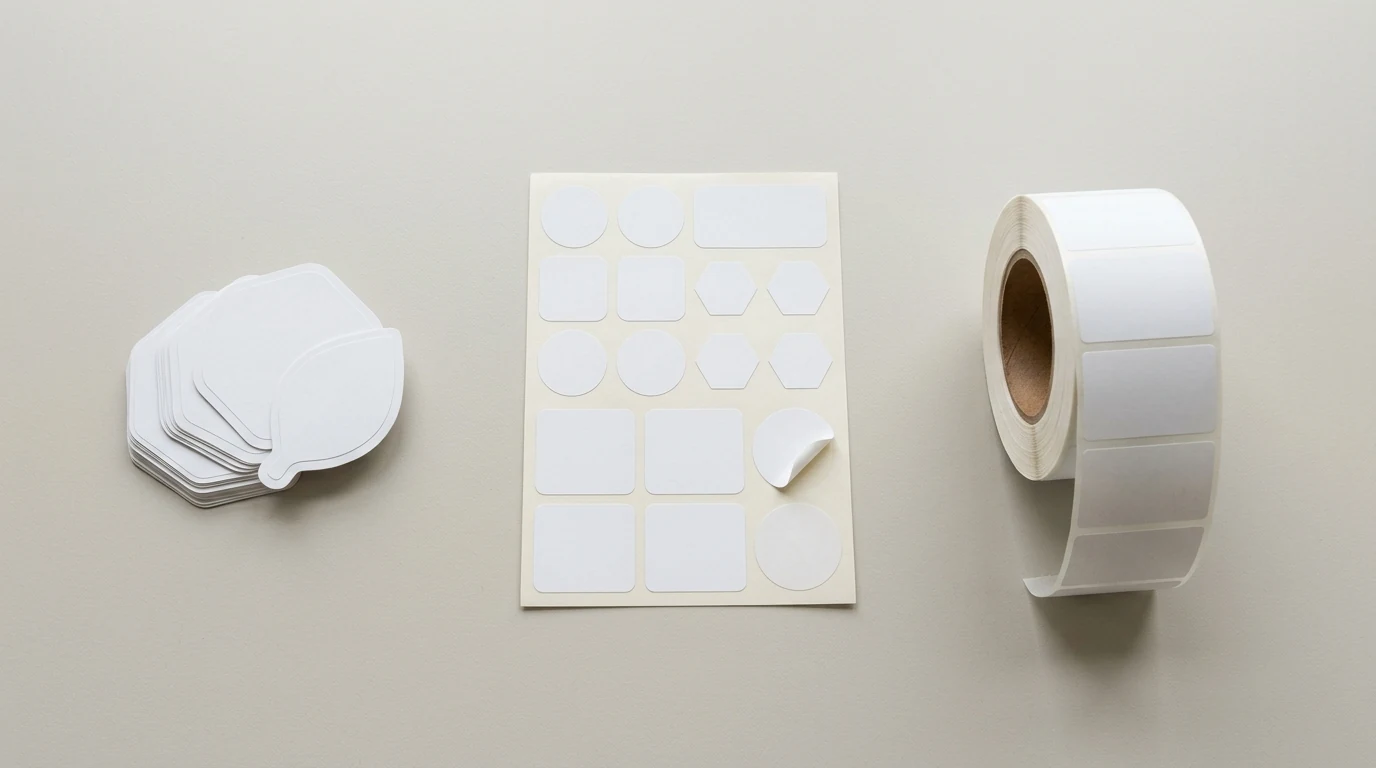
Pressure-sensitive labels and stickers are supplied in three primary physical formats—separate individual pieces, flat sheets, or continuous rolls—and picking the wrong delivery format adds avoidable labor or edge damage. Multi-design sticker sheets commonly range from compact 2“x6” strips up to 6“x12” and 12“x12” sheets for organized multi-piece sets, whereas bulk packaging lines demand continuous kiss-cut rolls sized to dispenser width and sensor type.
| Application scenario | Recommended format | Liner and blade requirement | Primary failure mode avoided |
|---|---|---|---|
| Event handouts, merchandise inserts, retail counter singles | Singled die-cut sticker (through-cut) | Full through-cut with rounded outer corners | Premature detachment initiated at sharp pointed corners |
| Mail-in promos with sharp custom contours or fast consumer peel | Bordered kiss-cut single | Selective kiss cut leaving an uncut backing margin | Bent tips during transit and slow edge-picking by end users |
| Multi-SKU sample packs, kitting kits, collectible sets | Multi-up kiss-cut sheet (2“x6”, 6“x12”, or 12“x12”) | Flat dimensionally stable liner (such as CCK or poly-coated MFK) | Loose mixed pieces and curled backing sheets during storage |
| Manual benchtop fulfillment (hundreds to thousands per shift) | Kiss-cut custom roll labels on benchtop electric dispenser | Continuous uncut liner (SCK or Glassine) feeding a peeler plate | Hand-peeling bottleneck near 500/hr and finger-induced label curl |
| Automated conveyor packaging lines | Kiss-cut custom roll labels on inline rotary die-cut rolls | Zero liner nicking under take-up hub tension; capacitive or ultrasonic sensor if clear | Liner web snap at the strip plate and missed edge detection on clear film |
| Architectural glass, vehicle lettering, multi-part logos | Transfer-cut vinyl decal (kiss cut + weeded + pre-mask) | Blade depth calibrated within 1 mm; adhesive transfer tape over weeded vinyl | Misaligned individual letters during manual installation |
Qualifying liner release and peel adhesion before bulk runs
Even with the right cut format, inconsistent release force or adhesive temperature mismatch can cause labels to pre-dispense inside a roll or refuse to lift cleanly at the peeler plate. Most pressure-sensitive adhesive test methods are conducted at 23 degrees Celsius and 50% relative humidity, with supplementary tests at actual application temperatures and lighter rub-down pressures. For cold-chain distribution, most permanent and peelable label adhesives have a lower service temperature limit of -10 degrees Celsius, whereas freezer (frost-fix) adhesives operate down to -40 degrees Celsius.
Before releasing a high-volume custom roll or sheet order, specify three standardized quality checks with your converter:
- Liner release force (ASTM D3330/D3330M Test Method D): Measures the force needed to strip the release liner from the adhesive at a defined peel rate—important because liner release force changes as dispensing speed changes. Test Method A under the same standard evaluates 180-degree peel adherence against a standard stainless steel panel or target container surface.
- Label-stock peel uniformity (ASTM D6252/D6252M): Measures peel adhesion of pressure-sensitive label stocks at a 90-degree angle to verify consistency within a single sheet or roll, between rolls, and across production lots.
- Extreme distribution qualification (ASTM D7932): Sets laboratory simulation and acceptance criteria for printed pressure-sensitive adhesive labels exposed to deteriorating chemicals, weather, and elevated or cold temperatures across extended distribution cycles.
Takeaway: Lock down the delivery format (singled die cut, bordered kiss cut, multi-up sheet, transfer-cut decal, or continuous roll), specify an unscored liner matched to dispenser tension, and verify release and peel uniformity under ASTM D3330/D3330M and ASTM D6252/D6252M before bulk converting.
Frequently Asked Questions
What is the main physical difference between die-cut stickers and kiss-cut stickers?
A through-cut die-cut sticker shears completely through the facestock, pressure-sensitive adhesive, and release liner so the backing matches the outer artwork contour. A kiss-cut sticker or label cuts through only the top facestock and adhesive layer while leaving the silicone-coated release liner intact underneath.
Why can singled die-cut stickers not run on automated roll label applicators?
Manual dispensers, semi-automatic dispensers, and automated applicators separate labels by pulling a continuous backing liner around a tight-radius peeler plate under take-up hub tension so the stiffer label projects forward as a leading flag. Because singled die-cut pieces sever the release liner, there is no continuous carrier web to pull across the strip plate.
Is a decal the same thing as a sticker?
Traditionally, a decal transfers a printed image onto another surface using water or heat, such as a water-slide transfer. A dry peel-and-stick graphic using standard pressure-sensitive adhesive is technically a sticker or vinyl-cut decal, though multi-letter vinyl graphics use transfer tape or a paper pre-mask to move separate characters together.
How much faster is roll-dispensed kiss-cut labeling compared with peeling by hand?
In bulk mailing house benchmarks, an employee manually applying labels to envelopes averaged approximately 500 labels per hour, whereas loading continuous kiss-cut labels into an electric semi-automatic label dispenser raised throughput to over 2,000 labels per hour while eliminating finger curl and leaving one hand free.
Which ASTM standards measure release liner peel force and label adhesion?
ASTM D3330/D3330M Test Method D measures the force required to remove a release liner from the adhesive at a specified peel rate, and Test Method A measures 180-degree peel adherence. ASTM D6252/D6252M measures 90-degree peel adhesion of pressure-sensitive label stocks across sheets, rolls, and production lots, while ASTM D7932 covers printed labels for extreme distribution environments.
Sources
- ASTM D3330/D3330M Standard Test Method for Peel Adhesion of Pressure-Sensitive Tape (ASTM International)
- ASTM D6252/D6252M Standard Test Method for Peel Adhesion of Pressure-Sensitive Label Stocks at a 90° Angle (ASTM International)
- ASTM D7932 Standard Specification for Printed, Pressure-Sensitive Adhesive Labels for Use in Extreme Distribution Environments (ASTM International)
- Label (Wikipedia)